
Mens Blazer Outfit Casual: The Formality Dial Method and Formulas That Work
A mens blazer outfit casual enough for dinner with friends, yet sharp enough for a client lunch, is the hardest working formula in menswear. It is also the one men get wrong most often, usually in the same two ways.
The first failure is the jacket itself: a shiny suit jacket borrowed from a matched suit, worn over jeans and hope.
The second is a formality clash, where the shirt aims at the boardroom and the shoes aim at the gym.
Both failures are fixable with one test, and this page is built around it. Learn the formality dial, run the five fit checks, and every formula that follows becomes a variation you can judge for yourself.
What Makes a Blazer Casual: Construction Before Combinations
Casual is not something you do to a blazer with the rest of the outfit. Casual is built into the jacket before you pair it with anything, in three construction choices.
The Soft Shoulder
A casual blazer has little or no shoulder padding and no stiff chest canvas. It drapes instead of standing to attention, following your shoulder line the way a heavy shirt would.
That softness is the whole point. A padded, structured shoulder announces formal tailoring in every room, and no t-shirt underneath it can talk the room out of that announcement.
Texture Over Shine
The second marker is the cloth surface. Hopsack, tweed, flannel, corduroy, linen and cotton twill all have a matte, tactile finish that sits naturally beside denim and knits.
Smooth worsted wool with a sheen does the opposite. Shine is the visual language of the business suit, and it clashes with every casual fabric you pair it with. This texture over shine rule decides most blazer purchases.
Lining, Weight and Pockets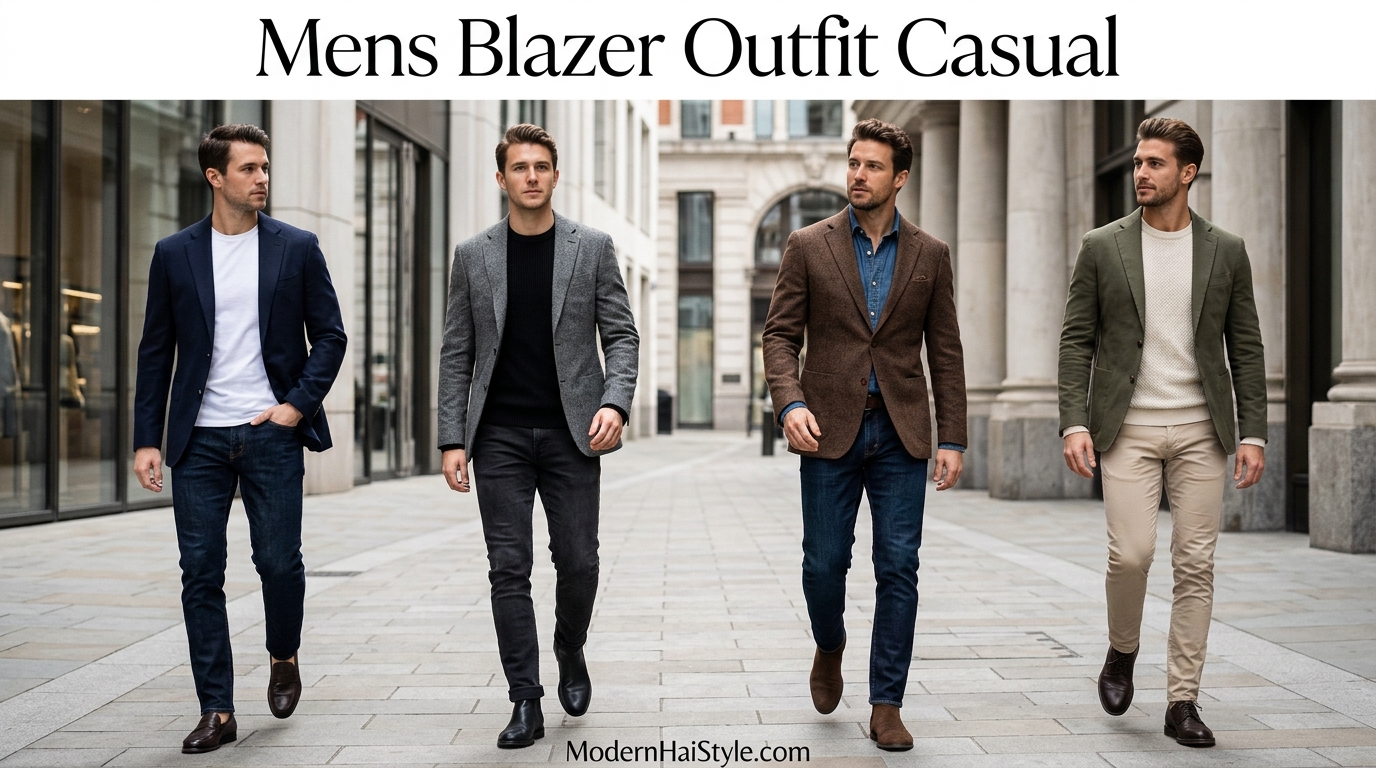
Casual blazers are usually unlined, half lined or quarter lined, which keeps them lighter, cooler and less rigid. They often carry patch pockets instead of flap pockets, another small signal of relaxation.
None of this makes the jacket sloppy. It makes the jacket honest about its register, which is what lets the outfit relax without looking like a mistake.
Blazer, Sport Coat or Suit Jacket: Know What You Own
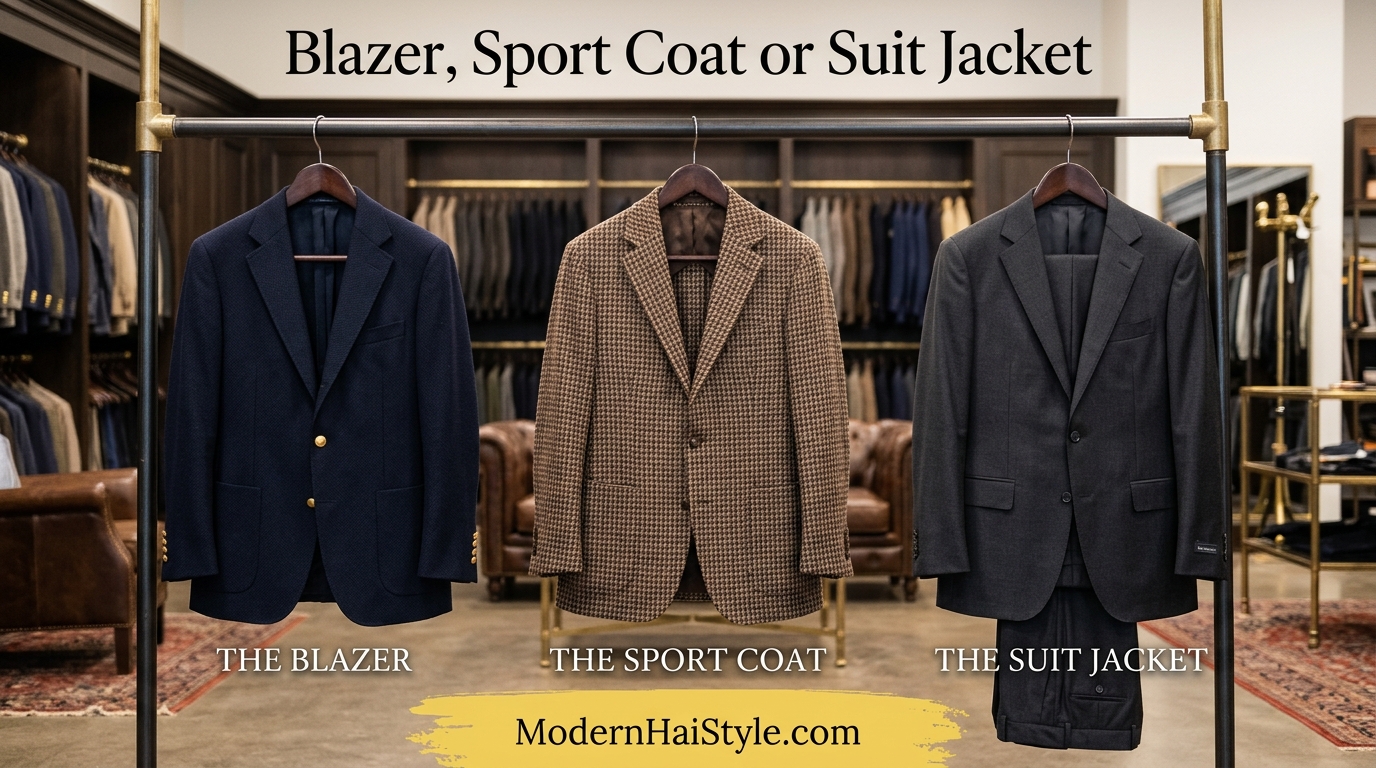
Half the confusion in this category is vocabulary. Three garments get called blazers, and they behave very differently in casual outfits, so use Real Men Real Style’s blazer and jeans guide as the reference point for the distinctions.
|
Garment |
Defining features |
Casual outfit verdict |
|---|---|---|
|
Classic blazer |
Solid color, usually navy, contrasting buttons in brass, horn effect or pearl styles, hopsack or flannel cloth |
The reference casual blazer: pairs with jeans, chinos and trousers |
|
Sport coat |
Patterned or heavily textured: tweed, checks, herringbone, houndstooth |
Even more relaxed than a blazer: the easiest jacket to dress down |
|
Suit jacket |
Cut to match trousers, smooth worsted wool, structured shoulders, flap pockets |
The problem piece: reads as a broken suit with casual partners |
The navy blazer carries a naval inheritance: the dark jacket with metal buttons descends from naval uniform tradition, which is why the classic form still uses contrasting buttons today.
The word blazer itself has two traditional origin accounts, both told as tradition rather than settled fact.
One credits the blazing red jackets of a Cambridge rowing club in the 1820s; the other, the dressed crew of HMS Blazer in the 1840s.
Whichever account you prefer, the modern rule is simpler. If the jacket has matching trousers hanging beside it, it is a suit jacket, and it needs the rescue test in the mistakes section before it earns a casual outing.
Fit First: The Five Checks
A casual blazer hides nothing. Its softness means fit does the work that structure does in a suit jacket, so run these five checks with your most worn layer underneath.
|
Check |
Pass sign |
Fail sign |
|---|---|---|
|
Shoulders |
Seam sits on the edge of the shoulder bone |
Seam droops past the bone or pulls and creases |
|
Chest and button |
Top button closes without pulling; a flat hand slides inside |
Fabric strains, the button pulls, lapels splay open |
|
Sleeves |
End at the wrist bone, showing roughly a quarter to half inch of shirt cuff |
Sleeves cover the hand or end mid forearm |
|
Length |
Hem covers the seat on classic cuts |
Hem ends mid seat (reads cropped) or well past it (reads like a coat) |
|
Button stance |
Top button sits at or just above the navel |
Button sits low, lengthening the torso and dating the jacket |
Two checks deserve emphasis. The shoulder cannot be rescued by tailoring, so buy the shoulder and alter the rest. Sleeves, waist and small length trims are routine alterations; shoulders are effectively fixed.
And learn the button rules now, because they govern every outfit below. On a two button blazer, fasten the top button only, never the bottom, and unbutton the jacket when you sit down.
The Formality Dial: The One Test Every Casual Blazer Outfit Must Pass
Here is the test, in the form Real Men Real Style’s blazer and jeans guide gives it for jeans, generalized to every outfit on this page.
In a blazer outfit, the jacket is the dressiest piece and the bottom half is the most casual piece. Those two are fixed.
Your shirt and your shoes are the dial between them. They decide which way the whole outfit tips, toward smart or toward casual, and the test is simple: they must be set to the same level as each other.
A crisp dress shirt with white sneakers fails the test, because the top half is headed to a meeting and the feet are headed to the weekend. An Oxford shirt with loafers passes, at the same upper middle setting.
|
Dial setting |
Shirt or layer |
Shoes |
Where the outfit belongs |
|---|---|---|---|
|
1, most casual |
Plain crew neck t-shirt |
Clean white sneakers |
Weekend days, casual dinners |
|
2 |
Henley or knit polo |
Suede sneakers or loafers |
Relaxed evenings, creative offices |
|
3 |
Oxford button down, open collar |
Suede loafers or Derby shoes |
Smart casual default, most offices |
|
4 |
Fine knit or turtleneck |
Chelsea boots or clean Derbies |
Date night, evening events |
|
5, smartest casual |
Dress shirt, knit tie optional |
Polished Derby shoes |
Business casual ceiling |
The second half of the test is contrast. Your trousers or jeans must be clearly different from the jacket in color and texture, or the eye reads a mismatched suit.
Navy blazer on near navy jeans is the classic trap. Navy blazer on grey trousers or dark indigo denim is the classic fix, because indigo and navy differ in texture even when the tones are close.
Run both halves of the test in the mirror, shirt and shoes agreeing, top and bottom contrasting, and you have judged the outfit the way a stylist would. Everything after this section is application.
The Six Dress-Down Swaps
If your blazer outfits keep reading too formal, you do not need a new jacket. You need the swaps, set out cleanly in MensArray’s guide to dressing down a blazer, applied in order.
1. Drop the tie.
The tie is the loudest formality signal in the outfit. Removing it, and opening the collar, moves the same jacket a full setting down the dial before anything else changes.
2. Swap the dress shirt.
Trade the formal poplin shirt for an Oxford button down, a knit polo, a fine knit sweater or a plain t-shirt. Each step down that list is a step toward casual that the jacket absorbs easily.
3. Swap the trousers.
Suit trousers make the jacket a suit. Dark jeans or chinos in a clearly contrasting color make it an outfit, and the contrast rule from the dial test applies in full.
4. Swap the shoes.
Polished Oxford shoes pin the outfit at formal. Suede loafers, Chelsea or chukka boots, Derby shoes in matte leather, or clean white sneakers each lower the setting in a controlled way.
5. Choose texture over shine.
If the outfit still reads stiff, the jacket’s cloth is usually the reason. A textured blazer in hopsack, tweed or cotton dresses down almost by itself; a shiny one resists every swap on this list.
6. Open the jacket, roll the sleeve.
The finishing signals: worn unbuttoned over a tee or knit, a casual blazer reads intentional and relaxed. On unstructured or knit blazers only, one sleeve roll shows the lining and completes the message. Never roll a stiff, fully lined jacket.
The fastest result of all six swaps is the formula the dress-down guides converge on: unstructured blazer, plain white t-shirt, dark indigo jeans, white leather sneakers. Memorize it as the baseline; every formula below is a variation.
Formulas by Bottom: Jeans, Chinos, Trousers and the Shorts Verdict
Blazer With Jeans: The Denim Rules
Jeans are the most wanted partner and the easiest to get wrong, so the rules come first. Wear dark indigo or black jeans, slim or straight in fit, with no distressing, no rips and no heavy fading.
Light wash and baggy denim sit too far down the formality scale; the outfit reads accidental instead of mixed.
The current wide leg cuts covered in men’s wide leg jeans outfit can work, but only in dark, clean denim with a shorter, cleaner blazer above them.
Three formulas cover most of a man’s month:
- The baseline: navy unstructured blazer, white crew neck tee, dark indigo jeans, white leather sneakers. Works for dinner, dates and casual offices alike.
- The evening version: charcoal or black blazer, black fine knit crew neck, black jeans, black suede Chelsea boots, with texture separating the dark pieces.
- The rugged version: brown tweed sport coat, grey merino crew neck, dark jeans, brown suede chukka boots. Fall’s most reliable formula.
Blazer With Chinos: The Natural Partner
Chinos sit at almost exactly the blazer’s own formality level, which makes them the easiest pairing in this guide. The dial barely needs adjusting; shirt and shoes fine tune rather than rescue.
The proven color pairings: navy blazer with stone, olive or grey chinos; tan cotton blazer with navy chinos; grey flannel blazer with dark green chinos. Brown suede loafers finish almost all of them.
Blazer With Trousers: The Smart End
Wool or tailored trousers push the outfit to the top of the casual range, one step below a suit. This is where the classic separates combination lives: navy blazer, grey trousers, Oxford shirt, Derby shoes.
Keep the contrast rule strict here. Trousers that nearly match the blazer in a similar smooth fabric produce the fake suit, the single most common separates mistake.
The Shorts Verdict
Honesty beats enthusiasm: a blazer with shorts almost never works. The jacket’s coverage and weight fight the shorts’ lightness, and the proportions read unfinished in photographs.
The rare exception is a very light, unstructured linen or cotton blazer over tailored chino shorts at a summer event, with loafers. If the day is warm enough for shorts and the event is ordinary, leave the blazer at home.
Formulas by Occasion
Everyday Casual
The daily setting of the dial is two or three: knit polo or Oxford shirt above, chinos or dark jeans below, loafers or clean sneakers on the feet.
It handles school runs, lunches, errands and casual dinners without a costume change.
Rotate the layer to keep it alive across the week: tee on warm days, Oxford on cooler ones, fine knit when the temperature drops. The jacket stays constant; the rotation is what stops a staple from becoming a uniform.
Smart Casual Office and Casual Friday
For relaxed offices, the blazer is the blazer alternative to a suit, and it passes when the dial sits at three or four.
Oxford shirt, chinos or tailored trousers, suede loafers or Derbies, jacket buttoned when you stand for a meeting.
The fuller office wardrobe logic matches men’s office outfits casual: restrained colors, clean shoes, and one piece carrying the personality.
Where the office leans formal, the ceiling of this guide is the floor of formal office outfits, and the suit takes over.
Date Night
The date formula is dark, textured and fitted: charcoal or navy unstructured blazer, black or deep colored fine knit, dark jeans, Chelsea boots or suede loafers. Low light rewards texture, which is why the knit beats the tee here.
It follows the same logic as strong men’s date night outfits generally: polish with an edge, comfort you can forget about, and nothing that looks like you dressed as a character for the evening.
Wedding Guest: The Ruling
As with offices, this is a dress code question, not a style question. At casual, garden and rustic weddings, a clean blazer with tailored trousers, a shirt and loafers is correct guest wear.
At cocktail, formal and black tie codes, the blazer is not enough and a suit is required. The general rules in men’s wedding guest outfits apply unchanged: read the code first, then express yourself inside it.
Travel
The travel blazer earns its own note because it solves a real problem: looking arrived after hours in a seat. Choose a knit or jersey blazer, or a wrinkle resistant wool blend, unlined, in navy or charcoal.
It wears like a cardigan on the plane, resists creasing in a bag, and lands as the smart layer for dinners and meetings at the other end. Dark jeans and one pair of loafers complete the travel kit.
The Color Matrix: Blazer Colors Against Trousers and Denim
Color advice in most guides arrives as scattered examples. Here it is as one matrix, built on the contrast rule: clear separation between jacket and bottom half, every time.
|
Blazer |
Best partners |
Accents that work |
The clash to avoid |
|---|---|---|---|
|
Navy |
Grey trousers, dark indigo jeans, stone, olive and white bottoms |
Brown suede shoes, white sneakers |
Near navy jeans in smooth denim (the fake suit) |
|
Grey |
Navy trousers, black jeans, charcoal bottoms |
White tee layers, black boots |
Head to toe mid grey with no texture change |
|
Black |
Grey jeans, washed black denim, charcoal trousers |
White tee contrast, brown shoe break |
All black in identical smooth fabrics (reads flat) |
|
Brown and tan |
Indigo jeans, cream and ecru bottoms, olive chinos |
Cream knits, white sneakers |
Black trousers under a warm brown jacket |
|
Olive and green |
Stone chinos, dark indigo, white jeans in summer |
Tan suede, oatmeal layers |
Bright red or orange partners fighting the earth tone |
Two matrix principles matter more than any cell. First, texture can substitute for color contrast: charcoal blazer on washed black jeans works because hopsack and denim read differently at the same tone.
Second, light jackets want anchoring. A tan or sand blazer over pale everything floats; give it dark indigo, navy chinos or chocolate shoes below to ground the outfit.
Shoes: The Formality Ladder on Your Feet
Shoes are half of the dial, so they get their own ladder. Read it beside the dial table: your shoe choice should sit at the same setting as your shirt choice.
|
Shoe |
Dial setting |
Best with |
|---|---|---|
|
White minimalist sneakers |
1 to 2 |
Tees and knit polos, jeans and chinos, unstructured blazers |
|
Suede loafers |
2 to 4 |
Almost everything: the most versatile blazer shoe |
|
Chukka and desert boots |
2 to 3 |
Tweed and textured jackets, fall outfits |
|
Chelsea boots |
3 to 4 |
Date night and evening formulas, dark denim |
|
Derby shoes |
3 to 5 |
Chinos and trousers, office settings |
|
Polished Oxford shoes |
5 and above |
Suits; usually too formal for casual blazer outfits |
The sneaker rules are strict but simple, and the sneaker styling in men’s retro sneakers outfit follows the same logic: clean, minimal, leather or suede, low profile.
Running shoes and chunky trainers sit below the ladder’s bottom rung and pull the whole outfit down with them.
Suede deserves its reputation as the blazer’s best friend. Its matte texture matches textured cloth, bridges jeans and trousers, and works in loafers, chukkas, Chelseas and Derbies alike. One brown suede pair covers most of this guide.
Seasonal Rotation: Fabrics by Season
The same blazer wardrobe works all year if the fabric rotates with the temperature. This is the table competitors mention in pieces and never assemble.
|
Season |
Blazer fabrics |
Formulas that lead |
Notes |
|---|---|---|---|
|
Spring |
Cotton twill, hopsack, light wool blends |
Blazer, knit polo, chinos, loafers |
The second peak season; colors lighten |
|
Summer |
Linen, linen cotton, seersucker, unlined cotton |
Blazer, tee or open collar shirt, white jeans or chinos, loafers or sneakers |
Light colors; expect and accept linen’s creases |
|
Fall |
Tweed, flannel, corduroy, textured wool |
Sport coat, merino knit, dark jeans, chukka boots |
Peak blazer season; texture carries the outfits |
|
Winter |
Heavy flannel, tweed, knit blazers as layers |
Blazer, turtleneck, wool trousers, boots; or slim blazer under an overcoat |
The blazer becomes a middle layer, not the weather layer |
Winter deserves one clarification. In genuinely cold weather the blazer works under a coat or over serious knitwear, and the cold weather sets in men’s capsule wardrobe for winter are built on exactly that layering logic.
A blazer alone is a three season garment in most of the US.
Summer has the opposite rule: structure melts. Choose the least constructed jacket you own, unlined linen or cotton, and let the creases read as ease rather than error.
In hot climates this is the only honest way to wear the garment.
The Blazer’s Place in the Jacket Wardrobe
A casual blazer does not compete with the other jackets in a wardrobe; it divides the calendar with them. Knowing the borders stops you forcing one garment into another’s job.
The men’s denim jacket outfit owns daytime and double denim experiments. The men’s varsity jacket outfit owns the sporty, youthful register. A mens leather jacket outfit owns evenings and edge, with its own fit first logic.
The blazer owns the smart middle: the office day, the dinner, the event with a dress code written in pencil.
In a lean wardrobe built like men’s capsule wardrobe essentials, it is the piece that converts casual staples into occasion outfits.
Register matters here. The relaxed tailoring in men’s old money outfits shows the same garment at its quietest: soft shoulders, muted colors, nothing branded or loud. That register is the blazer’s home territory.
Complete the Look: Hair That Matches the Register
A blazer outfit is a clean lines exercise, and the haircut either supports the line or argues with it. The smarter the dial setting, the cleaner the cut should be.
For the higher settings, office, date night, weddings, a fade slick back haircut supplies exactly the polish the outfit is aiming at. The slicked line echoes the lapel’s clean geometry instead of competing with it.
For the lowest settings, tee and sneakers on weekends, short and decisive cuts like military haircuts keep the outfit’s structure honest. Longer, messier hair can work at the casual end, but it fights the dressed formulas above setting three.
The wider style coverage on Modern Hai Style treats the cut side in depth.
The rule of thumb from the clothing side stays simple: match the hair’s formality to the dial setting, the same test your shirt and shoes already passed.
Buying for Casual Outfits: The One Blazer Spec
If you buy one casual blazer, buy the specification that the strongest guides converge on. It is unglamorous on paper and unbeatable in a wardrobe.
The spec: navy, single breasted, two buttons, soft or natural shoulders, patch pockets, twin vents, in a textured wool, hopsack or cotton cloth, half lined or unlined, hem covering the seat.
Every element earns its place. Navy pairs with the widest range of bottoms. Soft shoulders keep it casual. Patch pockets lower the register. Texture passes the shine test beside denim and knits.
The knit blazer option deserves its own line for comfort led buyers. Cut from jersey, it wears like a cardigan with lapels, resists wrinkles, travels well, and pairs with everything a t-shirt pairs with.
It is the most bought modern category for a reason.
The three outfit test closes the purchase, as it does for any major jacket. At home, wear the blazer with your three most worn outfits before removing tags.
If it completes all three, it is a wardrobe piece; if it demands new clothes, it is a costume purchase.
Cost per wear settles the quality question.
A well made blazer worn weekly across three seasons reaches a low cost per wear within a couple of years, while a fused, shiny budget jacket tires visibly and gets replaced inside that window.
Mistakes That Ruin a Casual Blazer Outfit
1. The orphaned suit jacket.
The founding mistake of this category. A structured, shiny suit jacket over jeans reads as a broken suit, because that is what it is.
The rescue test: soft shoulder, textured cloth, shorter cut; fail any one and it stays with its trousers.
2. Shirt and shoes at war.
A dress shirt and tie up top, running shoes below; or a tee above polished Oxfords. The dial test exists for this mistake. Set shirt and shoes to the same level before you leave.
3. The fake suit.
Blazer and trousers in near matching colors and similar smooth fabrics. It reads as a suit that missed. Contrast in color, or at minimum in texture, is non negotiable for separates.
4. Distressed denim underneath.
Rips, heavy fading and stacked baggy fits sit too far down the formality scale. The gap between jacket and jeans becomes a cliff, and the outfit reads accidental. Dark, clean, slim or straight denim is the rule.
5. Button errors.
Bottom button fastened on a two button jacket, or the jacket left buttoned while seated, pulling and creasing. Top button only when standing, open when sitting: a five second habit that changes how the garment hangs.
6. Dressing the blazer past its ceiling.
A casual blazer at a black tie event, or a tee and blazer presented as business formal. Every outfit on the dial has a ceiling, and the wedding and office sections mark them. Respect the code of the room.
Care That Keeps It Looking Intentional
Steam, do not press. A steamer relaxes wrinkles and refreshes the lapel roll without crushing the cloth. Hard pressing flattens texture, and texture is half of what makes the jacket read casual and expensive.
Rest the jacket. Give a blazer at least a day between wears, on a wide hanger that supports the shoulders. Rotation is what keeps soft shoulders soft instead of slumped.
Brush and air. A clothes brush after wear removes the dust that dulls textured cloth. Air the jacket before it returns to the closet, especially knit and travel blazers worn on long days.
Dry clean sparingly. Frequent dry cleaning strips and shines woven cloth, undoing the matte finish this guide depends on. Spot clean first, and reserve the cleaner for genuine need.
Knit blazers follow their own label; many tolerate gentle washing, woven blazers do not.
Frequently Asked Questions
What do you wear with a casual blazer?
Dark clean jeans or chinos below, a plain t-shirt, Oxford shirt or fine knit above, and loafers, Chelsea boots or clean white sneakers. The blazer supplies the structure; everything else stays simpler than the jacket.
Can you wear a blazer with jeans?
Yes, it is the foundational casual pairing. Use dark indigo or black jeans, slim or straight, no distressing, and a textured or unstructured blazer rather than a smooth suit jacket.
Can you wear a suit jacket as a blazer casually?
Usually no. Suit jackets are cut to match trousers, in smooth worsted wool with structured shoulders, and read as a broken suit with jeans. A soft, textured separates jacket is the rare exception.
What is the difference between a blazer and a sport coat?
A classic blazer is solid colored, usually navy, with contrasting buttons. A sport coat is patterned or heavily textured: tweed, checks, herringbone. Both work casually; the sport coat is the more relaxed of the two.
What shoes go with a casual blazer?
Suede loafers are the most versatile. White minimalist sneakers push casual, Chelsea and chukka boots push rugged polish, Derby shoes push smart. Shiny Oxford shoes are usually too formal for jeans.
Can you wear a blazer with a t-shirt?
Yes, with rules: plain, fitted, crew neck, neutral color, heavier cotton that holds its shape, and a hem that ends around the waist. Pair it with unstructured blazers rather than stiff structured ones.
Can you wear sneakers with a blazer?
Yes, if they are clean, minimal and leather or suede. White low top sneakers are the default. Running shoes and chunky trainers fight the jacket’s line.
Should a casual blazer be buttoned or open?
Both work. Open over a t-shirt reads relaxed and intentional; buttoned reads sharper. On a two button blazer, fasten the top button only, never the bottom, and unbutton when you sit.
How should a casual blazer fit?
Shoulder seam on the edge of the shoulder bone, chest closing without pulling, sleeves at the wrist bone showing a little shirt cuff, hem covering the seat, and room for the layer you actually wear under it.
What color blazer is most versatile for casual outfits?
Navy, by wide stylist consensus: it pairs with grey, stone, olive and denim, and works in every season. Grey is second, and the most flexible with black jeans and monochrome looks.
Can you wear a blazer with a hoodie?
Yes, under conditions: a slim, plain hoodie under an unstructured blazer or bomber-style jacket, jeans below, sneakers or boots. A bulky hoodie under a slim structured blazer fails the fit.
Can you wear a blazer with shorts?
Rarely well. A very light unstructured linen or cotton blazer over tailored chino shorts can work at summer events. In most cases, if it is warm enough for shorts, the blazer fights the outfit.
Is a blazer smart casual or business casual?
It is the bridge garment for both. With chinos, an Oxford shirt and loafers it is business casual in relaxed offices; with jeans, a tee and sneakers it is smart casual.
Can you wear a blazer without a tie?
Yes, that is the default for casual outfits. The tie is the first thing the dress-down method removes; an open collar, a knit or a tee replaces it.
What is an unstructured blazer?
A blazer built without the stiff internals: little or no shoulder padding, no chest canvas, often unlined or half lined.
It drapes like a heavy shirt cut as a jacket, which is why it pairs naturally with tees, jeans and sneakers.
Structured or unstructured blazer for casual wear?
Unstructured for most casual outfits, because its soft shoulder matches casual partners. Lightly structured works for office-leaning smart casual. Heavy structure belongs to suits.
Can you wear a black blazer casually?
Yes, with contrast and texture care: black blazer with grey or washed black jeans, white tee, black boots or white sneakers. All black in similar smooth fabrics reads flat, so vary textures.
What goes with a navy blazer casually?
Grey chinos or trousers, dark indigo jeans, stone or olive chinos, white jeans in summer. White, light blue and grey layers above; brown suede shoes below are the classic finish.
Can you wear a blazer in summer?
Yes, in linen, cotton or seersucker, unlined or half lined, in lighter colors, over tees or open collar shirts, with loafers worn sockless or minimal sneakers. Wool hopsack in open weave is the office-safe summer option.
How do you wear a blazer in winter?
Layer under and over: fine knit or turtleneck under a flannel or tweed blazer, or a slim blazer under a long overcoat. Boots replace sneakers; the blazer becomes the middle layer, not the weather layer.
Can you roll up blazer sleeves?
Yes, on unstructured, unlined or knit blazers, one or two turns to show the lining or the shirt. Do not roll stiff structured or fully lined suit-style jackets; it creases the construction and reads forced.
What jeans should you avoid with a blazer?
Distressed, ripped, heavily faded, baggy and very light wash jeans. They sit too far down the formality scale for the jacket and make the outfit look accidental rather than mixed.
Can you wear a double breasted blazer casually?
Yes, and it is a strong party and evening option. Keep the partners simple (plain knit or tee, clean trousers or dark jeans), because the jacket carries more visual weight than a single breasted.
What is the best first casual blazer to buy?
A navy unstructured or lightly structured blazer in textured wool or cotton: single breasted, two buttons, patch pockets, soft shoulders. It covers the most outfits in the most seasons of any single purchase.
Can you wear a blazer to a wedding as a guest?
At casual and rustic weddings, yes: a clean blazer with tailored trousers and a shirt. At cocktail or formal dress codes, a suit is required and the blazer stays home.
Can you wear a blazer on a date?
It is one of the best date garments: a dark unstructured blazer, fitted tee or fine knit, dark jeans, Chelsea boots or suede loafers. Polish with an edge, and nothing costume-like.
How do you stop a blazer outfit looking like a fake suit?
Contrast. The trousers or jeans must be clearly different in color and texture from the jacket. Near matching separates in similar smooth fabric are what create the mismatched suit illusion.
What shirt goes under a blazer for casual outfits?
In order of formality: Oxford button down, knit polo or polo shirt, fine knit sweater, henley, plain crew neck t-shirt. Match the shirt’s formality to the shoes, not just to the jacket.
Can you wear a blazer with a polo shirt?
Yes. A knit polo is one of the best middle options, smarter than a tee and easier than a shirt. Keep it fitted, plain and tucked or cleanly untucked at waist length.
Can you wear a blazer over a sweater?
Yes, fine gauge knits only: merino crew necks, turtlenecks and thin V-necks layer cleanly. Chunky knits belong under heavier jackets and coats, not blazers.
What fabrics make a blazer casual?
Texture is the signal: hopsack, tweed, flannel, corduroy, linen, cotton twill, boucle and jersey knit all dress down easily. Smooth, shiny worsted wool resists casual pairings.
Can you wear a blazer with white jeans?
Yes, a strong summer formula: navy, tan or olive blazer, white or ecru jeans, loafers or white sneakers. Keep the white clean and the fit slim or straight.
How long should a casual blazer be?
Classic rule: the hem covers the seat. Shorter fashion cuts exist and pair with casual outfits, but a blazer that ends mid seat or higher reads cropped and limits the outfit’s polish.
Can men over 40 wear a blazer casually?
Yes, at the cleaner end: a well fitted unstructured blazer, dark jeans or chinos, knitwear and Oxford shirts, quality loafers or boots. Fit and fabric quality replace trend pieces.
Can a blazer be tailored?
Sleeves and body length within limits, waist suppression and button moves are routine alterations. Shoulders and major length changes are effectively not alterable, so buy the shoulder fit first.
What is a knit blazer?
A blazer cut from jersey or knitted fabric, wearing like a cardigan with lapels. It is the most comfortable and travel friendly casual blazer, resists wrinkles, and pairs with everything a t-shirt pairs with.
Do you need a pocket square with a casual blazer?
No. It is optional seasoning: a plain cotton or linen square in a flat fold adds polish for evenings and events. Skip it with tees and hoodies, where it fights the register.
Can you wear a blazer with joggers?
Almost never in a way that survives photos. Tailored joggers in wool-like fabric with a knit blazer is the rare stylist exception. Standard athletic joggers sit too low on the formality scale.
How do you care for a casual blazer?
Steam rather than iron, rest it at least a day between wears, store on a wide hanger, brush after wear, and dry clean sparingly. Knit blazers follow their label; woven blazers are never machine washed.
Can you wear a blazer with a denim shirt?
Yes, with contrast discipline: a dark denim shirt under a lighter or textured blazer, or a light chambray under navy. Keep the denim shirt clearly different from any denim below.
What is the fastest casual blazer outfit?
The formula the dress-down guides converge on: unstructured blazer, plain white t-shirt, dark indigo jeans, white leather sneakers. Five minutes, and every other casual blazer outfit is a variation of it.
How many casual outfits can one blazer make?
A navy or grey unstructured blazer anchors at least five: tee and jeans, Oxford and chinos, knit and jeans, polo and chinos, turtleneck and trousers. That range is the cost per wear argument for buying one good blazer.
Conclusion
A mens blazer outfit casual in register and confident in effect is not a shopping problem. It is a testing problem, and the test takes ten seconds in front of a mirror.
Check the jacket is genuinely casual in construction, soft shouldered and textured. Check your shirt and shoes sit at the same dial setting. Check the top and bottom halves contrast clearly.
Pass all three and the outfit works, in the office, at dinner and everywhere between.
Your move this week: take the blazer you already own and run the dial test on your three most worn combinations, then run the three outfit test before buying anything new.
Most men discover the jacket was never the problem, and the fixes cost nothing.

Dilawar is a passionate writer and contributor at Modern Hairstyle (modernhaistyle.com), specializing in hairstyles, hair care, grooming, fashion, beauty, and lifestyle trends. He enjoys sharing practical tips, hairstyle inspiration, and easy-to-follow guides to help readers discover their personal style. His goal is to provide informative, engaging, and helpful content that keeps readers updated with the latest trends.


