
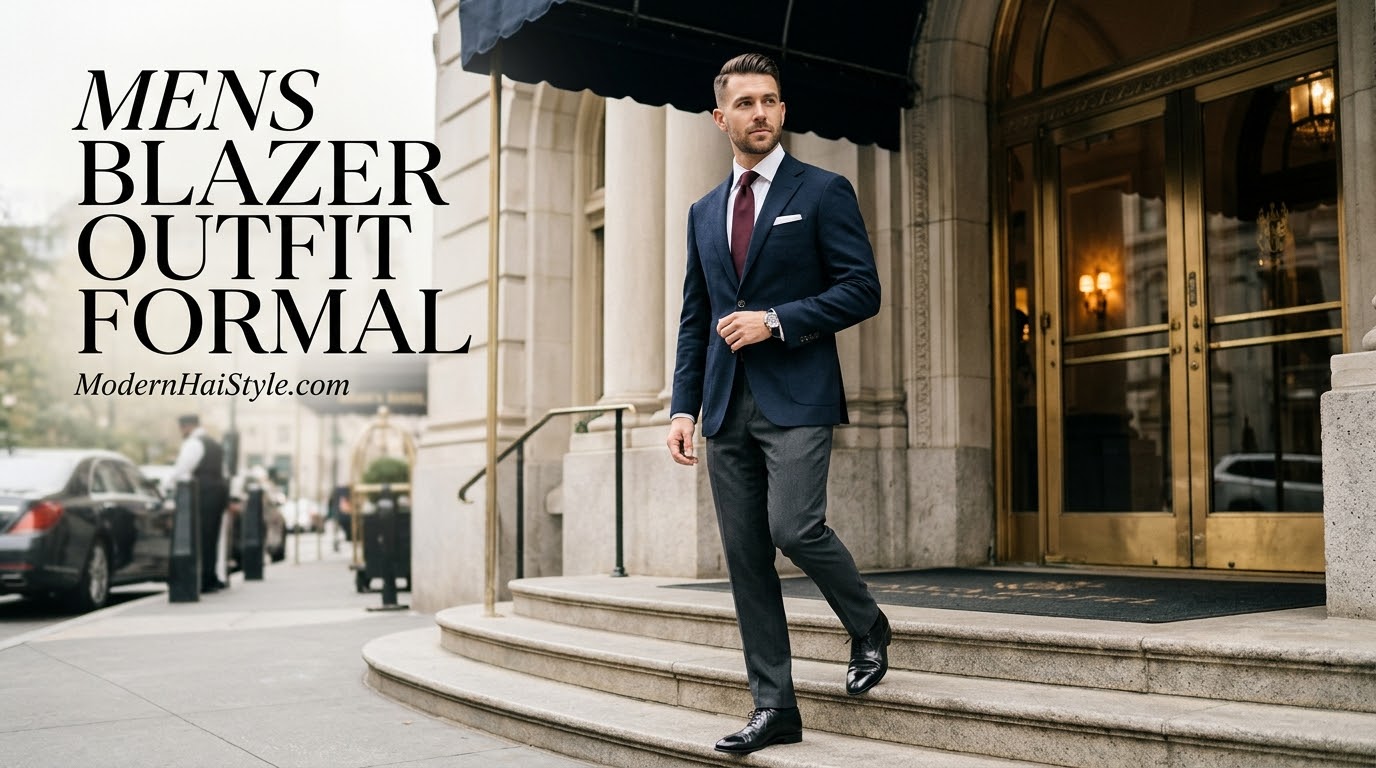
Mens Blazer Outfit Formal: The Dress Code Ladder and Where a Blazer Stops
The Dress Code Ladder: Where Blazer Separates Pass, Risk and Fail
Every formal decision in this guide hangs off one table. Find your event’s rung, read the verdict, and the rest of the article is execution.
|
Dress code |
Blazer verdict |
What the outfit needs |
|---|---|---|
|
Business casual |
Passes easily |
Blazer, dress shirt or knit, chinos or trousers, loafers or Derbies |
|
Semi formal |
Passes |
Structured blazer, dress trousers, dress shirt, tie expected, polished leather shoes |
|
Cocktail attire |
Passes with discipline |
Dark deliberate separates or a suit, silk tie, Oxfords or sleek Derbies, pocket square |
|
Business formal |
Risky |
The suit is the standard; blazer separates only in relaxed readings of the code |
|
Black tie optional |
Fails as separates |
Dark suit as the guest floor; a tuxedo is welcome but not required |
|
Black tie |
Fails completely |
Dinner jacket (tuxedo), formal shirt, bow tie, patent or polished shoes |
The two ends deserve a sentence each. At the bottom, the blazer’s problem is never being too much; business casual is where it relaxes, and the lower register borders the territory covered by men’s office outfits casual.
At the top, the problem is absolute.
Black tie does not mean a dark suit or a good blazer; it names a specific uniform built around the dinner jacket, and arriving in anything else announces that the code was not read.
Reading the Invitation: Signals That Move You a Rung
Invitations rarely print the whole truth, so read the signals around the words. TrueKung’s cocktail attire guide builds its cocktail guidance on exactly these signals, and they generalize across the ladder.
- Venue: a hotel ballroom or grand hall pushes one rung up; a garden, loft or restaurant pulls one rung down.
- Time: evening events dress darker and more formal than daytime ones at the same code.
- Host wording: creative or festive grants personality (color, velvet, pattern); traditional or formal removes it.
- Your role: the closer you stand to the center (wedding party, speaker, interviewee), the less freedom you have to interpret down.
When the signals conflict, follow the higher reading. Nobody remembers the guest who was slightly too polished; everyone remembers the one who was underdressed.
What Makes a Blazer Formal: Construction and Fabric
Formality in a jacket is not a color choice. It is a set of construction decisions, and they run in the opposite direction from casual blazers: where casual removes structure, formal restores it.
Structure Returns
The formal blazer has a defined shoulder, light padding and canvas in the chest, so the jacket holds an architectural line instead of draping like a shirt.
That line is what reads as authority in a boardroom or a receiving line.
Construction quality has its own ladder: fused interlining at the budget end, half canvas as the value standard, full canvas at the top, molding to the chest and rolling the lapel naturally.
At formal level, half canvas is the sensible floor.
The Smooth Cloth Rule
Formal cloth is smooth and dark. Worsted wool with a clean face, wool flannel in cold months, and fresco (an open weave worsted) for summer formality make up the working set.
Texture and pattern push the other way. Every step toward tweed, hopsack visibility, checks or linen is a step down the ladder, toward the sport coat register.
The taxonomy in The Vou’s comparison of blazers, suit jackets and sports coats orders the three jackets the same way: suit jacket most formal, blazer in between, sports coat most relaxed.
Lapels, Pockets and Buttons
Peak lapels are the more formal and ceremonial choice, standard on double breasted jackets and dinner jackets. Notch lapels are the versatile standard and pass everywhere a blazer passes.
Pockets follow the same gradient: jetted or flap pockets read formal; patch pockets read casual and should not appear above semi formal. Buttons go quiet: dark horn or self tones, never the bright metal of the classic casual navy blazer.
The Fabric Formality Ranking
|
Fabric |
Formality |
Best use |
|---|---|---|
|
Worsted wool, smooth |
Highest for a blazer |
Year round formal standard: weddings, interviews, boardroom |
|
Wool flannel |
High, seasonal |
Fall and winter formal, softer light, pairs with grey trousers beautifully |
|
Fresco and tropical wool |
High, seasonal |
Summer formality: weddings and offices in heat |
|
Velvet |
High for evening only |
Cocktail, festive and dinner jacket territory; never daytime business |
|
Hopsack and textured wool |
Middle |
Business casual to relaxed semi formal ceiling |
|
Tweed, corduroy, linen |
Below the formal line |
Sport coat register; do not promote them to formal events |
Color obeys the same gradient as cloth. Black and midnight navy sit at the top, then charcoal, then navy, then mid grey. Formality rises with darkness, smoothness and simplicity, and falls with pattern, texture and light color.
The Deliberate Separates Test
The single most useful sentence in formal dressing comes from Men’s Wearhouse’s cocktail attire guide: separates work when the jacket and trousers look deliberate rather than leftover.
Here is that sentence turned into a checklist you can run in a mirror.
1. The contrast is chosen, not survived.
Jacket and trousers differ clearly in color, navy against grey being the reference, and the pairing looks like a decision. Two near matching pieces in similar cloth fail instantly: that is the fake suit, formal edition.
2. The fabrics are coordinated in weight and finish.
A worsted blazer with flannel trousers works because both are dress fabrics with compatible weight. A blazer with chinos, denim or anything washed fails the finish test at formal level.
3. Everything is pressed and finished.
Creased trousers, a limp shirt collar or scuffed shoes each subtract a rung. At formal level, preparation is a garment: the same outfit pressed and polished passes where the rumpled version does not.
4. The full slot list is at code level.
Jacket, shirt, tie, trousers, shoes and the one accent all sit at the same rung.
A cocktail jacket over loafers with no tie is not a cocktail outfit with two relaxations; it is a semi formal outfit at a cocktail event.
5. You could defend every piece.
The summary test: if the host asked why you chose each piece, every answer would be a reason, not an apology. Separates that pass all five checks are not a compromise; they are a legitimate formal dialect.
Fit at Formal Level: Precision Is the Whole Game
Casual fit forgives; formal fit testifies. The checks are the same five as anywhere, shoulder, chest, sleeve, length and stance, but the tolerance tightens to zero.
The shoulder seam sits exactly on the edge of the shoulder bone, with the structured shoulder holding a clean, unbroken line. Any droop or divot reads as borrowed clothing, which is the exact impression a formal outfit exists to prevent.
Sleeves end at the wrist bone showing roughly a quarter to half inch of shirt cuff, the formal tell that the outfit was assembled by someone who knows the conventions.
Trousers break cleanly, with little or no pooling at the shoe.
The jacket closes flat, without pull at the button, and the hem covers the seat.
If a piece needs tailoring, tailor it before the event: at this level, fit is not a suggestion, it is most of the formality the outfit has.
Formulas by Rung
Business Casual Ceiling
The top of the everyday register: structured or lightly structured blazer, dress shirt with an open collar or a knit tie, chinos or tailored trousers, suede loafers or Derbies.
This is the rung the blazer was born for, and Men’s Wearhouse’s semi formal guide treats its upper half as the semi formal doorway.
Business Formal
The ruling first: the suit is the standard here, in dark navy, charcoal or black, with a white or light blue dress shirt, a silk tie and polished Oxfords, as SuitShop’s suit jacket vs blazer guide confirms in its occasions list (interviews, formal weddings, funerals, key meetings).
Where an organization’s reading is relaxed, the closest blazer approximation is a structured navy or charcoal blazer, white dress shirt, conservative silk tie, charcoal or grey tailored trousers and black Oxfords.
Know that it is an approximation, and that the full office wardrobe logic in formal office outfits starts from the suit for a reason.
Semi Formal
The blazer’s home rung.
The definition in Men’s Wearhouse’s semi formal guide is the consensus: a well fitted suit, or a sharp blazer paired with tailored dress trousers, a dress shirt, usually a tie, and polished leather shoes.
Jeans, sneakers and t-shirts are never appropriate at this level.
The reference formula: navy blazer, white dress shirt, burgundy silk tie, grey flannel trousers, polished dark brown or black Oxfords, white linen pocket square. It covers dinners, receptions, ceremonies and most formal social invitations a man receives.
Cocktail Attire
Cocktail is semi formal’s evening sibling: dressier, darker, more celebratory.
Men’s Wearhouse’s cocktail attire guide gives the safe read as a suit and tie, with separates accepted when deliberate, and TrueKung’s cocktail attire guide adds the signal table that decides between them.
|
Signal |
Wear the suit |
Wear blazer separates |
|---|---|---|
|
Evening city venue or hotel ballroom |
Yes |
Rarely |
|
Gallery, loft or brand event |
Sometimes |
Yes |
|
Host writes creative or festive |
Sometimes |
Yes |
|
Daytime or garden setting |
Sometimes |
Yes |
|
You need zero risk |
Yes |
No |
The separates version at cocktail: dark structured blazer (navy, charcoal or black), white or pale dress shirt, silk tie, charcoal or mid grey trousers, polished Oxfords, and a pocket square as the one celebratory note.
The Evening Escalation: Velvet and the Dinner Jacket Boundary
Evening is where the formal blazer gains a specialty weapon: velvet. A black or deep colored velvet blazer, navy, burgundy or forest, is the festive formal jacket, built for low light and celebration.
Velvet’s rules are balance rules. Pair its plush texture with smooth, solid partners: a plain dress shirt, flat finish trousers, polished shoes.
Never stack another bold weave or print against it, and keep the underlayer neat and thin so the jacket closes cleanly.
The velvet formula at cocktail level: black velvet blazer, white dress shirt, black or charcoal tailored trousers, polished black Oxfords or loafers, one accent only. The holiday and party formulas in men’s party outfits run on the same engine.
The Dinner Jacket Is Not a Blazer
At the top of the evening sits a different garment, and confusing it with a blazer is the category’s most expensive mistake.
The dinner jacket (the tuxedo jacket) has satin or grosgrain faced lapels, usually a single button, and matching trousers with a satin stripe.
Inside black tie optional, the dinner jacket has one recognized blazer-adjacent variation: a velvet dinner jacket worn with tuxedo trousers, a formal shirt, a bow tie and patent or velvet shoes.
That is a tuxedo dialect, not a blazer outfit, and the distinction is the whole point.
Below that line, at black tie optional without a dinner jacket, the guest’s floor is a dark suit. An ordinary blazer with trousers sits below the code, however beautifully it is assembled.
Occasion Rulings
Weddings, by the Code on the Invitation
Weddings are where this keyword earns its keep, because the same garment is perfect at one wedding and wrong at the next. Read the invitation’s code, then apply the ladder.
Semi formal and daytime weddings: the reference separates formula passes. Cocktail weddings: suit as the safe read, deliberate dark separates accepted. Formal and black tie weddings: suit or tuxedo, no blazer route.
The wider guest guidance in men’s wedding guest outfits and the party-side outfits in men’s wedding outfits follow the same code-first logic.
Job Interviews
The ruling is asymmetric because the risk is. In law, finance, senior corporate and client facing hiring, wear the suit; the interviewer is scoring judgment, and the suit is the zero risk answer.
In creative, tech and relaxed industries, a structured blazer outfit (dress shirt, tie, tailored trousers, polished Derbies or Oxfords) can present complete authority. When you cannot read the company’s register in advance, the suit remains the default.
Funerals and Memorials
The standard is a dark suit, sober shirt and a dark tie, because the day is not about the wearer. Nothing festive, nothing casual, nothing that draws the eye.
The respectful fallback, when no suit exists: a charcoal or black blazer, dark dress trousers, a white or muted shirt and a dark tie, shoes polished and quiet.
It is the one occasion where a blazer outfit should aim to be unremarkable.
Galas, Award Nights and Formal Dinners
Most galas are black tie or black tie optional, which places them under the dinner jacket ruling. At the rarer festive or smart gala, a velvet blazer outfit is the insider’s answer: celebratory, photographed constantly, and safely above semi formal.
Formal dinners without a printed code default to the cocktail formula, darkened: charcoal or navy blazer, white shirt, quiet tie, dark trousers, Oxfords.
The evening register overlaps heavily with the elevated end of men’s date night outfits, with the tie added and the knit removed.
Shirts and Ties: The Formal Layer System
At formal level the shirt stops being a layer and becomes part of the architecture.
The dress shirt standard: smooth poplin, white first, then light blue and pale tones, with a structured spread or point collar built to carry a tie.
|
Combination |
Shirt |
Tie |
Register |
|---|---|---|---|
|
The reference |
White poplin, spread collar |
Burgundy or deep green silk |
Semi formal to cocktail, the default |
|
The boardroom |
White or light blue poplin |
Navy or charcoal silk, quiet pattern |
Business formal approximation |
|
The evening |
White poplin, French cuffs option |
Black, midnight or grenadine silk |
Cocktail and formal dinners |
|
The festive |
White or pale shirt |
Rich solid silk, jewel tone |
Velvet blazer partner |
Tie discipline is simple and strict. Silk is the formal fabric; grenadine adds texture without noise; knit ties sit one rung lower and belong to business casual.
Match tie width roughly to lapel width, keep patterns quieter than the room, and let the tie be darker than the shirt.
French cuffs with cufflinks raise any of these combinations for weddings and evening wear. Studs and pleated fronts belong to the formal shirt of black tie only, and importing them into a blazer outfit overshoots the garment.
Shoes: The Formal Ladder on Your Feet
Shoes are the rung check nobody can fake, because they are read instantly and remembered. The ladder, top to bottom:
|
Shoe |
Formality |
Where it passes |
|---|---|---|
|
Cap toe Oxford, polished black |
The reference |
Every rung a blazer or suit reaches |
|
Wholecut or plain Oxford |
Top |
Evening and formal weddings |
|
Derby, polished leather |
One step down |
Semi formal, business settings, cocktail in dark colors |
|
Monk strap |
Semi formal to cocktail |
Adds character without dropping the rung |
|
Polished leather loafer |
The relaxed floor |
Relaxed cocktail and semi formal in summer readings |
|
Patent leather |
Black tie only |
Dinner jacket territory, not blazer outfits |
|
Sneakers, boots with lug soles, suede casual shoes |
Below the line |
Never at formal level |
Two disciplines sit on top of the ladder. Polish is part of the shoe: a scuffed Oxford ranks below a gleaming Derby. And belt matches shoes in color family, the small coordination that separates assembled outfits from collected ones.
Suede, the casual blazer’s best friend, mostly exits here. Its matte softness belongs to the lower rungs; at formal level, smooth polished leather is the language, with suede Derbies at semi formal as the only common exception.
Accessories: The One or Two Accent Rule
Formal accessories obey a ceiling: one or two accents at most, a rule the velvet guidance in the retailer literature states plainly and the whole ladder follows. Every accent beyond two stops refining the outfit and starts decorating it.
The pocket square is the first accent and the cheapest signal of a considered outfit: white linen in a straight, flat fold at formal level.
Colored or patterned squares belong to festive rungs, and a square should complement the tie, never match it exactly.
The second accent is a choice, not a default: cufflinks at a wedding, a dress watch at a dinner, a tie bar worn between the third and fourth shirt buttons.
Choose the one the occasion rewards and leave the others in the drawer.
The composed register in men’s old money outfits and the restraint in men’s quiet luxury outfits are the same discipline from different angles: quality visible, effort invisible.
Complete the Look: Grooming at Formal Level
Formal dressing is judged as a whole silhouette, hair included, and the grooming standard rises with the rung. The rule mirrors the shoe ladder: the higher the code, the cleaner the finish.
A classic gentleman haircut is the reference cut for the formal blazer: tidy sides, a combed top, nothing that argues with the lapel line. It is the haircut equivalent of the cap toe Oxford, correct everywhere on the ladder.
For evening and festive rungs, a fade slick back haircut gives the polished surface that velvet and dark tailoring ask for. Keep facial hair trimmed and deliberate; at formal level, stubble reads as an unfinished outfit, not a style choice.
The wider grooming coverage on Modern Hai Style treats the cut side in depth. From the clothing side, the test is consistency: the man in the mirror should look like one decision, not several good ones.
Buying the Formal Blazer: Spec, Canvas and the Event Test
The spec: navy or charcoal, single breasted with notch lapels (double breasted with peak lapels for evening led wardrobes), structured shoulder, half or full canvas, smooth worsted wool, flap or jetted pockets, quiet horn buttons, hem covering the seat.
Every element maps to the ladder. Structure and smooth cloth buy the rungs; canvas buys the drape and the years; dark quiet colors buy compatibility with the grey trousers you will wear most.
The event test replaces guesswork. Before removing tags, dress the blazer for your next three real formal events: the wedding formula, the interview or presentation formula, the evening formula. A jacket that covers all three is a wardrobe asset.
Cost per wear makes the quality case across a social calendar: a formal blazer worn to weddings, dinners and presentations across years reaches a low cost per wear quickly, and a canvassed jacket is still improving its drape when a fused one has bubbled.
In a planned wardrobe like men’s capsule wardrobe essentials, it is the formal anchor piece.
Winter formality adds one layer to the test: the blazer must close over a fine knit for cold venues and sit under a tailored overcoat, exactly the layering logic in men’s capsule wardrobe for winter.
Mistakes That Leave You Underdressed
1. Reading the code down.
Semi formal heard as smart casual, cocktail heard as business casual. Each code has a floor, and the ladder table at the top of this page exists so the floor is never a guess.
2. The leftover separates look.
Separates assembled from whatever was clean, near matching, unpressed. The deliberate test has five checks because leftover is a look, and hosts can see it from across the room.
3. Casual construction at a formal event.
The unstructured, patch pocketed blazer that charms at business casual reads as a cardigan with lapels at a formal wedding. Construction is formality; the soft jacket stays at its own rungs.
4. Shoe failure.
Sneakers at cocktail, suede at a formal wedding, scuffed Oxfords anywhere. Shoes are the fastest tell in the outfit, and the ladder’s floor is polished leather from semi formal upward.
5. The missing tie.
An open collar presented at a code that expects a tie.
The tie is the cheapest rung in the entire system: when the invitation is silent and the event is evening, wear it and remove it only if the room proves you wrong.
6. Overshooting into costume.
Studs and a bow tie with a blazer, three accents and a lapel pin, velvet in three pieces. Formal dressing rewards restraint; the man straining to look formal reads as less formal than the man who simply is.
Care and Preparation: The Night Before Standard
Formal outfits are won the night before: jacket steamed and hung, trousers pressed with their crease, shirt ironed with the collar standing, shoes polished and rested on trees.
Store the blazer on a wide hanger, rested at least a day between wears, brushed after use. Dry clean woven formal jackets sparingly, since frequent cleaning dulls and shines worsted cloth over time.
Travel with formality is a packing discipline: the jacket worn or carried, never folded into a case’s bottom, and steamed on arrival.
Where Formal Ends: The Boundary With Casual
Everything above semi formal’s doorway belongs to this page; everything below it belongs to the blazer’s other life, with tees, denim, sneakers and soft unstructured jackets.
The two registers share the garment’s name and almost nothing else. Knowing which register an invitation asks for is the whole skill this ladder teaches.
Frequently Asked Questions
Is a blazer formal enough for a wedding?
It depends on the code on the invitation. At semi formal and many cocktail weddings, a tailored blazer with dress trousers, a dress shirt and a tie passes when the separates look deliberate.
At formal and black tie weddings, wear a suit or a tuxedo.
Can a blazer replace a suit?
At semi formal level and below, yes, as deliberate separates. At business formal and anywhere the room will be uniformly suited, the suit is the correct garment. At black tie, neither a blazer nor a regular suit replaces the tuxedo.
Is a blazer semi formal or formal?
The blazer lives at semi formal by default. A structured blazer in smooth dark cloth with dress trousers and a tie reaches into cocktail and the lower edge of formal; it does not reach black tie.
Do you wear a tie with a formal blazer?
At formal level, yes. The tie is expected at cocktail and formal weddings unless the invitation says otherwise, and at business formal settings. The open collar version belongs to business casual and below.
What shoes are formal enough with a blazer?
Polished leather Oxford shoes are the reference. Derbies sit one step down and pass at semi formal; sleek leather loafers are the relaxed cocktail minimum in lenient readings; patent leather belongs to black tie. Sneakers never pass at formal level.
Can you wear a blazer to a black tie event?
No. Black tie specifies a dinner jacket (tuxedo) with satin or grosgrain lapels, formal shirt and bow tie. A standard blazer, however good, reads underdressed. At black tie optional, a dark suit is the guest’s floor.
What about black tie optional: is a blazer acceptable?
Only in its dinner jacket form: a velvet or satin faced dinner jacket with tuxedo trousers is a recognized black tie optional variation. An ordinary blazer with trousers is below the code; a dark suit is the safe guest choice.
What color blazer is most formal?
The darkest smooth colors: black and midnight navy at the top, then charcoal, then navy. Formality rises with darkness, smoothness of cloth and simplicity of detail, and falls with pattern, texture and light colors.
Blazer or suit for a job interview?
The suit, in conservative industries and for senior roles, without exception worth risking.
In creative and tech workplaces a structured blazer with dress trousers, shirt and tie can pass, but the suit is the zero risk answer while you are being judged.
Can you wear a blazer to a funeral?
A dark suit is the standard and the respectful default.
If no suit is available, a charcoal or black blazer with dark dress trousers, a white or muted shirt and a dark tie is the acceptable fallback. Nothing festive, nothing casual.
What trousers go with a formal blazer?
Tailored dress trousers in a contrasting, coordinated cloth: grey flannel or worsted with a navy blazer is the reference combination. Charcoal, mid grey and black trousers cover most formal blazers; chinos and jeans are below formal level.
Is a double breasted blazer more formal?
Yes, modestly. The double breasted cut carries more ceremony and pairs with peak lapels at the formal end. It suits evening and wedding formulas well, provided the rest of the outfit keeps the discipline.
What shirt do you wear with a formal blazer?
A dress shirt in smooth poplin: white first, then light blue or pale tones, with a structured spread or point collar that supports a tie. French cuffs with cufflinks raise the formality for evening and wedding wear.
What is the difference between a formal blazer and a suit jacket?
A suit jacket is half of a matched set, cut from the same cloth as its trousers. A formal blazer is a standalone structured jacket designed for contrasting trousers.
The blazer can be tailored and smooth enough for semi formal and cocktail wear, but it remains separates.
Can you wear separates to a cocktail event?
Yes, when they look deliberate rather than leftover: coordinated fabrics, clear but harmonious contrast, everything pressed, a tie worn, and shoes at code level. Evening ballroom settings push toward a full suit.
What is semi formal attire for men?
A well fitted suit, or a sharp blazer with tailored dress trousers, a dress shirt and usually a tie, with polished leather shoes. Semi formal sits above business casual and below formal, and it never includes jeans, sneakers or t-shirts.
What is cocktail attire for men?
A polished suit and tie, dressier than business casual and short of a tuxedo, is the safe read. Deliberate blazer separates are accepted at relaxed or creative cocktail events.
Leather dress shoes are required; the tie is expected unless stated otherwise.
What is business formal for men?
A conservative suit in dark navy, charcoal or black, a white or light blue dress shirt, a tasteful silk tie and polished dress shoes. A blazer outfit approximates it only in relaxed readings; the suit is the standard.
Can you wear a velvet blazer to a formal event?
Yes, velvet is the evening specialist. A black or deep colored velvet blazer with smooth solid partners, dress trousers and polished shoes suits cocktail and festive formal events, and in dinner jacket form it reaches black tie optional.
Should a formal blazer be structured or unstructured?
Structured. Formal level requires the defined shoulder, canvas and clean drape that unstructured construction deliberately removes. Save the soft jacket for casual and business casual registers.
Notch or peak lapels for a formal blazer?
Peak lapels are the more formal and ceremonial choice, standard on double breasted and dinner jackets. Notch lapels are the versatile standard and pass everywhere a blazer passes. Shawl collars belong to dinner jackets.
What tie goes with a formal blazer?
A silk tie in a solid or quiet pattern, darker than the shirt: burgundy, deep green, navy and charcoal are the safe family. Grenadine adds texture without noise. Match tie width roughly to lapel width.
Do you need a pocket square with a formal blazer?
At formal level it is close to expected: a white linen square in a straight fold is the classic, cheapest signal of a considered outfit. Keep colored or patterned squares quiet and never identical to the tie.
Can you wear a blazer with a waistcoat?
Yes, three piece separates are a recognized formal variation when the waistcoat is chosen deliberately (matching the trousers or a quiet contrast) and the fabrics coordinate. It raises warmth and ceremony for weddings and winter events.
How should a formal blazer fit?
Precisely: shoulder seam on the bone edge, chest closing flat without pulling, sleeves showing roughly a quarter to half inch of shirt cuff, hem covering the seat, trousers with a clean break.
At formal level there is no relaxed fit allowance.
What fabrics are most formal for a blazer?
Smooth worsted wool leads, with wool flannel close behind in cold months, fresco for summer formality, and velvet for evening. Texture and pattern lower formality; hopsack, tweed and linen sit below the formal line.
Can you wear a black blazer formally without looking like staff?
Yes, with texture and contrast management: a black blazer in a rich cloth, a white dress shirt, grey or charcoal trousers and polished shoes reads as a guest.
The staff look comes from black on black with a white shirt and no variation.
Is a blazer appropriate for a gala?
Read the code. Most galas are black tie or black tie optional, where the dinner jacket or a dark suit rules.
At the rare smart or festive gala, a velvet blazer outfit can pass; when the invitation is silent and the venue is grand, choose the suit.
Can groomsmen wear blazers instead of suits?
Yes, at semi formal and rustic or garden weddings, coordinated separates are a common and photogenic choice. The couple’s dress code governs; at formal weddings the wedding party wears suits or tuxedos.
What do you wear with a navy blazer for a formal look?
The reference formula: navy blazer, white dress shirt, burgundy or deep green silk tie, grey wool or flannel trousers, polished black or dark brown Oxford shoes, white linen pocket square. It covers weddings, dinners and presentations.
Can you wear loafers with a formal blazer outfit?
Polished leather loafers pass at relaxed cocktail and semi formal summer events. For formal weddings, interviews and business formal settings, Oxford or Derby shoes are the correct call.
Can you wear a blazer to court or a formal hearing?
Dress as for business formal: a dark suit is the standard advice. Where a suit is impossible, the darkest structured blazer with matching formality trousers, shirt and tie is the minimum respectful presentation.
How do you make a blazer outfit look more formal?
Upgrade in order: structure and smooth dark cloth in the jacket, a dress shirt, a silk tie, tailored trousers, polished Oxford shoes, a white pocket square, and precision fit with everything pressed. Each step raises the outfit roughly one rung.
Can you wear a blazer without a tie to a formal event?
At true formal level, no: the tie is part of the code. The exceptions are stated on the invitation (no tie, festive, creative) or the event is actually semi formal in a relaxed venue, where an open collar can pass.
What is a dinner jacket, and is it a blazer?
A dinner jacket is the tuxedo jacket: satin or grosgrain faced lapels, usually one button, worn with matching tuxedo trousers, a formal shirt and a bow tie.
It is its own garment class, not a blazer, and it is what black tie requires.
Are double vents or a center vent more formal?
Side (double) vents are the formal and tailored standard, sitting cleanly and moving well. A center vent is acceptable and more common on ready to wear. No vent is the dinner jacket tradition.
Can you wear a patterned blazer formally?
Quiet patterns only: a subtle check or fine stripe in dark colors can pass at semi formal and festive events. Bold patterns, bright colors and heavy textures belong to the sport coat register below formal.
What should a father of the bride or groom wear: blazer or suit?
Follow the wedding party’s level. At formal weddings, a suit or tuxedo matching the party’s formality; at semi formal weddings, elevated separates with a tie are appropriate and photograph well beside the party.
Can you wear a blazer for a business presentation or client meeting?
Yes, in most industries a structured blazer outfit at business formal approximation (dress shirt, tie, tailored trousers, polished shoes) presents authority. In law, finance and senior corporate settings, wear the suit.
How formal is a blazer with dress trousers and no tie?
Business casual to relaxed semi formal, depending on execution. It is a useful register for dinners and receptions, but it is one rung below the same outfit with a tie, and invitations rarely reward guessing down.
What is the best first formal blazer to buy?
A navy or charcoal structured blazer in smooth worsted wool, single breasted with notch lapels (or double breasted for evening led wardrobes), half or full canvas, worn with grey trousers. It covers the widest formal range short of a suit.
When should you just wear the suit instead?
Whenever the cost of being wrong is real: formal weddings, black tie optional events, conservative interviews, funerals of close relations, and any evening ballroom setting. The zero risk rule governs: doubt at the top rungs resolves to the suit.
Conclusion
A mens blazer outfit formal in effect is a ladder problem, not a taste problem.
The garment climbs from business casual to cocktail on the strength of structure, smooth cloth, deliberate separates and polished shoes, and it stops, cleanly and permanently, at black tie.
Work your rung honestly, run the deliberate test, and let fit and preparation carry the rest. The blazer rewards the man who knows exactly where it belongs, because he is never the underdressed one in the photograph.
Your move before the next invitation: run the event test this week. Dress your best blazer for your next three formal occasions, wedding, presentation and evening, and note honestly which rung each version reaches.
Whatever fails the test tells you whether to tailor, to upgrade, or to buy the suit, and it costs nothing to learn it at home.

Dilawar is a passionate writer and contributor at Modern Hairstyle (modernhaistyle.com), specializing in hairstyles, hair care, grooming, fashion, beauty, and lifestyle trends. He enjoys sharing practical tips, hairstyle inspiration, and easy-to-follow guides to help readers discover their personal style. His goal is to provide informative, engaging, and helpful content that keeps readers updated with the latest trends.


