U Part Wig Human Hair: The Leave-Out Bargain, Explained Honestly
U part wig human hair searches usually start with a frustration: lace wigs ask for glue, skill, and patience that a Tuesday morning does not have. The U part answers by deleting the lace entirely and letting your own hair play the starring role.
That swap is the whole product. Your part is real because it is yours, the price drops because the expensive construction is gone, and the install takes minutes.
The bill arrives somewhere else: in the health and match of the leave out section your hair contributes. This guide prices both sides of that bargain honestly, including the cases where the newer V part or a lace wig serves you better.
What a U Part Wig Is and How the Opening Works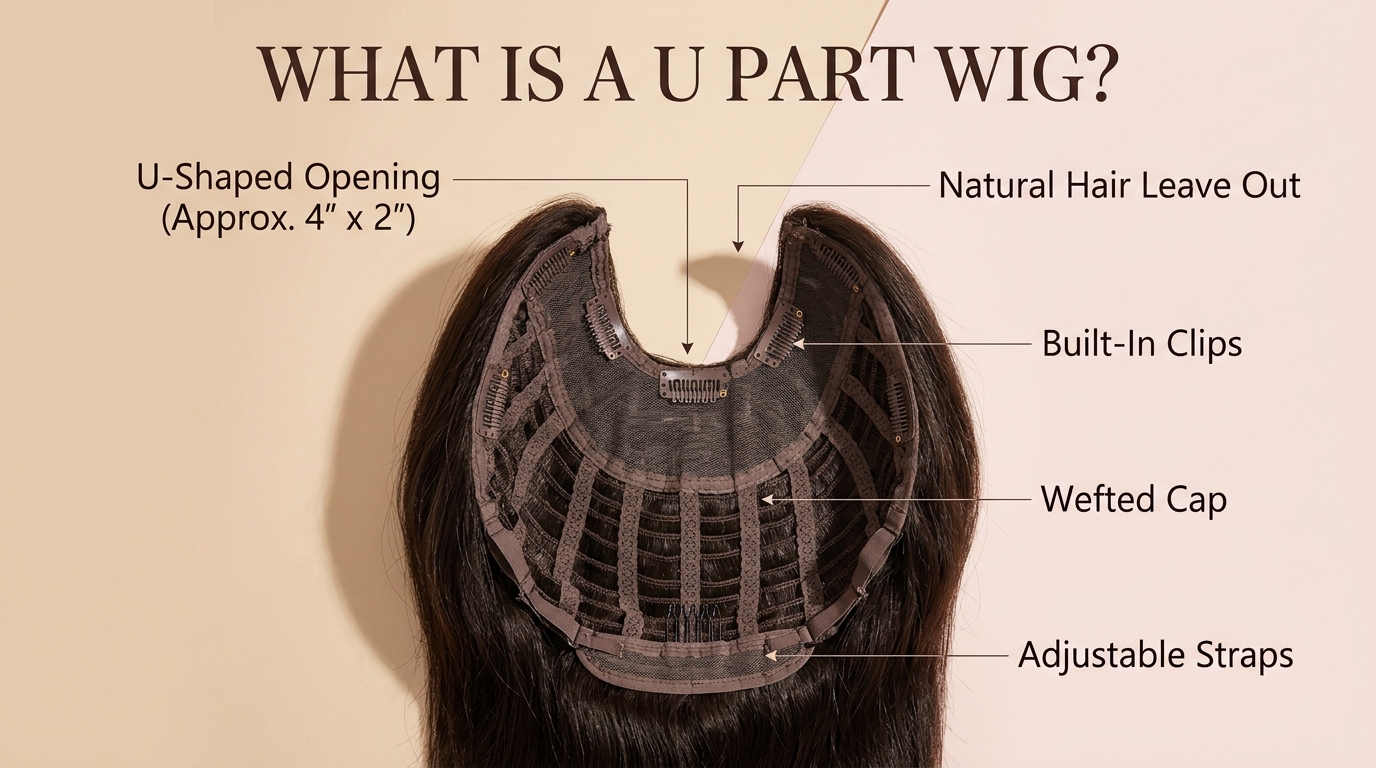
A U part wig is a wig with a U shaped opening cut into the top of the cap. There is no lace panel anywhere on it.
Your own hair fills the opening. You leave out a U shaped section of your natural hair, clip the wig on underneath it, and blend your hair over the top.
What shows at the part and crown is your scalp and your hair. That is the entire realism mechanism, and it is why the style fools people at conversational distance.
The cap underneath is ordinary: a machine made wefted cap with clips and combs inside, an adjustable strap, and on newer models an elastic drawstring.
Security comes from those clips gripping your braided base. The UNice V part vs U part comparison counts the hardware on its own models: three combs around the U opening on its U design.
Install runs in one direction: braid down, leave the U out, set the wig, clip, blend. On the UNice U design there is also a band across the cap to cut before the first wear.
The Trade: What You Give Up, What You Get
Every wig design is a bargain. The U part’s bargain is unusually clear, because both sides of it sit on your own head.
What you get: no glue on your edges, ever. No lace to cut, tint, melt, or replace. No install appointment and no stylist bill for wearing it.
You also get scalp access, which no full wig offers. Buyers in the shop reviews cite doing their full natural hair routine underneath as the reason they chose the design.
And you get nightly freedom. A clipped U part comes off in seconds, so your hair and scalp get the night off too.
What you give up: a section of your own hair works every day the wig does. The leave out is styled, heated, and exposed to weather while everything underneath it rests.
It also has to match: color, texture, and shine, in daylight and in photos. The GoviHair U part vs V part comparison states the cost plainly: blending can mean heat tools on your own hair, which can cause damage over time.
Neither side is a trick. The design suits people whose leave out is healthy and matchable, and it punishes people whose is not. The rest of this guide is about knowing which one you are before you pay.
One more entry belongs on the get side: camera realism. Lace can flash, shine, or grid under phone flash and video calls, especially as it ages.
A leave out part is skin and hair, and it photographs like skin and hair at every age of the wig.
U Part vs V Part: The Successor, Compared
The V part wig is the U part’s own upgrade, sold by the same brands, and it is winning. Knowing why tells you whether the U is still your design.
|
Feature |
U part wig |
V part wig |
|---|---|---|
|
Opening |
U shaped, about 4 x 2 inches (UNice) |
Narrow V shaped band |
|
Leave out needed |
A wide U section |
Little to none (up to 3/4 less, per UNice) |
|
Parting |
Middle or side part from one wig |
Part largely fixed by the band |
|
Blend |
Fullest, most convincing with abundant hair |
Easier, thinner strip to blend |
|
Protection |
Leave out exposed daily |
More of your hair stays covered |
|
Install |
Clip in, plus blending time |
Fastest, near zero blending |
The WIGI Hair U part vs V part guide compresses the comparison into one line worth keeping: U part means more leave out and a fuller blend; V part means less leave out and a cleaner, more protective design.
The EhWap U part and V part styling guide adds the styling read: the U’s wider leave out band builds volume at the crown and suits wavy, curly, and face framing looks, while the V tapers toward sleek lengths and neat ponytails.
Choose the U when your hair is full, you enjoy styling your leave out, and parting flexibility matters. Choose the V when your hair is fine, thinning, tired of heat, or simply not available for daily duty.
The Coverage Test: Can Your Hair Cover a 4 by 2 Opening?
Run this test before any product page. The U opening on the market’s standard design measures about 4 by 2 inches, and your leave out has to cover it completely, edges included.
Part your hair into a U at the crown, the size of a credit card laid the wide way. Pull that section forward and look at it honestly in daylight.
Ask three questions. Is the section thick enough that skin and tracks would not show through it? Is it long enough to lie flat over the opening and blend past its edges?
Is it healthy enough to be styled on every wear day without breaking? A yes to all three means the U part will work on your head.
A no on thickness is the most common failure, and it has a designed answer: the V part’s opening is a fraction of the size, and comparison guides steer thin and fine hair there for exactly this reason.
A no on health argues for rest first. A leave out that is already breaking will not survive becoming the hardest working section of your hair.
Texture Matching: Marry the Wig to Your Leave Out
Texture mismatch is the number one reason U parts look like wigs. The fix happens at purchase, not at the mirror.
Match the wig to your leave out after styling, not to your hair as it grows. If you silk press weekly, your styled state is straight, and the wig should meet it there.
Kinky straight and yaki straight textures exist for this marriage. Their texturized finish mimics pressed or relaxed textured hair, so the leave out needs far less heat to agree with the wig.
Silky straight units demand a silky leave out, which means more flat iron passes on your own hair at every wear. Price that heat into the decision.
Curly and body wave units blend best with leave outs worn in their natural pattern, the one route where the leave out skips heat entirely.
One honesty note from the listings themselves: kinky straight hair is texturized during manufacturing, and the sellers warn it may not hold curls well afterward. Buy it for straight looks, not for curl plans.
Color and Shine: The Other Two Matches
Match color in daylight, at your leave out’s ends, where multi tonal hair shows its lightest self. Most buyers land in natural black, an off black brown.
When your hair sits between shades, a wig slightly darker than the leave out usually blends better, because the leave out lies on top and reads as the highlight layer.
Then check shine. A dry, matte leave out over conditioned, glossy wig hair shows the seam in every photograph, even when texture and color agree.
Condition and finish both hair sources with the same products on wear days. The seam disappears when the light behaves the same on both.
Install, Step by Step
The install is two jobs: a foundation you build once, and a two minute routine on wear days.
- Wash and condition your hair, then decide the part. Everything after this step assumes the part is chosen, because the leave out is sectioned around it.
- Section the U. Clip up a U shaped section at the crown, roughly the size of the wig’s opening, and keep it separate and protected while you build the base.
- Braid or flat twist the rest down, flat and low. Straight back cornrows are the standard; flat twists are the gentler option for tangle prone hair.
- Prepare the wig. On designs with a band across the opening, cut it now. Check the clips open and close cleanly, and set the strap or drawstring loose.
- Set and anchor. Place the wig so its opening frames your leave out, then close every clip and comb into the braided base, front pair first, and snug the strap.
- Blend last. Release the leave out, lay it over the opening’s edges in the direction the wig hair falls, and style both hair sources together as one head of hair.
Wear days after the first are steps five and six only. Most of the install reputation this category has, on in minutes, is earned by keeping the braided base fresh between wears.
The Sew Down Option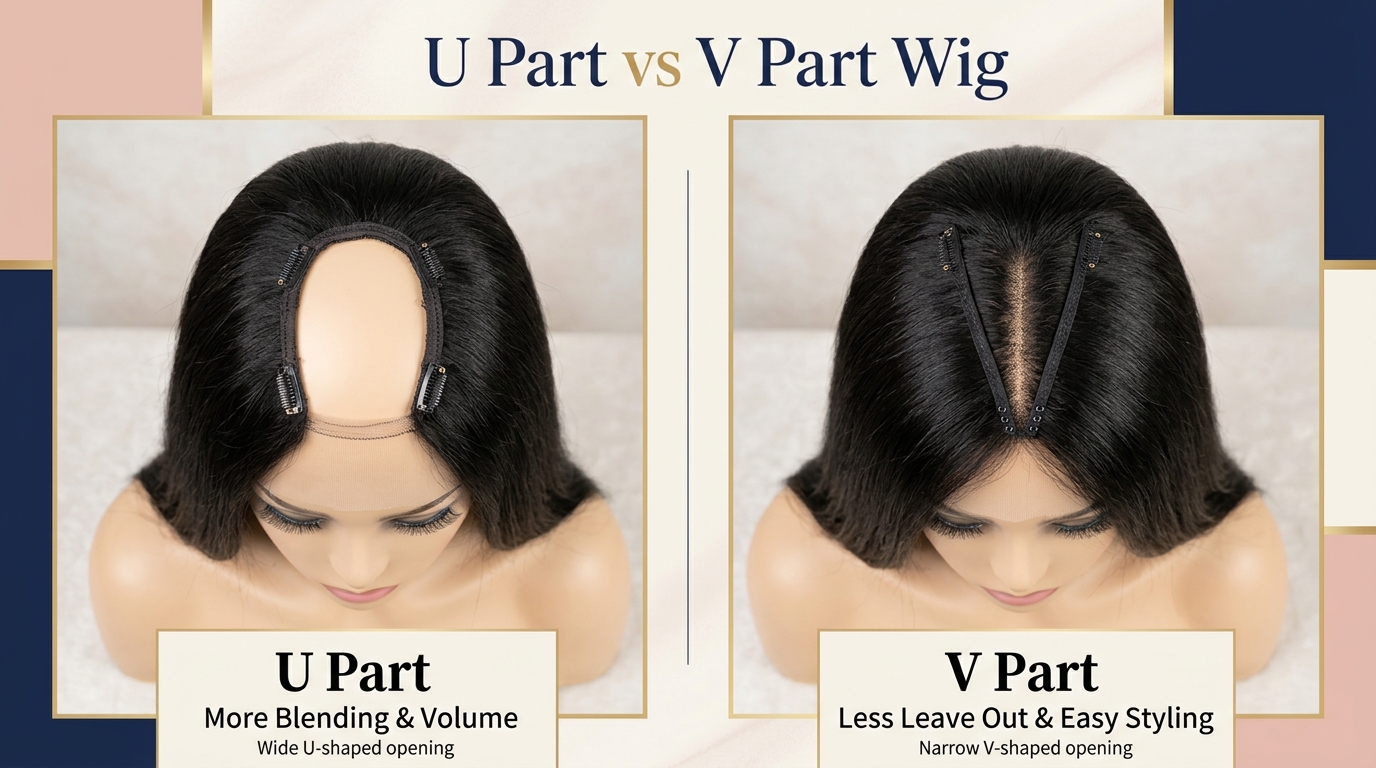
Stitching the wig’s perimeter to your braided base converts a daily unit into a multi week install, and buyers describe doing exactly this in the shop reviews.
Sewing down trades the nightly freedom for sew in style longevity, while keeping the leave out and the scalp access that define the design.
Use a curved needle, keep the tension loose, and treat it with the same caution as any sewn install. The next section’s rules apply with interest.
The Leave-Out Health Protocol
This is the section the rest of the internet skips, and it is the difference between a protective style and a slow problem.
The tension rule. The UNice V part vs U part comparison carries the medical caution: repeated tension can lead to traction alopecia, the hair loss the American Academy of Dermatology attributes to styles that pull, with Johns Hopkins hairstyle research pointing the same way.
Clips are small tension devices. Rotate their anchor points between wears so the same hairs do not carry the load daily, and never clip into hair that is already sore or thinning.
The heat rule. Your leave out takes heat so the wig does not have to look fake. Heat protectant on every styling day is non negotiable, and moderate temperatures beat daily silk press severity.
Build low heat days into the week: a leave out worn in a twist out under a curly unit, or under a scarf line, rests the section without resting the style.
The moisture rule. The leave out is the only part of your hair living outdoors. Moisturize and seal it like the visible hair it is, and trim it on your normal schedule, not the wig’s.
The access rule. Use the design’s advantage. With the wig off nightly, your scalp and braids get washed, oiled, and inspected on a rhythm no sew in wearer can match.
Spot the early signs the dermatology guidance names: soreness, breakage at the blend line, or thinning where clips sit. Any of them means change the routine, not push through it.
A detailed read on tension and hair loss sits in The Crowned Standard’s traction alopecia explainer, written from the AAD’s own guidance.
Prices by Tier, With the Receipts
U part human hair is the budget lane of the human hair world, and the tiers are visible in primary listings:
|
Tier |
Where it sells |
Price (as listed) |
What you get |
|---|---|---|---|
|
Brand shop |
UNice’s own store |
$89 at 16 in to $156 at 24 in, 150% density |
Current models, drawstring upgrades, returns |
|
Marketplace |
Reseller listings of brand lines |
About $109 at 18 in |
Same families, thinner support |
|
Social commerce |
TikTok Shop brand stores |
From about $75 |
Flash pricing, variant by variant |
|
Beauty supply |
Local stores, community reported |
About $50 |
Basic units, buy in person |
The UNice kinky straight U part wig shop page shows the brand math clearly: length is the price dial, with each two inches adding roughly ten to twenty dollars on its kinky straight line.
Compare that with a lace front at the same length and the U part’s case makes itself: the missing lace and hand knotting are worth half or more of the ticket.
The parent category context matters too. Our full human hair wig guide prices salon human hair from 400 dollars upward; this lane exists precisely for buyers who want real hair without that bill. Both guides live together in the Hair Wig category at ModernHaistyle.
Who Should Skip the U Part Entirely
Honest routing is part of the guide. Skip the U, whatever the listings promise, if any of these are true:
- Your crown cannot pass the coverage test. Thin or fine hair over a 4 by 2 opening shows tracks, and no blending skill fixes arithmetic. The V part was designed for you.
- Your leave out is currently damaged. Heat styling a breaking section daily converts a wig purchase into a hair loss plan. Rest it under a full wig or a V first.
- You want zero daily styling. The U part’s morning is short, but it is not nothing: the leave out gets laid, blended, and finished every wear.
- You need high updos daily. The wefted back cannot fake a lace hairline in a high ponytail. That job belongs to 360 and full lace constructions.
Everyone else gets a fair bargain: real scalp at the part, no glue anywhere, and a price that leaves room for the second unit rotation. Outfit level styling for the finished look lives in Womens streetwear outfits 2026, and the finishing accessories sit in Mens accessories for outfits.
Before You Buy: The Five Checks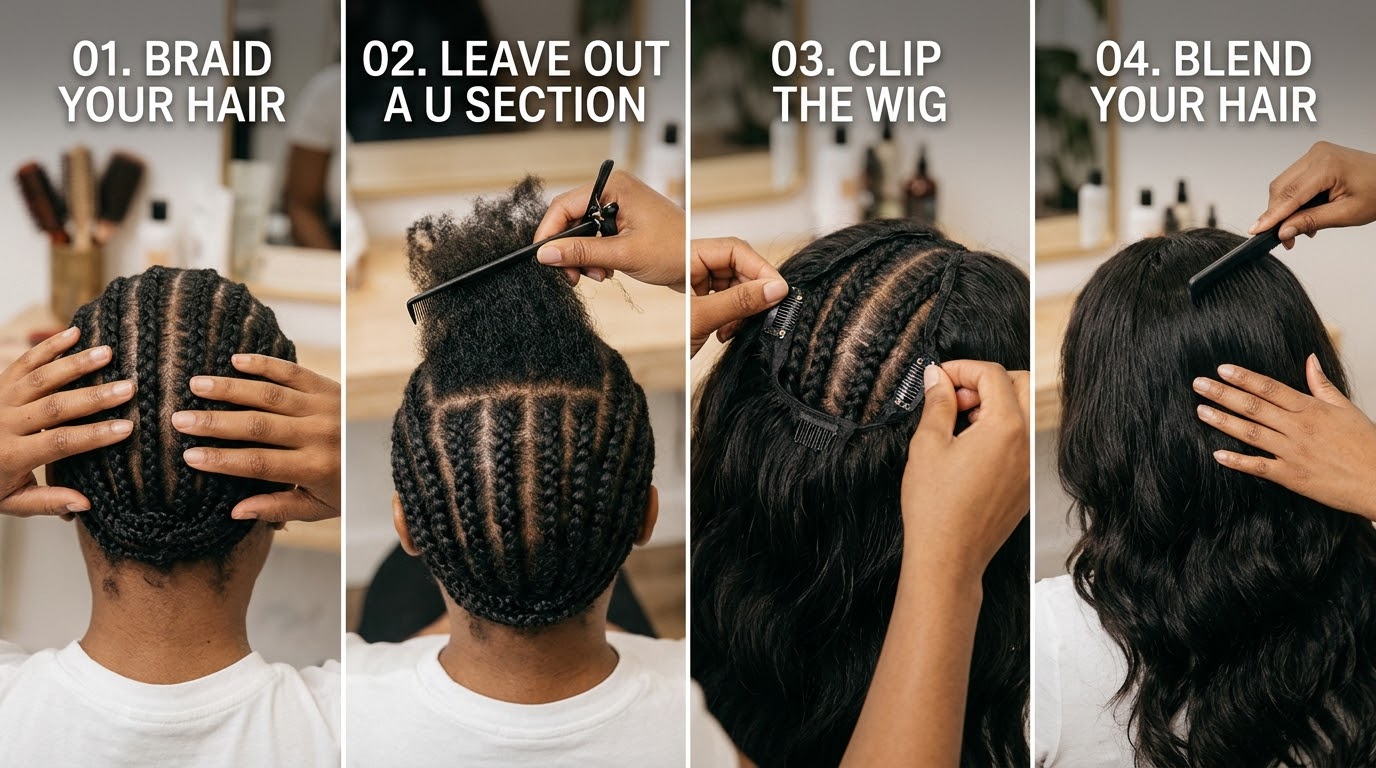
- Opening dimensions in inches, from the listing text, not the photos. No stated size, no purchase.
- Texture against your styled leave out, including the texturizing warning on kinky straight units.
- Clip and comb count and placement, because security and tension distribution both live there.
- Density and length measurement method, so the 150 percent and the inches mean what you think they mean.
- The return policy, because blend failure is only visible on your own head, at your own mirror.
Frequently Asked Questions
What is a U part wig?
A wig with a U shaped opening at the top of the cap and no lace anywhere. Your own hair comes through the opening and blends over it, so the part and crown are your real scalp.
The construction is why it looks real, and also why it asks work from your own hair every wear.
How does a U part wig work?
You braid or flat twist your hair down, leaving out a U shaped section. The wig clips into the braided base around the opening, and you style your leave out over its edges.
No lace to cut, no glue to apply, no knots to bleach, because the visible part is your own hair.
What is the difference between a U part and a V part wig?
Opening size, and therefore leave out. The U opening measures about 4 by 2 inches on the standard design; the V’s narrow band needs up to three quarters less leave out, per the brand comparison.
The U gives parting flexibility and the fullest blend. The V installs faster, can be worn with little to no leave out, and protects more of your hair.
How much leave out do I need for a U part wig?
Enough to cover a roughly 4 by 2 inch opening and its edges: a U shaped section a few inches wide at the crown, with hair long and thick enough to lie over the tracks.
Fine or thin hair that cannot cover the opening is the classic failure, which is why guides steer thin hair to the V part.
Can I wear a U part wig with no leave out?
Not as designed: the opening must be covered, and on a U part your hair does that job. Workarounds include bangs cut into the wig or a scarf over the opening.
If no leave out is a firm requirement, the honest answers are a V part worn with little to none, or a glueless lace wig.
How do I install a U part wig?
Braid or flat twist your hair down, leaving out the U section. On some designs, cut the band across the cap first. Set the wig over the base, close the interior clips and combs around the opening, and adjust the strap.
Blend last: lay the leave out over the edges and style both hair sources together. Most wearers take minutes once the base is built.
Do U part wigs need glue or lace?
No, and that is the product’s reason to exist. Security comes from interior clips and combs, an adjustable strap, and on newer models a drawstring.
There is no lace panel at all, which removes lace cutting, tinting, and adhesive from your routine and from your edges. The trade: your leave out creates the part and hairline effect instead.
Can I sew down a U part wig?
Yes. Stitching the perimeter to your braided base turns a daily clip in unit into a multi week install, and buyers describe doing exactly this in shop reviews.
It trades nightly removal for sew in longevity while keeping the leave out and scalp access. Use a curved needle and loose tension.
Will a U part wig damage my hair?
The wig is gentle; the routine around it is where damage lives: daily heat on the leave out, clip tension on the same anchor points, and a leave out left dry while the hair underneath is cared for.
Repeated tension can lead to traction alopecia, per dermatology guidance. Rotate clip positions, use heat protectant, and moisturize the leave out.
Is a U part wig good for thin or fine hair?
It is the hardest fit in the category. The U opening needs a leave out section dense enough to cover tracks and edges, and thinning crowns often cannot spare it.
Comparison guides steer thin hair to the V part, whose opening is a fraction of the size. A U can still work on fine hair that is full at the crown.
Which texture should I choose for blending?
The one that matches your leave out after styling. Kinky straight and yaki straight mimic pressed or relaxed textured hair, so the leave out needs less heat to match.
Silky straight wigs demand a silky leave out and more flat iron passes. Curly units blend best with leave outs worn in their natural pattern.
Can I do a middle part and a side part with the same U part wig?
Yes, and it is the U’s structural advantage over the V. The wider opening lets you shift where your leave out parts, so a middle part today and a side part tomorrow come from the same unit.
The V’s narrow band fixes the part much closer to where it sits.
How much does a U part wig human hair cost?
Mainstream lines cluster between about 75 and 200 dollars. On the leading brand’s own shop, its kinky straight line at 150 percent density lists from 89 dollars at 16 inches to 156 at 24 inches.
Marketplace listings run about 109 dollars at 18 inches, social commerce starts near 75, and community posts show a beauty supply tier near 50 dollars.
Why is a U part wig cheaper than a lace front wig?
The expensive parts are missing: no lace panel, no hand knotting along a hairline, no HD film, and a machine made cap instead.
You pay for human hair on a wefted cap, and your own hair does the hairline work a lace front is paid to fake. The gap is construction, not necessarily hair quality.
How long does a U part wig last?
The hair follows normal human hair rules: a quality unit serves a year or more of regular wear with sulfate free washing and sane heat use.
The U specific wear points are mechanical: clips loosen, combs bend, and opening edges take daily handling. Check the hardware monthly and the wig will usually outlast your expectations.
Can I put a U part wig in a ponytail?
A low or mid ponytail, usually yes, gathering wig hair and leave out together. A high sleek ponytail exposes the wefted back and sides, where there is no lace, and reads as a wig at the edges.
High updos belong to 360 and full lace constructions. Within this family, sleek ponytails are the V part’s cited styling strength.
Can I sleep in a U part wig?
If it is clipped in, take it off: that is the design’s advantage, and sleeping in clips adds tension hours to the same anchor points.
If yours is sewn down, treat it like a sew in: wrap or braid the hair, use a satin surface, and keep the leave out moisturized, because it sleeps exposed.
Can I swim in a U part wig?
Technically yes, practically it is a rough day for both hair sources. Chlorine and salt tangle human hair and dry your leave out, and a clipped unit is not secured for diving or strong surf.
Most wearers use an older unit on water days. If you swim in it, rinse before and after and wash both the wig and your leave out the same day.
How do I blend my leave out so the wig looks natural?
Match three things: texture, shine, and direction. Texture comes from choosing the right wig first and heat styling the leave out last, as little as possible.
Shine shows the seam in photos when one source is dry and the other glossy. Direction is the lay: your leave out falls over the opening’s edges the same way the wig hair falls.
What foundation should I braid under a U part wig?
Flat and low. Straight back cornrows are the standard; flat twists are the gentler alternative for tangle prone hair.
Keep braids out of the U zone itself, and keep bulk minimal where clips anchor, because bulk under a clip is a comfort and security problem. Part the braids so you can reach your scalp with a nozzle bottle between installs.
Can I moisturize my own hair while wearing a U part wig?
Yes, and it is the category’s genuine advantage over full wigs and closed sew ins. The opening and the unbraided leave out give direct scalp access.
Buyers cite doing their full natural hair routine underneath as the reason they chose the design. With a clipped unit removed nightly, wash day access is total.
Is a U part wig a protective style?
Mostly, with an asterisk shaped like your leave out. The braided hair underneath is protected from styling, weather, and manipulation, and the wig takes the friction instead.
The leave out does the opposite of resting: it is styled, heated, and exposed daily. Treat it as the maintenance priority and rotate to low leave out styles so it recovers.
U part wig vs sew in: which is better?
They share a foundation and a leave out; they differ in commitment. A sew in installs for weeks and holds through everything, at salon cost or serious DIY skill.
A U part clips on in minutes, comes off at night, and costs a fraction as much. The middle path exists too: sew the U part down and remove it on your own schedule.
U part wig vs half wig: what is the difference?
Where the opening sits. A half wig covers the back and sides and stops behind your front hairline, so your front hair frames the look.
A U part covers the full perimeter and opens only at the top, so your hair shows at the part and crown. Half wigs are faster; U parts give a realistic part and more styling range.
U part wig vs lace front: which looks more natural?
At the part, the U part wins by definition: the scalp showing is yours. At the hairline, the lace front wins, because the U’s hairline depends on your leave out blending over the cap.
Lace fronts free you from matching entirely. U parts free you from lace skills, glue, and lace prices. Natural is situational.
Can I dye or bleach a U part human hair wig?
Yes, human hair takes color, with the usual hierarchy: virgin natural black units color most predictably, and texturized kinky straight hair lightens less evenly because it was already processed for its texture.
The blending twist: dyeing the wig can break your color match with your leave out, so plan both colors together.
How do I choose the right color?
Match your leave out in daylight, at the ends rather than the roots if your hair is multi tonal. Most buyers land in natural black, an off black brown that flatters most hair.
Between shades, a wig slightly darker than the leave out usually blends better, because the leave out lies on top and reads as the highlight layer.
Can I wear a U part wig if my hair is relaxed?
Yes, relaxed hair is one of the classic leave out types for this design, and yaki straight textures were made to mimic it.
The caution is fragility: chemically processed hair taking daily heat is the most delicate version of the bargain. Moderate temperatures, protectant every time, and protein and moisture attention between installs.
Can I wear a U part wig while transitioning to natural hair?
It is one of the most popular uses. The wig carries length and style while new growth comes in protected underneath, with no big chop deadline.
The blend challenge is two textures in one leave out: relaxed ends and natural roots. A silk press or a kinky straight unit’s forgiveness handles it; many transitioners move to the V’s smaller leave out as growth progresses.
What density and length should a beginner start with?
150 percent density is the category default and a sensible start: full without costume weight. For length, 16 to 20 inches is the manageable band.
Longer units tangle more and make the blend line harder to keep invisible. Start with the texture closest to your hair’s styled state and every other variable gets easier.
How do I stop my U part wig from slipping?
Work the security stack in order: braids flat and dry underneath, every clip and comb engaged, strap or drawstring snug rather than tight.
If slipping persists, sew two anchor points at the sides or move to a perimeter sew down. Slipping is almost always base or clip discipline, not a defective wig.
Does a U part wig need a wig cap?
Not in the lace wig sense: there is no lace to protect and your own hair is the top layer. Most wearers braid directly and clip over the braids.
A thin stocking cap is optional for keeping braids neat, and current glueless models are marketed as needing none. Skip anything bulky; bulk is the enemy of a flat blend.
How often should I wash a U part wig?
On the parent category’s rhythm: every 10 to 15 wears or when build up shows, in lukewarm water with sulfate free shampoo, conditioned and air dried.
Your leave out runs on your own hair’s wash schedule, usually more frequent, and since the unit comes off, the two routines stay separate. Wash the wig before the first wear too.
Can I exercise in a U part wig?
Yes, it is one of the design’s strengths: no glue to sweat loose and your scalp breathes through the opening. Clip security holds through normal training for most wearers.
Sweat leaves salt at the blend line, so rinse the leave out after hard sessions. High impact and contact sports argue for a sewn down perimeter or a different unit that day.
What is an upgrade U part wig?
Marketing language for the current generation: drawstring backs instead of plain straps, more and better placed clips, and openings refined toward the V shape’s smaller footprint.
Leading brands sell kinky straight lines as exactly this, an upgrade U that behaves like a V, which tells you the two designs are converging. Judge upgrades by the listed mechanics, not the word.
Are U part wigs going out of style because of V part wigs?
The V is clearly the growth design: narrower opening, a no leave out option, and faster installs lead the brands’ newest lines.
But the U keeps two advantages no V has matched: true parting flexibility and the fullest blend for wearers with abundant hair. Expect it to settle into that niche rather than disappear.
How do I make a U part wig from bundles or convert a wig?
The DIY route is established: sew bundles onto a dome or spandex cap, leaving a U shaped section unsewn at the top, then add clips inside the opening’s edges.
A lace wig can be converted by cutting a U into its top, which sacrifices the lace permanently. Measure the opening against your own part and leave out before any cutting.
What should I check before buying a U part wig?
Five checks: the opening dimensions in inches from the listing text, the texture against your styled leave out, the clip and comb count and placement, the density and how length is measured, and the return policy.
Blend failure is only visible on your head. A listing that cannot state its opening size was written for search engines, not for you.
Can older women wear U part wigs?
Yes, with the same conditions as anyone: enough crown hair to cover the opening and a texture that matches.
Where crown thinning is the concern, a smaller opening design or a topper style piece may serve better than forcing a U. Many older wearers value the category for no glue near fragile edges and full scalp care access.
Do U part wigs work on Caucasian or fine straight hair?
They work when the leave out can cover and match. Silky straight units match fine straight textures natively, which sometimes makes the marriage easier than expected.
The constraints are coverage, since fine hair over a 4 by 2 opening can show tracks, and clip grip on slippery hair, which a braided or twisted base solves.
Can I wear a U part wig every day?
Yes, daily wear is the design’s home ground, and reviewers report 12 hour shifts without a single adjustment. Done well, it has three habits.
Rotate the clip anchor points so the same hairs do not carry tension daily, keep the leave out moisturized and heat protected, and wash the wig and your own hair on their own schedules.
How do I store and maintain a U part wig between wears?
Detangle it, make sure it is fully dry, and store it on a stand or in its bag away from sun, like any human hair wig.
The U specific habit is clip care: close the clips for storage so they do not snag the hair, and check combs monthly for bends. Security lives in those small parts, and so does the wig’s useful life.
Conclusion
A u part wig human hair purchase is a bargain in the literal sense: your hair does the work that lace, glue, and salon hours do in other designs, and the price and realism both follow from that.
Run the coverage test, marry the texture to your styled leave out, and keep the health protocol non negotiable: rotate the clips, protect the leave out from heat, and use the scalp access the design gives you.
Do those three things and the trade pays out every single wear, in a part nobody can clock and a routine your own hair survives.
Start with the mirror test today; it costs nothing and answers the only question that decides this purchase. More wig guides and styling pieces wait in the Hair Wig category at ModernHaistyle.

Dilawar is a passionate writer and contributor at Modern Hairstyle (modernhaistyle.com), specializing in hairstyles, hair care, grooming, fashion, beauty, and lifestyle trends. He enjoys sharing practical tips, hairstyle inspiration, and easy-to-follow guides to help readers discover their personal style. His goal is to provide informative, engaging, and helpful content that keeps readers updated with the latest trends.