
Mens wedding outfits start with the groom, not with a guest list or a rental catalog. Formality, venue, season, and partner outfit shape the groom outfit first, then the party follows. That order keeps photos intentional and prevents a groom from blending into his own party.
Mens wedding outfits work when groomsmen coordinate without copying the groom exactly. Same suit color, same tie family, and same shoe formality create unity, while one clear groom difference creates identity. A stranger should spot the groom in a group photo without asking.
Mens wedding outfits also need budget fairness and a real timeline, because five or six men with different sizes, budgets, and cities cannot improvise. One base style, one rental shop or retailer, one deadline, and one group message prevent most party outfit failures. Early decisions protect friendships as much as photos.
Mens wedding outfits reward fit over trend, because a tailored navy suit photographs better than a loud velvet jacket that pulls at the shoulders. Color, texture, and accessories add personality only after shoulders, waist, trouser break, and shoe comfort are correct. A groom who moves easily looks confident all day.
Mens wedding outfits should balance personal style with partner harmony, because two outfits appear together in ceremony, portraits, and reception photos. Formality levels should agree, colors should complement rather than match exactly, and textures should sit in the same world. Couples who shop or plan together avoid most outfit clashes.
Groom First, Party Second, Guests Third
Formality and Venue Decide First
Formality is the first groom decision, because black tie, formal, semi formal, cocktail, and casual each demand a different suit or tuxedo. A black tie evening wedding calls for a tuxedo, while a daytime garden wedding calls for a suit. Venue alone never overrides a stated formality, but it refines fabric and shoes.
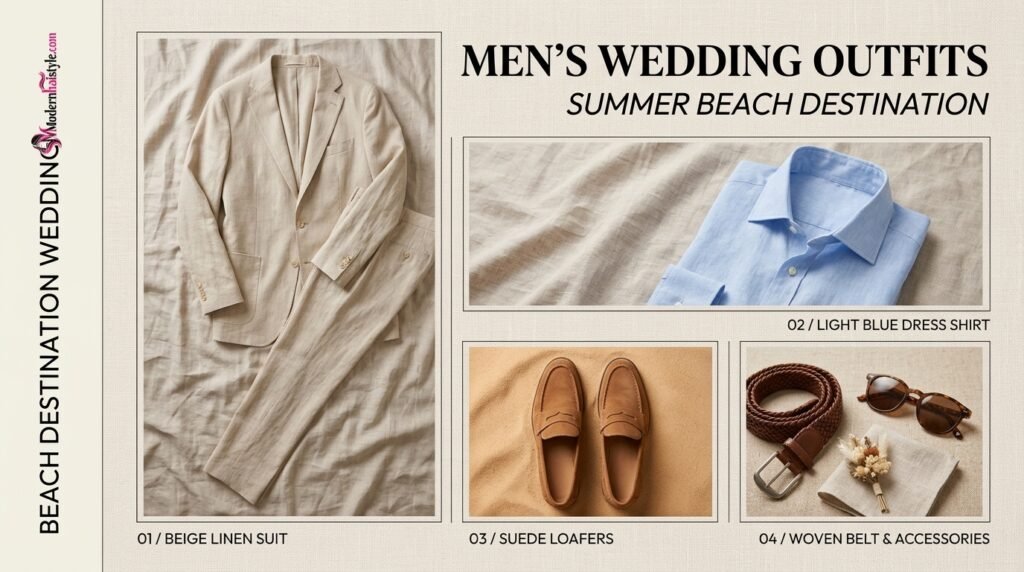
Venue changes fabric, color, and shoes after formality is set, with ballrooms favoring structure and dark colors. Barns favor texture and sturdy shoes, beaches favor linen and loafers, and churches favor modest, structured outfits. A groom outfit that ignores venue surface or temperature will struggle by midday.
Season changes fabric weight and color, with summer favoring linen, cotton, and tropical wool. Winter favors wool, flannel, and tweed, while spring and fall favor midweight wool and richer seasonal tones. Perfect Tux fall content highlights navy, emerald, and brown for autumn, as retailer trend claims rather than measured data.
Partner outfit harmony means checking formality, color family, and texture together, not choosing a groom outfit in isolation. A formal gown pairs poorly with a casual linen suit, while a relaxed dress pairs poorly with a stiff black tuxedo. Couples should agree on formality level before finalizing either outfit.
The Stranger Test for Groom Identity
The stranger test comes from Tip Top Canada groomsmen content, which asks whether a stranger can spot the groom in a lineup. If the groom blends in completely, adjust one element rather than rebuilding every outfit. That test keeps party unity while protecting groom identity in every photo.
One clear difference works best, because multiple differences can make the groom look like a separate event. A three piece suit against two piece groomsmen suits, a different shade, or a distinctive tie creates identity cleanly. Two or three differences together can look disconnected and noisy.
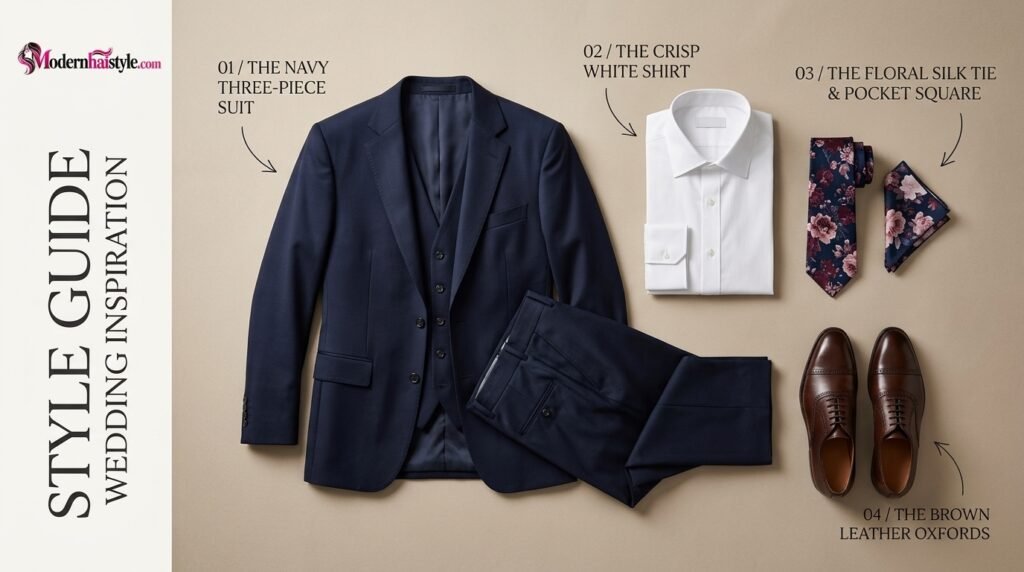
Subtle differences include waistcoat style, lapel style, fabric texture, pocket square, and boutonniere design. A groom in a navy three piece suit with a textured tie stands apart from groomsmen in navy two piece suits with solid ties. Subtlety matters, because wedding photos reward clarity over spectacle.
Photo checks should happen at a fitting, with the full party lined up in similar light to wedding photos. Check front, side, and seated views, because waistcoats and jackets behave differently when seated. A groom difference that disappears when jackets come off needs a shirt, tie, or boutonniere backup.
Partner, Palette, and Theme
Wedding palette should guide groom and groomsmen colors, with suit color chosen first and accent colors added through ties, pocket squares, and boutonnieres. Navy suits accept burgundy, blush, gold, and sage accents, while charcoal suits accept similar families with cooler tones. Palette coordination beats exact fabric matching across suits, dresses, and flowers.
Bridesmaid coordination works by color family, not by identical fabric, because dress fabric and suit fabric rarely match exactly. Men’s Wearhouse groomsmen content notes that complementary colors look more natural than exact matches across every fabric. A shared palette gives the party a recognizable connection without forced uniformity.
Theme should influence texture and accessories, with rustic themes favoring tweed and earth tones, and modern themes favoring clean lines and dark neutrals. Themed weddings still need formality agreement, because a theme does not replace a dress code. Ask the couple or planner when theme and formality seem to conflict.
Groom Suit Versus Tuxedo
The Decision Question
Suit or tuxedo is the central groom question, and dress code plus time of day answer it most reliably. MrGuild UK content frames the rule simply: a suit for daytime weddings and a tuxedo for evening weddings or black tie invitations. That UK retailer rule still works as a starting point for US weddings, with venue formality as the final check.
Tuxedo details include satin or grosgrain lapels, satin covered buttons, and patent leather shoes, according to Dimitra Designs retailer content. Those details separate a tuxedo from a dark suit at a glance, especially in evening light. A dark suit with satin lapels is not automatically a tuxedo, because shirt, trousers, and accessories also matter.
Suit versatility makes suits the better choice for daytime, semi formal, and casual weddings, because suits can be reused for work and other events. Navy and charcoal suits serve weddings, dinners, and professional settings after the wedding day. Tuxedos serve formal events only, so purchase frequency should guide the buy versus rent choice.
Evening suit option exists for grooms who dislike tuxedos but face an evening formal wedding, with a very dark, structured suit and tie as the fallback. Men’s Wearhouse wedding content frames dark navy and charcoal suits as formal alternatives to tuxedos at black tie optional events. That fallback works only when the invitation allows it, not at strict black tie weddings.
Lapels, Buttons, and Silhouettes
Peak lapels add presence and formality, making them a strong choice for groom tuxedos and formal suits. Peak lapels suit broad shoulders and taller frames well, while narrow peak lapels suit slimmer frames better. Lapel width should match tie width roughly, because mismatched widths break proportion.
Notch lapels suit most suits and many tuxedos, with a versatile, classic look that photographs cleanly. Notch lapels work for daytime, semi formal, and cocktail weddings without drawing attention to themselves. Grooms who want a timeless look should default to notch lapels unless a formal tuxedo calls for peak or shawl.
Shawl lapels suit tuxedos and velvet dinner jackets, with a smooth, rounded line that reads elegant after dark. Shawl lapels pair well with bow ties and minimal accessories, because the lapel itself carries visual interest. Shawl lapels on a daytime suit can look overdressed, so reserve them for evening events.
Single breasted versus double breasted is a silhouette choice, with single breasted suits suiting most grooms and venues. Double breasted suits add structure and presence, especially for taller or broader grooms, and they suit formal and vintage inspired weddings. Double breasted jackets need precise fit, because button pull shows quickly.
Three Piece Suits and Waistcoats
Three piece suits add structure, formality, and a polished look when jackets come off at the reception. Men’s Wearhouse groomsmen content notes that a vest helps an outfit look considered when jackets come off, which matters during dancing and dinner. A waistcoat should fit close without pulling, and it should cover the shirt fully when the jacket opens.
U-shaped vests feel modern and intentional when jackets come off, according to Perfect Tux trend content, because they frame shirt studs and bow ties. Low cut waistcoats suit tuxedos and formal suits, while higher waistcoats suit traditional three piece looks. Test waistcoat fit seated and standing, because reception seating changes how vests sit.
Groom three piece versus groomsmen two piece is one of the cleanest groom differences, because it is visible in photos without changing color. Groomsmen in two piece suits with matching ties look unified, while the groom in a three piece suit stands apart naturally. That difference survives jacket removal, unlike a tie difference alone.
Waistcoat color should stay within the wedding palette, with matching waistcoats for classic looks and contrasting waistcoats for modern looks. A contrasting waistcoat in burgundy, gold, or patterned fabric can add personality, but it should not clash with bridesmaid colors or flowers. Check waistcoat color in photos, because flash can shift tones.
Velvet, Color, and Bold Groom Choices
Velvet dinner jackets add depth and luxury for evening receptions, according to Perfect Tux trend content, with black velvet as the safest choice. Emerald, burgundy, and navy velvet jackets suit festive winter weddings, but they need simple shirts and accessories. Velvet photographs richly under chandeliers, yet it can look heavy in daylight.
Colored groom suits include midnight blue, burgundy, emerald, brown, and charcoal, with navy remaining the safest versatile choice. Wedgewood Weddings venue content highlights burgundy and emerald groomsmen trends, plus pastel sage pairings, as trend ideas rather than rules. Color should complement the wedding palette, not compete with the partner outfit or bridesmaid colors.
Tone on tone patterns like jacquard and micro paisley add texture that photographs well without loud contrast, according to Perfect Tux content. Black on black patterns suit fashion forward grooms who want interest without color risk. Bold floral and paisley patterns need simple shirts and accessories, or the outfit becomes noisy.
Ivory and off white groom jackets appear in inspiration lists, but they carry high risk for guests and grooms alike. An ivory jacket can clash with partner white, photograph unpredictably, and stain easily during a long day. Grooms considering ivory should test the jacket with the partner outfit in wedding light before committing.
Groom Colors and Palette Coordination
Palette, Not Exact Match
Palette coordination means choosing a color family for the whole party, then letting suits, dresses, ties, and flowers live inside it. Exact matching across different fabrics usually fails, because dye, texture, and light change colors. Men’s Wearhouse groomsmen content supports complementary colors over exact matches for that reason.
Suit color first sets the palette anchor, with navy, charcoal, and black as the most flexible anchors. Tan, light gray, and muted green anchors suit relaxed and daytime weddings, but they limit tie and flower choices more. Choose the anchor before choosing accent colors, because accents depend on the anchor.
Accent colors include tie, pocket square, boutonniere, and shoe tones, with one accent dominating and others supporting. Burgundy accents suit navy suits, gold accents suit emerald and navy suits, and sage accents suit tan and gray suits. Too many accents create a rainbow party rather than a coordinated party.
Photo color checks should happen in natural and indoor light, because flash, sunlight, and ballroom light shift colors differently. Navy can read black indoors, burgundy can read brown outdoors, and pastel can wash out in bright sun. Photograph the full party together before the wedding when possible.
Bridesmaid and Flower Coordination
Bridesmaid colors should sit in the same palette family as groom and groomsmen accents, without forcing identical shades. A burgundy bridesmaid palette pairs with navy suits and burgundy ties, while a sage palette pairs with tan or gray suits and sage accents. Palette families create harmony without uniform fabric.
Boutonniere coordination should complement bridal flowers and bridesmaid bouquets, with groom boutonnieres slightly distinct from groomsmen boutonnieres. Groom boutonnieres can be larger, more detailed, or a different flower within the same palette. Pin placement and stem length matter in close photos, so test boutonnieres at a fitting.
Flower color clash happens when suit accents, bridesmaid dresses, and flowers each pull in different color directions. A red tie, pink bridesmaids, and orange flowers can clash even when each color looks good alone. Limit the palette to three main colors plus neutrals for the whole party.
Clash Examples to Avoid
Navy suit with neon tie clashes with most wedding palettes, because neon reads as party novelty rather than wedding formality. Neon ties suit themed parties with explicit couple permission, not classic weddings. A groom who wants color should choose jewel tones over neon tones.
Black suit with bright white sneakers clashes in formality, because shoes set the outfit level as much as jackets do. Formal suits need polished leather shoes, while casual suits can accept loafers. Sneakers suit only explicitly casual weddings with couple permission.
Pattern overload happens when suit pattern, shirt pattern, tie pattern, and pocket square pattern all compete. One pattern should lead, with others solid or subtly textured. Pattern overload photographs as noise, especially in group photos where many patterns multiply.
Groomsmen Coordination System
One Base Style for Everyone
One base style means one suit or tuxedo color, one jacket style family, and one trouser style for the whole party. Lakeside Bridal rental content stresses one base style early, with jackets and pants consistent across the group. Personality should come through accessories, not through mismatched suits.
Same suit color is the strongest unity signal, because color differences show immediately in group photos. Related shades can work when the palette is intentional, but random shades look accidental. Men’s Wearhouse groomsmen content allows related gray shades when shirt color and tie family stay consistent.
Same tie family means ties in the same color family and formality, even when patterns differ slightly. A solid tie family with small pattern variation suits modern parties, while identical ties suit classic parties. Tie width should stay consistent across the party for photo harmony.
Same shoe formality means all groomsmen wear polished leather shoes of similar formality, even when sizes and fits differ. Tip Top Canada groomsmen content lists same shoe style and color as a coordination rule, because shoe mismatch shows in full length photos. Shoe comfort still matters, so allow different brands within the same formality.
Allowed Variations by Fit
Different jacket fits are necessary and welcome, because groomsmen have different builds, heights, and comfort needs. Men’s Wearhouse groomsmen content explicitly allows the same fabric color with a choice of jacket fits for varied builds. Slim, regular, and big and tall fits can share one color without looking disconnected.
Different trouser cuts can also vary by build, with tapered, straight, and relaxed cuts in the same color family. Trouser length must still be set by shoe height, because hem differences show in photos. A tailor or rental fitter should check each groomsman individually, not by group size alone.
Different shirt fits matter for neck, chest, and sleeve length, especially for groomsmen who wear ties or bow ties. Collar fit should close without gaping, while sleeve length should show cuff correctly. Shirt fit variations are invisible when jackets are on, but they matter when jackets come off.
Forbidden variations include different suit colors without a palette plan, different formality levels, and different shoe types like sneakers mixed with oxfords. Those variations break unity and make the party look like separate events. If a groomsman needs a different color for skin tone or availability, adjust the whole palette plan, not one outfit.
Tie, Shoe, and Accessory Rules for the Party
Tie versus bow tie should be decided once for the party, with tuxedos favoring bow ties and suits favoring neckties in most cases. Mixing bow ties and neckties across groomsmen can work only when the groom difference is intentional and the palette stays consistent. Random tie type mixing looks accidental in photos.
Pocket square rules should be simple for the party, with one fold and one color family for groomsmen, and a distinct fold or color for the groom. White linen pocket squares suit formal parties, while colored silk squares suit cocktail and modern parties. Identical pocket squares for groomsmen create unity without forcing identical suits.
Boutonniere rules should give groomsmen matching boutonnieres and the groom a distinct boutonniere within the same palette. Boutonniere size, flower type, and pin placement should be tested at a fitting, because large boutonnieres can pull lapels. Spare boutonnieres and pins belong in the day of kit.
Accessory restraint keeps the party polished, with one watch, one pocket square, and cufflinks when needed as the base. Too many rings, bracelets, and novelty items distract from the groom and the couple. Groomsmen should agree on metal tone, with silver, gold, or black dominating across the party.
| Role | Outfit base | Groom difference | Tie | Shoes |
| Groom | Navy three piece suit or black tuxedo | Three piece, different shade, or distinct tie | Distinct tie or bow tie | Polished oxfords or patent shoes |
| Best man | Same color two piece suit or tuxedo | Optional distinct boutonniere, no groom confusion | Same tie family as groomsmen | Same formality as groomsmen |
| Groomsmen | Same color two piece suit or tuxedo | None, unified group look | Same tie family, identical or tonal | Same style and color family |
| Father of groom | Related shade suit, not party suit | Distinct from groom and groomsmen | Own tie within palette | Polished dress shoes |
| Father of bride | Related shade suit, not party suit | Distinct from groom and groomsmen | Own tie within palette | Polished dress shoes |
| Guests | Guest dress code, one step below party | Never copy groom exactly | Guest code tie rules | Guest code shoe rules |
Best Man, Fathers, and Ring Bearer
Best Man Distinction Without Confusion
Best man distinction should be subtle, because the best man supports the groom without competing for photo focus. A distinct boutonniere, a slightly different tie texture, or a pocket square variation can mark the role. A completely different suit color can confuse guests about who the groom is.
Best man duties include holding rings, helping with outfit checks, and managing the day of kit, so his outfit must allow movement and pockets. A best man who cannot move, sit, or dance comfortably cannot help the groom effectively. Fit and shoe comfort matter more for the best man than for other groomsmen.
Best man speech and photos require an outfit that looks polished seated, standing, and in close portraits. Waistcoat fit, collar fit, and tie length show in speech photos, so test those details before the wedding. A best man who looks polished in every view supports the groom visually.
Fathers Coordination Without Copying
Fathers of the couple should wear related shade suits that sit in the wedding palette without matching the groom or groomsmen exactly. A father in charcoal with groomsmen in navy looks intentional, while a father in the exact groomsmen suit can confuse role identity. Fathers deserve distinct, dignified outfits that photograph as family, not party members.
Father fit and comfort matter for long days, with structured suits, comfortable shoes, and layers for venue temperature changes. Older fathers may need extra shoe comfort, lighter fabrics, and simpler accessories. A father outfit that prioritizes comfort still photographs well when fit is correct.
Father accessories can include a distinct tie, pocket square, and boutonniere within the palette, without copying groom details. A father boutonniere can be smaller or simpler than the groom boutonniere, marking family role clearly. Metal tone should match the party for photo harmony.
Ring Bearer Sizing Note
Ring bearer outfits need separate children sizing, comfort, and safety rules, and they should not be treated as small adult groomsmen outfits. Children grow quickly, so order closer to the wedding date and allow for growth adjustments. Comfort, movement, and bathroom access matter more than exact adult suit replication.
Ring bearer coordination can use a simplified version of the party palette, with a small suit, vest, or smart outfit in a related color. Avoid heavy fabrics, stiff shoes, and complex accessories that restrict movement or cause discomfort. Parents should test the outfit for walking, sitting, and photo time before the wedding.
Fit System for a Group
Jacket Fit Checks for Every Man
Shoulder fit should sit at the natural shoulder edge for every groomsman, regardless of size or build. Extended shoulders look borrowed, while tight shoulders create dents and restrict movement. Rental fitters should check shoulders first, because shoulder fixes are the hardest and most expensive.
Jacket length should cover the seat and reach about mid hand, with variation by style and height. Short men need shorter jackets to lengthen legs visually, while tall men need longer jackets for proportion. Jacket length should be checked with trousers and shoes, not in isolation.
Waist suppression should follow the body without pulling buttons or creating horizontal lines across the front. Slim fits need careful waist checks, while regular fits need enough room for movement and sitting. A jacket that pulls when buttoned needs a size or alteration change before the wedding.
Sleeve length should show about half an inch of shirt cuff, with variation by shirt cuff style and jacket style. Sleeve length errors show in close photos, especially during ring exchange and hand holding. Check sleeve length with the actual shirt and cufflinks, not with a different shirt.
Trouser, Shirt, and Shoe Fit
Trouser waist should sit comfortably without a belt holding the outfit together, because belts finish outfits rather than support them. Waist gaps when seated or pinches when standing need alteration before the wedding. Bring the intended belt and shoes to every fitting.
Trouser break should be slight for most wedding suits, with no pooling fabric and no floating hem. Break should be checked standing, walking, and sitting, because wedding days include all three. Hem length must use the actual wedding shoe height, not a similar shoe.
Shirt collar should close with a tie without gaping, because collar gap undermines the whole neckline in photos. Neck size, collar style, and tie knot all affect collar fit, so test them together. A collar that pulls open needs a larger neck size or a different collar style.
Shoe fit should allow toes to move without heel slip, because the party stands, walks, and dances for hours. MrGuild UK content warns that standing six hours in stiff new leather ruins a good day, a point that applies to US parties as well. Break in shoes over several short wears before the wedding.
Fit by Body Type and Height
Short groomsmen benefit from higher trouser rises, shorter jacket lengths, and tapered legs that lengthen the leg line. Monochrome dark outfits and vertical textures can add perceived height without tricks. Avoid very wide trousers, long jackets, and heavy patterns that overwhelm a smaller frame.
Tall groomsmen benefit from balanced jacket length, mid rise trousers, and patterns that break up height without shortening legs. Three button jackets and textured fabrics can add proportion, while very short jackets can look undersized. Sleeve length needs careful checks for tall sizes.
Slim groomsmen benefit from slim, not skinny, fits that follow the body without pulling or clinging. Structured shoulders and light padding can add balance, while very soft jackets can look shapeless. Avoid oversized jackets that hide frame and create excess fabric.
Broad and big and tall groomsmen benefit from structured jackets, wider lapels in proportion, and trousers with room through thigh and seat. Dark colors and vertical textures help, but fit matters more than color alone. A good tailor can adjust waist, seat, and sleeve length for comfort and polish.
| Body type | Jacket guidance | Trouser guidance | Pattern guidance |
| Short | Shorter jacket, higher rise | Tapered, slight break | Vertical, subtle, monochrome |
| Tall | Balanced length, mid rise | Straight, slight break | Textured, balanced, not oversized |
| Slim | Slim, structured shoulder | Slim, not skinny, tapered | Subtle, small scale, solid base |
| Broad, big and tall | Structured, proportional lapel | Room through thigh and seat | Vertical, dark, subtle texture |
Season and Venue Playbook for the Party
Summer and Beach Party
Summer party outfits need breathable fabric, light colors, and a heat plan for the whole group, not only the groom. Linen, cotton, and tropical wool suits handle heat better than heavy wool or flannel. A spare shirt for the groom and groomsmen can refresh the party between ceremony and reception.
Beach party outfits add sand, wind, and sun to summer rules, with linen suits and loafers as the practical base. Wind can lift jackets and ties, so unstructured blazers and secure pocket squares help. Sunglasses suit outdoor ceremonies, but remove them for indoor photos and evening events.
Summer color favors light gray, tan, stone, pastel blue, and sage for relaxed weddings, with navy still working for formal summer weddings. Evening summer weddings can darken to navy or charcoal, even when the day is hot. Avoid all white party outfits, because white remains reserved for the couple in most traditions.
Spring and Garden Party
Spring party outfits favor light gray suits, pastel shirts, and floral or subtle patterned ties, with garden venues as a common setting. Midweight wool and linen blends handle cool mornings and warm afternoons better than single season fabrics. A light blazer layer helps when ceremonies start outdoors and receptions move inside.
Garden party shoes need wider soles or loafers for grass, because narrow dress shoes can sink and stain. Brown loafers suit many garden looks, while black oxfords suit more formal garden weddings. Check venue paths, because gravel, lawn, and stone each favor different soles.
Spring patterns can include small florals, micro checks, and pastel ties, but scale should stay subtle for the party. A floral tie with a solid shirt suits garden weddings, while a floral suit can outshine the couple. Keep one pattern focal point per man and let the rest stay quiet.
Fall and Barn Party
Fall party outfits favor wool, tweed, flannel, and richer colors like burgundy, olive, and charcoal, with texture as a key feature. Tweed blazers, wool suits, and leather boots suit barn venues without losing polish. Layering with a waistcoat adds warmth for outdoor ceremonies and cool evenings.
Barn party venues add dust, gravel, and uneven floors, so sturdy leather shoes and darker trousers handle conditions better than delicate fabrics. A full tuxedo usually feels overdressed at a barn wedding, while a textured suit or blazer outfit feels intentional. Check heating, because barns can swing from warm to cold quickly.
Fall color should stay rich but not loud, with burgundy ties, olive accents, and charcoal suits as safe combinations. Bright orange or neon accents can clash with fall decor and wedding party colors. Earth tones suit fall photos, especially in outdoor and barn settings.
Winter and Ballroom Party
Winter party outfits favor wool and flannel suits in dark tones, with overcoats, scarves, and gloves for travel. Layering starts with a moisture wicking undershirt, then dress shirt, tie, suit, waistcoat, and topcoat for cold weather. Remove outerwear indoors to reveal the full outfit and avoid overheating.
Ballroom party outfits favor structured suits, polished shoes, and evening formality, with dark colors and silk ties. Dance floors reward broken in leather soles and comfortable fit, because the party spends hours standing and moving. Avoid heavy boots indoors, because they can look casual under ballroom light.
Winter accessories include leather gloves and neutral scarves outdoors, but remove them indoors for photos and dining. A dark overcoat in black, navy, or gray suits most winter weddings, while bright outerwear can clash with formal dress. Check coat check availability before choosing a bulky coat.
Budget Fairness and Who Pays
Who Pays Options, Agreed Early
Who pays is a budget fairness question, not a style question, and it should be agreed early in writing for the whole party. Options include couple pays all, groomsmen pay own suits, couple pays shared accessories, or a split by item. No single US rule controls this choice, unlike the UK custom noted by MrGuild, where groomsmen usually pay own suits and couples cover shared accessories.
UK custom warning matters, because MrGuild UK content describes British practice, not US practice, and copying it blindly can create unfair expectations. US couples and groomsmen should agree payment explicitly when asking groomsmen, not after colors are chosen. A clear agreement protects friendships and prevents resentment.
Shared accessories often include ties, pocket squares, and boutonnieres, because shared items create unity without forcing every man to buy a new suit. Couples who pay shared accessories reduce groomsmen cost while keeping photo coordination. Shared items should be ordered together to avoid shade mismatch.
Budget comfort should be set by the least comfortable groomsman, not by the groom or the most affluent groomsman. A suit that is affordable for one man can be a burden for another, especially with travel, shoes, and alterations added. Choose a base that everyone can afford comfortably, or offer rental and secondhand options.
Rent Versus Buy by Person
Renting suits groomsmen who attend one wedding, live out of town, or dislike suit ownership, because rental avoids storage and cleaning costs. Rental packages vary in included shoes, shirts, ties, and accessories, so compare full package contents, not headline rental fees. Rental deadlines matter, because sizes and styles can sell out during wedding season.
Buying suits groomsmen who want a reusable suit for work, dinners, and future weddings, because a navy or charcoal suit serves many events. Buying costs more upfront, but cost per wear drops with reuse. Groomsmen who buy should choose a versatile color, not a wedding specific color they will never wear again.
Mixed rent and buy can work when the base color and formality stay consistent, but shade matching becomes critical. A rented navy suit and a purchased navy suit can differ in shade under photos, so test them together before the wedding. One rental shop for all renters plus a shade check for buyers reduces mismatch risk.
Secondhand and borrowed suits can help budget groomsmen, but condition, fit, and shade need careful checks. A borrowed suit that fits poorly looks worse than a cheaper rental that fits well, while a secondhand suit with damage can fail in photos. Budget for cleaning and alterations in every secondhand plan.
Out of Town Fittings
Out of town groomsmen need a clear fitting plan, with one rental shop chain, local tailor measurements, or shipped try on options. Lakeside Bridal rental content stresses one group message with shop info and deadline, which helps out of town groomsmen most. Vague group chat instructions create missed fittings and size errors.
Measurement sharing should include chest, waist, shoulder, sleeve, inseam, shoe size, and neck size, with a local tailor or rental fitter verifying numbers. Self measurements can err, especially for shoulders and sleeve length, so professional measurement is worth the effort. Keep measurement sheets in one file for the whole party.
Final try on should happen at least one week before the wedding for local groomsmen, and on arrival day for out of town groomsmen when possible. Final try on checks shoulders, waist, trouser break, collar, tie length, and shoe fit together. A final try on that skips shoes or accessories misses the most common fit failures.
Timeline and Day Of Kit
Groom Timeline
- Six to twelve months before: Choose formality, venue, season, partner harmony, and groom suit versus tuxedo direction.
- Four to six months before: Choose groom color, fabric, three piece versus two piece, and groomsmen base style.
- Three to four months before: Order or rent groom outfit, set groomsmen deadline, agree who pays in writing.
- Two months before: Collect groomsmen measurements, confirm rental shop, order shared accessories and boutonnieres.
- One month before: First fittings for groom and local groomsmen, alteration notes, shoe break in starts.
- Two weeks before: Final fittings, alteration completion, full outfit photo check with shoes and accessories.
- Wedding week: Steam, polish shoes, pack day of kit, confirm out of town groomsmen arrival fittings.
- Wedding day: Full outfit check, boutonniere pin, tie and collar check, shoe comfort check before ceremony.
Groomsmen Rental Deadline System
Rental deadline should be set eight to twelve weeks before the wedding for peak season, with a hard cutoff that leaves time for size swaps. Rental shops need time to order, alter, and replace sold out sizes, especially for tall, short, and big and tall groomsmen. A deadline that is too late creates panic and compromise.
Group message template should include base style, color, tie family, shoe formality, rental shop, deadline, measurement instructions, and budget notes. One message beats endless group chat opinions, because clear instructions reduce confusion. Update the group once when details change, not with daily style debates.
Size change plan should include a contact, a deadline for size updates, and a backup size option for groomsmen whose weight or build changes. Weight changes, muscle changes, and injury can alter fit quickly, so final fittings matter. A size change plan should be kind and private, not a group discussion.
Day Of Kit Checklist
- Spare shirt for the groom, plus a spare tie or bow tie for the party.
- Boutonniere pins and spare boutonnieres for groom, best man, and groomsmen.
- Shoe cloth and polish for scuffs, plus heel grips and insoles for comfort.
- Sewing kit for buttons, loose threads, and minor hem issues.
- Stain pen for food, drink, and grass marks during photos and reception.
- Blotting paper and water for heat, plus a small towel for outdoor ceremonies.
- Safety pins and fashion tape for waistcoat, shirt, and boutonniere fixes.
- Phone charger and contact list for tailor, rental shop, planner, and photographer.
Grooming, Photos, and Long Day Comfort
Grooming for the Groom and Party
Hair and facial hair should be trimmed and styled a few days before the wedding, not experimented with on the morning. A fresh haircut two to three days before allows natural settling, while a same day cut can look too sharp. Beard oil, trim, and clean necklines finish the look without distraction.
Skin and fragrance should stay clean and subtle, because strong cologne can overwhelm ceremony seating and close photos. Apply fragrance lightly, avoid new skincare products before the wedding, and carry blotting paper for summer heat. Sunscreen matters for outdoor ceremonies, but choose a non greasy formula under dress shirts.
Nail and hand care matters for ring exchange photos, with clean nails and moisturized hands for the groom and best man. Ring photos focus on hands, so rough nails or dry skin show in close shots. A simple manicure or careful home care a few days before helps.
Photo Coordination for the Party
Group photo poses should show groom difference clearly, with the groom centered or slightly forward in key party photos. Photographers can use height, position, and boutonniere details to mark the groom, but outfit difference should do most of the work. Discuss groom difference with the photographer before the wedding day.
Seated photos reveal waistcoat fit, trouser break, and shoe polish differently from standing photos, so test seated looks at a fitting. A waistcoat that pulls when seated or trousers that ride up can distract in dinner and speech photos. Sit, stand, and walk during fittings to test real wedding movement.
Color in photos should be checked in natural, indoor, and flash light, because suit colors shift under different lighting. Navy can read black indoors, burgundy can read brown outdoors, and pastel can wash out in bright sun. A full party photo test before the wedding prevents color surprises.
Long Day Comfort
All day comfort needs breathable shirts, comfortable shoes, and fit that allows sitting, standing, walking, and dancing. A groom who cannot sit comfortably will struggle through dinner and speeches, while groomsmen with sore feet will fade during dancing. Comfort checks should happen at final fittings, not on the wedding day.
Heat and cold comfort needs fabric, layers, and venue plans for the whole party, with spare shirts and overcoats as needed. Outdoor ceremonies in heat need water, shade, and breathable fabric, while cold churches need overcoats for travel. Venue temperature changes between ceremony and reception require layer planning.
Movement comfort includes ring handling, dancing, hugging, and photo poses, all of which test shoulder, waist, and trouser fit. A jacket that restricts arm movement or trousers that pull when bending will show in photos and behavior. Test movement at fittings with real wedding actions, not only standing poses.
Second Weddings, Courthouse, and Elopements
Second Wedding Groom Outfits
Second wedding groom outfits can be simpler and more personal than first wedding outfits, with suits favored over tuxedos in many cases. Formality should match the celebration size and venue, not a rule about second weddings. A navy suit with a distinctive tie or waistcoat suits many second weddings well.
Second wedding party outfits can be smaller and more relaxed, with groomsmen in coordinated suits or blazers rather than full tuxedos. Budget fairness still matters, because smaller parties do not remove cost pressure. A smaller party allows more individual fit attention and better photo coordination.
Courthouse and Elopement Groom Outfits
Courthouse groom outfits favor a well fitted suit or blazer with dress trousers, because courthouse weddings are shorter and more formal in setting than casual. A navy or charcoal suit with a white shirt and tie suits most courthouse ceremonies. Overdressing with a tuxedo can feel out of place in a courthouse, while underdressing with jeans fails the occasion.
Elopement groom outfits favor versatility, travel packing, and venue adaptation, because elopements can occur on beaches, mountains, or city halls. A linen suit suits beach elopements, while a wool suit suits mountain or city elopements. Packing, wrinkle management, and shoe surface planning matter more for elopements than for local weddings.
Guests in Brief, Cross Link Only
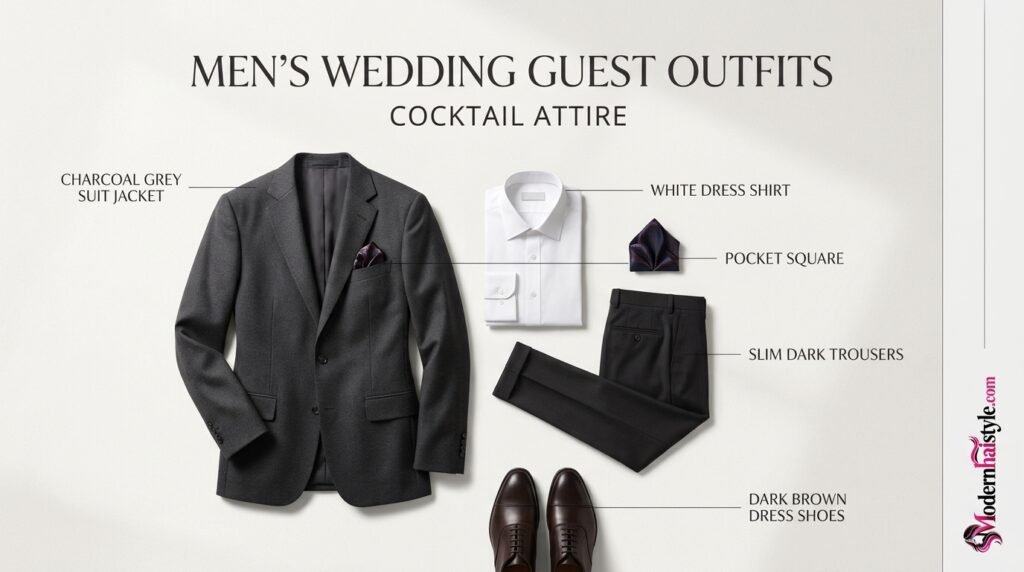
Guest outfits follow a separate dress code system, with guests dressing one step below the wedding party in most cases. Guests should never copy the groom exactly, never wear white, and never outshine the couple or wedding party. For full guest formulas, use the mens wedding guest outfits page, linked from this section, rather than duplicating guest content here.
Guest code table below summarizes guest levels only, for party planning context. Party members should not use guest levels as their own outfit guide, because party formality sits one step above guests in most weddings. Guests who are also groomsmen at another wedding should follow each event code separately.
| Guest code | Guest core outfit | Party comparison |
| Black tie guest | Tuxedo, black bow tie, patent shoes | Party also tuxedo, groom distinct by detail |
| Cocktail guest | Dark suit, tie, leather shoes | Party suit or tuxedo, groom distinct |
| Semi formal guest | Matched suit, tie, leather shoes | Party matched suit, groom three piece difference |
| Casual guest | Blazer, dress trousers, collared shirt | Party suit, groom distinct, guests softer |
Mistakes to Avoid
- Letting the groom blend in with groomsmen, because photos lose the central figure without one clear difference.
- Choosing different suit colors randomly, because random shades look accidental rather than coordinated.
- Mixing formality levels across the party, with tuxedos mixed with casual blazers without a palette plan.
- Ignoring budget fairness, because a suit one groomsman cannot afford creates resentment and last minute compromises.
- Setting rental deadlines too late, because sizes sell out and alterations run out of time during wedding season.
- Skipping final fittings with shoes, because trouser break, collar fit, and shoe comfort fail most often at final checks.
- Matching every fabric exactly, because dye and texture differences make exact matches look forced and often fail.
- Forgetting out of town groomsmen, because vague group chat instructions create missed fittings and size errors.
- Choosing novelty patterns for the whole party, because pattern overload photographs as noise in group photos.
- Wearing unbroken shoes for hours, because sore feet change posture, mood, and dancing for the whole party.
Tips That Improve Every Party Outfit
- Choose groom outfit first, then set one groomsmen base, then add one groom difference.
- Send one group message with base style, color, tie family, shoe formality, shop, deadline, and budget notes.
- Agree who pays in writing early, including shared accessories, rental fees, and alteration costs.
- Use the stranger test at a fitting, with the full party lined up in photo light.
- Allow different jacket fits in the same color, because varied builds need varied fits for unity.
- Coordinate by palette, not exact match, with bridesmaids and flowers in the same color family.
- Start shoe break in early, with several short wears before the wedding day.
- Photograph the full party together before the wedding, in natural and indoor light.
- Pack a day of kit with spare shirt, tie, boutonniere pins, shoe cloth, sewing kit, and stain pen.
- Test movement at fittings, including sitting, walking, dancing, hugging, and ring handling.
Frequently Asked Questions
What should a groom wear to his wedding?
A groom should wear a tailored suit or tuxedo that matches wedding formality, venue, and season. Daytime weddings favor suits, evening and black tie weddings favor tuxedos, and partner outfit harmony should guide the final choice. Fit, color, and shoe comfort matter as much as style.
Should a groom wear a suit or a tuxedo?
A groom should wear a suit for daytime weddings and a tuxedo for evening or black tie weddings. That rule, noted by MrGuild UK content, works as a starting point for US weddings with venue formality as the final check. A dark suit can serve as a formal alternative at black tie optional events.
Do groom and groomsmen wear the same suit?
Groom and groomsmen often wear the same suit color, but the groom should differ by one clear point. Men’s Wearhouse groomsmen content allows same fabric color with different jacket fits, while Tip Top Canada content suggests groom difference by shade, three piece versus two piece, or tie. Identical outfits make the groom hard to spot in photos.
How should groomsmen coordinate without looking identical?
Groomsmen should share one base style, same suit color, same tie family, and same shoe formality, with fit variations allowed. That system creates unity without forcing every body into the same jacket cut. Personality should come through accessories, not through mismatched suits.
How can the groom stand out from groomsmen?
The groom can stand out by wearing a three piece suit while groomsmen wear two piece suits, or by choosing a different shade, tie, or boutonniere. Tip Top Canada groomsmen content frames this as a stranger test: a stranger should spot the groom in a lineup. One difference works best, because multiple differences can look disconnected.
Should the best man wear a different outfit?
The best man should wear the groomsmen base with a subtle distinction, such as a distinct boutonniere or tie texture. A completely different suit color can confuse guests about who the groom is, so best man distinction should stay subtle. Fit and shoe comfort matter more for the best man, because he assists the groom all day.
Should groomsmen match the bridesmaids?
Groomsmen should coordinate with bridesmaids by palette family, not by exact fabric match. Men’s Wearhouse groomsmen content notes that complementary colors look more natural than exact matches across different fabrics. A shared palette gives the party harmony without forced uniformity.
Should groomsmen match the wedding flowers?
Groomsmen ties, pocket squares, and boutonnieres should complement wedding flowers, not match every flower exactly. Boutonnieres should sit in the same palette as bridal flowers, with the groom boutonniere slightly distinct. Flower color clash happens when too many accent colors compete.
Who pays for groomsmen suits?
Who pays for groomsmen suits should be agreed early in writing, with options including couple pays all, groomsmen pay own, or couple pays shared accessories. No single US rule controls this choice, unlike the UK custom noted by MrGuild, where groomsmen usually pay own suits. Budget comfort should be set by the least comfortable groomsman.
Who pays for the groom’s suit?
The groom usually pays for his own suit or tuxedo, unless the couple agrees a different arrangement as part of wedding budgeting. Groom suit cost should be planned with partner outfit cost, because both outfits appear together in photos. Rental can reduce groom cost for rare formal events.
How far in advance should a groom buy a suit?
A groom should order a suit four to six months before the wedding, with fittings starting two months before and final fittings two weeks before. Custom suits need more time than off the rack suits, because fabric, construction, and alterations add weeks. Rental timelines can be shorter, but peak season still needs early booking.
How far in advance should groomsmen rent suits?
Groomsmen should rent suits eight to twelve weeks before the wedding in peak season, with a hard deadline that leaves time for size swaps. Rental shops need time to order, alter, and replace sold out sizes, especially for tall, short, and big and tall groomsmen. A deadline that is too late creates panic and compromise.
Can groomsmen wear different suit colors?
Groomsmen can wear related shades when the palette is intentional, with consistent shirt color and tie family. Men’s Wearhouse groomsmen content allows related gray shades with consistent accessories, while random shades look accidental. Same suit color remains the safest choice for classic weddings.
Can groomsmen wear different suit fits?
Groomsmen should wear different suit fits when builds differ, because the same jacket cut cannot fit every body well. Men’s Wearhouse groomsmen content explicitly allows same fabric color with different jacket fits for varied builds. Fit variations are invisible in photos when color and formality stay consistent.
Should groomsmen wear the same shoes?
Groomsmen should wear the same shoe style and color family, with different brands allowed for fit and comfort. Tip Top Canada groomsmen content lists same shoe style and color as a coordination rule, because shoe mismatch shows in full length photos. Shoe formality should match suit formality for every groomsman.
Should groomsmen wear the same tie?
Groomsmen should wear the same tie family, with identical ties for classic parties and tonal pattern variation for modern parties. Tie width should stay consistent across the party for photo harmony, even when patterns differ slightly. Random tie colors break unity quickly in group photos.
What color suit should a groom wear?
A groom should wear navy, charcoal, or black for classic weddings, with burgundy, emerald, and brown for seasonal or modern weddings. Navy suits accept the widest accent colors, while charcoal suits cooler palettes well. Color should complement the wedding palette and partner outfit, not compete with them.
Can a groom wear a colored suit?
A groom can wear a colored suit when the wedding palette, formality, and venue support it, with burgundy, emerald, and midnight blue as strong choices. Colored suits need simple shirts and accessories, because color itself carries visual interest. Pastel suits suit daytime and beach weddings better than formal evening weddings.
Can a groom wear a velvet jacket?
A groom can wear a velvet dinner jacket for evening receptions, with black velvet as the safest choice. Perfect Tux trend content highlights black velvet for evening luxury, with emerald and burgundy velvet for festive winter weddings. Velvet needs classic trousers, a bow tie, and minimal accessories to stay formal.
Can a groom wear a three piece suit while groomsmen wear two piece?
Yes, a groom in a three piece suit with groomsmen in two piece suits is one of the cleanest groom differences. That difference survives jacket removal, unlike a tie difference alone, and it looks intentional in photos. Waistcoat fit should be checked seated and standing, because reception seating changes how vests sit.
What should a groom wear to a beach wedding?
A groom should wear a light linen or cotton suit, a light dress shirt, and loafers at a beach wedding. No tie is required for beach formal weddings, but the outfit should still look intentional and polished. Leather sandals suit only when the couple explicitly allows them, and barefoot needs explicit permission.
What should a groom wear to a barn wedding?
A groom should wear a wool or tweed suit, or a textured blazer with dress trousers, plus sturdy leather shoes or boots at a barn wedding. A full tuxedo usually feels overdressed at a barn wedding, while texture and earth tones feel intentional. Dust and gravel make darker trousers and robust soles practical.
What should a groom wear to a church wedding?
A groom should wear a modest, structured suit or tuxedo with a collared shirt, tie or bow tie, and tailored trousers at a church wedding. Short sleeves, open collars, and very casual fabrics can feel out of place in traditional religious settings. Formality should match the church and ceremony, not only the reception venue.
What should a groom wear to a winter wedding?
A groom should wear a wool or flannel suit in dark tones, with an overcoat, scarf, and gloves for travel at a winter wedding. Velvet dinner jackets suit winter evening receptions, while tweed suits suit winter daytime weddings. Remove outerwear indoors to show the full outfit and avoid overheating.
What should a groom wear to a summer wedding?
A groom should wear a linen, cotton, or tropical wool suit in light or navy tones at a summer wedding. Breathable fabric, a spare shirt, and broken in shoes matter most in heat, because summer ceremonies involve standing outdoors. Evening summer weddings can darken to navy or charcoal, even when the day is hot.
Conclusion
Mens wedding outfits work when the groom leads, the party coordinates, and guests follow a separate code. One base style, one tie family, and one shoe formality create unity, while one clear groom difference creates identity. Palette coordination, fit by body type, and budget fairness turn that system into photos that look intentional rather than improvised.
Mens wedding outfits also need a timeline, a group message, and a day of kit, because coordination fails through missed deadlines more often than through bad taste. Order early, fit with actual shoes and accessories, photograph the full party together, and agree who pays before colors are chosen. Those practical steps protect friendships and photos equally.
Mens wedding outfits should end with one simple action: choose groom formality and color, set one groomsmen base, add one groom difference, and send the group message with shop, deadline, and budget notes. Test the stranger test at a fitting, break in shoes early, and pack a spare shirt and boutonniere pins. That measured plan gives the groom a clear identity, the party a unified look, and the couple photos that last.

