Long Hair Wig: Lengths, Density, and the Care That Scales With Inches
Long hair wig shopping runs on a number that does not mean what you think it means.
The inches on the listing are real, but they are measured with the hair pulled fully straight, so the length you wear is always less than the length you bought, and how much less depends entirely on texture.
Long starts at 20 inches. From there the ladder runs 20 to 24 inches for classic long, 26 to 30 for extra long, and beyond that for the specialists.
Every step up that ladder raises four things together: the price, the weight, the tangling, and the care time. That package deal is the subject of this page.
Three disciplines keep long buyers out of trouble. Buy by apparent length, not listed length. Match density to length, or meet the wispy ends. And budget the maintenance tax in minutes per week, not just dollars, before the unit arrives.
Below: the ladder with body positions, the texture shrinkage chart, the density proportionality rule in a table, construction choices at length, the full care system, prices and lifespans printed as the labeled strands they are, and the honest beginner box most sellers would rather skip.
The Short Answer: Long Starts at 20 Inches, Measured Stretched
A long hair wig is any unit of 20 inches or longer. Retail draws the line there consistently: LuvMe’s long range opens at 20, and everything below it is sold as medium.
At 20 inches the hair reaches the upper to mid back; at 30 it is a deliberate statement.
The measurement convention explains every length complaint ever posted. Length is measured from the crown of the cap to the tip of the longest strand, stretched completely straight.
Froodl’s length and density guide for lace front wigs states that convention precisely. A unit is exactly as long as listed, in the one posture hair never actually wears.
So buy the apparent length. Decide where you want the hair to fall (mid back, waist, hips), then work backward through your texture’s shrinkage to the listed inches that deliver it. The next two chapters give you the ladder and the conversion.
The Length Ladder: What 20 to 30 Inches Actually Looks Like
|
Listed length |
Straight, where it falls |
Best for |
Care load |
|---|---|---|---|
|
20 inches |
Upper to mid back |
Everyday long, first long unit |
Moderate |
|
22 inches |
Mid back |
Soft glam, loose waves |
Moderate |
|
24 inches |
Waist to lower back |
The classic long look, body wave and straight |
Noticeable |
|
26 inches |
Below the waist |
Statement length, layered styles |
High |
|
28 inches |
Hip skimming |
Events, photos, fuller textures |
High |
|
30 inches |
Bold, very long |
Extra glam, photo ready styles |
Very high |
|
32 to 40 inches |
Extreme |
Specialist, costume, editorial |
Specialist |
Height moves every row. The same 24 inches falls lower on a shorter torso and higher on a taller one, which is why two honest reviews of the same unit can disagree about length. Judge length photos against the model’s height whenever a listing provides it.
Length is the one spec that taxes everything else. Price climbs by the inch, weight climbs with it, tangling multiplies, wash day lengthens, and storage stops fitting in a drawer.
ModernHaistyle’s hair wig category gathers the full wig range if your ladder decision is still open at the short end too.
Texture Changes the Length: The Shrinkage Chart
|
Texture |
What 24 listed inches wear like |
Why |
|---|---|---|
|
Straight |
24 inches, waist to lower back |
No pattern, no loss |
|
Body wave |
About 21 to 22 inches |
The wave settles shorter than the stretch |
|
Loose or deep wave |
About 20 to 22 inches |
Tighter pattern, more spring |
|
Curly |
About 20 to 22 inches |
Curl shrinkage of 2 to 4 inches is normal |
|
Kinky curly |
18 to 20 inches or shorter in appearance |
The tightest pattern springs the most |
The wave rows carry a seller’s own arithmetic. OnHairShow’s independent first lace front buying guide warns that a 22 inch body wave wears like roughly 18 to 19 inches once the waves settle.
It advises planning on two to three inches less than the listing suggests for waved textures. LuvMe Hair’s 24 inch wig guide, with its texture chart publishes the same story as a texture chart for its 24 inch units.
Shrinkage is not deception. The stretched convention is the industry standard because it is the only measurement every factory can repeat.
The deception risk lives elsewhere, in reviews and photos that never mention texture. ModernHaistyle’s curly hair wig guide to patterns and shrinkage works the pattern side of this chart in full, pattern by pattern.
Practical conversion: for waves, order two inches above your target fall; for curls, two to four. If the hair must touch a precise point (a waistband, a dress line), measure against a tape on your own body and convert with the chart, never with hope.
Density Must Match Length: The Proportionality Rule
Density is fullness as a percentage of a standard natural baseline: 130 percent is light and natural, 150 is medium and the everyday standard, 180 is full, and 200 and above is glam territory. The percentage alone tells you nothing until it is paired with a length.
|
Density |
At 20 inches and under |
At 22 to 26 inches |
At 28 inches and over |
|---|---|---|---|
|
130 percent |
Natural, fine hair match |
Thin at the ends |
Wispy, avoid |
|
150 percent |
The natural standard |
Good for straight; ends soften in waves |
Ends likely thin |
|
180 percent |
Full, photo look |
The end fullness choice |
Balanced fullness |
|
200 percent |
Helmet risk, no taper |
Full glam, tapers properly |
Proportionate glam |
|
250 percent |
Do not buy |
Dramatic, heavy |
Stage and editorial |
The photo trap explains half the table. Listings shoot around 180 percent because fullness photographs well.
OnHairShow’s independent first lace front buying guide warns that the same density on a real head can feel like wearing a helmet. The guide’s everyday verdict is 150 percent, or 130 for fine hair and thinning coverage.
The long end inverts the instinct. At 22 inches and beyond, 150 percent in waves can read wispy at the tips.
Froodl’s length and density guide for lace front wigs pairs 180 percent with those lengths to keep the ends full.
UNice’s beginner wig guide, built on four deciding questions completes the rule: 200 percent and above needs 24 inches or more, because density without length has no taper.
Read the rule as a sentence: the longer the hair, the more density its ends need; the shorter the hair, the less density its silhouette can carry. Every density mistake in the reviews is that sentence violated in one direction or the other.
Construction at Length: Frontals, Closures, and the Ponytail Test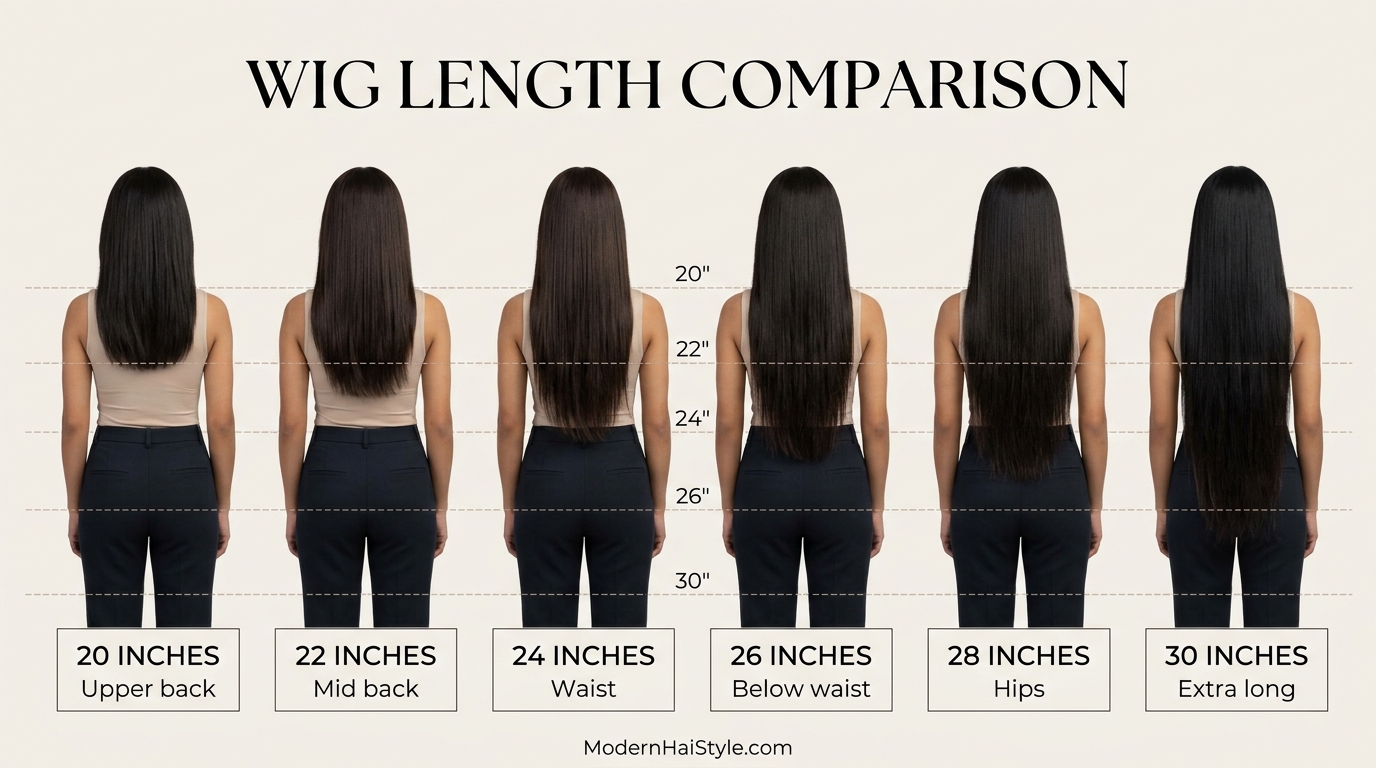
Length changes what construction must do. Long hair gets pulled up, swept back, and braided, and every one of those styles interrogates the cap’s edges. The construction question at length is not realism in the mirror; it is realism in motion.
|
Construction |
Parting and styling at length |
Choose it when |
|---|---|---|
|
4×4 or 5×5 closure |
One part zone; styles worn down |
Daily wear, lowest maintenance |
|
7×5 glueless closure |
Wider part, wear and go install |
Beginners at length, quick installs |
|
13×4 lace frontal |
Ear to ear hairline, most down and half up styles |
The long default for variety |
|
13×6 lace frontal |
Deeper part, high ponytails and updos |
Ponytails are your signature |
|
Full lace |
Part and pull up anywhere |
Maximum styling freedom, premium price |
|
U part or V part |
Your own leave out blends the front |
You want your hairline in the picture |
The ponytail test decides between rows. If you will wear the unit up weekly, closure rows fail the back and sides, and the 13×6 or full lace earns its premium.
If your long hair lives down, a closure delivers the same front view for less money and less lace care.
The blend constructions deserve their footnote. ModernHaistyle’s U part wig guide and ModernHaistyle’s V part wig guide cover the leave out family, where your own front hair covers the edge entirely.
ModernHaistyle’s half wig guide to blending your own hairline covers the three quarter option. At long lengths these blend beautifully, provided your leave out can match the unit’s texture.
The Maintenance Tax: Care That Scales With Inches
Every inch is a recurring payment. Long units tangle at the nape, where hair rubs collars, chair backs, and shoulders all day. The ends are the oldest, driest hair on the unit, which is why every care rule below is really a rule about ends.
1. Detangle before anything
Ends upward, always. Start at the tips with a wide tooth comb or loop brush and work toward the roots in sections, before washing and after every wear. Dragging a brush root to tip through 26 inches is how mats are manufactured.
2. Wash on a cadence, gently
Retail care guidance clusters at every 8 to 14 wears or roughly weekly to fortnightly at daily wear; the strands differ by brand and this page prints the range rather than a false precision.
Cool or lukewarm water, sulfate free shampoo worked through without rubbing or twisting, and no bunching: long hair washed like laundry tangles like laundry.
3. Condition where the damage lives
Mid lengths and ends only, never the roots or the knots. One care authority concentrates its advice on the bottom six inches, where age, friction, and dryness all collect. Leave in moisture between washes is the long unit’s daily bread, applied lightly to avoid buildup.
4. Dry and store like it matters
Air dry on a stand, fully, before styling or storing. Store on the stand or in a satin bag, never balled in a drawer.
At night, the unit comes off, or the hair goes into a loose braid on a satin pillowcase; sleeping with long loose hair is the single fastest route to a matted nape.
5. Heat with respect
Human hair takes heat; it also keeps the damage. Use a protectant, moderate temperatures, and remember the unit has no scalp oils repairing it overnight and no regrowth replacing what breaks.
ModernHaistyle’s human hair wig guide to grades, caps, and costs covers the material grades and their heat limits in full.
Rotation is the tax cut. Two units worn alternately rest between wears, halve each unit’s wash frequency, and outlast one unit worn daily by a wide margin. Sellers say it because it sells; it also happens to be true, and at long lengths the math is strongest.
Prices and Lifespans: Labeled Strands, Not Promises
No honest single price exists for a long wig, because length, density, lace, and grade all multiply together. What exists are strands from named sources, and they are printed here as strands, checked on 2026-11-09.
|
Strand |
Figure |
Source |
|---|---|---|
|
Daily wear human hair, entry |
From about 200 dollars |
OnHairShow buying guide |
|
Recommended first lace front band |
200 to 300 dollars |
OnHairShow buying guide |
|
One unit, 14 inches (4×4 lace) |
138 dollars |
ILikeHair variant ladder |
|
Same unit, 22 inches (4×4 lace) |
225 dollars |
ILikeHair variant ladder |
|
Same unit, 22 inches (13×4 lace) |
257 dollars |
ILikeHair variant ladder |
Read the ladder, not the numbers. Eight inches added 87 dollars inside one product, and lace size added 32 more on the same length. Your configuration will differ; the pattern, price steps with inches and lace, is the durable fact that survives every sale.
|
Lifespan strand |
Claim |
Source |
|---|---|---|
|
Human hair with care |
12 to 24 months |
UNice beginner guide |
|
Human hair with care and rotation |
1 to 2 years |
Asteria care Q and A |
|
Standard synthetic |
3 to 6 months |
UNice beginner guide |
|
Care guide optimism |
3 years or more |
Apohair care guide (vendor claim, flagged) |
The flagged row is the lesson. Care content from sellers trends optimistic, and a 3 year promise on a daily worn long unit should be read as best case marketing.
Plan your cost per year on the 12 to 24 month band and let a well kept unit pleasantly surprise you.
The Beginner Honesty Box: Long Is a Second Wig
The strongest independent voice in this market tells beginners not to start here. OnHairShow’s independent first lace front buying guide puts a first wig at 14 to 18 inches.
Long units tangle the worst, take the longest to wash, weigh the most, and demand the most maintenance of any configuration.
The regret story is canonical. UNice’s beginner wig guide, built on four deciding questions opens its beginner guide with the buyer who chose 26 inches at 250 percent density, wore the unit twice, and put it in a box.
Every element of the maintenance tax arrived at once, at maximum settings, with no habits built to pay it.
None of this argues against long hair. It argues for sequence: learn detangling, washing, and storage on a forgiving length, then step up to 24 inches with the habits already installed.
Buyers who arrive at long units second keep them; the care system in this page is written for exactly that reader.
The Error Clinic: Wispy Ends, Nape Tangles, and the Helmet
1. Wispy ends at 24 inches
150 percent in waves, surprised by thin tips. Fix: apply the proportionality table before buying; at 22 plus inches in textured hair, step to 180 percent or choose double drawn hair, whose fuller ends resist the taper.
2. The matted nape
A bird’s nest by Friday. The nape is a friction zone, not a quality verdict. Fix: detangle the nape specifically after every wear, braid for sleep, and keep collars and scarves in mind on long wear days. Deep condition the zone weekly.
3. The helmet
200 percent at 20 inches. Density with nowhere to taper reads as a solid mass. Fix: match the table; if you own the unit already, layers cut by a wig stylist restore movement without losing length.
4. The two inch shock
A 24 inch curly unit that wears at 21. Nobody cheated you; the stretched convention plus curl shrinkage did the arithmetic. Fix: convert with the shrinkage chart before ordering, and judge returns by apparent length against the chart, not against the number.
5. Blend wording at a human hair price
“Human hair blend” sold as a premium unit. The independent guide’s warning is blunt: blend means synthetic with some real strands, priced by the wording. Fix: buy only where the listing states 100 percent human hair in so many words, and treat every softer phrase as fiber.
6. Washed like laundry
Bunched, rubbed, and twisted in hot water. Long hair felts under exactly that treatment. Fix: the wash protocol above, downward motions only, conditioner kept off the knots, and a full air dry before the unit is touched again.
Choosing Your Configuration: A Worked Decision
1. The daily wear professional
22 to 24 inches, straight or body wave, 150 to 180 percent, 13×4 frontal or 7×5 glueless closure. Long enough to read as long, short enough to wash on a weeknight, dense enough at the ends without the helmet. This is the configuration the guides’ verdicts converge on.
2. The event and photo buyer
26 to 30 inches, 180 to 200 percent, texture of choice, frontal. Care load is irrelevant across a handful of wears, and the density rule is satisfied by the length.
Synthetic enters the conversation honestly here: three to six months of lifespan covers a season of events at a third of the price.
3. The protective styling wearer
Length matched to your leave out plan, construction from the blend rows if your own hairline joins the style, or a glueless closure if it does not. ModernHaistyle’s hair wig hub guide maps the whole construction family if the rows here leave the choice open.
4. The coverage wearer
Comfort specifications lead: breathable cap, secure fit without adhesive pressure, density matched to your own former fullness rather than to listing photos.
General information only: for medical hair loss, a specialist fitting is worth its cost at any length, and ModernHaistyle’s home for hair guides can start that reading.
Frequently Asked Questions
1. What is considered a long hair wig?
Any unit of 20 inches or longer. Retail draws the line there consistently, with 20 to 24 inches as classic long, 26 to 30 as extra long, and 32 and beyond as specialist territory.
Below 20 inches the market sells medium, whatever the listing headline says.
2. How are long wigs measured?
Stretched, from crown to tip. The longest strand is pulled completely straight and measured from the top of the cap.
The listed inches are therefore a maximum the hair reaches in no natural posture, which is why texture converts the number before it reaches your back.
3. How long is a 24 inch wig on a person?
Waist to lower back, in straight hair. LuvMe’s texture chart places straight 24 inch units at the waist on most frames, with body position shifting by your height and torso length.
In waves the same unit wears at about 21 to 22 inches; in curls, 20 to 22.
4. Why does my 24 inch curly wig look shorter?
Because of curl shrinkage. Curly patterns spring back 2 to 4 or more inches from their stretched length, and the measurement convention is stretched.
A 24 inch curly unit wearing at 20 to 22 is exactly to specification.
Order two to four inches above your target fall for curls.
5. How long is a 30 inch wig?
A bold, deliberate statement length. Thirty inches falls well past the waist toward the hips in straight textures on most frames, with weight, price, and care time all at their maximum for mainstream units.
It is an event and photo length for most wearers, not a starter length.
6. What density is best for a long wig?
It depends on the length, by rule. 150 percent is the natural everyday standard up to about 20 inches; at 22 inches and beyond, especially in waves and curls, 180 percent keeps the ends full.
Fine hair and thinning coverage stay at 130 to 150 at any length.
7. Why do the ends of my long wig look thin?
Density too low for the length. Fullness thins as it travels, and at 150 percent a long wavy unit can run out of hair before it runs out of inches.
The fixes are 180 percent at 22 plus inches, or double drawn hair, which keeps the ends fuller by construction.
8. Does 200 percent density need long hair?
Yes, to taper naturally. UNice’s beginner guidance is explicit: 200 percent and above needs 24 inches or more, because density without length has no taper and reads as a helmet.
At 20 inches, 200 percent is the classic density mistake in this market.
9. Why do long wigs tangle so much?
Length multiplies friction. More hair rubs more clothing, chair backs, and itself, all day, and the ends are old, dry hair with no scalp oil reaching them.
Add product buildup and sleep friction and tangling is the default state a routine must actively prevent.
10. How do I stop my long wig tangling at the nape?
Treat the nape as its own zone. Detangle it after every wear, ends upward, before small knots become mats; deep condition it weekly; braid the hair for sleep; and mind collars, scarves, and seat backs on long wear days.
Most nape mats are a week’s skipped two minute habit.
11. How often should I wash a long human hair wig?
Every 8 to 14 wears, by the retail strands. Brand care guidance clusters there, or roughly weekly to fortnightly for daily wearers.
Wash sooner when buildup is visible.
The strands differ by seller, so treat any single exact number, including this range’s edges, as guidance, not law.
12. How do I detangle a long wig without damage?
Ends upward, in sections, before washing. Wet or dry, start at the tips with a wide tooth comb or loop brush and climb gradually.
Never drag from root to tip through long hair, never brush it soaking wet and heavy, and never wash first and detangle later.
13. Can I sleep in a long wig?
You can, protected, at a cost. Braid the hair loosely and sleep on satin, or expect nape matting and a shortened lifespan.
The better habit at long lengths is removal at night; the unit rests, your scalp rests, and the two minute braid becomes a thirty second stand placement.
14. How should I store a long wig?
On a stand, or in a satin bag. Air dried fully, detangled, and kept out of drawers, plastic bags, and sunlight.
Long units balled into storage arrive at their next wear pre tangled.
For travel, a satin bag inside a structured case keeps 30 inches civilized.
15. How long do long human hair wigs last?
Twelve to 24 months of regular wear, as the main strand. UNice’s guidance gives human hair 12 to 24 months with care; Asteria’s care answers say 1 to 2 years, extended by rotation.
Seller claims of 3 plus years exist and are flagged in this guide as best case optimism.
16. How long does a long synthetic wig last?
About 3 to 6 months of regular use. That is UNice’s strand for standard synthetic, and it frames the honest comparison: synthetic long units are an event season purchase, human hair a year plus purchase.
Heat friendly fibers sit in the same life band with better styling options.
17. Is a long human hair wig worth it over synthetic?
For daily wear, yes; for events, often no. Human hair wins on lifespan, heat styling, and behavior across a year of wear.
For a handful of event wears, a good synthetic delivers the photographs at a third of the price and none of the wash day.
Match the material to the wear count.
18. Can a beginner buy a 24 inch wig first?
Honestly, it is a hard first unit. The independent buying guidance puts a first wig at 14 to 18 inches because long units tangle worst, weigh most, and wash slowest.
A determined beginner who pre learns the care system can do it; the boxed after two wears story is what happens without it.
19. What is the best first long length to try?
Twenty to 22 inches, at 150 percent, in body wave or straight. Enough length to feel the category, short enough to forgive beginner habits, dense enough without the helmet.
Step to 24 and beyond as a second long unit, with detangling and storage already automatic.
20. Can I put a long wig in a ponytail?
Only with the right construction. High ponytails and updos need lace at the back and sides: a 13×6 frontal at minimum, full lace for anywhere styling.
Closures and 13×4 frontals wear down and half up beautifully but expose their construction pulled fully up.
21. What lace size is best for long wigs?
Match lace to your styling, not your budget alone. Worn down daily: a 7×5 glueless closure or 13×4 frontal.
Part variety and half up styles: 13×4.
Ponytails and updos: 13×6 or full lace.
Every step up buys styling freedom with money and lace care.
22. Is a closure or frontal better for a long wig?
Frontal for freedom, closure for ease. A frontal gives the full hairline and deeper styling range at long lengths; a closure gives one part, a faster install, and less lace to maintain.
Most daily wearers at length are better served by the closure than their first instinct suggests.
23. How heavy is a long wig?
Heavier than any shorter unit, by physics. Weight scales with inches times density; marketplace guidance for extreme lengths cites units exceeding 120 grams, a vendor strand to treat as indicative.
Secure fit, flattened natural hair, and realistic density keep long weight wearable all day.
24. Why is my long wig so heavy at 250 percent?
Too much fullness on the unit you chose. At 250 percent the hair mass itself is the load, and no cap adjustment removes it.
Wear it for shorter sessions, choose it only at 24 plus inches where it tapers, and let your daily unit live at 150 to 180.
25. Does length change the price of a wig?
Yes, steeply, inside a single product. One retail ladder checked for this guide priced the same unit at 138 dollars in 14 inches and 225 dollars in 22 inches, same cap.
Length is priced per inch because hair itself is; expect every two inch step to show on the tag.
26. Why do long wigs cost more per inch?
Because long hair is the scarce input. Strands that reach 24 plus inches take years to grow and survive fewer processing steps, so the raw material costs more before any cap is sewn.
The ladder is the market pricing scarcity, which is also why implausibly cheap long units deserve blend suspicion.
27. What does human hair blend really mean?
Mostly synthetic, by the independent guide’s warning. OnHairShow is blunt: human hair blend means synthetic fiber with some real strands mixed in, marketed by the softer wording.
Buy where the listing states 100 percent human hair in so many words, or knowingly buy fiber.
28. Remy or virgin hair for a long wig?
Remy for value, virgin for ceiling. Remy means cuticles aligned in one direction, the tangling defense that matters most at long lengths.
Virgin adds never processed, taking color and heat best.
At 24 plus inches, aligned cuticles are not a luxury; misaligned long hair is a mat with a head start.
29. Single drawn or double drawn for long lengths?
Double drawn at long lengths. Single drawn hair tapers naturally toward the ends, which at 26 inches can read as wispy.
Double drawn keeps more full length strands, so the ends stay fuller.
It costs more; at long lengths it solves the exact complaint this guide’s density chapter fights.
30. What cap size fits most women?
About 22 to 22.5 inches. That is the average cap the market builds to, with petite under 22 and large above roughly 22.75 in retail sizing strands.
Measure your own circumference with your hair prepped as you will wear it; long units forgive sizing errors least.
31. Can I heat style a long human hair wig?
Yes, with protectant and moderation. Human hair takes irons and wands like growing hair, including the damage, and a wig has no regrowth replacing what breaks.
Seller heat guidance varies by color state; moderate temperatures and a protectant spray are the safe universal strand.
32. What temperature is safe for styling a long wig?
Moderate, and seller strands differ. One retailer’s care answers put natural colored human hair around 356 to 392 degrees Fahrenheit and colored hair lower, at 320 to 356; treat those as that brand’s guidance.
The universal rule is lower than you think, with protectant, in passes.
33. How do I revive a matted long wig?
Patiently, in sections, with moisture. Saturate with water and conditioner, then work the mat from the very ends upward with fingers first and a wide tooth comb second, small sections, no force.
Severe mats are a salon detangling service, and the bill teaches the routine that prevents the sequel.
34. When should I trim the ends of my long wig?
When the ends stay dry, split, and thin after conditioning. A light trim of the last inch or two by a wig experienced stylist restores the hem, removes the oldest damage, and stops tangles where they start.
At long lengths you have inches to spare; spend one on health.
35. Does rotating two long wigs make them last longer?
Yes, measurably. Alternating units rests each between wears, halves wash frequency per unit, and spreads friction across two heads of hair.
Seller care answers credit rotation directly for reaching the top of the lifespan band, and at long lengths the effect is largest.
36. Can I swim or exercise in a long wig?
With preparation and an older unit. Chlorine and salt dry long hair fast and can shift color; secure the unit well, wet and condition before, braid it, and wash the same day.
Many long wearers keep a designated activity unit for exactly this, which is rotation applied to water.
37. How do I travel with a 30 inch wig?
In a satin bag, inside structure. Detangle, braid loosely, bag in satin, and pack in a hat box or structured case where the length cannot be crushed or knotted by luggage.
Style on arrival from the braid out; never pack a long unit loose in a suitcase.
38. What is the best texture for a first long wig?
Body wave, for most first time long buyers. It wears forgivingly, hides minor density sins, reads natural at 150 to 180 percent, and its 2 to 3 inch apparent shortening is easy to convert.
Straight shows every wispy end and every inch of tangle; curls demand the most moisture work.
39. Body wave or straight for a long wig?
Body wave forgives; straight declares. Straight shows true length, sleekness, and every thin end; body wave shows movement, hides taper, and shortens the read by 2 to 3 inches.
Choose straight when length itself is the statement and your density budget is honest; wave for daily life.
40. How long does a long wig take to wash and dry?
Longer than any other length band. Washing is a careful 20 to 30 minutes of downward work, and air drying 24 inches fully can take hours on the stand.
Which is why rotation matters: a unit still drying cannot be worn.
Plan wash day the night before a rest day.
41. What products does a long wig need?
A short, length focused kit. Sulfate free shampoo, a rich conditioner for the ends, a light leave in for between washes, heat protectant, a wide tooth comb and loop brush, and satin for storage and sleep.
Heavy oils and alcohol laden sprays work against long hair; keep the kit light.
42. Are long wigs good for hair loss coverage?
Yes, with comfort leading the spec. Long coverage units exist across the cluster’s constructions; choose breathable caps, secure fit without adhesive pressure, and density matched to your own former fullness.
General information only: for medical hair loss, a specialist fitting earns its cost.
Conclusion
Long hair wig buying simplifies once the three disciplines hold. Convert the listed inches through your texture before you fall in love with a number. Match density to length so the ends survive the journey.
And count the maintenance tax in minutes, because that is the currency long hair actually charges.
The configuration most readers should start from is unglamorous and right: 22 to 24 inches, 150 to 180 percent, body wave or straight, frontal or glueless closure, real human hair stated in so many words.
It is long enough to be unmistakably long, and forgiving enough to still be beautiful in month six.
Then wear it like you own the system. Detangle the nape, feed the ends, braid the night, rest the unit in rotation.
Length is the most dramatic spec in the wig market and the most honest one: it gives exactly the glamour it promises, at exactly the price, in inches and in minutes, that this page has shown.

Dilawar is a passionate writer and contributor at Modern Hairstyle (modernhaistyle.com), specializing in hairstyles, hair care, grooming, fashion, beauty, and lifestyle trends. He enjoys sharing practical tips, hairstyle inspiration, and easy-to-follow guides to help readers discover their personal style. His goal is to provide informative, engaging, and helpful content that keeps readers updated with the latest trends.