Wig Hair: Two Doors, One Query, and the Material Ladder That Decides Both
wig hair is one search with two different shoppers behind it. Half the searchers want a finished wig, and half want the hair itself.
The hair itself means bundles, wefts, and bulk hair for making wigs. That material door is where quality is actually decided.
So this guide covers wig hair from the material up. Grades, tests, bundle math, and the labels that inflate all get settled here.
The finished formats live in the Hair wig category on this site. This page is the layer underneath every one of them.
Read the doors first, then the ladder. Everything else in hair buying hangs on those two frames.
Two Doors: Which Shopper Are You?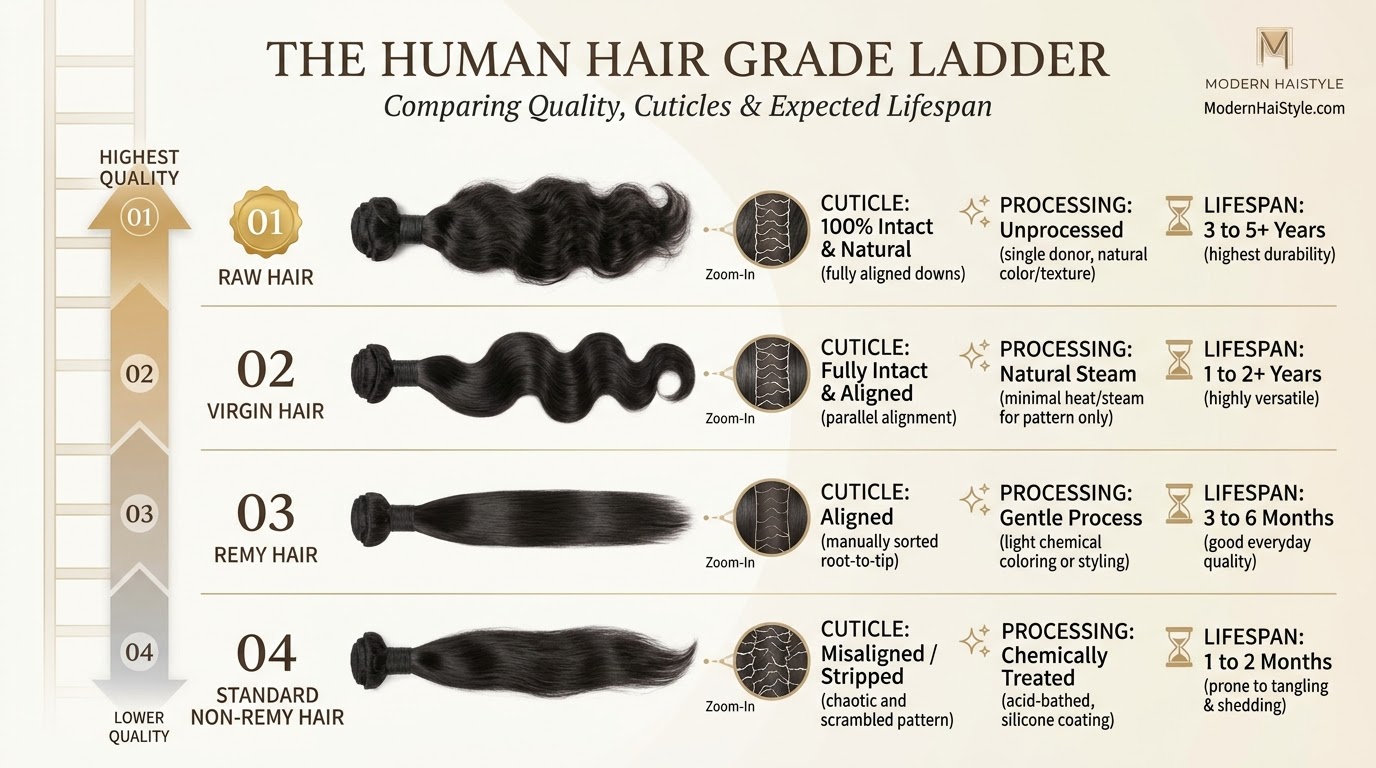
Door one: a ready wig made of hair
Most retail results answer this shopper. They want a unit they can wear this week.
Format guides serve them: lace fronts, glueless lines, half wigs, headband wigs. The Hair wig hub is the map of that whole shelf.
The Human hair wig guide goes deeper on the finished product. Quality, fit, and care of a completed human hair unit live there.
Door two: the hair material itself
This shopper buys hair by the bundle or by weight. A maker, a salon, or their own two hands finish the product.
Bundles feed sew ins and commissioned custom wigs alike. Bulk loose hair feeds hand tied and ventilated work.
Nobody routes both doors, which is this page’s job. The material ladder below serves both shoppers equally.
The Grade Ladder on Two Axes
Axis one: alignment (the Remy question)
Remy describes how the hair was collected and kept. Cuticles stay intact and run root to tip in one direction.
The Thanh An Hair Remy definition and grade axes guide defines it precisely, with the collection method. A gathered ponytail, cut once and kept banded, preserves the direction.
Hair science gives the cuticle about six to eight layers of scale like cells. Aligned scales lie flat against each other and slide.
Misaligned strands catch scale on scale instead. That friction is what tangling physically is.
Axis two: chemical history (the virgin question)
Virgin describes what has never been done to the hair. No dye, no bleach, no perm, no relaxer, ever.
Its practical value is predictable color behavior. Unprocessed hair lifts and takes dye evenly.
Definitions vary by vendor, which matters more than it sounds. One factory in this research counts only single donor hair as virgin.
No regulator defines either term anywhere. Treat both words as conventions to verify, not standards to trust.
Where the axes meet: raw hair
Raw hair is both axes at their peak together. Aligned, untouched, and usually from a single donor.
It comes only in naturally occurring colors and textures. That limit is its authenticity proof and its inconvenience.
The DHWarak Indian Hair remy virgin raw comparison traces the label’s history in the trade. Temple hair was sold as remy virgin before raw became the word.
The bottom rung: standard and non Remy hair
Loose collected hair arrives mixed head to tail. Factories strip its cuticles in an acid bath to stop the tangling.
Then a silicone coating restores a smooth first impression. The shine is real for about three to five washes.
Standard hair is a rational budget product for short wear. It becomes fraud only when sold wearing a premium label.
The ladder as a table
|
Grade |
Alignment Guaranteed |
Chemical History |
Lifespan Strand (One Factory Table) |
Best For |
|---|---|---|---|---|
|
Raw |
Yes, single donor |
Never processed |
18 to 24 plus months (virgin band) |
Custom units, bleach plans |
|
Virgin |
Not by the word itself |
Never processed |
18 to 24 plus months |
Coloring and bleaching |
|
Remy |
Yes, intact and aligned |
May include steam texturing |
12 to 18 months |
Everyday wigs and installs |
|
Standard (non Remy) |
No, stripped and coated |
Acid bath plus silicone |
3 to 6 months |
Short term and budget wear |
The K-Hair 100 percent human hair grades guide publishes that lifespan table in its grades guide. Treat the numbers as one factory’s strand, clearly labeled.
The ordering matters more than the exact months. Every source in the research agrees on the ladder’s shape.
What 100 Percent Human Hair Does Not Guarantee
Origin is all the headline promises
The claim means the strands came from people. No synthetic fiber is blended in, and that is the whole promise.
It says nothing about alignment, donors, or processing. The best raw bundles and the cheapest coated hair both wear it.
Grade letters promise even less than the headline. 7A through 12A has no issuer, no test, and no ceiling.
The letter inflation cycle
Exporters describe the pattern openly across decades. A top label gets adopted by everyone, inflates, and gets replaced.
Remy went through it, then virgin, now raw. Letters skip the cycle by simply adding numbers yearly.
Judge sellers by specifications instead of adjectives. Donor policy, collection method, and processing steps are the honest dialect.
Tests That Beat Labels
The wash test: judge at wash three
Wash the hair three to five times with normal shampoo. Coated hair changes character as its silicone leaves.
Aligned Remy hair behaves the same at wash five. That stability is the product you actually paid for.
Run the test inside the return window at retail. Wholesale buyers should test samples from the production lot.
The CifyChina hair factory sourcing and vetting guide insists on exactly that lot discipline. Showroom samples prove nothing about the carton, it warns.
The burn test: fiber truth in ten seconds
Burn a few strands from an inconspicuous spot. Human hair smells like burning protein and crumbles to ash.
Synthetic fiber melts into hard little beads instead. The two results cannot be confused with each other.
Use the test on mystery blends and marketplace buys. It settles the human versus synthetic question permanently.
The alignment and weight checks
Run fingers from root end to tip end and back. Aligned hair feels smooth down and slightly resistant up.
Weigh every bundle on a kitchen scale at arrival. About 100 grams is the standard; short weight is a quiet downgrade.
Short hairs padded into a bundle show at the ends. Double drawn hair stays thick; single drawn tapers naturally.
Bundle Math: Turning Hair Into a Wig
How many bundles make a wig
Most full installs take three to four bundles at common lengths. One factory figure anchors that range at 16 to 20 inches.
Each standard bundle weighs about 95 to 105 grams. Total grams installed is what fullness actually means.
A closure or frontal replaces the top bundle’s coverage. That is why bundle plus closure sets sell as a unit.
The Curly hair wig guide shows how texture changes the math. Curls expand visually, so curly installs read fuller per gram.
Length changes everything
The same 100 grams stretches thinner as length grows. A 26 inch bundle has far less end fullness than a 14 inch one.
Long installs therefore need more bundles, not bigger ones. Four bundles is a floor at long lengths, not a luxury.
Long hair also multiplies friction against clothing. The Honest Hair Factory human hair wig buying guide reserves Remy and virgin hair for long wigs for exactly that reason.
Buying long in a cheap grade is the worst cell in the matrix. Length and low grade punish each other.
Double drawn versus single drawn
Double drawn bundles have most short hairs removed. The bundle stays thick from the weft to the ends.
Single drawn keeps the natural taper of grown hair. It looks natural at short and mid lengths.
At long lengths the taper reads as thinness. That is where double drawn earns its premium.
Origin Labels Are Texture Names
The geography on the pack
Brazilian, Peruvian, and Malaysian describe texture styles. They are not verified statements about where hair grew.
Luster, coarseness, and curl behavior are what the names sort. Buy the texture you want, under no provenance illusion.
A provenance premium for the name alone is wasted money. The hair in the pack rarely matches the map on it.
One more signal deserves naming before the geography section. Sellers who separate stock by grade in writing behave like the honest side of the trade.
Different prices and return terms per grade signal real inventory behind the words. Sellers pricing one miracle hair at every tier are telling you the tiers are imaginary.
The listing layout itself is evidence, readable early. You can judge it before a single dollar moves.
Where the hair actually flows
China is the world’s largest human hair products producer. Xuchang in Henan processes a large share of global raw hair.
Qingdao is known for hand tied lace wigs and systems. Guangzhou hosts trading companies that supply export buyers.
Indian temple hair is the classic single donor source. Vietnam exports raw hair with a strong reputation among makers.
None of this makes any single unit good or bad. It makes origin marketing the weakest quality signal available.
Formats Built on the Material
The same hair, different products
Bundles become sew ins, custom wigs, and clip in sets. The grade decision transfers across every format built.
Ready wigs span lace fronts to the glueless formats. The V part wig human hair guide and the U part wig human hair guide cover the minimal opening designs.
Half wigs and headband wigs run on the same ladder. Their hair grades matter exactly as much as a lace front’s.
The Luvme glueless wig line audit audits one brand across those formats. Its titles show grade language doing retail work in the wild.
Lace quality is a separate purchase
A unit can pair excellent hair with poor lace. Judge the hair ladder and the lace grid independently.
Bleached knots and pre plucked hairlines are finishing labor. They say nothing about the hair’s grade or lifespan.
Replacement cycles differ too: lace tires before good hair does. That gap argues for mid grade hair on heavy lace labor.
Prices Without Invented Averages
Why no single price belongs in this guide
The spread inside the keyword is too wide for an average. Budget standard bundles and verified raw hair differ by multiples.
Ready wigs add format and labor costs on top. Any one number would mislead both doors of shoppers.
Compare price per gram inside one grade tier instead. That ratio exposes overpricing that per bundle prices hide.
What actually moves the price
Donor scarcity moves it first: single donor costs most. Alignment keeping costs labor at collection time.
Length multiplies material cost beyond the inch count. Double drawing removes saleable weight, so fullness costs extra.
Steam texturing and color work add processing cost. Coated standard hair skips every one of these steps.
Sale stacks apply to hair like everything else here. List, sale, and code prices differ; date any figure you quote.
Care by Grade
Better hair wants consistency, not more product
Sulfate free washing and gentle detangling protect alignment. Work from the ends upward, as with every quality unit.
Heavy coating products mask the cuticle you paid for. Moisture without buildup is the raw and Remy goal.
Air drying preserves both texture and weft integrity. Heat belongs on the hair, at sane temperatures, with protectant.
Standard hair lives on its coating
Silicone friendly products temporarily extend its good weeks. That is a legitimate strategy for short term wear.
No care routine upgrades a grade, ever. Care protects the grade you bought; it cannot promote it.
Plan replacement on the factory strand timeline. Three to six months of good behavior is the honest expectation.
Worked Example: Building One Custom Unit
The brief and the buy
The plan: a 20 inch body wave unit, natural fullness. Three Remy bundles plus a matching closure make the buy.
The bundles arrive and get weighed: 101, 99, 103 grams. Weight checks pass before any washing happens.
The test week
Wash one is unremarkable, as designed by every seller. Wash three is where the verdict actually forms.
The hair detangles the same at wash three and five. Alignment confirmed; the build proceeds with confidence.
The finished math
Total hair cost sits mid ladder, as planned. The unit’s expected working life runs 12 to 18 months.
That strand math beats replacing coated units quarterly. Cost per month is the comparison that flatters honestly.
Mistakes That Cost Money
Buying letters instead of axes
A 12A listing with no donor or process information is noise. Specifications are the only dialect worth paying for.
Ask what was done to the hair, in plain steps. Sellers who answer plainly are usually selling honestly.
Skipping the wash test window
Judging hair on day one judges the coating, not the hair. Every regret story in this category starts there.
Keep tags and packaging until wash three is done. Returns exist for exactly this discovery moment.
Under buying length
Three bundles at 26 inches reads thin at the ends. The disappointment gets blamed on quality instead of math.
Add the fourth bundle at long lengths upfront. Retrofitting fullness later costs more than buying it once.
Paying origin premiums
A famous origin name on an unverifiable pack is pure margin. Redirect that money into grade, where it performs.
Who Should Buy What
The first time buyer
True Remy, mid lengths, ready made or maker built. It forgives beginner handling and washes honestly.
Skip both extremes while learning your habits. Coated hair teaches bad lessons; raw hair punishes tuition.
The custom unit planner
Virgin if color work is planned, raw if budget allows. Bleach plans decide the grade more than wear plans do.
Commission the maker after the hair passes its tests. Never hand untested bundles to a maker you pay by labor.
The salon or reseller
Lot samples, wash tests, and weight tolerances per carton. The vetting list inside CifyChina hair factory sourcing and vetting guide is the professional baseline.
Your reputation wears every grade you sell. One coated batch sold as Remy ends a client list.
The occasional wearer
Standard grade or heat friendly synthetic can be right. Short horizons make premium grades poor economics.
Buy the honest bottom rung proudly and replace on schedule. The failure mode is pretending it is the top rung.
Reading a Listing Like a Vetting Buyer
The specification hunt
Scroll past adjectives to the specification lines first. Donor policy and processing steps are the tells.
A listing naming collection method earns a second look. A listing naming only letters and origins earns a pass.
Photos prove almost nothing in this category. Sourcing guides warn that identical photos cover different quality tiers.
Review language that transfers
Fit and softness praise describes day one only. Wash three reports are the reviews worth weighting.
Reviewers who bleach tell you the axis two truth. A set that lifted evenly was virgin in fact, not just in title.
Longevity reports past six months sort Remy claims. Coated hair has no six month success stories.
Gray, Specialty, and Men’s Hair
Gray blending is its own craft
Salt and pepper units mix gray percentages deliberately. Natural gray human hair is scarce and priced accordingly.
Most gray wig hair is fiber or blended for consistency. That is a practical choice, not a downgrade confession.
Match gray placement to how the wearer actually grays. Temples and crown first reads honest at any age.
Men’s hair systems run the same ladder
Toupees and hair systems buy the same grades. Base type changes; the hair ladder does not.
Short lengths forgive lower grades more easily. Daily adhesive wear punishes them faster, which balances the math.
Medical buyers need softness plus honesty
Coverage during treatment prioritizes scalp comfort first. Cap softness and weight matter beside hair grade.
Mid grade Remy in a soft cap is the common answer. Premium raw hair rarely changes the medical experience itself.
The Ethics and Sourcing Question
What is known and what is marketing
Temple collection in India is a documented ritual practice. Donor compensation across the wider trade is murkier.
Some sellers publish sourcing stories with real detail. Vague ethics language with no specifics is decoration.
Certification claims deserve the same test as grades. Ask who issues it and what exactly it audits.
Disposal and second life
Quality human hair units resell and donate onward. A Remy unit at month ten still holds real value.
Coated and synthetic hair ends as landfill almost always. Cost per wear and waste per wear rhyme here.
Rotation and Seasonal Planning
Two units outlast one expensive unit
Rotation rests both hair and construction between wears. Elastic, lace, and wefts recover shape on off days.
A mid grade pair often outlasts one raw unit worn daily. The math surprises buyers anchored on single prices.
Seasons change the right texture
Humidity rewards curl patterns worn as they come. Silk press plans belong to dry season calendars.
Summer favors lighter densities and breathable caps. Winter static argues for moisture richer routines.
Plan purchases a season ahead of need. Bundle prices and maker queues both tighten in peak months.
Hair Forms: Bundles, Bulk, Closures, Frontals
Bundles and wefts
A bundle is hair sewn onto a weft track. The weft is what gets sewn or glued into a construction.
Double machine wefts carry two stitching layers for strength. One factory credits them with far less shedding, as a vendor strand.
Weft sealing before construction is maker discipline. A sealed weft sheds less across the unit’s whole life.
Bulk hair, the honest form
Bulk is loose hair with no weft at all. It sells by weight for ventilating, hand tying, and braid additions.
Nothing hides inside bulk: no weft, no finishing. Its price therefore tracks true grade more closely than any form.
Makers judge a supplier by bulk first when they can. If the bulk is honest, the bundles usually are too.
Closures and frontals
Closures and frontals are hair ventilated onto lace pieces. They finish the top and front of a bundle built unit.
Their hair must match the bundles in grade and texture. A frontal a grade above the bundles wastes money visibly.
Lace size sets the parting freedom you are buying. Hair quality on the piece follows the same two axes.
From Bundles to Unit: The Making Path
The commission sequence
A custom unit starts as a conversation about wear. Length, fullness, color plans, and budget set the grade.
Then the hair is bought and tested before labor starts. Follow the sequence in order and the unit cannot surprise you.
- Choose the grade by axes. Alignment for behavior, chemical history for color plans.
- Order bundles plus closure. Three to four bundles at mid lengths, weighed on arrival.
- Run the wash test. Three to five washes inside the return window, behavior logged.
- Burn test a strand. Fiber truth confirmed before any maker touches the hair.
- Commission the construction. Cap size, lace choice, and density agreed in writing.
- Seal wefts and build. The maker constructs, fits, and finishes the unit.
- Final fit check. Worn at home for an hour before the first full day out.
Ready made versus commissioned, honestly
Ready made wins on speed, returns, and predictable pricing. A good ready unit in true Remy beats a rushed commission.
Commissioned wins on fit, exact density, and hair choice. It loses on time and on any refund path.
The deciding factor is how unusual your needs are. Standard needs are served ready made; specific needs justify makers.
Texture Processing: How Patterns Are Made
Steam shapes the curl you buy
Most bundle textures are not grown, they are set. Steam processing wraps hair around rods and sets the pattern gently.
Body wave, loose wave, and deep wave are steam patterns. They relax gradually over months of washing, by design.
Kinky and coily patterns exist in raw hair but scarcely. Donor pools for tight natural textures are genuinely smaller.
What pattern relaxation means for buyers
A steam pattern at month six is softer than at delivery. Buy the texture one step tighter than your target look.
Virgin purists avoid steam and accept natural patterns only. Everyone else trades a little purity for texture choice.
Color work interacts with steam history too. Patterned hair lifts less evenly than unpatterned hair of similar grade.
Density Percentages, Translated
What the percentage describes
Ready wig density compares hair amount to a natural head baseline. 150 percent is the natural everyday standard across formats.
180 percent reads full and deliberate, the glamour register. Higher percentages exist and mostly serve stage and photo work.
Weight is the honest underlying variable in both doors. Grams installed decide fullness whether a maker or a factory installs them.
Matching density to the wearer
Fine natural hair wearers overbuy density most often. A unit far fuller than their own history reads as a costume.
Thick hair wearers can carry 180 percent naturally. Their baseline makes the same percentage read as normal.
Band and cap formats hide density errors in different places. Fullness judgment always happens at arm length, in daylight.
Storage and Handling Between Wears
Bundles waiting to be made
Keep unmade bundles banded in their bought orientation. A flipped bundle quietly loses the alignment premium.
Store them clean, dry, and flat in breathable bags. Heat and sun degrade hair that is not even installed yet.
Label every set with grade, length, and purchase date. Six month old mystery bundles cause bad builds.
Finished units in rotation
Stands preserve cap shape and lace condition best. Drawers and bags are travel storage, not home storage.
Detangle before storing, never after a long day unbrushed. Knots set overnight become construction problems.
A silk or satin cover reduces friction dust and dryness. Small habits compound across a 12 to 18 month lifespan strand.
Frequently Asked Questions
1. What does wig hair mean?
Two meanings share the query: a finished wig made of hair, and the hair material itself (bundles, wefts, bulk). Retail answers the first; factories answer the second.
This guide routes both.
2. Is wig hair real human hair?
Sometimes: wig hair spans human hair grades, synthetic fiber, heat resistant synthetic, and blends. The 100 percent human hair label excludes synthetic blending but says nothing about grade.
3. What is Remy hair, exactly?
Remy is the alignment axis: cuticles intact, all running root to tip in one direction. Collected as a gathered ponytail and kept banded, it tangles far less.
It promises nothing about chemical history.
4. What is virgin hair, exactly?
Virgin is the chemical history axis: never dyed, bleached, permed, or relaxed. Vendor definitions vary (one factory counts only single donor hair), because no regulator defines the term.
5. What is raw hair?
Raw is both axes at their peak: aligned, untouched, usually single donor. It comes only in natural colors and textures.
Exporters trace the label back to temple hair sold as remy virgin.
6. Remy vs virgin hair: which is better?
They answer different questions: Remy guarantees tangle behavior, virgin guarantees coloring behavior. Bleach plans favor virgin; daily wear favors true Remy.
Raw is both guarantees together.
7. What is non-Remy hair?
Hair collected without directional control, then acid stripped and silicone coated to feel smooth. The shine is borrowed: sourcing guides note tangling arrives as the coating washes off.
8. What does 100 percent human hair guarantee?
Origin only: strands from people, no synthetic blended in. It guarantees nothing about alignment, donors, or lifespan.
The best raw bundles and the cheapest coated hair both wear the label.
9. What do the grade letters 7A, 8A, 10A, 12A mean?
Nothing standardized: the A grades are per seller marketing with no issuer or test. Numbers inflate yearly.
Compare on the two axes and by tests, never by letter count.
10. How can I tell if wig hair is real human hair?
Burn test: human hair smells like protein and turns to ash; synthetic melts into beads. Wash test: coated hair tangles by wash three to five.
Alignment checks complete the set.
11. Why did my human hair wig tangle after washing?
That is the signature of coated non Remy hair sold above its grade. The silicone washes away and stripped, misaligned cuticles grab each other.
Judge hair at wash three, not day one.
12. How many bundles do I need to make a wig?
Three to four bundles at common lengths (one factory figure for 16 to 20 inches), each about 95 to 105 grams. Longer lengths need more, since bundles thin as length grows.
13. How much does one bundle of wig hair weigh?
About 100 grams (roughly 3.5 ounces), with 95 to 105 the factory stated range. Weigh bundles on arrival: underweight bundles are a quiet downgrade that shows as thin ends.
14. Are Brazilian, Peruvian, and Malaysian hair actually from those countries?
Generally no: those names describe texture and luster styles, not verified origin. Much of the world’s hair is processed in Xuchang, China.
Buy the texture, not the map.
15. What is single donor hair?
Hair from one person’s ponytail, kept as one bundle: perfectly consistent texture and color. It is scarce and priced like it.
Budget priced single donor claims deserve a wash test.
16. What is double drawn hair?
Most short hairs removed, so the bundle stays thick weft to ends. Single drawn keeps natural taper.
Double drawn earns its premium at long lengths, where taper reads thin.
17. What is a double machine weft?
**A weft sewn with two stitching layers.
One factory credits it with roughly 60 to 70 percent less shedding, a vendor figure.** Direction is sound: weft construction decides shedding.
18. Can wig hair be bleached to 613 blonde?
Virgin and raw hair, yes: unprocessed dark hair lifts predictably to 613. Processed and steam textured hair lifts unevenly.
Strand test before committing a full set to bleach.
19. How long does wig hair last by grade?
One factory table: standard 3 to 6 months, Remy 12 to 18, virgin 18 to 24 plus. A vendor strand, not a standard, but every source agrees on the ordering.
20. Why is some wig hair so cheap?
The expensive steps were skipped: loose collection, acid stripping, silicone instead of alignment, short hairs as weight. Cheap hair is rational for short wear; it is fraud only under a premium label.
21. What hair do wig makers actually buy?
Remy or virgin bundles with intact aligned cuticles, raw single donor at the top, bulk loose hair for hand tied work. One manufacturer reserves Remy and virgin for long wigs specifically.
22. Wig hair vs extension hair: is it the same hair?
Yes, at the material level: the same bundles feed wigs, sew ins, and extensions. Grade decisions transfer across formats, which is why the ladder is written about hair itself.
23. Is synthetic wig hair ever the right choice?
Yes, for defined jobs: occasional wear, bold colors without bleaching, pre styled looks, tight budgets. The trades are movement realism, lifespan, and melting near high heat.
24. What is blended wig hair?
Human plus synthetic in one product, priced between the two. Heat limits follow the fiber portion, and labels rarely state the ratio.
Heat stylers should buy one honest material.
25. How should I wash test hair before committing?
Test a sample from the actual production lot wholesale, or the full set inside the return window at retail. Wash three to five times plainly and watch detangling behavior change, or hold.
26. What is temple hair?
Hair from Indian temples, where donors shave their heads ritually, yielding single donor aligned ponytails. Exporters call it the historical source behind the remy virgin label and the raw top tier.
27. Where is most wig hair processed?
China, per a 2026 sourcing guide: Xuchang processes a large share of raw hair, Qingdao is known for hand tied work, Guangzhou hosts traders. Vietnam and India are key raw and temple sources.
28. Does steam processing make hair not virgin?
By strict definition yes: steam texturing is processing, so patterned bundles are not untouched. One factory allows minimal steam inside its Remy tier.
Ask what was done, not which word is printed.
29. Can wig hair be dyed any color?
Virgin and raw dye like bio hair; processed hair darkens but lifts poorly; stripped hair dyes unevenly. The grade you buy decides the color menu you actually get.
30. Why do long wigs tangle more than short ones?
Length multiplies friction against clothing and itself, and aligned cuticles are the only defense. One manufacturer reserves Remy and virgin for long wigs for this reason.
31. How do I store wig hair bundles before making a wig?
Clean, dry, loosely banded in original root to tip orientation, in a breathable bag away from heat. Mark the orientation: a flipped bundle loses the alignment you paid for.
32. What is the difference between bulk hair and bundles?
Bundles are hair sewn onto weft tracks; bulk is loose hair sold by weight for ventilating and hand tying. Bulk shows hair in its most honest state, so its pricing tracks grade closest.
33. How much does wig hair cost?
The spread forbids an average: budget standard bundles, mid Remy, and raw at several times the middle. Compare price per gram inside one tier at a time.
34. Is raw hair worth it for a first wig?
Usually not: first wigs are where fit and habits get learned, and Remy forgives beginner handling at a fraction of raw’s price. Buy raw when the unit plan is final, not exploratory.
35. What density should a wig made from bundles have?
Three standard bundles give natural fullness at mid lengths; four push toward glam. In custom work, total grams installed are what density percentages describe on ready wigs.
36. Can wig hair be heat styled?
Human hair takes heat like bio hair with protectant and sane temperatures. Synthetic melts except rated heat resistant types.
Coated hair styles well on day one and worse later.
37. Why does new wig hair sometimes smell?
Processing residues and packaging, usually settled by one wash. A smell surviving washing, paired with rapid tangling and shedding, is a return window case, not a care problem.
38. What should salons and wig makers verify before a bulk order?
Lot samples (not showroom samples), wash tests, weight and length tolerance checks per carton, written Remy separation. Identical photos across sellers prove nothing about the hair in the box.
39. How do I care for Remy and raw hair differently from standard hair?
Gentler consistency: sulfate free washing, moisture without heavy coating buildup, ends up detangling, air drying. Standard hair lives on its coating, so silicone products extend it briefly.
Care protects a grade; it never upgrades one.
40. Wig hair vs a hair wig: are they the same search?
Sibling queries, different centers: hair wig centers the finished product and has its own cluster guide. Wig hair splits between product and material, so this page teaches the ladder under both.
41. What is the best wig hair for beginners?
True Remy at mid lengths, ready made or maker built. It survives beginner care honestly at a sane middle price.
Skip coated hair’s bad lessons and raw hair’s expensive tuition.
42. How do I know a seller’s grade claims are honest?
Look for specifications: donor policy, collection method, processing steps, bundle weights, return terms that survive a wash test. Sellers publishing the two axes separately speak the honest dialect.
Conclusion
A Modern Hair Style reader can now shop both doors of this keyword. The ladder, the tests, and the math replace every label claim.
Choose wig hair by its axes: alignment for behavior, chemical history for color plans. Then verify with a wash before the return window closes.
The format guides in the Hair wig category build on this material layer. Pick the hair first, and every format decision gets easier.

Dilawar is a passionate writer and contributor at Modern Hairstyle (modernhaistyle.com), specializing in hairstyles, hair care, grooming, fashion, beauty, and lifestyle trends. He enjoys sharing practical tips, hairstyle inspiration, and easy-to-follow guides to help readers discover their personal style. His goal is to provide informative, engaging, and helpful content that keeps readers updated with the latest trends.