
Mens office outfits casual are the hardest outfits to get right. “Casual” means three different things in three different offices, and the wrong level looks either overdressed or sloppy. One office calls it dark jeans and a polo, another calls it chinos and an Oxford shirt.
A third calls it trousers, a dress shirt, and a blazer with no tie. Wear the wrong level and every piece can fit well yet still look wrong.
You get the core wardrobe, shoes, fabrics, seasonal plans, US climate guidance, and fit rules by body type. You also get brands by budget and hybrid-work dressing, all as full piece lists. Every outfit can be copied tomorrow morning without a photo.
What Counts as a Casual Office Outfit?
A casual office outfit for men is a collared shirt or polo, tailored chinos or trousers, and polished leather shoes. No suit and no tie are required, unless the meeting calls for a blazer. That formula — structured top + tailored bottom + polished shoes — is the safest test.
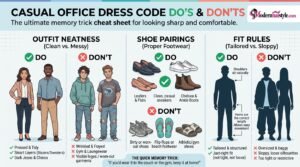
If your outfit passes that test, it is office-ready in most casual offices. If it fails on two parts — a graphic tee plus trainers, for example — it is weekend wear. One casual piece can work if the other pieces are structured, but two casual pieces usually tip the outfit over the line.
When in doubt, dress one level up. It is easier to remove a blazer than to wish you had worn one. That rule alone prevents more office mistakes than any single purchase, because overdressed is forgiven faster than underdressed.
The Formality Dial: 5 Office Levels
Level 1: Startup and Creative Casual
Level 1 is the most relaxed office level, for tech startups, creative studios, and agencies where rigid dress codes feel outdated. The formula is dark-wash jeans, an elevated casual top, and clean modern sneakers. The key is in the details, because relaxed does not mean sloppy at this level.
Your jeans should be well-fitted and dark enough to look intentional, not accidental. Your top should be a quality henley, crew-neck sweater, or fitted tee in a neutral tone. Your sneakers should be minimalist leather or clean canvas, not running shoes, because running shoes break the outfit instantly.
Level 1 outfit: dark-wash jeans + charcoal crew-neck sweater + white leather sneakers. That outfit communicates approachability while keeping a polished edge, which is exactly what a creative office rewards. Add an overshirt or unstructured blazer if a client walks in unexpectedly, and you are covered without changing clothes.
Level 2: Flexible Professional — The Sweet Spot
Level 2 is the sweet spot of modern office dressing, for hybrid workplaces, creative agencies, and companies with smart-casual policies. The formula is tailored chinos, a crisp button-down or refined polo, and versatile footwear that bridges casual and formal. Most readers in this article live at Level 2 most days.
Choose chinos in navy, olive, or khaki, and pair them with a well-fitted button-down shirt. White, light blue, or subtle patterns work beautifully, because they are professional without being formal. For footwear, think leather loafers, clean desert boots, or polished Oxford sneakers, all of which bridge the gap between casual and formal.
Level 2 outfit: navy chinos + white Oxford shirt + brown loafers. Layer strategically with a lightweight cardigan or unstructured blazer when the situation calls for more presence. That flexibility — dress up or down within the same outfit framework — is why Level 2 is the foundation for most office wardrobes.
Level 3: Corporate Casual
Level 3 is where business casual gets more structured, for established corporations that have embraced modern dress codes without abandoning polish. Dress trousers replace chinos, dress shirts become non-negotiable, and footwear steps firmly into leather territory. Optional blazers add instant authority when meetings matter.
Build around wool-blend dress trousers in charcoal, navy, or subtle patterns. Choose crisp dress shirts in classic colours — white, light blue, or refined stripes — because those colours signal competence without distraction. Leather dress shoes are essential here: Oxford lace-ups, refined loafers, or sleek monk straps all work at this level.
Level 3 outfit: charcoal wool trousers + light blue dress shirt + brown derbies + navy blazer, removed for desk work. That outfit communicates competence and reliability, qualities that matter in traditional business environments. When people ask what business casual means in a corporate setting, Level 3 is often the answer they are seeking.
Level 4: Client-Facing Professional
Level 4 handles client meetings, important presentations, and situations where appearance directly impacts business outcomes. Every detail matters here, because you represent not just yourself but your entire organisation. The formula becomes more refined: premium dress trousers, carefully selected dress shirts, quality leather shoes, and blazers that fit like they were made for you.
Invest in superior dress trousers with impeccable tailoring, and choose dress shirts in premium fabrics. Crisp cotton or subtle textures that catch light beautifully will read as more expensive than a louder pattern. Your leather shoes should be investment pieces — classic Oxfords, sophisticated brogues, or elegant loafers — because clients notice shoes first after the handshake.
Level 4 outfit: navy dress trousers + white dress shirt + charcoal blazer + black Oxfords + leather belt matched to shoes. Accessories start playing a supporting role here: a refined watch, a quality belt, and an occasional tie for elevated moments. That outfit demonstrates expertise and attention to detail, which builds trust before you say a word.
Level 5: Executive Smart Business Casual
Level 5 is smart business casual in its truest form, the most elevated expression of non-formal business dress. You are in senior-level environments where leadership presence matters, but full suiting is not required daily. The formula reaches peak sophistication: impeccably tailored separates, premium materials, flawless fit, and accessories that whisper rather than shout quality.
Think luxury dress trousers in fine wool or wool-silk blends, and dress shirts from premium brands in fabrics that feel as good as they look. Your blazers should be tailored to perfection, creating clean lines that enhance your silhouette without stiffness. Footwear becomes an investment category — handcrafted leather shoes, perhaps from heritage brands, that age beautifully with care.
Level 5 outfit: fine wool charcoal trousers + white premium dress shirt + tailored navy blazer + handcrafted brown Oxfords + classic watch. At this level, you are not just dressed appropriately — you are setting the standard for professional excellence in the room. Every element works in harmony to create a look that is both authoritative and approachable, which is the hardest balance in office dressing.
| Level | Office type | Top | Bottom | Shoes | Blazer? |
| 1 Startup / Creative | Tech, agency, studio | Henley, sweater, quality tee | Dark-wash jeans | Minimal sneakers | Optional overshirt |
| 2 Flexible Professional | Hybrid, smart-casual policy | Oxford, polo, knit polo | Chinos | Loafers, desert boots, Oxford sneakers | Optional |
| 3 Corporate Casual | Established corporation | Dress shirt, non-negotiable | Wool-blend trousers | Derbies, loafers, monk straps | Recommended |
| 4 Client-Facing | Meetings, presentations | Premium dress shirt | Premium dress trousers | Oxfords, brogues, loafers | Yes |
| 5 Executive | Senior leadership | Premium dress shirt | Fine wool trousers | Handcrafted leather shoes | Yes, tailored |
The Decision Table: Jeans, Sneakers, Shorts, and More
Most office mistakes come from one question asked too late: “Can I wear this?” This table answers the seven most common questions by level, so you do not have to guess. “Sometimes” means it works only if the piece is clean, dark, well-fitted, and paired with structured pieces — not if it is worn, faded, or sporty.
| Piece | Level 1 | Level 2 | Level 3 | Level 4–5 |
| Dark-wash jeans, no distressing | Yes | Sometimes | No — use trousers | No |
| Clean minimalist sneakers | Yes | Sometimes | No — use leather shoes | No |
| Polo shirt, structured, solid | Yes | Yes | Sometimes | No — use dress shirt |
| T-shirt, heavyweight, plain | Sometimes, under a layer | Sometimes, under a blazer | No | No |
| Shorts, tailored chino | No for office | No for office | No | No |
| Hoodie | Sometimes, in creative offices only | No | No | No |
| No blazer | Yes | Yes | Sometimes | No — wear one |
| Graphic tee, cargo, trainers | No | No | No | No |
Shorts deserve a clear rule, because they cause the most confusion. Tailored chino shorts work for a truly casual office only in the loosest sense, and most US offices still expect long trousers. When in doubt, keep long pants, because a short that is acceptable in one office can look like a holiday outfit in the next.
Linen trousers are the summer alternative that keeps you cool without breaking the dress code. They breathe almost as well as shorts, and they look like office trousers, not beachwear. That swap is the safest summer decision in this article.
Sneakers deserve the same clarity. Clean, minimal leather sneakers in white or a neutral colour work at Levels 1–2, while running shoes, chunky trainers, and visibly worn sneakers fall below the line everywhere. If your sneakers have bright colours, large logos, or athletic soles, they are not office sneakers, no matter how clean they are.
Business Casual vs Smart Casual vs Casual
Business casual prioritises office-appropriate structure, with tailored chinos or trousers, a collared shirt, and leather shoes that work across meetings and daily tasks. Smart casual leans more relaxed, with refined touches like dark jeans, knit polos, and premium sneakers for creative environments or after-hours networking.
Casual, on its own, means weekend wear — jeans, t-shirts, sneakers, and hoodies — with no office structure required. That distinction matters, because “casual office” is often used loosely for all three, and only the first two belong in an office.
The key contrasts are structure, fabric, footwear, and accessories. Business casual favours sharper lines and dress-shirt cottons, while smart casual embraces textured knits and slightly relaxed silhouettes. Business casual footwear is leather dress shoes and loafers, while smart casual allows elevated sneakers, and accessories in business casual welcome blazers and watches, while smart casual stays minimal.
| Dress code | Structure | Typical top | Typical bottom | Typical shoes | Best for |
| Business casual | Sharp, tailored | Dress shirt, Oxford | Chinos, wool trousers | Loafers, derbies, Oxfords | Office, meetings, corporate |
| Smart casual | Relaxed but refined | Knit polo, sweater, tee under layer | Dark jeans, chinos | Clean sneakers, loafers, boots | Creative office, dinner, events |
| Casual | No office structure | Tee, hoodie | Jeans, shorts | Trainers, sandals | Weekend, home, informal social |
| Business formal | Matched suit, tie required | Dress shirt + tie | Suit trousers | Oxfords, cap-toes | Boardroom, formal events, law/finance |
Business formal is a different code entirely, and confusing it with business casual causes overdressing. Business formal demands a matched suit, a tie, and polished leather dress shoes, with no flexibility on separates. Business casual gives you mix-and-match separates, optional ties, and a wider shoe range, which is why it suits most modern offices better than a daily suit.
The Core Wardrobe: 15 Pieces That Make 20+ Outfits
Tops: Oxfords, Polos, Knits, and the One Tee That Works
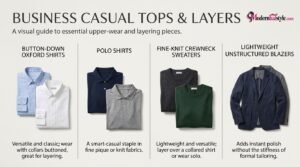
Start with two Oxford shirts: white and light blue. Those two shirts work with every bottom in this article, from navy chinos to charcoal trousers. They are the safest shirts for meetings, interviews, and first days, because they are neutral, crisp, and professional.
Choose Oxford cloth or poplin in cotton, with a button-down or spread collar that sits neatly under a blazer. A collar that collapses under a jacket looks sloppy, while a collar that stands cleanly looks intentional, even without a tie.
Add a refined knit polo in navy or grey, and a structured piqué polo in a solid colour. A knit polo drapes more softly and suits evening and travel, while a piqué polo suits daytime and warmer weather. Avoid golf polos with large logos, bright colours, or sporty cuts, because those read as leisure wear, not office wear.
Add a fine-gauge crew-neck sweater and a quarter-zip sweater in navy or charcoal. A crew-neck over a collared shirt adds structure without a blazer, because the collar peeking out signals intention. A quarter-zip works for cooler offices and travel days, but it should be fine-gauge and plain, not chunky or logo-heavy, to stay office-appropriate.
Add one heavyweight plain tee in white or black, for layering only at Levels 1–2. A heavyweight tee holds its shape, drapes cleanly, and works under a blazer or overshirt, while a thin tee looks like underwear under a jacket. Never wear a graphic tee, a faded tee, or a tee with a stretched neckline to the office, because those details undo an otherwise good outfit.
Bottoms: Chinos, Wool Trousers, and Dark Jeans
Start with two bottoms: tailored chinos in navy or charcoal, plus dress trousers in a complementary neutral. Those two bottoms anchor the entire wardrobe and work across Levels 2–3, which is where most office days sit. Choose a tapered leg, a comfortable waistband that stays comfortable when seated, and a hem that falls cleanly over shoes.
Add a second chino in stone or khaki for variety, and a wool-blend trouser in grey for smarter days. Stone chinos lighten a winter outfit and pair with navy, white, and olive tops, while grey wool trousers pair with almost every shirt and blazer in the wardrobe. That four-bottom rotation — two chinos, one wool trouser, one dark jean — covers a full work week without repetition.
Add one pair of premium dark-wash jeans, with a clean finish, minimal fading, no distressing, and a neat fit. Dark jeans work at Level 1 and, in relaxed offices, at Level 2, but they do not work at Levels 3–5. Pair dark jeans with an Oxford shirt, a polo, a sweater, or a blazer, and polished footwear, so the outfit reads as intentional rather than weekend.
Avoid cargo pants, joggers, ripped jeans, and baggy trousers in every office level. Those pieces signal leisure or manual work, not office work, and they cannot be rescued by a good shirt or shoe. If a trouser has large cargo pockets, an elasticated ankle, or visible distressing, it belongs outside the office, no matter how comfortable it feels.
Layers: Unstructured Blazer, Sports Coat, Overshirt, Overcoat
Include one strategic layer: an unstructured blazer in charcoal or navy. That single blazer transforms any combination from Level 2 casual to Level 3 corporate-ready instantly, which is why it is the most valuable layer in the wardrobe. Choose an unlined or half-lined blazer in a breathable fabric, so it works in summer as well as in air-conditioned offices.
Understand the difference between a blazer and a sports coat, because competitors blur it. Blazers tend to look cleaner and slightly more structured, and a navy blazer with grey trousers or beige chinos is one of the easiest combinations to build. Sports coats can introduce more texture, pattern, and personality, and they work especially well when you want a polished jacket without resembling a matching suit.
Add an overshirt in navy or olive for Level 1–2 days and coastal or cool evenings. An overshirt sits between a shirt and a jacket, so it suits offices where a full blazer feels overdressed. Wear it open over a tee or buttoned over a polo, with chinos or dark jeans, and it will look intentional without looking corporate.
Add an overcoat in charcoal or camel for winter, worn over the blazer. A wool overcoat completes a winter office outfit, protects the blazer underneath, and looks professional on a commute. Choose a coat that covers the blazer hem, fits comfortably over a sweater, and pairs with Chelsea boots or dress boots for wet and cold days.
Shoes: Loafers, Derbies, Chelsea Boots, and Minimal Sneakers
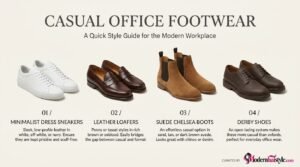
Choose two shoe options first: leather loafers for polished versatility, and clean Oxford sneakers for approachable professionalism. Both work with chinos, while dress shoes pair perfectly with trousers, which is why those two shoes cover most office days. Loafers work with chinos, tailored trousers, polos, and summer outfits, while Oxford sneakers work with chinos, dark jeans, and relaxed Fridays.
Add derbies or brogues for smarter days, and Chelsea boots for fall and winter. Derbies are slightly dressier than loafers and work when a meeting calls for a more traditional appearance. Chelsea boots are a useful fall and winter option with tailored trousers, chinos, knitwear, sports coats, and overcoats, because they are easy to slip on and look polished in wet weather.
Keep leather shoes clean and polished, because shoes make or break the look. Scuffed, dirty, or worn shoes undermine an otherwise perfect outfit, while polished shoes elevate even a simple shirt-and-chino combination. Rotate shoes so each pair dries between wears, use shoe trees for leather shoes, and condition leather regularly to prevent cracking.
| Shoe | Best for | Works with | Avoid with |
| Leather loafers | Everyday office, summer, meetings | Chinos, trousers, polos, Oxfords | Shorts in formal offices, gym wear |
| Derbies / brogues | Smarter meetings, corporate days | Wool trousers, dress shirts, blazers | Dark jeans in formal settings |
| Oxford shoes | Client meetings, executive days | Dress trousers, suits, blazers | Casual Fridays, dark jeans |
| Chelsea boots | Fall, winter, commuting | Trousers, chinos, knitwear, overcoats | Summer heat, shorts |
| Minimal sneakers | Startup, creative, casual Friday | Dark jeans, chinos, polos | Levels 3–5, formal meetings |
| Desert / chukka boots | Transitional seasons | Chinos, dark jeans, sweaters | Formal client meetings |
20 Copy-and-Paste Office Outfits by Occasion
Everyday Office — 5 Outfits
- The Monday Standard: navy blazer + white button-down + dark chinos + brown loafers. This is your default outfit, and when in doubt, wear this, because it works in almost every casual office. The blazer adds authority, the white shirt adds crispness, and the loafers keep it comfortable for a full day.
- The Flexible Tuesday: light blue Oxford shirt + charcoal chinos + brown loafers, no blazer. This is the Level 2 sweet spot, polished but relaxed, and it works for desk work, internal meetings, and after-work drinks. The light blue shirt softens the charcoal, so the outfit looks approachable without looking casual.
- The Warm Wednesday: navy polo + grey trousers + loafers, no socks or no-show socks. This is ideal for warm weather and relaxed workplaces, because the polo breathes and the trousers keep structure. Choose a structured polo, not a golf polo, so the outfit still reads as office wear.
- The Layered Thursday: grey sweater over a white shirt + navy trousers + derbies. This is a smart layered look for cooler days, because the collar peeking out adds structure without a blazer. The sweater should be fine-gauge, not chunky, so it fits under a blazer if the day changes.
- The Smart Friday Warm-Up: white Oxford shirt + olive chinos + suede loafers. This adds subtle colour while staying professional, and it works as a bridge into casual Friday. Olive chinos pair with white, navy, and light blue shirts, so they earn their place in a small rotation.
Client Meetings and Presentations — 5 Outfits
- The Client Classic: navy blazer + white dress shirt + grey trousers + brown leather dress shoes + brown belt. This is one step below a suit but unmistakably professional, and it is the safest client-meeting outfit in this article. Keep colours controlled, avoid distressed denim and loud prints, and let fit do the talking.
- The Corporate Authority: charcoal blazer + light blue shirt + navy trousers + loafers. This is a Level 3–4 outfit that signals competence without stiffness, because the blazer is structured but the shirt is soft blue, not stark white. It works for presentations to senior leadership and for first meetings with a new client.
- The Textured Meeting: textured navy blazer + striped shirt + grey trousers + dark loafers. Texture adds interest without colour risk, which is useful when you meet the same client repeatedly and do not want to repeat the exact same outfit. A subtle stripe or texture reads as intentional, while a loud pattern reads as distracting.
- The No-Tie Professional: charcoal trousers + light blue dress shirt + no tie + leather belt + Oxford shoes. This is the modern client outfit for offices that have dropped ties but not polish, because the Oxford shoes and tailored trousers carry the formality. A tie is optional here, and adding one only helps if the client is notably more formal than you.
- The Presentation Upgrade: sports coat + open-collar shirt + dress pants + polished leather shoes. This is polished without looking too formal, because the open collar relaxes the outfit while the sports coat keeps it authoritative. It works for conference talks, pitches, and panel appearances where a suit would feel stiff but a polo would feel underdressed.
Casual Friday — 5 Outfits
- The Casual Friday Standard: polo shirt + dark jeans + Chelsea boots, no blazer. This is the classic casual Friday formula, relaxed but still a level above everyone in hoodies. Dark jeans are essential here — light, faded, or ripped jeans turn casual Friday into weekend wear.
- The Sneaker Friday: dark slim jeans + henley or fitted tee + unstructured blazer + clean white sneakers. This is relaxed but intentional, because the blazer lifts the jeans and tee into office territory. The sneakers must be clean and minimal, or the whole outfit collapses into weekend wear.
- The Startup Friday: premium dark-wash jeans + charcoal crew-neck sweater + minimalist white sneakers. This is a Level 1 Friday outfit that communicates creativity and approachability, especially in tech and agency offices. The sweater should be quality knit, not a hoodie, because knit holds shape all day while a hoodie sags.
- The Smart Polo Friday: fitted polo in a rich colour (not a golf polo) + tailored trousers + clean leather sneakers. This is effortless but intentional, because the tailored trousers and leather sneakers balance the polo’s casualness. A rich colour — navy, burgundy, forest — looks more expensive than a bright or neon polo.
- The Summer Friday: linen shirt with sleeves rolled + lightweight chinos + loafers, no socks. This only works if your office is truly casual, and when in doubt, keep long pants and a collared shirt. Linen breathes in heat, but it wrinkles, so steam it in the morning and accept some texture by afternoon.
Interviews and First Days — 5 Outfits
- The Interview Safe: crisp dress shirt + tailored chinos or trousers + polished leather shoes + blazer. This is the safest interview outfit for a casual company, because it dresses toward the polished end of the code. Avoid graphic tees, distressed jeans, athletic sneakers, loud colours, and anything wrinkled or poorly fitted.
- The First-Day Read: white Oxford shirt + navy trousers + brown loafers + unstructured blazer carried, not worn, on arrival. This lets you read the room on day one: if the office is more relaxed, leave the blazer off; if it is more formal, put it on. That adaptability is more valuable than guessing the dress code correctly on the first try.
- The Creative Interview: patterned dress shirt (gingham or stripes) + khaki chinos + leather loafers or desert boots + matching belt. This shows personality while staying professional, which matters in creative, agency, and startup interviews. The pattern should be subtle, not loud, so it adds interest without distracting from your answers.
- The Corporate Interview: navy blazer + white shirt + charcoal trousers + Oxford shoes + tie, only if the company is notably formal. This is the Level 4–5 interview outfit, for finance, law, consulting, or senior roles where a tie is still expected. If the company is casual, drop the tie but keep the blazer, because overdressed is forgiven faster than underdressed.
- The Promotion Meeting: charcoal blazer + light blue dress shirt + navy trousers + brown derbies + classic watch. This is the outfit for a performance review, a promotion case, or a meeting with senior leadership, because it signals that you take the moment seriously. Keep accessories quiet — one watch, one belt, no pocket square and lapel pin together, because both together look like peacocking.
The 5-Day Office Plan: One Wardrobe, No Repeat Outfit
A 5-day plan needs only 8 core pieces to make 12+ combinations, if the pieces complement each other across every combination. Start with two bottoms (navy chinos, charcoal trousers), three tops (white button-down, navy knit polo, subtle patterned dress shirt), one layer (unstructured blazer), and two shoes (leather loafers, Oxford sneakers).
That 8-piece template is the most reusable structure in the SERP, and it is the foundation for the plan below. It works because every top works with every bottom, which is why a neutral palette matters more than the number of pieces.
| Day | Outfit | Level | Why it works |
| Monday | Navy blazer + white button-down + dark chinos + brown loafers | 2–3 | Default, authoritative, no decisions needed |
| Tuesday | Light blue Oxford + charcoal trousers + loafers | 2 | Polished, approachable, blazer-free |
| Wednesday | Navy knit polo + navy chinos + Oxford sneakers | 2 | Warm, comfortable, still structured |
| Thursday | Grey sweater over white shirt + navy trousers + derbies | 2–3 | Layered, cool-weather, meeting-ready |
| Friday | Patterned shirt + khaki chinos + desert boots, blazer optional | 1–2 | Casual Friday, personality, still polished |
Rotate shoes and layers, not just shirts, to avoid visible repetition. The same white shirt looks different with loafers and a blazer on Monday versus derbies and a sweater on Thursday, because the shoe and layer change the whole silhouette. That rotation is what prevents a small wardrobe from looking like the same outfit every day.
Plan a wash and press rhythm, not just outfits. Press shirts on Sunday, steam linen on the morning it is worn, and rotate shoes so each pair dries between wears. A 5-day plan fails on Thursday if Wednesday’s shirt is wrinkled and Thursday’s shoes are still damp from Tuesday, so care is part of the plan, not an afterthought.
Seasonal Office Outfits
Summer: Linen, Tropical Wool, and Breathable Fits
Summer office dressing keeps the same polished foundation while choosing lighter fabrics, breathable shirts, tailored trousers or chinos, and less structured layers. Loafers and other lightweight polished footwear complete the outfit without making it feel overly formal, which is the summer goal.
The mistake in summer is not heat — it is dropping structure entirely because it is hot. A linen shirt with tailored trousers is still office wear, while a tee with shorts is not, even if both feel cool.
Choose linen shirts, linen-cotton blends, and tropical wool for summer office wear. Linen breathes best in humid heat, linen-blend holds shape better for trousers, and tropical wool breathes for a blazer while still looking formal. Moisture-wicking performance shirts are a modern alternative for long, hot commutes, but they should look like dress shirts, not gym shirts, to stay office-appropriate.
Summer outfit: light blue linen shirt + lightweight stone chinos + brown loafers, no blazer. That outfit works for most summer office days, because the linen breathes, the chinos look smart, and the loafers are polished without being heavy. Add an unstructured blazer for meetings, and remove it for desk work, because air conditioning makes a blazer useful indoors even in summer.
Fall: Rich Tones, Layers, and Boots
Fall is the easiest season for office dressing, because layers add structure naturally. Rich tones — burgundy, olive, camel, charcoal — suit fall fabrics and look more expensive than bright summer colours. A crew-neck sweater over a collared shirt, a patterned blazer, and lace-up boots are the fall office staples that competitors list most often.
Fall outfit: black tee as a base layer + chinos + boots + patterned blazer. A black tee works as a base layer in fall because you can layer almost anything on top, and an unstructured blazer in a wool-blend fabric makes it look sophisticated. That outfit works for creative and flexible offices, while a dress shirt version works for corporate offices.
Fall shopping list: Oxford cloth button-down, short-sleeve polo, sweater polo, crew-neck sweater, black tee, patterned blazer, navy blazer, khaki chino, dark-wash jean, 5-pocket pant, loafer, and lace-up boot. That 12-piece fall list, from Style Girlfriend’s fall guide, is a useful starting point, but it should be adapted to your office level, not copied blindly.
Winter: Merino, Flannel, Overcoats, and Dress Boots
Winter office dressing layers button-down shirts with fine-gauge sweaters, sports coats, and overcoats. Tailored trousers, flannel trousers, and Chelsea boots add warmth while maintaining a professional appearance, which is the winter goal. The mistake in winter is bulk — a chunky sweater under a tight blazer looks uncomfortable and restricts movement all day.
Choose merino wool, flannel, and wool-blend trousers for winter office wear. Merino is lightweight, warm, and layers cleanly under a blazer, while flannel adds texture and warmth for trousers. A quarter-zip sweater in merino, a wool overcoat, and dress boots complete the winter system without needing a separate winter wardrobe.
Winter outfit: quarter-zip sweater + wool trousers + Chelsea boots + overcoat. That outfit is reliable for cold days, because the quarter-zip layers cleanly, the wool trousers insulate, and the Chelsea boots handle wet pavements. Add a merino sweater under a blazer for meetings, and a scarf in a muted tone for the commute, not for the office itself.
Spring: Light Layers and Transitional Colours
Spring suggests light cotton-linen blends, stretch wool, soft colours, and weather-ready loafers or suede boots. Spring temperatures change quickly, so breathable fabrics and light layers work best, because you may need a layer in the morning and not in the afternoon. A lightweight cardigan or unstructured blazer is the spring layer that handles that swing without bulk.
Spring outfit: white Oxford shirt + stone chinos + suede loafers + unstructured blazer carried. That outfit bridges winter and summer, because the Oxford is crisp, the chinos are light, and the blazer is available for meetings or cool mornings. Suede loafers suit spring, but they need weather protection if rain is forecast, so keep leather loafers as the wet-day backup.
US Climate Guide: Humid, Dry, Coastal, and Urban Offices
Humid Southeast and Gulf Coast
Humid Southeast summer, from Florida to the Gulf Coast, needs linen first. Humid heat makes heavy cotton trap heat and sweat, while linen’s open weave lets air move and moisture escape. Choose linen shirts, linen trousers, and linen-blend shorts for humid days, and accept linen wrinkles as part of the climate, not as a failure.
Humid office outfit: white linen shirt + lightweight navy chinos + brown loafers. That outfit breathes in humidity, looks smart in an office, and survives a commute better than a heavy Oxford shirt. Steam linen in the morning, and choose darker linen for evening meetings, because dark linen masks wrinkles better than white linen.
Dry Southwest and Inland California
Dry Southwest summer, from Arizona to inland California, needs seersucker and light cotton. Dry heat feels different from humid heat, because sweat evaporates quickly and the air feels less heavy, but sun exposure is stronger. Seersucker, with its puckered texture that lifts fabric off the skin, works well in dry heat, while light cotton chinos and tees work for everyday wear.
Dry office outfit: light blue seersucker or cotton shirt + stone chinos + leather loafers + sunglasses for the commute. A hat matters more in dry Southwest offices for the commute, because sun exposure is intense and shade is scarce. Sunscreen is still needed for exposed skin, even with a long-sleeve shirt, because dry heat does not reduce UV exposure.
Cool Coastal and Pacific Northwest
Cool coastal summer, from coastal California to the Pacific Northwest, needs a layer. Coastal summer can be cool in the morning and evening, even when the afternoon is warm, and a coastal breeze after sundown makes a layer essential. Choose a linen overshirt or an unstructured blazer as the layer, and keep linen trousers and a long-sleeve linen shirt for sun protection and warmth.
Coastal office outfit: light blue Oxford shirt + charcoal trousers + navy overshirt + brown loafers. That outfit handles a cool morning, a warm afternoon, and a breezy evening without changing clothes, because the overshirt can be added or removed. A coastal capsule that has no layer will leave you cold at dinner, even if you were hot at lunch.
Hot Urban Offices: New York, Chicago, and Air Conditioning
Hot urban summer means walking in heat outdoors, then sitting in air-conditioned offices indoors. That temperature swing needs a layer — an unstructured blazer or an overshirt — that can be put on indoors and removed outdoors. Urban summer also needs white sneakers or loafers for walking, because city walking in heavy dress shoes all day is uncomfortable.
Urban office outfit: knit polo + stone chinos + white sneakers for the commute, swapped for loafers at the desk if the office is stricter. A backpack or tote for carrying the layer, sunglasses, and a water bottle completes the urban system, because you cannot carry a blazer in your hands all day. That commute-to-desk swap is the most practical urban office habit in this article.
Fit Rules by Body Type
Tall, Short, Slim, Muscular, and Big-and-Tall
Tall men should check short length, trouser break, and blazer length first, because standard lengths are often too short for a tall frame. Choose trousers with a longer inseam that do not ride up when you sit, and a blazer that covers the waistband even when you raise your arms.
A tall man in a standard blazer that is too short looks underdressed, even if the blazer itself is high quality. That length check matters more than brand, because a short blazer cannot be fixed by a better fabric.
Short men should choose a tapered trouser, a shorter blazer, and a shirt that does not overwhelm the frame. Excess fabric makes a short frame look smaller, so fit must be tighter and cleaner. A tapered leg, a blazer that hits at mid-fly, and a shirt that hits at the belt all create a longer leg line, which is the goal for a short frame.
Slim men should choose a tailored fit, not a skinny fit, because a tailored fit follows the body without clinging, while a skinny fit restricts movement and looks uncomfortable in heat. A slim-straight trouser, a tailored shirt, and a clean shoulder seam all work for a slim frame, while very relaxed, oversized pieces can look shapeless in light fabrics.
Muscular and big-and-tall men should prioritise structured fabrics and athletic fits over very soft linen that clings. Cotton-sateen, linen-blend, and cotton twill hold shape better than 100% linen on a larger frame, and athletic fits give room in the chest, seat, and thighs without bagginess. Bonobos is noted in competitor comparisons for athletic fits that accommodate different body types, while Charles Tyrwhitt is noted for classic, slim, and extra-slim shirt fits — verify current fit guides at purchase time.
Fit is the foundation of office style, and it matters more than price. A well-tailored $50 shirt looks better than a poorly fitted $150 shirt, because fit is what other people see first. Shirts should sit cleanly across the shoulders, trousers should follow the shape of the body without excessive fabric, and jackets should fit comfortably through the chest and shoulders.
Fabric Guide: What to Wear in Heat, Cold, and Air Conditioning
Cotton, Linen, Wool, and Performance Fabrics Compared
Cotton is the everyday office workhorse, because it is durable, easy to care for, and wrinkles less than linen. Oxford cloth is textured and casual-smart, poplin is smooth and dressier, and twill is sturdy and holds structure for trousers. Long-staple cotton makes a better dress shirt, because it feels softer, holds shape longer, and pills less than short-staple cotton.
Linen is the most breathable summer fabric, because its open weave lets air move and moisture escape, which keeps you cool in humid heat. A linen-cotton blend reduces wrinkling while keeping most of linen’s breathability, which makes it the practical choice for trousers and travel shirts. Choose 100% linen for shirts you can steam, and blends for bottoms that need to hold shape all day.
Wool is the smart fabric for trousers and blazers across seasons, because tropical wool breathes in summer, wool-blend trousers insulate in winter, and Super 110–130 wool drapes cleanly year-round. Merino knit is lightweight layering that elevates smart-casual combinations without bulk, which is why merino sweaters appear in almost every competitor’s winter and transitional list.
Performance fabrics are the modern office alternative, with moisture-wicking, wrinkle-resistant, and four-way stretch properties that suit long workdays, travel, and commuting. Brands like Mizzen+Main are noted for performance dress shirts that resist wrinkles and move with you, but performance shirts should look like dress shirts, not gym shirts, to stay office-appropriate.
Avoid excessive polyester blends, which wrinkle unevenly and look flat under office lighting, according to competitor fabric guidance. That flat look is hard to fix with fit or colour, because the fabric itself lacks depth under fluorescent light.
| Fabric | Best for | Breathability | Wrinkle | Office use |
| Cotton Oxford / poplin | Dress shirts, everyday | Good | Low–medium | All levels, all seasons |
| Linen / linen-cotton | Summer shirts, trousers | Highest | High / medium | Levels 1–3, summer |
| Tropical wool | Blazers, trousers, summer | High | Low | Levels 3–5, summer |
| Wool blend / flannel | Trousers, winter layers | Medium | Low | Levels 2–5, fall/winter |
| Merino knit | Sweaters, polos, layers | Good | Low | All levels, transitional |
| Performance / technical | Travel, commute, long days | High | Very low | Levels 1–3, travel |
Brands by Budget: Budget, Mid-Range, and Premium Compared
Brand perception influences professional credibility, but fit influences it more. Professionals seeking the best men’s business casual brands must consider fabric sourcing, construction quality, fit consistency, and brand perception in their industry, not just price. A budget shirt that fits perfectly beats a premium shirt that does not, because fit is visible and price is not.
Budget tier: focus on tailoring adjustments, not on buying more pieces. Uniqlo is noted for affordable essentials — Oxford shirts, chinos, and lightweight knits — with simple, understated designs that are easy to mix and match. Dockers is noted for iconic chinos and khakis, modernised with updated fits and materials, and is a dependable office-friendly pant for regular wear.
Mid-range tier: balanced cost-to-quality ratio, good for scaling a wardrobe. Banana Republic is noted for timeless office staples with a modern touch — cleaned pants, custom-fitted knitwear, and simple jackets — often solid value on sale. Bonobos is noted for fit-focused chinos, dress pants, button-downs, and blazers, particularly for men who need tailored looks without stiffness, and for office pants that move with you.
Premium tier: Italian tailoring, premium wool mills, and strong drape retention, ideal for executives and leadership roles. Charles Tyrwhitt is noted for well-made shirts, timeless style, and multi-shirt bundles that bring per-shirt cost down, with classic, slim, extra-slim, and super-slim fits. Brooks Brothers is noted as the traditional American standard, with non-iron dress shirts in Oxford, broadcloth, and twill, plus Supima and Egyptian cottons, in slim, regular, relaxed, and Big & Tall fits.
Prices below are competitor-reported and must be verified at purchase time, because collections and prices change. Uniqlo Super Non-Iron Slim Shirt was reported at $49.50, Charles Tyrwhitt dress shirts at $129 list with multibuy discounts often bringing them to 45–65 per shirt, and Brooks Brothers non-iron shirts at about $128. Do not treat those prices as current without checking the brand’s current page on the date you buy.
| Tier | Brands | Best for | Watch out for |
| Budget | Uniqlo, Dockers | Essentials, chinos, first office wardrobe | Fabric quality varies by item; check fit in person |
| Mid-range | Banana Republic, Bonobos | Scaling a wardrobe, fit-focused pants and shirts | Sale pricing changes; verify current fits |
| Premium | Charles Tyrwhitt, Brooks Brothers, Suitsupply, Proper Cloth | Dress shirts, tailoring, executive days | Premium price needs premium fit to be worth it |
| Performance | Mizzen+Main, Rhone, Ministry of Supply, State and Liberty | Travel, long days, wrinkle resistance | Must look like a dress shirt, not gym wear |
Charles Tyrwhitt vs Bonobos is the most useful brand comparison for office buyers. Choose Charles Tyrwhitt if you work in a formal office, value traditional craftsmanship and Egyptian cotton, prefer a classic British aesthetic, and buy dress shirts in bundles. Choose Bonobos if you have struggled to find pants or shirts that fit off the rack, your office is business-casual or smart-casual, comfort and versatility matter more than traditional tailoring, and you want a modern wardrobe that works for office and weekend.
Hybrid and Video-Call Dressing
Waist-Up, Commute, and Desk-to-Dinner
Hybrid work needs clothes that transition smoothly between environments, looking comfortable on video calls but still sharp when you head to the office. A quarter-zip sweater or lightweight blazer can dress up a simple tee when required, which is the hybrid trick: keep the base simple, add one structured layer for the camera or the office.
That layer should be within reach, not buried in a closet, or you will not use it. A blazer on the back of your chair is a hybrid tool, not decoration, because it turns a home outfit into an office outfit in seconds.
Video-call dressing is waist-up dressing, but it still needs a full outfit. A collared shirt or knit polo in a solid colour reads better on camera than a busy pattern, because patterns moiré and distract on video. Light blue, navy, and white shirts read cleanly on camera, while black can lose detail and bright colours can blow out the image, depending on lighting.
Commuting needs wrinkle-resistant fabrics and secure pockets, because a commute creases clothes before the workday starts. Pair a travel blazer with stretch chinos and a moisture-wicking tee for a long commute, and finish with comfortable leather sneakers that can be swapped for loafers at the desk. A functional bag — messenger, briefcase, or leather backpack — keeps a laptop, a blazer, and gym gear organised without looking like a gym bag in the office.
Desk-to-dinner dressing is the same outfit with one change: shoe, layer, or accessory. Add a blazer to a polo-and-chino outfit for dinner, swap sneakers for loafers, or add a watch and a leather belt to signal evening. That one-change rule is why a capsule office wardrobe works for after-work events: you do not need a second outfit, you need one smarter layer or shoe.
Grooming, Care, and Finish: The 10-Minute Polish Checklist
Grooming and finish are part of the outfit, not an extra. A pressed shirt, clean shoes, a tucked shirt, a collar that sits neatly, and a belt that matches your shoes all signal intention, while wrinkled garments and scuffed shoes undermine professional appearance even if the clothes themselves are expensive.
That finish is what separates a casual office outfit from a weekend outfit in the same pieces. Two men can wear the same shirt and chinos, and the one with pressed shirt and polished shoes will look like the office version.
Press shirts and maintain crisp, clean lines, especially for Oxfords and dress shirts. Steam linen in the morning, press cotton shirts on Sunday for the week, and hang shirts rather than folding them tightly, because folding sets creases. A shirt that is clean but wrinkled reads as careless, while a shirt that is pressed reads as professional, even if it is a budget shirt.
Match your belt to your shoes in tone, and keep accessories quiet and practical. A brown belt with brown shoes, a black belt with black shoes, and a simple watch are all you need for most office days. A pocket square or a lapel pin can make a blazer look more polished, but adding both can look like peacocking, so choose one, not both, for a normal office day.
Shoe care is the highest-return grooming habit in this article. Polish leather shoes, brush suede shoes, rotate shoes so each pair dries, and use shoe trees for leather shoes to preserve shape. Clean minimalist sneakers regularly, because a dirty white sneaker ruins an otherwise sharp outfit faster than any other single detail.
Mistakes That Make a Casual Office Outfit Look Sloppy
- Wearing overly casual items. Steer clear of graphic tees, flip-flops, cargo pants, and athletic wear in business casual environments, because those pieces cannot be rescued by a blazer or a good shoe.
- Poor fit and grooming. Avoid overly tight clothing, wrinkled garments, and scuffed shoes that undermine your professional appearance, because fit and finish are visible before brand or price.
- Misreading the dress code. Do not assume all business casual settings are identical, because some require more polish than others, and a startup outfit will fail in a corporate office.
- Wearing running shoes as office shoes. Running shoes, chunky trainers, and athletic designs are too casual for business casual, even if they are clean and expensive.
- Wearing distressed or faded jeans to a meeting. Dark, clean, well-fitted jeans work in relaxed offices, but ripped, faded, or light jeans do not work for client meetings or interviews.
- Wearing loud prints or large logos. Loud prints, logo-heavy shirts, and bright colours distract in meetings and read as leisure wear, not office wear, especially on video calls.
- Skipping a layer when the day might change. A day that starts as desk work can become a client meeting, so carry a blazer or keep one at the office, rather than wishing you had one available.
- Matching nothing: belt, shoes, and bag in different tones. A brown belt with black shoes, a gym backpack with a blazer, and a scuffed shoe with a pressed shirt all break the outfit’s coherence, even if each piece is good on its own.
Expert Tips
- Identify your office level before you buy anything. Level 1, 2, 3, 4, or 5 determines whether jeans, sneakers, and polos are allowed, and buying before you know the level wastes money.
- Buy the 8-piece template first, then expand. Two bottoms, three tops, one blazer, and two shoes make 12+ combinations, which is enough to test whether a capsule works for your office.
- Use the structured top + tailored bottom + polished shoes test every morning. If your outfit passes all three parts, it is office-ready; if it fails two parts, change one piece before you leave.
- Change the shoe and the layer, not just the shirt, to avoid repetition. The same shirt and trousers look different with loafers and a blazer versus sneakers and no layer.
- Keep a blazer at the office, even if you do not wear it daily. A day that starts as desk work can become a client meeting, and a blazer on the back of your chair covers that change instantly.
- Match belt to shoes, and keep accessories to one statement piece. A watch plus a belt is enough; a pocket square plus a lapel pin together looks like peacocking in a normal office.
- Steam linen in the morning and accept evening texture. Linen wrinkles are part of the fabric, and a perfectly smooth linen shirt looks unnatural, not polished.
- Rotate shoes so each pair dries between wears. Rotation prevents odour, extends shoe life, and gives you a backup pair when one pair is wet from a commute.
- Dress one level up for interviews, first days, and client meetings. Overdressed is forgiven faster than underdressed, and you can always remove a blazer or tie.
- Verify prices and fits on the brand’s current page before you buy. Collections, prices, and fit guides change, and a competitor-reported price from last season is not a current price.
FAQs
What is a casual office outfit for men?
A casual office outfit for men is a collared shirt or polo, tailored chinos or trousers, and polished leather shoes, with no suit or tie required. That formula works in most casual offices, and a blazer is added for meetings or smarter days. If the outfit has two casual pieces — a graphic tee plus trainers, for example — it is weekend wear, not office wear.
What is the difference between business casual and smart casual for men?
Business casual prioritises office structure, with tailored chinos or trousers, a collared shirt, and leather shoes, while smart casual leans more relaxed, with dark jeans, knit polos, and premium sneakers. Business casual is one step more formal, and many workplaces ban jeans under business casual while allowing them under smart casual. Use business casual for office days and smart casual for creative offices, dinners, and after-hours events.
Can men wear jeans to a casual office?
Yes, dark-wash jeans with a clean finish, minimal fading, no distressing, and a neat fit work in relaxed offices at Levels 1–2. Pair them with an Oxford shirt, polo, sweater, or blazer, and polished footwear, so the outfit reads as intentional. For conservative offices, interviews, client meetings, or Levels 3–5, chinos or tailored trousers are the safer option.
Can men wear sneakers to the office?
Yes, clean, minimal leather sneakers in white or a neutral colour work at Levels 1–2, especially in startup, creative, and hybrid offices. Running shoes, chunky trainers, bright colours, and large logos fall below the line everywhere, because they read as athletic wear, not office wear. For Levels 3–5, wear leather loafers, derbies, or Oxfords instead.
Can men wear shorts to a casual office?
No, in most US offices, even tailored chino shorts are not office-appropriate, and long trousers are the safer choice. Shorts work for a truly casual office only in the loosest sense, and when in doubt, keep long pants. Linen trousers are the summer alternative that keeps you cool without breaking the dress code.
Can men wear a t-shirt to the office?
Sometimes, a heavyweight plain tee works at Levels 1–2, but only under a blazer, overshirt, or structured layer, never on its own as an office top. A thin, faded, or graphic tee does not work at any office level, because it reads as underwear or weekend wear. For Levels 3–5, wear a collared shirt or polo instead.
Can men wear a polo shirt to the office?
Yes, a structured polo in a solid colour works at Levels 1–2, and sometimes at Level 3 in warmer weather or less formal offices. Choose a clean, structured polo, not a golf polo with large logos or bright colours, and pair it with tailored trousers or chinos. A knit polo drapes more softly and suits evening and travel better than piqué cotton.
Do men need to wear a blazer for business casual?
No, a blazer is not required for business casual, but it is the fastest way to look more polished. A well-fitted Oxford shirt with chinos and loafers, a polo with tailored trousers, or a fine-gauge sweater over a collared shirt can all look professional without a jacket. When you skip the blazer, fit and footwear matter even more, because there is no layer to hide a poor fit.
What is the easiest business casual outfit for men?
The easiest business casual outfit is a white or light blue Oxford shirt, navy or charcoal chinos or trousers, and brown loafers, with a navy blazer added for meetings. That outfit works in almost every casual office, because every piece is neutral, tailored, and polished. It is also the best default when you do not know the office level on a given day.
What should men wear on casual Friday?
Casual Friday outfits for men include a polo with dark jeans and Chelsea boots, or dark jeans with a fitted tee, unstructured blazer, and clean white sneakers. Both formulas are relaxed but still a level above hoodies and trainers, because the jeans are dark and clean, and the shoe or blazer adds structure. Light, faded, or ripped jeans turn casual Friday into weekend wear.
What should men wear to a client meeting in a casual office?
For a client meeting, dress one level up from your normal office day: navy blazer, white or light blue dress shirt, tailored trousers, and polished leather shoes. Keep colours controlled, avoid distressed denim, gym sneakers, wrinkled shirts, and loud prints, because a client-facing outfit should feel clean and intentional. If the meeting is especially important or the industry is conservative, move closer to business formal.
What should men wear to a job interview at a casual company?
For an interview at a casual company, dress toward the polished end of the code: crisp dress shirt, tailored chinos or trousers, polished leather shoes, and a blazer. Avoid graphic tees, distressed jeans, athletic sneakers, loud colours, and anything wrinkled or poorly fitted, because interviews reward polish over casualness. If the company is notably formal, add a tie; if it is casual, drop the tie but keep the blazer.
What should men wear on their first day at a new office?
On your first day, wear a white Oxford shirt, navy trousers, brown loafers, and an unstructured blazer carried, not worn, on arrival. That lets you read the room: if the office is more relaxed, leave the blazer off; if it is more formal, put it on. Guessing the dress code correctly matters less than being able to adapt in the first hour.
What if my office dress code is unclear or unwritten?
If the dress code is unclear, observe colleagues for a week, check the employee handbook, and dress one level up until you know the norm. Industry matters too: finance leans more formal, tech allows a more relaxed approach, and client-facing roles need more polish than internal roles. When uncertain, choose slightly overdressed over underdressed, because it is easier to remove a jacket than to wish you had one.
What colours work best for men’s office outfits?
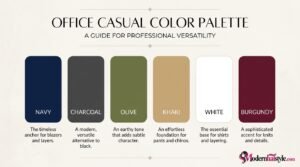
Navy, charcoal, white, light blue, stone, khaki, and olive work best for men’s office outfits, because they mix easily and look professional in every season. That neutral palette, sometimes called the blue/khaki or blue/grey rule, lets every top work with every bottom, which is essential for a small office rotation. Add one accent — burgundy, forest, or camel — in a single piece, not in every piece, to avoid clashing.
What shoes should men wear with chinos to the office?
Leather loafers, derbies, desert boots, and clean Oxford sneakers all work with chinos to the office, depending on the level. Loafers are the most versatile, derbies are smarter for meetings, desert boots suit transitional seasons, and Oxford sneakers suit relaxed Fridays. Match your belt to your shoes in tone, and avoid running shoes, flip-flops, and scuffed shoes with chinos.
What is the best office outfit for summer for men?
The best summer office outfit for men is a light blue linen or linen-cotton shirt, lightweight stone or navy chinos, and brown loafers, with an unstructured blazer for meetings. Linen breathes in humid heat, linen-blend holds shape better for trousers, and tropical wool works for a summer blazer. Avoid shorts in most offices, and use linen trousers as the cool alternative to shorts.
What is the best office outfit for winter for men?
The best winter office outfit for men is a quarter-zip or merino sweater over a dress shirt, wool or flannel trousers, Chelsea boots, and a wool overcoat. Merino layers cleanly under a blazer, flannel adds warmth and texture for trousers, and Chelsea boots handle wet pavements while looking polished. Add a muted scarf for the commute, not for the office itself.
How do men dress casual but professional?
Men dress casual but professional by combining one relaxed piece with structured pieces: a polo with tailored trousers, dark jeans with a blazer, or a sweater over a collared shirt. The key is intention: clean lines, quality fit, and polished shoes, rather than a collection of casual pieces worn together. If every piece is casual, the outfit is weekend wear; if one piece is casual and the rest are structured, it is office wear.
What brands are best for men’s casual office clothes?
The best brands for men’s casual office clothes by tier are Uniqlo and Dockers for budget essentials, Banana Republic and Bonobos for mid-range fit-focused pieces, and Charles Tyrwhitt and Brooks Brothers for premium dress shirts and tailoring. Performance brands like Mizzen+Main suit travel and long days, but they must look like dress shirts, not gym shirts. Verify current prices and fit guides on each brand’s page before buying, because collections change.
How should office clothes fit for tall, short, and big-and-tall men?
Tall men should check trouser inseam and blazer length first, short men should choose tapered trousers and shorter blazers, and big-and-tall men should choose structured fabrics and athletic fits. Slim men should choose tailored, not skinny, fits, because tailored follows the body without restricting movement. In every case, fit matters more than price, because a well-fitted budget shirt beats a poorly fitted premium shirt.
Can men wear the same office outfit twice in one week?
Yes, if you change the shoe, layer, or accessory, because the same shirt and trousers look different with loafers and a blazer versus sneakers and no layer. Repeating the exact same outfit, including shoes and layer, on consecutive days reads as a lack of rotation, while changing one element makes it a new outfit. A 5-day plan works precisely because it rotates shoes and layers, not just shirts.
What should men wear for a video call from home?
For a video call from home, wear a solid-colour collared shirt or knit polo in light blue, navy, or white, with tailored trousers or chinos, even if only your upper body is visible. Solid colours read better on camera than busy patterns, which can moiré and distract, and a full outfit prevents an embarrassing moment if you stand up. Add a quarter-zip or blazer if the call is with a client or senior leadership.
What bag should men carry to a casual office?
Men should carry a messenger bag, briefcase, or leather backpack to a casual office, in a colour that matches their shoes and belt in tone. A gym bag, a bright backpack, or a worn tote undermines a polished outfit, even if the clothes themselves are perfect. Choose a bag that fits a laptop, a blazer, and daily essentials without looking bulky, and keep it clean and scuff-free.
How many outfits can men make from 15 office pieces?
Fifteen well-chosen office pieces can make 20+ outfits, because 8 core pieces alone — two bottoms, three tops, one blazer, and two shoes — make 12+ combinations. The maths only works if every top works with every bottom, which is why a neutral palette and a formality dial matter more than the number of pieces. A capsule with random colours will make fewer good outfits than a smaller capsule with a disciplined palette.
Conclusion on Mens Office Outfits Casual
Mens office outfits casual work when you stop guessing and start using a system. Identify your office level, apply the structured top + tailored bottom + polished shoes test, and copy formulas that fit that level. Five levels, from startup creative to executive smart business casual, cover almost every US office, and the decision table for jeans, sneakers, shorts, and t-shirts removes the daily uncertainty that makes office dressing stressful.
Start with the 8-piece template, then build to 15 pieces and 20 outfits. Buy two bottoms, three tops, one unstructured blazer, and two shoes first, test the 5-day plan in this article, and then add seasonal layers, smarter shoes, and one premium piece at a time. Check fit before price, match belt to shoes, keep shoes polished, and verify current brand prices and fits before you buy, because collections change.
Build your rotation in that order, and use the Related Topics links above to go deeper on the pieces that matter most to your office. Start with the formality dial and the decision table, because those two tools will prevent more mistakes than any single purchase — and in a casual office, avoiding one underdressed day is worth more than owning one more shirt.

