
Mens capsule wardrobe summer planning fails when it starts with a shopping list. A list of twenty random pieces will clash, repeat, and leave you with nothing for Monday. A capsule works only when every piece matches the rest.
The count is stated plainly here and used throughout. This capsule is 20 pieces: 8 tops, 5 bottoms, 1 layer, 3 shoes, and 3 accessories. Swim trunks are a seasonal add-on, not counted in the core 20.
On a beach trip, swap light jeans for swim trunks to stay at 20. That swap keeps the count honest and the capsule consistent. You get a 20-piece checklist, a palette rule, fabric rules, fit rules, and outfit formulas.
The 20-Piece Summer Capsule in 30 Seconds
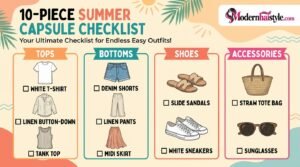
Tops (8): white tee, navy tee, grey tee, white linen shirt, light blue linen shirt, camp collar shirt, navy polo, and knit polo. Bottoms (5): stone chinos, linen trousers, navy chino shorts, tailored linen shorts, and light-wash jeans.
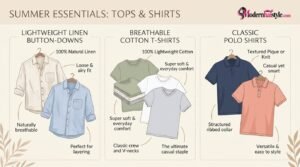
Layer (1): unstructured blazer in tan or blue linen-cotton. Shoes (3): white sneakers, brown loafers, and leather sandals. Accessories (3): sunglasses, a brown leather belt, and a dad cap or Panama hat.
Palette: navy, white, stone, and olive as the base, plus light blue and sand as neutrals, and one accent. Fabrics: linen for humid heat, cotton for everyday wear, linen-cotton blends for wrinkle resistance, and seersucker for dry heat.
That checklist covers work, weekend, evening, beach, and travel. The palette does the work, so you do not plan each outfit from scratch. Change the shoe, the layer, or the accessory, and the same top and bottom become a different outfit.
What Is a Mens Summer Capsule Wardrobe?
Capsule vs. Full Wardrobe vs. Travel Capsule
A capsule wardrobe is a small, coordinated set of clothes that can be mixed and matched into many outfits. The point is not owning less for its own sake, but owning right. Each piece should be worn often and work with the rest.
A capsule that only saves space but still clashes has failed. It should make mornings easier, not harder. If you stand in front of it and still cannot choose, the system is wrong.
Counts measure different scopes, and competitors confuse them. Ten to twelve pieces is a travel capsule for one week in one bag, with a wash planned once. Twenty pieces is a summer capsule for a season at home.
Twenty-four pieces is a year-round capsule, including wool trousers and a heavier jacket. Those items do not belong in summer, so do not buy them for July. Thirty to thirty-five pieces is closer to a full wardrobe, not a capsule at all.
Do not compare those counts as if they were the same thing. A reader who buys a 24-piece year-round list for summer will end up with a topcoat he never wears. A reader who buys a 10-piece travel list for a whole summer will run out of clean shirts by Wednesday.
Match the count to the scope first, then buy the pieces. That one decision prevents most capsule mistakes before you spend anything.
The Palette Rule: Dark Neutral, Light Neutral, and Two Accents
A capsule only works when colours play well together, so limit yourself to a small palette before you buy anything. The most disciplined system in the SERP, from Colorito, uses four palette roles. Those roles are a dark neutral, a light neutral, and two accents.
Fill every slot in those colours, and any shirt works with any trouser. Compatibility is decided at the palette level, not outfit by outfit in front of the mirror. That is what makes a capsule fast to use.
Dark neutrals anchor trousers and outerwear, and navy, charcoal, and brown are the safest choices. Light neutrals suit shirts and knits, and white, light blue, and cream are the safest choices. Accents add interest, and olive, burgundy, sand, or one bold stripe are useful accents.
Accents should appear in only one or two pieces, not in every piece. If every piece is bold, nothing matches and the palette collapses. Restraint is what makes an accent stand out.
For this summer capsule, the palette is navy, white, stone, and olive as the base. Light blue and sand are added as neutrals, with one accent. That palette keeps every top working with every bottom.
It also keeps shoes simple and accessories from fighting the clothes. If you are unsure which colours suit you, start with navy, grey, and white. Men who begin with those three colours rarely come back with outfits that clash.
The 20-Piece Checklist
Tops (8): Tees, Linen Shirts, Camp Collar, and Polos
White tee, navy tee, and grey tee are the foundation. They work under a blazer, with shorts, with chinos, and on their own. Choose heavyweight cotton with a clean silhouette, not a thin, sheer tee.
A thin tee loses shape after two washes and looks tired fast. A heavyweight tee holds its structure in heat and drapes cleanly. It also survives repeated washing without going see-through.
White linen shirt and light blue linen shirt are the smart-casual workhorses. A white linen shirt works for work, dinner, and evening. A light blue linen shirt works for daytime, travel, and weekend.
Both breathe better than Oxford cloth in heat. Both pair with stone chinos, navy shorts, and linen trousers without a second thought. That is why linen shirts earn two slots, not one.
Camp collar shirt, also called a Cuban collar shirt, is the relaxed summer shirt that makes an evening outfit feel intentional. Choose a camp collar in olive, a neutral stripe, or one bold colour. Wear it open over a tee or buttoned with linen trousers.
A camp collar with a wide stripe in a bold colour is one of the most effective short-sleeve options for summer. It adds pattern without adding heat, which is exactly what a summer evening needs.
Navy polo and knit polo cover the gap between a tee and a shirt. A navy polo in piqué cotton suits daytime, sport, and casual work. A knit polo in merino or cotton knit suits evening and travel with a softer drape.
You need one of each if you cover both daytime and evening. If you only need one, choose the knit polo for its versatility. It dresses up more easily than piqué cotton.
Bottoms (5): Chinos, Linen Trousers, Shorts, and Light Jeans
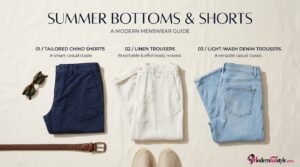
Stone chinos are the most versatile bottom in the capsule. They work for work, dinner, travel, and weekend with almost every top. Choose lightweight chinos in cotton-sateen or a cotton-linen blend.
Choose stone or khaki, with a tapered leg and a clean front. Stone chinos with a white linen shirt create a smart-casual look. Stone chinos with a tee and sneakers create a relaxed weekend look.
Linen trousers are the elegant answer when shorts are not appropriate but heat is high. Choose linen trousers in stone or light grey, with a tapered leg. Pair them with a linen shirt for the most practical warm-weather outfit that still looks dressed up.
Linen trousers with a camp collar shirt and loafers work for dinner. Linen trousers with a white tee and sandals work for a coastal evening. That range is why linen trousers earn a slot.
Navy chino shorts are the smart-casual short, hitting just above the knee. Choose navy or stone, in cotton twill or a cotton-linen blend. Navy chino shorts work with a linen shirt, a polo, and a tee.
They look smarter than denim shorts for daytime and travel. Tailored linen shorts are the relaxed short, in beige, olive, or sand, in a linen-cotton blend. The blend holds shape better than 100% linen on the warmest afternoons.
Light-wash jeans are the casual anchor for cool evenings, travel days, and weekend outfits. Choose lightweight denim in a light wash, with a straight or slim-straight fit. Wear them with a tee, a polo, or a linen shirt.
On a beach trip, swap light jeans for swim trunks to keep the capsule at 20 pieces. Wear the swim trunks with a linen shirt and sandals for beach-to-lunch outfits. That swap is the cleanest way to handle vacation.
Layer (1): Unstructured Blazer
One unstructured, unlined blazer is the single layer that turns a tee-and-chinos outfit into a smart-casual outfit. Choose an unstructured blazer in tan or blue, in a linen-cotton blend or seersucker. Use a half-lined or unlined construction that breathes in heat.
A structured, padded blazer traps heat and looks wrong in summer. An unstructured blazer drapes like a shirt and still sharpens the whole outfit. That difference matters more in July than in January.
Wear the blazer for work meetings, dinners, weddings, and cool evenings, and remove it outdoors in high heat. An unstructured blazer over a white tee and stone chinos works for a creative office. The same blazer over a white linen shirt and linen trousers works for dinner.
That one layer is what makes a capsule cover both casual and smart occasions without a second jacket. Without it, the capsule stops at casual and cannot step up.
If you need a second layer for coastal evenings, add a linen overshirt as a seasonal extra, not as part of the core 20. A slightly heavier linen overshirt works when coastal breezes pick up after sundown. It layers over a tee without the formality of a blazer.
Keep the core at one blazer, and treat the overshirt as a climate add-on. Counting it in the core would break the 20-piece discipline.
Shoes (3): White Sneakers, Brown Loafers, and Leather Sandals
White sneakers are the city walking shoe, for travel, weekend, and all-day comfort. Choose clean, minimalist white leather sneakers, not running shoes. Running shoes look wrong with chinos and a blazer.
White sneakers work with shorts, chinos, jeans, and linen trousers. They are the shoe you wear on a travel day when you will walk for hours. Clean them often, because dirty white sneakers ruin a sharp outfit.
Brown loafers are the smart-casual shoe, for work, dinner, and evening, in leather or suede. Choose brown loafers with a clean shape, and wear them with no-show socks. No-show socks prevent sweat and odour while keeping the bare-ankle look.
Brown loafers with stone chinos and a linen shirt are a complete business-casual outfit. Brown loafers with linen trousers and a camp collar shirt are a complete evening outfit. One shoe, two very different occasions.
Leather sandals are the beach and relaxed-evening shoe, in simple leather with two or three straps maximum, in black or brown. Simple leather sandals work for beach lunch, coastal dinner, and relaxed evening. Functional sandals, gladiator styles, and slides do not work for styled outfits.
Slides are a beach and pool shoe, not a city shoe. They belong in a beach bag, not in a styled summer capsule. That distinction keeps the capsule looking intentional.
Espadrilles are a useful fourth shoe for coastal vacation, in canvas with a rope sole, for coastal casual wear and coastal dinner. If you add espadrilles, swap leather sandals for espadrilles on a coastal trip. That swap keeps the shoe count at three, because a capsule with four summer shoes starts to lose discipline.
Suede loafers are an alternative to leather loafers for a smarter look. They need more care in rain and should not be your only loafer. Leather is the safer first choice for daily summer wear.
Accessories (3): Sunglasses, Belt, and Cap or Hat
Sunglasses should be chosen for timeless frame shapes — wayfarer, round, rectangular acetate, or panto. Avoid trend-driven designs that date faster than the clothes. Choose tortoiseshell or dark acetate with UV protection.
Sunglasses are both a style piece and a sun-protection piece. A timeless frame works with every outfit in the capsule. A trend frame only works with one outfit in one season.
A brown leather belt matched to your brown loafers is the core belt. A black leather belt is the second belt if you wear black shoes or a dark blazer. A reversible black-to-brown belt is a useful capsule shortcut if you want to save a slot.
A belt should match your shoes in tone, not necessarily in exact shade. It should be simple leather without a large, loud buckle. Simplicity keeps the focus on the outfit, not the buckle.
A dad cap for casual and travel, or a Panama hat for coastal and evening, is the third accessory. Choose one, not both, for a 20-piece capsule. A dad cap works with a tee, shorts, and sneakers for weekend and travel.
A Panama hat works with a linen shirt, linen trousers, and loafers for coastal dinner and vacation. A watch, a dark leather wallet, and a canvas or leather backpack complete the accessory system. They are everyday carry, not capsule slots to count.
| Slot | Count | Pieces and colours |
| Tops | 8 | White tee, navy tee, grey tee, white linen shirt, light blue linen shirt, camp collar shirt (olive or stripe), navy polo, knit polo |
| Bottoms | 5 | Stone chinos, linen trousers (stone or light grey), navy chino shorts, tailored linen shorts (beige or olive), light-wash jeans |
| Layer | 1 | Unstructured blazer (tan or blue, linen-cotton or seersucker) |
| Shoes | 3 | White leather sneakers, brown loafers, leather sandals (black or brown) |
| Accessories | 3 | Sunglasses (wayfarer or tortoiseshell), brown leather belt, dad cap or Panama hat |
| Total | 20 | Swim trunks are a seasonal add-on: swap light jeans for swim on a beach trip to stay at 20 |
Fabrics for Summer
Linen vs. Linen-Blend: Wrinkle, Shape, and Care
Linen is the most breathable summer fabric, because its open weave lets air move and moisture escape. That keeps you cool in humid heat, where heavy cotton traps sweat. A 100% linen shirt feels light, airy, and effortless.
It also looks relaxed even when it wrinkles. That wrinkle is part of linen’s character, and dark linen masks wrinkles better than white linen. That is why a dark linen set works well for evening.
Linen-blend fabrics reduce wrinkling while keeping most of linen’s breathability. They combine linen with cotton in a linen-cotton or cotton-linen blend. For travel, linen-blend shirts reduce wrinkling while maintaining many breathability benefits.
That makes them the practical choice for a travel capsule. For shorts and trousers, a linen-cotton blend often helps the garment hold its shape. It still feels light and airy on the warmest afternoons.
Choose 100% linen for shirts you can steam, and linen-blend for shorts and trousers that need to hold shape. A 100% linen shirt steamed in the morning will look sharp for dinner. A 100% linen short will wrinkle and bag by lunchtime.
That split — linen for shirts, blend for bottoms — is the simplest wrinkle system. It beats trying to iron every piece every morning, which no one sustains in summer.
Cotton, Cotton-Sateen, Chambray, and Tropical Wool
Cotton is the everyday summer workhorse, because it is durable, easy to care for, and wrinkles less than linen. Long-staple cotton makes a better tee and polo, because it feels softer and holds shape longer. It also pills less than short-staple cotton.
A heavyweight cotton tee in white, navy, or grey is the most-worn piece in most summer capsules. It is worth buying the best cotton you can afford for those three tees. Cheap tees cost more per wear when they lose shape fast.
Cotton-sateen is a smooth, slightly lustrous cotton weave that suits lightweight chinos. It drapes cleanly and looks smarter than cotton twill. Cotton twill is a sturdier weave that suits tailored shorts and everyday chinos.
It holds structure and resists wear well. Chambray is a light, denim-like cotton fabric that suits summer shirts. It looks like denim but feels like a light shirt, and it works as a spring-to-summer transitional piece.
Tropical-weight wool is the smart fabric for a summer blazer and trousers. It is woven loosely to breathe in heat while still looking formal. A blazer in tropical-weight wool, or a linen-cotton blend, gives you a structured look without winter heat.
Seersucker, with its puckered stripe texture, is another smart summer fabric for blazers and shirts. It suits dry heat and business-casual settings, because the texture lifts the fabric off the skin and improves airflow.
| Fabric | Best for | Breathability | Wrinkle | Care |
| 100% linen | Shirts, coastal evening | Highest | High — accept texture, steam | Wash cold, hang-dry, steam |
| Linen-cotton blend | Shorts, trousers, travel shirts | High | Medium — holds shape better | Wash cold, reshape damp, hang-dry |
| Cotton / cotton-sateen | Tees, chinos, polos | Good | Low to medium | Wash cold, low-heat dry |
| Cotton twill | Tailored shorts, everyday chinos | Good | Low | Wash cold, air-dry to avoid shrinkage |
| Seersucker | Blazers, shirts, dry heat | High | Low — texture hides wrinkles | Wash cold, hang-dry |
| Chambray | Summer shirts, transitional layers | Good | Medium | Wash cold, hang-dry |
| Tropical wool | Summer blazer, smart trousers | Good | Low | Dry clean or gentle wash per label |
Colours That Mix
Base Palette: Navy, White, Stone, and Olive
Navy is the dark neutral that anchors the capsule. It works for trousers, shorts, polos, and blazers, and it pairs with white, stone, light blue, and olive. Navy chino shorts with a white linen shirt are a complete summer outfit.
A navy polo with stone chinos is another complete outfit, using the same palette logic. Navy is also the safest blazer colour for summer work, because it looks formal without looking wintery.
White is the light neutral that lightens the capsule. It works for tees, linen shirts, and sneakers, and it reflects heat in a way dark colours do not. A white tee with navy shorts and white sneakers is a clean weekend outfit.
A white linen shirt with stone chinos and brown loafers is a clean work outfit. White sneakers are the lightest shoe in the capsule, and they balance dark bottoms in the same way a white shirt balances dark trousers.
Stone and olive are the earth tones that give the capsule variety without breaking it. Stone chinos and stone linen trousers work with navy, white, light blue, and olive tops. Olive shorts and an olive camp collar shirt add a natural, coastal tone that still pairs with white and navy.
Stone is a warm neutral that suits most skin tones. Olive is a muted green that adds interest without shouting, which is exactly what an accent should do.
Accents: Light Blue, Sand, and One Bold Colour
Light blue and sand are the soft neutrals that expand the palette without adding risk. A light blue linen shirt works with stone, navy, and white bottoms. A sand linen short works with white, navy, and olive tops.
Those two colours are the reason a capsule with only navy, white, stone, and olive does not look repetitive. Light blue and sand create new combinations from the same core pieces, without breaking the palette.
One bold colour is enough for a capsule, and it should appear in only one piece. Use it in a camp collar shirt with a wide stripe, a bold linen shirt, or a single accent tee. A bold colour in one piece gives you a statement outfit for evening or vacation.
A bold colour in every piece destroys the palette and makes mixing impossible. If you are unsure which bold colour to choose, choose a wide-striped linen shirt. Stripes add pattern and colour in one piece, which is efficient.
Colour analysis is optional, not required. The Vou’s True/Cool Summer system, with steel grey, French navy, slate blue, cool plum, blue-grey, and cool charcoal, is one personal-colour system. It suits some men with cool undertones, but it is not a universal rule.
It should not replace the navy, white, stone, and olive base that works for most men. Use colour analysis as a refinement step after you have built the base capsule, not as a starting requirement.
Fit Rules for Summer
Short Length, Trouser Break, Blazer Length, and Tee Length
Shorts should hit just above the knee for chino shorts and tailored shorts. That length looks smart, keeps you cool, and works for daytime, travel, and smart-casual evening. Shorts that hit mid-thigh look too short for smart-casual.
Shorts below the knee look dated and heavy in summer heat. Check short length in a mirror while standing, not while sitting. Shorts ride up when you sit, and the standing length is what other people see.
Trousers should have a slight break or no break, with the hem just touching the shoe, not pooling around the ankle. Linen trousers and stone chinos with a tapered leg look cleanest with loafers and sneakers. A tapered leg shows the shoe and keeps the silhouette sharp.
A trouser that pools at the ankle looks heavy in summer, even if the fabric is light. The extra fabric adds visual weight, which defeats the point of a light summer fabric.
A blazer should cover the waistband and hit at mid-fly, with an unstructured shoulder that follows your natural shoulder line. A padded shoulder adds width and looks wrong in summer. An unstructured blazer that is too long looks like a coat.
A blazer that is too short looks like a jacket that does not belong with trousers. Check blazer length with the blazer buttoned and unbuttoned, because an unstructured blazer is often worn open in summer.
A tee should cover the belt and hit at mid-fly, with a shoulder seam that sits on your shoulder bone. A seam halfway down your arm means the tee is too large. A tee that is too long looks like a tunic, while a tee that is too short rides up when you move.
A heavyweight tee holds its length better than a thin tee. That is another reason to buy heavyweight cotton for the three core tees, not the cheapest option.
Tall, Short, Slim, and Big-and-Tall Adjustments
Tall men should check short length, trouser break, and blazer length first. Standard lengths are often too short for a tall frame, so those three checks matter most. Choose shorts that still hit just above the knee on your longer leg.
Choose trousers with a longer inseam that do not ride up when you sit. Choose a blazer that covers the waistband even when you raise your arms. A tall man in a standard blazer that is too short looks underdressed, even if the blazer itself is high quality.
Short men should choose a tapered trouser, a shorter blazer, and a tee that does not overwhelm the frame. Excess fabric makes a short frame look smaller, so fit must be tighter and cleaner. A tapered leg, a blazer that hits at mid-fly, and a tee that hits at the belt all create a longer leg line.
Avoid very long shorts, very long tees, and very wide trousers. Those pieces break the leg line and shorten the silhouette, which is the opposite of what a short frame needs.
Slim men should choose a tailored fit, not a skinny fit. A tailored fit follows the body without clinging, while a skinny fit restricts movement and looks uncomfortable in heat. A slim-straight trouser, a tailored short, and a tee with a clean shoulder seam all work for a slim frame.
Avoid very relaxed, oversized pieces unless you are deliberately styling an oversized look. Oversized summer clothes can look shapeless in light fabrics, especially linen, which already drapes softly.
Big-and-tall men should prioritise structured fabrics over very soft linen that clings. Cotton-sateen, linen-blend, and cotton twill hold shape better than 100% linen on a larger frame. Choose a tailored rather than slim fit, a longer blazer that balances proportions, and a wide toe box in shoes if needed.
No competitor gives big-and-tall-specific summer rules, so verify fit in person. Brands vary by model, and a size in one brand may not match another, so do not order blind in bulk.
Outfit Formulas by Occasion
Work and Business Casual
Work Monday: white linen shirt + stone chinos + brown loafers + unstructured blazer. That outfit works for a business-casual office, a client meeting, and a work dinner. The linen shirt breathes, the chinos look smart, the loafers look professional, and the blazer adds formality without heat.
Remove the blazer outdoors, and put it back on indoors. Air conditioning makes a tee feel cold, so a blazer is useful even in summer offices. That indoor-outdoor switch is a core summer skill.
Work Tuesday: light blue linen shirt + navy chino shorts + white sneakers, if your office allows shorts. If it does not, use light blue linen shirt + linen trousers + brown loafers instead. That distinction is the real summer office question, and the answer depends on your office dress code, not on fashion rules.
Check the code before you assume shorts are allowed. Keep linen trousers as the safe alternative that still feels like summer, because they breathe almost as well as shorts.
Work Friday: navy polo + stone chinos + white sneakers + unstructured blazer, open, for a relaxed Friday. A polo with chinos and sneakers is casual, but a blazer over it, even open, signals that you thought about the outfit. That formula is the easiest way to dress down without looking sloppy.
The blazer does the smart work while the polo and sneakers do the comfort work. That division of labour is what makes Friday outfits work.
Weekend Casual
Weekend Saturday: white tee + navy chino shorts + white sneakers + dad cap. That outfit is the simplest summer capsule outfit, and it works for errands, city walking, casual lunch, and travel. Every piece is comfortable, breathable, and easy to wash.
A white tee with navy shorts and white sneakers is clean, not boring, when the tee is heavyweight. The shorts should be tailored, and the sneakers should be clean, because those details make a simple outfit look sharp.
Weekend Sunday: grey tee + tailored linen shorts + leather sandals + sunglasses. That outfit is more relaxed than Saturday, because linen shorts and sandals signal leisure. The grey tee keeps the outfit from looking like beachwear, which matters for a city Sunday.
Grey works with beige, olive, and navy shorts. That is why a grey tee is a core capsule piece, not an afterthought, even though it looks plain on a hanger.
Weekend evening: camp collar shirt + light-wash jeans + brown loafers. That outfit bridges weekend and evening, because the camp collar adds pattern and interest. The jeans add structure, and the loafers add smartness, so the whole outfit steps up without a blazer.
A camp collar shirt open over a white tee, with jeans and loafers, is another version of the same formula. It works when the evening is cool enough for a layer, but not cool enough for a blazer.
Evening, Date, and Dinner
Evening dinner: camp collar shirt + linen trousers + brown loafers. That outfit is the summer evening standard, because the camp collar adds personality. The linen trousers add elegance, and the loafers add polish, so no piece has to do all the work.
Choose a camp collar in olive, a neutral stripe, or one bold colour. Keep the trousers in stone or light grey so the shirt can be the focus. If both shirt and trousers are bold, the outfit competes with itself.
Date night: knit polo + linen trousers + brown loafers + unstructured blazer, if the restaurant is smart. If the date is casual, use knit polo + stone chinos + white sneakers instead. A knit polo drapes more softly than a piqué polo, which makes it better for evening.
A blazer over it adds formality without a tie or a dress shirt. That formula works for a first date, because it looks intentional without looking overdressed, which is the right balance.
Coastal evening: white linen shirt + linen trousers + leather sandals + Panama hat, if the evening is coastal and relaxed. That outfit uses the coastal palette of white, sand, and stone, and it looks effortless. Every piece is breathable and light, so it suits a warm coastal evening.
A linen overshirt over a white tee, with linen trousers and sandals, is the cooler-evening version. Use it when a coastal breeze picks up after sundown and a shirt alone feels thin.
Beach and Coastal Vacation
Beach day: swim trunks + white linen shirt, open, + leather sandals + sunglasses + dad cap. That outfit is the beach-to-lunch formula, because the linen shirt provides sun protection. It also looks dressed up enough for a beach restaurant, while the swim trunks and sandals are ready for the water.
A long-sleeve linen shirt, with sleeves rolled up, gives more sun protection during midday walks. It still looks relaxed, because linen sleeves rolled up signal leisure, not work.
Coastal vacation day: camp collar shirt + tailored linen shorts + leather sandals. That outfit is the coastal capsule in one line, because the camp collar adds texture. The linen shorts breathe, and the sandals are easy to slip off at the beach.
A drawstring linen trouser, with a tapered leg, is the evening version of the same idea. It is comfortable enough for lounging yet crisp enough for an open-air restaurant, which is a useful coastal combination.
Beach-to-city day: white tee + stone chinos + white sneakers + linen shirt, worn open as a layer. That outfit transitions from beach to city, because the tee and chinos are city-ready. The sneakers are walking-ready, and the open linen shirt adds a layer that can be removed at the beach and put back on for dinner.
That transition is the whole point of a beach-to-city capsule: fewer pieces, more occasions. If a piece only works at the beach, it does not belong in a city capsule.
Travel Day and One-Bag Packing
Travel day outfit: knit polo + stone chinos + white sneakers + unstructured blazer, worn on the trip. Wear the bulkiest pieces on the trip — the blazer, the jeans, and the sneakers — so your bag stays light. A knit polo resists wrinkles better than a linen shirt, which makes it the best travel top.
Stone chinos resist wrinkles better than linen trousers for a long travel day. That wrinkle resistance matters on a flight, a train, or a long drive, where you sit for hours.
Seven-day travel packing: pack 10 to 12 pieces in one colour family, plan to wash once, and limit shoes to two pairs. Pack the pair you wear and one smarter pair, such as loafers, and nothing else. Pack four or five tops, one merino knit, one pair of chinos besides the jeans you travel in, shorts for a warm destination, and two shoes at most.
Navy, grey, white, and one earth tone keep every top working with every bottom. That colour discipline is the whole point when space is tight and you cannot afford a clash.
Day-by-day travel plan: Day 1 travel in knit polo, chinos, sneakers, and blazer. Day 2 white linen shirt, navy shorts, sneakers. Day 3 camp collar shirt, linen trousers, loafers.
Day 4 navy polo, stone chinos, sneakers, with a wash that evening. Day 5 white tee, tailored shorts, sandals. Day 6 light blue linen shirt, light jeans, loafers. Day 7 grey tee, navy shorts, sneakers.
That plan uses 10 pieces for 7 days without a repeat outfit. The shoe and the layer change the same top and bottom into a different look, which is why the plan works.
Shoes for Summer
Loafers, Sneakers, Sandals, and Espadrilles by Occasion
Loafers are the smart shoe, for work, dinner, and evening, in leather for durability and suede for a softer, smarter look. Leather loafers handle rain and daily wear better than suede. Suede loafers look smarter for evening but need more care.
Wear loafers with no-show socks, rotate them so each pair dries between wears, and condition leather regularly. Conditioning prevents cracking in summer heat, which is a common cause of early loafer failure.
White sneakers are the walking shoe, for city, travel, and weekend, in clean leather or canvas. White sneakers work with shorts, chinos, jeans, and linen trousers, but they must be clean to work with smart-casual outfits. A dirty white sneaker ruins an otherwise sharp outfit, no matter how good the shirt is.
Spot-clean white sneakers regularly, and keep a second pair for travel if you walk all day. One pair can dry while you wear the other, which prevents odour and extends both pairs.
Leather sandals are the relaxed shoe, for beach, pool, and relaxed evening, in simple leather with two or three straps in black or brown. Leather sandals work with shorts, linen trousers, and swim trunks, but they do not work for work or formal dinner. They are too casual for those occasions, even if they are expensive leather.
Espadrilles, in canvas with a rope sole, are a smarter coastal alternative to sandals. They work for coastal dinner where sandals would feel too relaxed, which makes them useful on vacation.
Dress sneakers are a modern smart-casual option, in minimalist leather or canvas, clean and well-maintained. They suit offices that allow sneakers but not running shoes, because they look like a shoe, not a trainer. A premium dress sneaker, such as a Cole Haan model named in Men’s Wearhouse guidance, bridges the gap between a white sneaker and a loafer.
Dress sneakers work with chinos and a blazer, but they do not replace loafers for formal work or evening. Keep loafers for the smartest occasions, and use dress sneakers for the middle ground.
Wrinkle, Sweat, and Care System
Linen Wrinkle System
Accept some linen texture, and manage the rest with blends and steaming. Linen wrinkles because its fibres are stiff and do not spring back after bending. That is why a linen shirt wrinkles at the elbows and waist after sitting.
That texture is part of linen’s look, and a perfectly smooth linen shirt looks unnatural. It looks like a shirt that was never worn, which is not the goal. The goal is controlled wrinkles that look intentional rather than messy.
Use linen-blend for pieces that need to hold shape, steam rather than iron where possible, and hang-dry or dry flat to reduce wrinkles. Wash linen cold, reshape damp, and hang the garment to dry, rather than tumble-drying on high heat. High heat sets wrinkles and shrinks the fabric, which makes the problem worse.
Steam a linen shirt in the morning for dinner, and accept that it will wrinkle again by evening. That cycle is normal for linen, not a failure of care, so do not fight it with constant ironing.
Dark linen masks wrinkles better than white linen, which is why a dark linen set works well for evening and travel. A black or dark charcoal linen set, with a short-sleeve button-down shirt and matching shorts, transitions from a sunny afternoon at the beach to an evening dinner. The dark colour helps mask the natural wrinkles that occur when wearing linen.
White linen, by contrast, shows every wrinkle, so it needs more steaming and a more relaxed attitude to texture. If white linen wrinkles bother you, choose a linen-blend white shirt instead of 100% linen.
Sweat, Odour, and Shoe Care
Sweat is a summer capsule problem, not just a comfort problem. Sweat stains, odour, and fabric breakdown all shorten a capsule’s life, because capsule pieces are worn often. Wash tees and polos cold, reshape damp, and air-dry to avoid shrinkage.
Wash linen shirts cold and hang-dry to preserve the fabric. Do not tumble-dry linen or heavyweight cotton on high heat, because high heat sets wrinkles, shrinks cotton, and breaks down elastic in waistbands.
Shoe odour prevention starts with rotation and no-show socks. Wear no-show socks with loafers, rotate shoes so each pair dries between wears, and spot-clean sneakers and sandals regularly. Do not wear the same pair every day in summer heat, because a shoe that never dries will smell, even if it is high quality.
Air-dry shoes after a wet day, and condition leather shoes regularly to prevent cracking. Conditioning keeps the leather supple, which matters more in summer heat and humidity than in winter.
Sun protection is part of summer care, not just style. A long-sleeve linen shirt, a Panama hat or dad cap, and sunglasses with UV protection all reduce sun exposure. They do not replace sunscreen, which is still needed for exposed skin.
A hat shades the face and scalp, sunglasses protect the eyes, and a linen shirt protects the arms and torso. Exposed skin still needs sunscreen, especially at the beach and on a boat, where reflection increases exposure.
Budget Tiers and Cost Per Wear
Good, Better, and Best Tiers
Good tier: buy the core first, in affordable versions, and test the system. A good-tier capsule uses affordable tees, chinos, shorts, and sneakers, with one linen shirt and one pair of loafers as the smarter pieces. That tier lets you test whether a capsule works for your life before you invest in premium pieces.
It still covers work, weekend, and travel if the palette and fit are right. The risk in the good tier is fabric quality: cheap linen wrinkles more, cheap tees lose shape faster, and cheap shoes wear out sooner.
Better tier: buy better fabrics for the pieces you wear most. A better-tier capsule invests in heavyweight cotton tees, linen-cotton blend shirts and shorts, quality chinos, and leather loafers and sneakers that last more than one season. That tier costs more upfront, but it costs less per wear, because each piece is worn dozens of times and lasts longer.
The better tier is the sweet spot for most men, because it balances quality and price without luxury pricing. If you only invest in one tier, invest here, because it gives the best return on the pieces you actually wear.
Best tier: buy premium fabrics and tailoring for the pieces that define the capsule. A best-tier capsule invests in a premium unstructured blazer, premium linen shirts, and premium leather shoes, with the rest of the capsule at better-tier quality. That tier is for men who wear a capsule every day for work and want the blazer, the shirt, and the shoe to look and feel premium.
The best tier does not mean buying every piece at luxury prices. It means buying the defining pieces at premium quality and the rest at good quality, which is a smarter use of budget.
Cost per wear is the honest way to compare tiers. Divide the price of a piece by the number of times you wear it, and a $150 linen shirt worn 50 times costs $3 per wear. A $30 shirt worn 5 times costs $6 per wear, even though it looked cheaper in the shop.
A capsule with fewer, better pieces often has a lower cost per wear than a large wardrobe of cheap pieces. Each capsule piece is worn more often, so the upfront price is spread across more wears, which is the real economy of a capsule.
One verified price point from the SERP is useful here, with a warning. Everlane’s capsule collection showed a tee price of $34 in the fetched variants, which gives a sense of good-tier tee pricing. That price was observed in a collection page and may change by season, so do not treat $34 as a permanent price.
Verify the current price, fabric, and fit before you buy. No other competitor in the SERP gave a usable, dated US price for a capsule piece. That gap is itself a reason to verify prices rather than inventing them in an article.
US Climate Guide
Humid Southeast, Dry Southwest, Coastal, and Urban Summer
Humid Southeast summer, from Florida to the Gulf Coast, needs linen first. Humid heat makes heavy cotton trap heat and sweat, while linen’s open weave lets air move and moisture escape. Choose linen shirts, linen trousers, and linen-blend shorts for humid summer, and accept linen wrinkles as part of the climate.
A camp collar shirt, with its open collar and short sleeves, breathes better than a buttoned Oxford in humid heat. A linen overshirt is less useful in humid heat than in coastal cool evenings, because humid heat needs less layering, not more.
Dry Southwest summer, from Arizona to inland California, needs seersucker and light cotton. Dry heat feels different from humid heat, because sweat evaporates quickly and the air feels less heavy. Sun exposure is stronger and temperatures are higher, so sun protection matters more.
Seersucker, with its puckered texture that lifts fabric off the skin, works well in dry heat. Light cotton chinos and tees work well for everyday wear, because they are durable and easy to care for in dry conditions.
A hat and sunglasses matter more in dry Southwest summer, because sun exposure is intense and shade is scarce. A dad cap or Panama hat shades the face and scalp, while sunglasses with UV protection protect the eyes. Sunscreen is still needed for exposed skin, even with a hat and a long-sleeve shirt.
Cool coastal summer, from coastal California to the Pacific Northwest, needs a layer. Coastal summer can be cool in the morning and evening, even when the afternoon is warm. A coastal breeze after sundown makes a layer essential, even on a day that felt hot at lunch.
Choose a linen overshirt or an unstructured blazer as the layer. Keep linen trousers and a long-sleeve linen shirt in the capsule for sun protection and warmth. A coastal capsule that has no layer will leave you cold at dinner, even if you were hot at lunch.
Hot urban summer, from New York to Chicago, needs a work-to-weekend capsule that handles air conditioning. Urban summer means walking in heat outdoors, then sitting in air-conditioned offices, restaurants, and transport indoors. That temperature swing needs a layer — an unstructured blazer or an overshirt — that can be put on indoors and removed outdoors.
Urban summer also needs white sneakers for walking, because city walking in loafers all day is uncomfortable. A backpack or tote for carrying the layer, sunglasses, and a water bottle completes the urban summer system.
Summer-to-Fall Transition
The 4-Piece Swap
You do not need four separate seasonal wardrobes. Keep the core all year and swap four to six pieces when the weather changes, as MensArray’s swap model suggests. The core that stays out year-round includes white tees, Oxfords, jeans, chinos, a navy blazer, and white sneakers.
The seasonal pieces swap in and out around that core. In a warm climate, you may only need two swaps a year, while in a cold climate, the winter add-ons do most of the work for four or five months.
For summer to fall, swap four pieces. Swap shorts for lightweight trousers, add an overshirt or flannel shirt, swap sandals for suede boots or loafers, and add a merino sweater or knit polo for cool evenings. Keep the linen shirts for early fall, because September can still be warm, and store swim trunks and linen shorts until next summer.
That 4-piece swap turns a summer capsule into an early-fall capsule without buying a new wardrobe. It is cheaper, faster, and less wasteful than a seasonal rebuild, which is the point of a capsule system.
Store summer pieces properly, not just in a box. Wash linen and cotton pieces cold, dry them fully, and store them in a clean, dry place. Damp storage causes mildew and odour, which can ruin a piece that was in perfect condition at the end of summer.
Keep the blazer on a hanger, not folded, to preserve its shape. Keep shoes with shoe trees or stuffing to preserve their shape, because a shoe that collapses in storage will not recover. A capsule that is stored well lasts longer, and a capsule that is stored damp will smell next summer no matter how good the fabric was.
Mistakes to Avoid
- Buying accents before the core. A bold camp collar shirt is useless if you have no white tee, no stone chinos, and no white sneakers to pair it with. Buy the core first, test outfit formulas, then add accents.
- Ignoring the palette. A capsule with random colours — a red tee, a green short, a yellow shirt — will clash, even if each piece is high quality. Choose the palette first, then buy only pieces in that palette.
- Choosing 100% linen for everything. A 100% linen short will wrinkle and bag by lunchtime, while a linen-blend short will hold shape. Use 100% linen for shirts you can steam, and blends for bottoms that need shape.
- Wearing slides for styled outfits. Slides work for beach and pool, not for city, dinner, or work. Simple leather sandals work for styled summer outfits, while slides do not, because they look like house shoes outdoors.
- Forgetting a layer. A summer capsule with no blazer or overshirt will leave you cold in air-conditioned offices and coastal evenings. One unstructured blazer covers work, dinner, and cool evenings.
- Buying the wrong shoe for the occasion. White sneakers for walking, brown loafers for work and dinner, leather sandals for beach and relaxed evening — each shoe has an occasion, and no single shoe covers all occasions.
- Ignoring fit. A capsule with poor fits is just a smaller pile of problems, because every piece is worn often and every fit flaw shows often. Check short length, trouser break, blazer length, and tee length before you buy.
- Copying a year-round count for summer. A 24-piece year-round list includes wool trousers and a topcoat that do not belong in summer, while a 10-piece travel list is too small for a season at home. Match the count to the scope: 20 for summer, 10 to 12 for travel.
Expert Tips
- Choose the palette before you buy a single piece. Navy, white, stone, and olive, plus light blue and sand, will prevent more outfit mistakes than any single purchase.
- Buy the core seven first, then test formulas. White tee, navy polo, white linen shirt, stone chinos, navy chino shorts, white sneakers, and brown loafers will tell you whether a capsule works for your life.
- Use linen for shirts and blends for bottoms. That split gives you linen’s breathability where it matters most, and shape retention where wrinkles matter most.
- Change the shoe and the layer, not just the top. The same tee and chinos look different with loafers and a blazer versus sneakers and no layer, and that change is what prevents outfit repetition.
- Wear the bulkiest pieces on a travel day. A blazer, jeans, and sneakers worn on the trip will keep your bag light and your packing simple.
- Steam linen in the morning, and accept evening wrinkles. Linen texture is part of the fabric, and a perfectly smooth linen shirt looks unnatural, not polished.
- Rotate shoes so each pair dries between wears. Rotation prevents odour, extends shoe life, and gives you a backup pair when one pair is wet.
- Check short length standing, not sitting. Shorts ride up when you sit, and the standing length is what other people see, so judge shorts in a mirror while standing.
- Keep one bold piece, not five. A single camp collar shirt in a bold stripe gives you a statement outfit, while five bold pieces destroy the palette and make mixing impossible.
- Swap four pieces for fall, do not buy a new wardrobe. Shorts for lightweight trousers, sandals for suede boots, add an overshirt and a merino sweater, and your summer capsule becomes an early-fall capsule.
FAQs
How many pieces should a mens summer capsule wardrobe have?
A mens summer capsule wardrobe should have 20 pieces: 8 tops, 5 bottoms, 1 layer, 3 shoes, and 3 accessories. Ten to twelve pieces is a travel capsule for one week, while 24 pieces is a year-round capsule. Match the count to the scope first, then buy the pieces.
What should be in a mens summer capsule wardrobe?
Tees, linen shirts, a camp collar shirt, polos, linen trousers, chinos, chino shorts, tailored shorts, light jeans, an unstructured blazer, white sneakers, brown loafers, leather sandals, sunglasses, a belt, and a cap or hat make up the 20-piece capsule. Swim trunks are a seasonal add-on for beach and vacation, swapped for light jeans on a beach trip.
What colours work for a mens summer capsule wardrobe?
Navy, white, stone, and olive as the base, plus light blue and sand as neutrals, and one accent work best for a mens summer capsule wardrobe. That palette lets every top work with every bottom, which is the whole point of a capsule. Colour analysis is optional, not required, and universal neutrals are the safe starting point.
What fabrics are best for summer menswear?
Linen for humid heat, cotton and cotton-sateen for everyday wear, seersucker for dry heat, linen-cotton blends for wrinkle resistance, and tropical-weight wool for a summer blazer are the best summer menswear fabrics. Linen breathes best, cotton is most durable, seersucker lifts off the skin in dry heat, and blends give you linen’s breathability with better shape retention.
How do I build a capsule wardrobe for summer?
Start with a palette, then fill 8 tops, 5 bottoms, 1 layer, 3 shoes, and 3 accessories in those colours, buy the core first, test outfit formulas, then add accents. Buy white tee, navy polo, white linen shirt, stone chinos, navy chino shorts, white sneakers, and brown loafers first, because those seven pieces will tell you whether a capsule works for your life.
What shoes go with a mens summer capsule wardrobe?
White sneakers for city walking and travel, brown loafers for work and dinner, and leather sandals for beach and relaxed evening go with a mens summer capsule wardrobe. Wear loafers with no-show socks, keep white sneakers clean for smart-casual outfits, and choose simple leather sandals with two or three straps in black or brown.
Can I wear shorts to a business casual office in summer?
It depends on your office dress code, and tailored chino shorts in stone or navy with a linen shirt and loafers work in relaxed business-casual offices. In formal offices, wear lightweight chinos or linen trousers instead, because shorts, even tailored shorts, may violate a formal dress code. Check the code before you assume shorts are allowed.
How do I stop linen from wrinkling?
Choose linen-blend shirts and shorts for shape retention, steam rather than iron where possible, wash cold, reshape damp, and hang-dry or dry flat. Accept some linen texture, because linen wrinkles are part of the fabric, and dark linen masks wrinkles better than white linen. Use 100% linen for shirts you can steam in the morning, and blends for bottoms that need to hold shape all day.
How do I pack a summer capsule wardrobe for travel?
Pack 10 to 12 pieces in one colour family for a week, wear the bulkiest pieces on the trip, limit shoes to two pairs, and plan to wash once. Wear the blazer, jeans, and sneakers on the trip, pack four or five tops, one merino knit, one pair of chinos besides the jeans you travel in, shorts for a warm destination, and two shoes at most.
What is a capsule wardrobe for men over 40?
The same 20-piece checklist, shifted smarter: trade one or two tees for polos or Oxford shirts, make the knit a merino or cashmere polo, choose an unstructured blazer as the layer, and keep at least one pair of good leather shoes. That shift, from MensArray’s over-40 guidance, keeps the capsule comfortable and casual while adding the smarter pieces that suit a more formal work and social life after 40.
Linen vs. cotton for summer — which is better?
Linen breathes better and suits humid heat, while cotton is more durable, easier to care for, and wrinkles less. Linen-blend gives you most of linen’s breathability with better shape and less wrinkling, which makes it the best compromise for shorts and trousers. Choose linen for shirts, cotton for everyday tees and chinos, and blends for travel and bottoms.
Linen vs. seersucker for summer?
Linen is softer and more versatile for shirts and trousers, while seersucker is lighter, more structured, and suits dry heat and business-casual blazers. Both fabrics breathe well, but seersucker’s puckered texture lifts the fabric off the skin and improves airflow in dry heat. Choose linen for coastal and humid summer, and seersucker for dry and urban summer.
Chino shorts vs. tailored shorts — which is more versatile?
Chino shorts in stone or navy, hitting just above the knee, are more versatile for smart-casual and evening use, while tailored linen shorts are cooler and more relaxed for beach and vacation. A capsule that covers work and vacation needs both, while a capsule that only needs one pair should choose chino shorts, because they work for more occasions than linen shorts alone.
Loafers vs. sneakers for summer?
Loafers in leather or suede are smarter for work, dinner, and evening, while white sneakers are better for city walking, travel, and all-day comfort. A capsule needs both, because neither shoe covers every occasion alone, and the shoe you choose changes the same top and bottom into a different outfit. Wear loafers with no-show socks, and keep white sneakers clean for smart-casual outfits.
White sneakers vs. leather sandals for summer?
White sneakers work for walking, travel, and smart-casual, while leather sandals work for beach, pool, and relaxed evening. Simple leather sandals with two or three straps in black or brown work for styled summer outfits, while functional sandals, gladiator styles, and slides do not work for styled outfits and belong at the beach or pool.
Camp collar vs. Oxford shirt for summer?
A camp collar shirt, also called a Cuban collar shirt, is more relaxed and breathable for evening and vacation, while an Oxford shirt is smarter for work. A capsule that covers both work and evening needs one of each, while a vacation capsule can use camp collar alone. A camp collar in olive, a neutral stripe, or one bold colour adds pattern without adding heat.
Unstructured blazer vs. overshirt for summer?
An unstructured, unlined blazer in linen-cotton or seersucker is smarter for work and dinner, while an overshirt is more casual for cool evenings and coastal breezes. Choose the blazer for business casual, the overshirt for weekend and travel, and keep the core capsule at one blazer, with the overshirt as a coastal add-on if you need a second layer.
How many outfits can I make from a 20-piece capsule?
Eight tops times five bottoms gives 40 top-bottom pairs before shoes and layers, but not every pair is a good outfit. Real outfit formulas by occasion — work, weekend, evening, beach, and travel — matter more than raw combination maths. A good outfit needs the right shoe, layer, and accessory as well as the right top and bottom.
What is a dark neutral, light neutral, and accent?
A dark neutral anchors trousers and outerwear, a light neutral suits shirts and tees, and accents add interest in one or two pieces. In Colorito’s system, dark neutral is navy or charcoal, light neutral is white or light blue, and accents are olive, burgundy, sand, or one bold colour. Fill every slot in those colours, and any shirt works with any trouser.
Should I follow colour analysis for a mens summer capsule?
Colour analysis is optional, not required, for a mens summer capsule wardrobe. A system such as True/Cool Summer, with steel grey, slate blue, and cool plum, suits some men with cool undertones. It should not replace the universal navy, white, stone, and olive base that works for most men.
Conclusion on Mens Summer Capsule Wardrobe
Mens capsule wardrobe summer planning works when you start with a palette. Build a 20-piece checklist in that palette, and prove the checklist with outfit formulas for the occasions you actually live. Eight tops, five bottoms, one unstructured blazer, three shoes, and three accessories will cover work, weekend, evening, beach, and travel.
That works because every top works with every bottom and every shoe has an occasion. Linen for humid heat, cotton for everyday wear, linen-blends for wrinkle resistance, and seersucker for dry heat will keep you cool. A wrinkle and sweat care system will keep the capsule looking sharp all season.
Start with the core seven, then build the full twenty. Buy a white tee, a navy polo, a white linen shirt, stone chinos, navy chino shorts, white sneakers, and brown loafers first. Test the work, weekend, and evening formulas in this article, and then add the remaining thirteen pieces in the same palette.
Check short length standing, trouser break, blazer length, and tee length before you buy. Verify current US prices at purchase time, and swap four pieces for fall when September arrives. If you want the full checklist as a printable plan, use the Related Topics links above to build your capsule piece by piece. Start with the palette — because in a summer capsule, the palette is what makes twenty pieces feel like forty outfits.

