
Intern Hair Wig Stylist Jobs: The License Gate, Trained Wig Skills, and Pay Strands
Intern hair wig stylist jobs are real work filed under other titles. Search the phrase and the results scatter: a London studio here, a Toronto salon there, and almost nothing in the US that actually says intern on the posting.
That scatter is the first thing to fix. In US hair, entry level work is posted as salon assistant, apprentice, and junior stylist, because the industry hires against a state license, not against a semester.
This guide translates the search into the route that actually exists. The license gate first, the training bargain employers offer second, pay read honestly third, and the three doors in at the end.
ModernHairstyle covers wigs as products across the ModernHairstyle home page; this page covers wigs as work. The skills underneath it, cutting, coloring, and fitting units like those in our human hair wig guide, are exactly what these employers hire and train.
The Short Answer: The Title You Searched, Translated
An intern hair wig stylist job, in US posting language, is an entry level salon role with wig training inside it. Employers post it as assistant, apprentice, or junior stylist, and they gate every version of it on a state cosmetology license.
The pattern inside real postings is consistent enough to plan around. License required, wig experience not required, training provided, and a probation step before full pay. That is the shape of the door.
|
What you searched |
What employers post |
What it actually is |
|---|---|---|
|
Intern |
Salon assistant |
Paid support role: shampooing, stations, watching seniors work |
|
Intern |
Apprentice |
Formal training route, structured, sometimes multi year in craft settings |
|
Intern |
Junior stylist |
Licensed, first clients, first book, supervised specialty work |
|
Intern |
Stylist (beginners welcome) |
A chair with training attached, common in wig studios |
Hold that table against every listing you open. If a posting’s duties match a row, you are looking at the job you meant, whatever its title says.
The License Gate: No License, No Chair
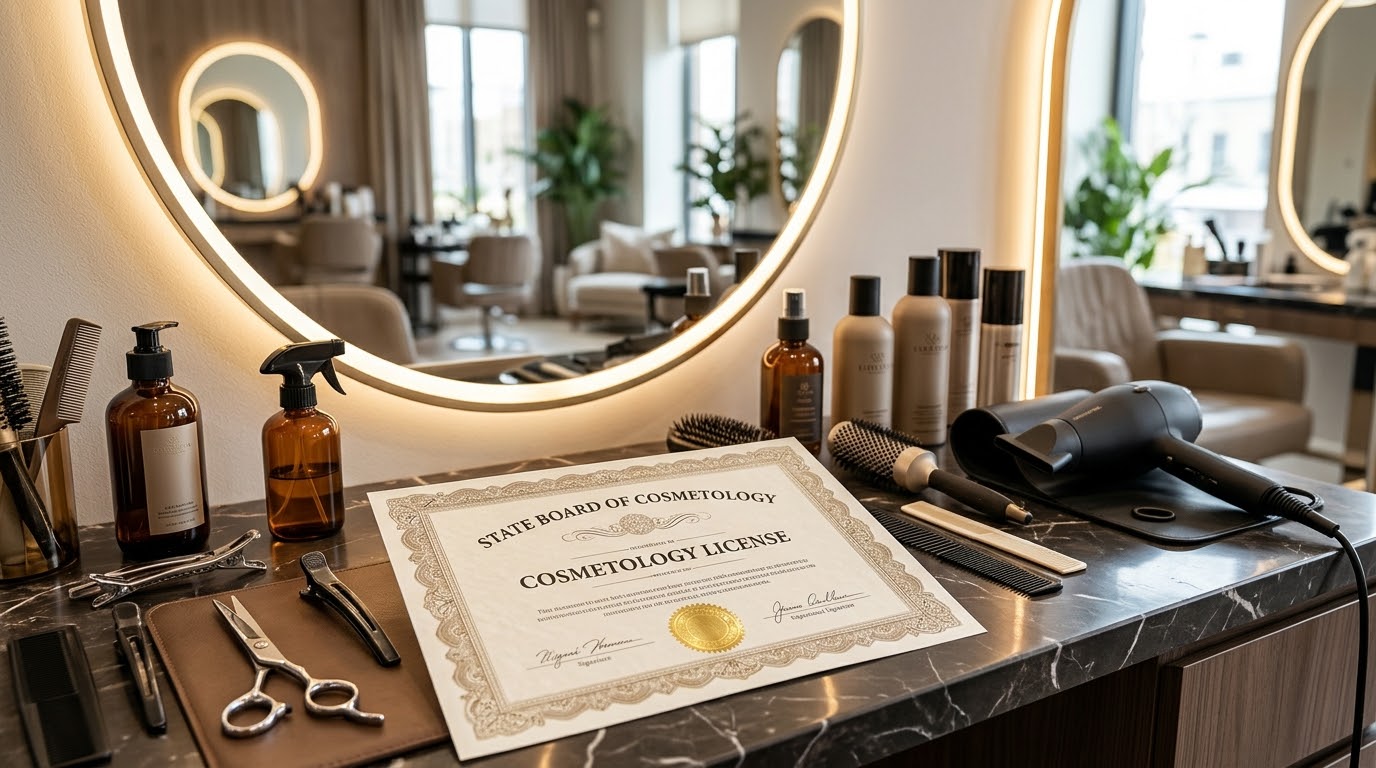
The Bureau of Labor Statistics states the rule without decoration: all states require barbers, hairstylists, and cosmetologists to be licensed. There is no wig exception, because wig styling sits inside that occupation’s own task list.
The BLS describes the route as a state approved program plus an exam. Qualifications generally include a minimum age, a high school diploma or equivalent, and graduation from a state licensed barber or cosmetology school.
Typical entry education is listed as a postsecondary nondegree award. That phrase matters: no degree is required anywhere in the standard route, and a degree by itself never authorizes practice. The license does.
Training hours and the live policy debate
Career guidance commonly cites 1,000 to 1,600 training hours, varying by state; the TradeColleges cosmetology career guide sets out that range alongside the current debate. Treat the range as a strand, and your own state’s figure as the only one that binds you.
That figure is politically live right now. Several states introduced bills in 2025 to cut required hours, some toward 600, and the Professional Beauty Association publicly opposed the reductions. Requirements can move while you are in school.
The practical consequence is a habit, not a number: check your state board before enrolling, before graduating, and before applying across a state line. The board is the only requirements authority in this entire guide.
What the license covers
The licensed occupation’s duties, as the federal profile lists them, already include wig work: cleaning and styling wigs and hairpieces appear in the task list beside cutting, coloring, and styling growing hair.
So the sequence is fixed. You do not train as a wig stylist and then get licensed. You get licensed as a stylist, and wig work becomes your specialty inside a license you already hold.
The Training Bargain: Employers Buy Licenses and Teach Wigs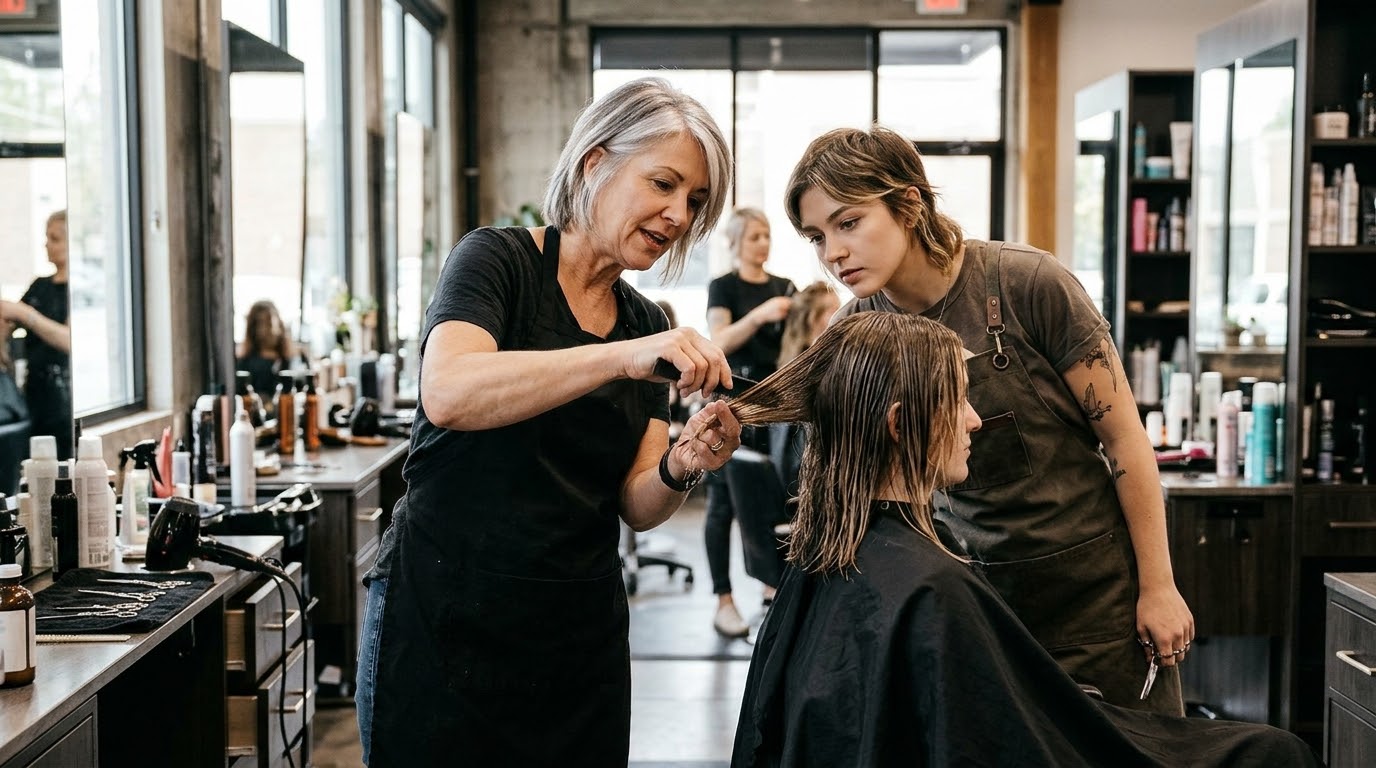
Read enough wig postings and one sentence keeps recurring in different words: wig experience is not required. The clearest current example is a US employer building a flagship team.
For a New York medical wig salon, the OneStep New York stylist recruiting page requires a New York State cosmetology license and salon experience. It then states plainly that no wig industry experience is required and beginners are welcome.
The duties it lists are the specialty layer itself: fitting and styling medical wigs for appearance care clients, in private fitting spaces, by appointment. The employer teaches that layer to licensed stylists it hires.
Why employers train instead of hiring experience
The economics explain the pattern. Licensed stylists are common; wig trained stylists are rare. An employer who demands both gets a tiny applicant pool, so the market splits the difference: hire the license, train the specialty.
Your salon skills are the transferable base: cutting, coloring, consultation, sanitation, and client handling all carry over. What changes is the surface, because a unit behaves differently from growing hair and must be learned on units.
The same bargain appears in the flagged foreign strands in this research, a London studio and a Toronto studio both describing wig training provided in post. Their credentials do not transfer to the US, but the hiring pattern is the industry’s, not one country’s.
The probation step
Training bargains usually include a probation window with a pay step. The New York posting pays $2,880 a month across a three month probation, stepping to $2,945 and up afterward, with part time at $16 an hour and up.
A probation step is not a red flag. It is the price of the training, printed in advance. The flag is a posting that promises training with no terms attached, because serious employers write the bargain down.
Pay as a Ladder of Strands: Read Every Figure With Its Source
Hairstylist pay is quoted everywhere and dated almost nowhere, which is how old figures keep outranking new ones. Read this niche’s pay as four strands, each with a source, a scope, and a date.
Strand one: the BLS 2025 release
The current federal release puts the combined occupation median at $35,880 a year, $17.25 an hour, across barbers, hairstylists, and cosmetologists together. The same release counts 670,800 jobs in 2025.
The hairdresser subgroup median is $17.21 an hour (May 2025), a near identical figure describing a narrower group. Neither number is an entry wage; a median describes the middle of everyone working, including owners of decades.
Strand two: the live posting
The New York medical wig posting pays $2,945 a month and up for full time stylists, which annualizes near the occupation median in year one, with tips and incentives on top and a fixed salary model that advertises no sales quotas.
That is one employer, one city, one model. It proves a licensed beginner can land near median pay in a specialty salon. It does not set a national entry rate, and this guide does not pretend otherwise.
Strand three: the first year secondary figure
Secondary career guidance puts junior stylists and assistants around $25,000 to $35,000 in the first year including tips. That band sits below the median for the reason medians hide: the first year is part training, part book building.
Tips deserve their own note. Career sources observe that tips can represent 15 to 25 percent of total compensation and are frequently underreported, which is one reason official medians read lower than many working stylists’ reality.
Strand four: the quarantined vintage
Older content across the career web still quotes May 2024 medians and 5 percent growth. Those were real figures in their release. Quoted beside 2025 data without a label, they become misinformation, and salary pages that mix them should be discounted entirely.
|
Strand |
Figure |
Source and date |
What it covers |
|---|---|---|---|
|
BLS release |
$35,880 a year median |
BLS, 2025 release |
The whole combined occupation |
|
BLS subgroup |
$17.21 an hour median |
BLS, May 2025 |
Hairdressers, stylists, cosmetologists |
|
Live US posting |
$2,945 a month and up |
OneStep NY, checked Nov 2026 |
One medical wig employer’s stylists |
|
First year guide |
$25,000 to $35,000 with tips |
TradeColleges strand |
Junior stylists and assistants |
Demand: Openings per Year Is the Number That Matters
Growth percentages make headlines; openings make careers. The BLS projects 7 percent growth from 2025 to 2035 for the occupation, much faster than average, adding about 48,400 jobs across the decade.
The entrant’s figure is the other one: about 80,300 openings projected each year, on average, across the decade. Most openings are replacements for stylists who leave or retire, and replacements do not care whether the market is fashionable.
For wig work specifically, the scarcity strand runs the other way: theatrical wig making’s workforce is described in industry strategy work as averaging over 50 years old, with few new entrants. An aging specialty inside a growing occupation is a documented opportunity, stated plainly.
Put the two numbers together and the entrant’s picture is clear. The occupation opens roughly eighty thousand doors a year, while the wig specialty trains almost everyone it hires. Demand is not the obstacle here. Sequencing is: license, then door, then specialty.
Three Doors In: Salon Assistant, Apprenticeship, Theatrical Craft
The three entry titles are three different bargains, not three names for one job. Choose by what you need most: income now, structure, or craft depth.
Door one: the salon assistant
Assistant roles are the fastest door: hired by salons and wig studios directly, paid from week one, and built around support work. Shampooing, station prep, retail, sanitation, and a front row seat at consultations are the curriculum.
The exit from this door is the junior stylist chair: first clients under supervision, first book, first commission math. Most working stylists entered through some version of this door.
Door two: the wig studio stylist
Specialty studios hire licensed stylists into training chairs, the pattern the New York posting shows. The work skews to consultation and fitting: measuring, advising, cutting units to the client, and teaching clients to wear what they bought.
Medical wig studios add a different skill on top: privacy and sensitivity with clients in treatment or living with hair loss. That manner is trainable but not fakeable, and employers screen for it in interviews.
This door also teaches the retail of trust: clients return for adjustments, replacements, and second units across years, so a medical stylist’s book renews itself in a way a fashion book does not. Studios know this, which is why they invest training months into beginners.
The product knowledge underneath this door is the cluster’s own subject: how units are built and graded, the ground our human hair wig guide covers, and how formats differ, from our half wig human hair guide to our headband wig human hair guide.
Door three: the theatrical apprenticeship
Theatrical wig making is the construction craft: building custom wigs by hand, including ventilating, knotting single hairs into lace one at a time. Industry strategy work puts a skilled maker’s time at 40 to 80 hours for one custom wig.
Structured programs there run two to three years, closer to a trade apprenticeship than a salon job. The Canadian salary strands attached to that document stay flagged as non US, but the program shape is the North American craft norm.
This door suits a specific temperament: patient, precise, and happy at a bench. It is also the door where the aging workforce makes entrants most valuable, because the craft cannot be rushed or automated.
|
Door |
Gate |
Pay shape |
Time to specialty |
|---|---|---|---|
|
Salon assistant |
License (or in school, by state) |
Hourly plus tips |
Months to a junior chair |
|
Wig studio stylist |
License required |
Salary or hourly, probation step |
Training inside the first year |
|
Theatrical apprentice |
Craft program entry |
Apprentice wage strands |
Two to three years |
Posting Literacy: Read Any Listing in Four Lines
Every serious posting in this niche answers four questions in its own text. Find these lines before you read anything else, including the salary.
- The license line. Which license, which state. No license line at all means the posting is foreign, informal, or not serious, and each possibility changes what you do next.
- The training line. Training provided, beginners welcome, or experience required, stated plainly. This line tells you whether the employer runs the bargain or expects you to arrive finished.
- The pay structure line. Base, probation step, tips, commission, or fixed salary, and which of them apply to you in month one rather than month thirteen.
- The restriction lines. Dual employment bans, non competes, and side job rules. At least one employer in this research prohibits side work in the same industry, in writing.
Postings that answer all four are employers with systems. Postings that answer none are asking you to discover their terms after you have committed, which is the oldest red flag in entry level hiring.
Red flags worth naming
Unpaid chair work tops the list: licensed services are paid work, and school externships are the only unpaid category with a legitimate frame. Vague training promises with no trainer, no timeline, and no pay step come second.
Third is the credential mismatch: a posting demanding your state’s license while describing another country’s system is usually an aggregator error, but it tells you the listing was never proofread by the employer.
The Application Kit: License, Portfolio, and the Right Questions
Applications in this niche are screened in a fixed order. The license check comes first and is binary; everything else competes only among the licensed.
The portfolio you can build before any job
Buy practice units cheaply and work them: cut, color, style, fit them on heads, and photograph every result in honest light. A small portfolio of deliberate unit work answers the experience question better than any cover letter adjective.
Draw the practice from the formats employers sell: a half wig styled three ways, a curly unit refreshed and shaped like the work in our curly hair wig guide, a fitting sequence photographed step by step. Studios hire people who already speak their product language.
The questions that mark you as serious
Ask who trains you and for how long. Ask what probation pays and when it steps. Ask whether tips and commission apply during training, and whether the contract restricts side work in the industry.
Those four questions signal that you read postings the way employers write them. In a beginners welcome interview, that literacy is itself a qualification, because the salon’s whole model depends on trainees who stay.
Timing your applications
Salons staff up before the holiday rush and absorb new licensees after spring and summer graduations. Apply ahead of both windows. Inside them you compete with every graduate in your state; ahead of them you compete with almost nobody.
Start the search where the titles are real: assistant, apprentice, and junior stylist, filtered by your city and your license state, with alerts set on the boards and the studio pages checked directly. The wider product cluster behind the work lives in our hair wig buying guide.
Set those alerts to run daily, not weekly. Entry postings at good studios are filled from the first qualified applicants more often than job search advice admits.
The licensed applicant who arrives in the first days competes with a handful of people instead of a graduating class. Speed is a genuine qualification signal here: it tells the employer you were watching their door before it opened.
Inside the Training: What Employers Actually Teach
Training is not a vague promise once you are inside it. It has a syllabus, even when the salon never prints one, and knowing its shape lets you judge a posting’s training line properly.
The consultation layer
First comes how to talk to a wig client, which differs from salon consultation. You learn to measure a head, discuss coverage honestly, and set expectations about what a unit can and cannot do for this particular client.
In medical settings the layer deepens into privacy discipline: appointment only rooms, no names beyond the booking, and results discussed with the client, never about her. Employers rate this manner as highly as any cutting skill.
The unit layer
Next, the units themselves: how constructions differ, why a cap fits or fights, how to cut a unit that cannot grow back a mistake. Every cut on a wig is permanent in a way salon hair forgives, and trainers drill that respect early.
Color work on units follows, with strand tests as religion, because processed human hair and synthetic fibers answer chemicals differently from the growing hair your license trained you on.
The business layer
Finally, the commercial skills: how the studio prices fittings, what retail a stylist is expected to explain, and how rebooking works. In commission models this layer decides your pay, so good employers teach it rather than leaving it to osmosis.
The First Year, Honestly: A Month by Month Shape
Entry years follow a recognizable arc across salons, and seeing it in advance turns a hard first quarter into a plan instead of a surprise.
Months one to three: the probation shape
Expect support work with supervised specialty tasks: assisting fittings, preparing units, watching consultations, and handling your first simple services with a senior checking the finish. Probation pay, where it exists, is the wage of this phase.
The skill being tested is not speed. It is reliability and manner: turning up, keeping sanitation automatic, and treating anxious clients gently. Trainees who pass probation pass on temperament as much as technique.
Months four to nine: the first book
Your own appointments begin, small and supervised, then steady. This is where the book starts compounding: a fitted client returns, brings a friend, and asks for you by name. Commission math starts to matter here, in either direction.
Expect your mistakes in this phase to be unit mistakes, a cut too brave, a color strand test skipped. Salons budget for them in trainees. Concealing them is the only version that damages a career.
Months ten to twelve: the step up
By year end the shape resolves into three states: a junior chair with a growing book, a studio stylist taking full consultations, or a decision that this specialty is not your craft. All three are information, and the third is cheaper at month twelve than year five.
After the First Job: The Ladder
The license is the floor of this trade; the specialty is the staircase. Wig trained stylists deepen along paths the general market cannot easily copy, because each path stacks scarce skills on the same license.
Medical fitting specialists become the named consultants clients request, the role the luxury and flagship postings describe. Theatrical makers move from apprentice benches toward lead maker status, where a decade of construction experience commands the top of that craft’s ladder.
Retail and brand education opens sideways: manufacturers and wig brands hire experienced stylists to teach other stylists, demo products, and run the training the next cohort of beginners will receive. The trainee of this year becomes the training line in someone else’s posting.
And the oldest exit remains: your own room. Booth rental, then a studio, then a team of your own, at which point the four posting lines in this guide become lines you write for the assistants you hire.
Frequently Asked Questions
1. Is there really such a job as a hair wig stylist intern?
Not under that exact title in the US. The work exists, but employers post it as salon assistant, apprentice, or junior stylist roles.
Search those three titles with wig or salon terms and the real openings appear.
2. Why do employers post assistant and apprentice jobs instead of internships?
Because chairs need licenses, not interns. US salon hiring runs on a licensed ladder: assistants support, apprentices train formally, junior stylists take first clients.
The intern label belongs to offices and schools, not salon floors.
3. Do I need a cosmetology license to work in a wig salon?
Yes, in every state. The Bureau of Labor Statistics states that all states require barbers, hairstylists, and cosmetologists to be licensed.
Wig salons hire from that same licensed pool, so the license is the entry ticket.
4. Can I style wigs professionally without a license if I only touch wigs?
Not as a business model. The occupation’s own task list includes cleaning and styling wigs and hairpieces, and the license covers the stylist, not the surface.
Employers gate postings on licensure regardless of specialty.
5. How long does cosmetology school take?
Typically 9 to 18 months. That strand comes from career guides describing state approved programs.
The real measure is hours, and your state board’s required hours decide your calendar, not the school’s marketing.
6. How many training hours does a cosmetology license require?
A strand of 1,000 to 1,600 hours in most secondary sources. Requirements vary by state and are under legislative debate in several.
Your state cosmetology board publishes the only number that applies to you.
7. Can I get a wig stylist job with a license but no wig experience?
Yes, that is the normal pattern. Real postings require the license and state that no wig industry experience is needed.
Employers expect to train cutting, fitting, and consultation for wigs on top of your salon skills.
8. What does beginners welcome actually mean in a wig posting?
It means the training is part of the offer. Beginners welcome postings trade instruction for licensure: you arrive legal to work, they teach the specialty.
Expect a probation step and supervised clients at the start.
9. What is the difference between a salon assistant and a junior stylist?
An assistant supports the floor, a junior stylist takes clients. Assistants shampoo, prepare stations, and learn by watching.
Junior stylists hold a license, book first clients, and build the book every later raise depends on.
10. What is the difference between an apprentice and an assistant?
An apprenticeship is a formal training route. Apprentices learn under a structured program, sometimes over years in craft settings.
Assistants hold a job with training inside it.
The words vary by state and employer, so read each posting’s terms.
11. What does a salon assistant do all day?
Support work that teaches the trade. Shampooing, mixing color, preparing stations, observing consultations, handling retail, and keeping sanitation standards.
It is unglamorous, paid, and how most stylists learn client handling before chairs.
12. How much do entry level wig stylists make?
Read it as strands, not a number. A detailed New York wig posting pays $2,945 a month and up full time with a probation step, and secondary guides put first year assistants around $25,000 to $35,000 including tips.
13. What is the median pay for hairstylists in the US?
$35,880 a year in the BLS 2025 release. That is $17.25 an hour for the combined occupation of barbers, hairstylists, and cosmetologists.
The hairdresser subgroup median is $17.21 an hour (May 2025).
Medians describe the middle, not the entry rung.
14. Why do different websites show different hairstylist salaries?
Because vintages get mixed. Career sites still circulate the May 2024 medians and a 5 percent growth figure beside newer releases.
Check the release date and the exact occupation on any salary claim before believing it.
15. What is a probation period in a wig salon job?
A lower paid training window at the start. One New York wig employer pays $2,880 across a three month probation against $2,945 and up after.
Probation steps are normal in this niche and should be printed in the posting.
16. Do wig stylists earn tips and commission?
Often, yes, on top of base pay. Models vary: fixed salary plus allowances, hourly plus tips, or commission on services and retail.
One medical wig employer advertises fixed salary with no sales quotas, which is the calmer model.
17. Is a fixed salary or commission better for a first wig job?
Neither, universally. Fixed salary suits a first year while skills and speed build.
Commission pays more once a book exists.
Evaluate any offer on its probation terms, training, and what happens to pay after month three.
18. Are wig stylists in demand?
The occupation is growing faster than average. The BLS projects 7 percent growth from 2025 to 2035 for barbers, hairstylists, and cosmetologists.
Wig specialization sits inside that demand, and the specialty workforce in craft settings is aging.
19. How many hairstylist jobs open each year?
About 80,300 a year on average. That BLS figure covers the whole occupation and includes replacements for people leaving, which is why it matters more to entrants than growth percentages.
Openings, not headlines, are the door width.
20. Why do I see London and Toronto postings when I search US jobs?
Because aggregators ignore borders by default. A US keyword search surfaces London and Toronto postings whose credentials and currencies do not transfer.
Filter by location, and treat any posting without your state’s license language as foreign until proven otherwise.
21. Does a UK NVQ qualification work for US wig jobs?
No, not for US salon work. The NVQ is a UK qualification.
US employers gate on your state cosmetology license.
UK postings are still useful reading for duties and training patterns, but their credential lines do not apply.
22. What is a medical wig stylist?
A stylist who fits wigs for clients with hair loss. Medical wig salons serve appearance care, often by appointment in private fitting spaces.
The work adds consultation sensitivity and privacy to the usual cutting and styling skills.
23. Do medical wig salons hire beginners?
Yes, explicitly in current postings. A New York medical wig flagship states that no wig industry experience is required and beginners are welcome, provided the state license is held.
The license is the requirement; the wig skills are trained.
24. What is theatrical wig making as a career?
It is the construction side of the craft. Theatrical makers build custom wigs by hand, including ventilating single hairs into lace.
A skilled maker can take 40 to 80 hours on one custom wig, per industry strategy documents.
25. How long is a theatrical wig apprenticeship?
Two to three years in structured programs. Theatre craft training runs long because the hand skills are slow to build.
Salons train faster on styling and fitting; construction apprenticeships are the deep route into making.
26. What skills transfer from salon hair to wigs?
Most of the core ones. Cutting, coloring, consultation, sanitation, and client handling transfer directly, which is why employers hire salon stylists into wig roles.
What changes is the surface: units behave differently from growing hair.
27. What wig skills will an employer train me in?
Fitting, cutting units, and consultation for wigs. Postings describe training in wig consultation, fitting, styling wigs and toppers, and product knowledge.
Craft routes add ventilating and construction.
Expect supervision first, solo clients after.
28. How do I build a wig portfolio before I have a job?
Practice on heads and document everything. Buy practice units, cut, color, and style them, and photograph the results in good light.
A small, honest portfolio of unit work beats a large folder of unrelated salon photos.
29. What should I put on a resume for an entry level wig job?
Lead with the license, then the specialty evidence. License and state first, then salon experience, then any wig work including practice portfolios.
Employers screen for licensure before they read anything else on the page.
30. What questions should I ask at a wig salon interview?
Ask about training, pay steps, and restrictions. Who trains you and for how long, what probation pays and when it steps up, whether tips and commission apply, and whether the contract restricts side work in the same industry.
31. What are red flags in an entry level hair posting?
Unpaid chair work is the big one. Licensed services are paid work.
Also watch for postings with no license requirement at all, no stated pay structure, or training promised with no trainer named.
Serious employers print their terms.
32. Can a wig internship be unpaid?
Licensed styling work should be paid. Externships arranged through schools are a separate, educational category.
An unpaid open ended internship doing client services is a red flag to walk away from and, where relevant, report.
33. What is an externship in cosmetology school?
It is school arranged salon experience. Cosmetology programs place students in salons for supervised hours before graduation.
It is part of earning the license, distinct from a job, and usually your first salon network.
34. Should I rent a booth or take a job as a new stylist?
Take the job first, in most cases. Employment gives training, clients, and a wage while your book is empty.
Booth rental suits stylists who already carry clients.
Renting a chair with no book is paying for overhead before income exists.
35. Can I do wig work as a side job while employed at a salon?
Read your contract before assuming. At least one wig employer in this research prohibits side jobs with businesses in the same industry.
Dual employment clauses are common in specialty salons, so the answer lives in your own agreement.
36. What is ventilating and do beginners learn it?
Ventilating is knotting single hairs into lace by hand. It is how custom wigs and lace pieces are built.
Salon stylists may never need it; theatrical and custom makers learn it inside apprenticeships over months, not weekends.
37. How do I find wig stylist jobs near me?
Search the real titles on the boards and direct sites. Use assistant, apprentice, and junior stylist with wig, salon, and your city.
Set alerts, and check wig studios’ own pages, because specialty employers often post there first.
38. When is the best time of year to apply for salon entry jobs?
Around graduations and before the holidays. Salons staff up for the holiday rush and absorb new licensees after spring and summer graduations.
Apply ahead of both windows rather than inside them, when competition peaks.
39. Do I need a degree to become a wig stylist?
No degree is required. The typical entry education is a postsecondary nondegree award from a state approved program, plus the license.
Degree guides exist, but graduation alone never authorizes practice; the license does.
40. What is the difference between a degree and a license in cosmetology?
A degree is education, a license is permission. You can hold a cosmetology degree and still be illegal to hire without the state license.
Employers and boards care about the license; degrees are optional extras.
41. Can I move my cosmetology license to another state?
Usually, through reciprocity or endorsement rules. States set their own transfer terms, often requiring your training hours to match theirs.
Check the destination board before moving, because hours shortfalls are the common snag.
42. What comes after the first wig job on the career ladder?
Specialist, then senior or educator or owner. Stylists deepen into medical fitting, theatrical construction, or retail consultancy, then teach, manage, or open rooms of their own.
The license is the floor; the specialty is the staircase.
Conclusion
Intern hair wig stylist jobs are real work filed under other titles, and now you know the translation. Assistant, apprentice, and junior stylist are the doors; intern is the word on the search box, not the posting.
The route runs in one order: license first, because no state lets you skip it; then a posting that trades training for that license; then specialty skills that compound for a whole career.
Read every pay figure the way this guide does, as a strand with a source and a date, and check your requirements at your state board. The demand is documented, the doors are named, and the first application is the only step left.
The wider wig cluster is gathered at the ModernHairstyle home page.

Dilawar is a passionate writer and contributor at Modern Hairstyle (modernhaistyle.com), specializing in hairstyles, hair care, grooming, fashion, beauty, and lifestyle trends. He enjoys sharing practical tips, hairstyle inspiration, and easy-to-follow guides to help readers discover their personal style. His goal is to provide informative, engaging, and helpful content that keeps readers updated with the latest trends.


