
Real Hair Wig: What Real Means, and How to Check Before You Buy
Real hair wig is the phrase shoppers type, and human hair wig is the phrase the trade sells. The two wordings point at the same product almost every time, and the gap between them is where the bad purchases happen.
No source anywhere defines the words real hair. No standard, regulator or certification stands behind the term, so any seller can print it, and the listings that use it range from genuine to openly fake.
The one wording that counts is exact. Only the phrase 100% human hair is a material claim a seller can be held to, a rule the two sharpest guides in the field reach from opposite directions.
What follows is the translation layer the head term never gets. The label ladder with real definitions, the verification chain with test limits, and prices printed as dated channel strands instead of one fake average.
Readers who already know their material can skip ahead. Construction choices live in our human hair wig guide, and the buying order near the end of the page turns the whole method into ten checks.
Real Hair Wig, Defined Honestly: The Shopper Phrase for a Human Hair Wig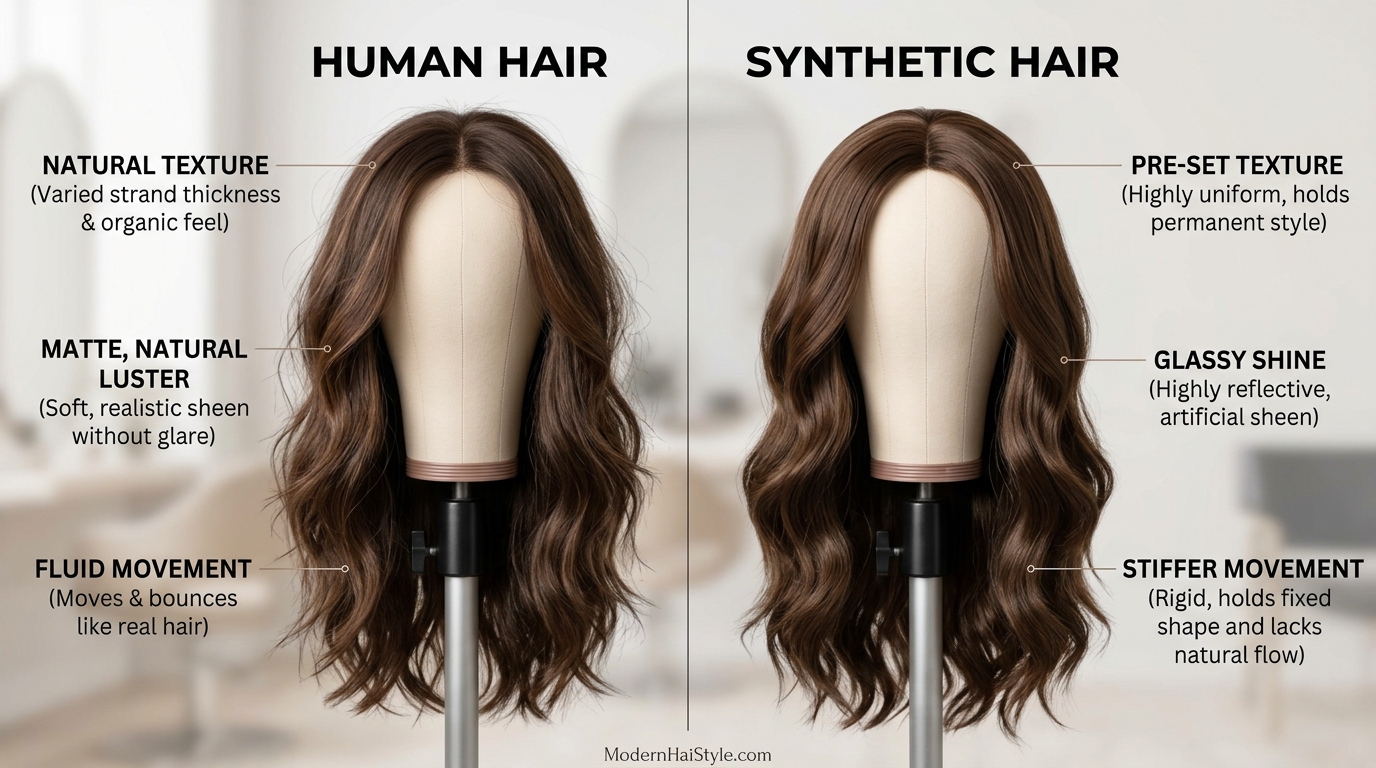
The plain definition is simple enough to state in one line. WigAnswers defines the term directly: real hair wigs are made from 100% human hair, typically Indian Remy or virgin hair that can be parted, heated, dyed and washed like your own.
OnHairShow reaches the same equation from the comparison side. Its real against synthetic page equates the terms outright, then adds that the high quality varieties worth wanting are the ones sold as Remy or virgin.
Retail copy treats the words as identical too. Simply Wigs tells its shoppers that all of its real human hair wigs are made from 100% human hair.
The one editorial guide in the results never separates the terms at all: the Hairalicious beginner guide to real hair wigs uses real, natural and human interchangeably across its whole beginner guide without one definition sentence, which is the gap in this field in miniature.
The material itself is covered in depth elsewhere on this site. Grades, caps and costs are the subject of our human hair wig guide, while our wig hair grades and materials guide takes the materials side rung by rung.
When Real and Human Diverge: Animal Hair and Natural-Looking Synthetic
One top guide breaks ranks and separates the terms. The Wig Company real human hair buying guide warns that not all real or natural hair is human, and that many real hair wigs are sourced from animals such as the yak.
The yak detail matters because the hair is genuinely similar. The Wig Company notes yak hair has a structure remarkably similar to human hair, and Prarvi Hair adds that animal hair has an established place in hairpieces.
The second divergence runs the other way, toward plastic. Prarvi Hair points out that natural-looking describes an effect rather than a material, so a synthetic wig can earn the word natural while containing no hair at all.
OnHairShow attacks the same gap from the wording side: the OnHairShow guide to spotting a fake human hair wig lists real hair itself among the vague phrases, beside human hair blend, human hair feel and remy-like, all meant to imply human hair without legally claiming it.
Two authorities, two different reasons, one working rule. Whether real fails because it can mean animal hair or because it claims nothing at all, the fix is identical: hold every listing to the exact phrase 100% human hair.
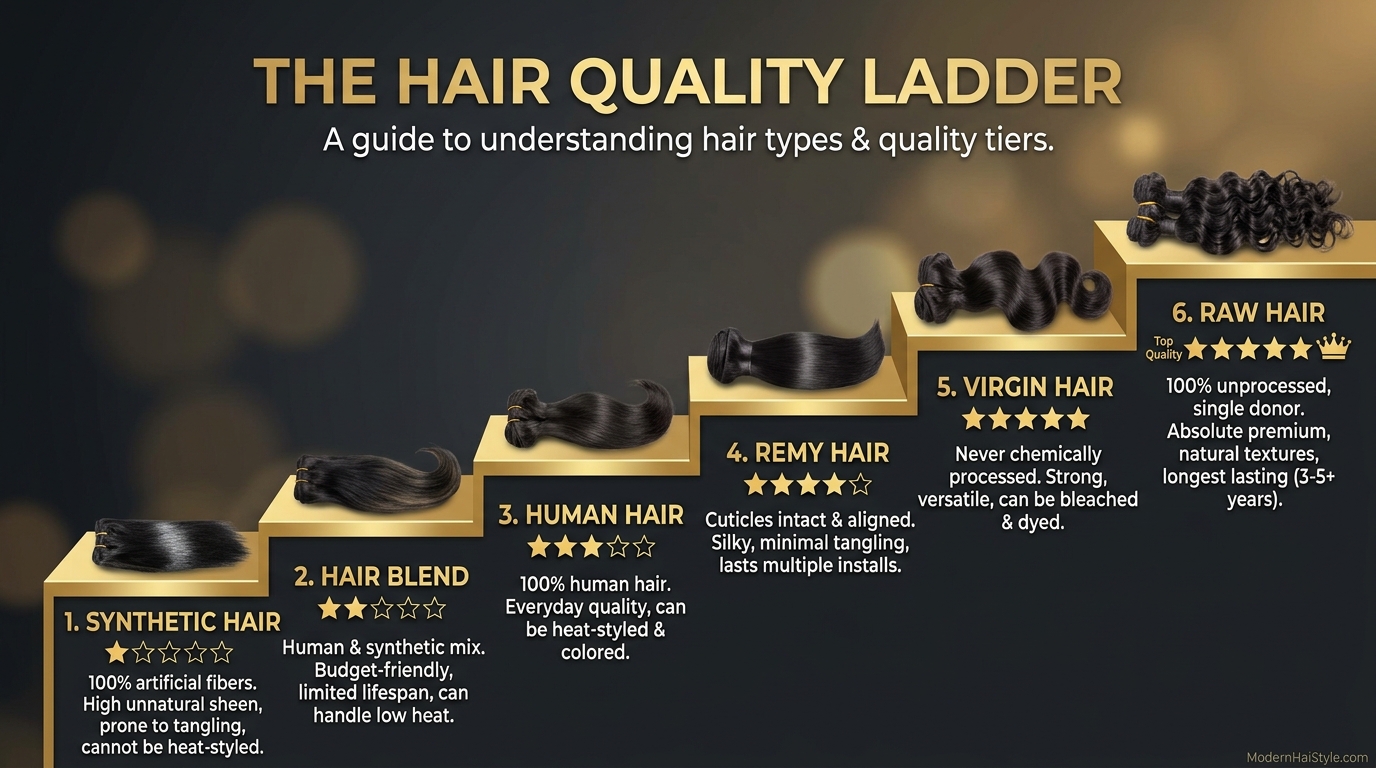
The Label Ladder: Seven Rungs From Synthetic to Raw Single-Donor
Every wig label sits somewhere on one ladder. The rungs below run from plastic fiber to single-donor raw hair, and each step up means more intact hair, more styling freedom and a higher honest price.
|
Rung |
What the label actually means |
What to check |
|---|---|---|
|
Synthetic |
Plastic fiber, usually Kanekalon or Toyokalon blends |
Whether a human claim is being implied nearby |
|
Heat-friendly synthetic |
Synthetic fiber built to tolerate low styling heat |
The brand ceiling, and that it is still plastic |
|
Human hair blend |
Human hair mixed with synthetic fiber |
The ratio, which is almost never printed |
|
100% human hair |
A material claim only, with no grade stated |
Which grade, asked directly |
|
Remy |
Cuticles all aligned in one direction |
Whether the seller will say Remy plainly |
|
Virgin |
Never colored, permed, bleached or relaxed |
Whether raw is also being claimed |
|
Raw / single-donor |
Unprocessed, unsteamed, one donor per bundle |
The price against the $300 floor strand |
Synthetic and Heat-Friendly Synthetic: Plastic With Two Temperature Stories
Synthetic fiber is plastic, and the field says so plainly. OnHairShow describes synthetic hair as plastic fibers, usually a blend of Kanekalon and Toyokalon, pre-styled to hold its shape through washing.
Heat-friendly synthetic is the same plastic with a heat tolerance. Wig Studio 1 defines it as synthetic fiber that can be styled with irons and dryers at low temperatures, sold as heat resistant, heat defiant, HD or HF.
The temperature numbers disagree, so they print as strands. Wig Studio 1 puts most heat friendly fibers at 300 to 350 degrees at most and recommends 270 to 280 for everyday styling, while Belle Tress strands run 250 to 300.
One naming collision causes real confusion at this rung. HD means Heat Defiant in Jon Renau synthetic fiber and high-definition lace in human hair lace wigs, the same two letters selling two unrelated products.
The comparison table behind these strands is worth reading directly: the OnHairShow real hair against synthetic comparison sets human hair against synthetic on look, movement, heat and lifespan, with its own everyday price strands kept separate from the channels below.
Human Hair Blend: The Ratio Is the Product, and It Is Almost Never Printed
A blend combines human hair with synthetic fiber in one wig. The neutral definition is that the ratio of each can vary, aiming at human hair softness and realism for less money.
Salon framing treats the blend as a legitimate middle tier. Daniel Shay’s describes blends as capturing strengths of each fiber, and names the only printed ratio in the field: EnvyHair, at 30 percent human hair and 70 percent heat-friendly synthetic.
Buyer-protection framing reads the same label far more coldly. OnHairShow says a human hair blend listing should be read as mostly synthetic, hopefully affordable, because the term is chosen to sound like human hair without claiming it.
Both strands agree on the deciding fact. The ratio is the product, listings almost never print it, and a seller who will not state it has answered the question. Price any unstated blend as mostly synthetic.
100% Human Hair: A Material Claim That States No Grade
This is the first rung that makes a material claim. The exact phrase 100% human hair promises the wig contains human hair rather than synthetic fiber, and it is the wording every check on this page starts from.
The limit of the claim is just as important as the claim. Tirumala Hair states it directly in the Tirumala Hair raw virgin Remy explainer: the phrase only tells you the hair is not synthetic, and it does not state a grade.
So the material claim opens the grade question instead of closing it. Human hair on a label can still be non-Remy, acid-stripped and silicone-coated underneath, which is why the ladder keeps climbing past this rung.
Remy, Virgin, Raw and Single-Donor: Definitions, and the Suppliers Who Disagree
Remy is a claim about direction, nothing more. Tirumala Hair defines it as cuticles all lying in one direction, as they do on a head, and Hair Trends India adds that Remy hair can be raw, virgin or chemically colored.
Non-Remy is the same species with the alignment lost. The Wig Company describes hair treated in acid that strips the cuticle layer, then coated with silicone for shine, the construction behind most early tangling and dulling.
Virgin is a claim about history, nothing more. The hair has never been colored, permed, bleached or relaxed. The Wig Company notes virgin human hair is usually Remy, but Remy hair does not have to be virgin.
Raw goes one step past virgin, and single-donor answers a different question. Raw hair has also not been steamed or treated to change texture, per Hair Trends India, while single-donor means every strand in a bundle came from one person.
Suppliers then disagree about how the top rungs combine. Tirumala defines virgin Remy as a real combined grade, while the Nyromi FAQ claims raw virgin hair does not exist. The conflict prints as strands, because no standard settles it.
The working hierarchy in the field still helps a buyer sort listings: the OnHairShow which hair is best guide orders it as basic human hair, then Remy, then virgin, then raw, and calls Remy the sensible minimum for a wig you plan to keep.
No rung on this ladder is certified by anyone. Tirumala states that no independent body grades human hair, and Superior Hair Factory concurs that Remy is not a universal certification. A printed certificate is a claim to question, not proof.
The Verification Chain: Wording, Price Floors, Seller Questions, Tests
Verification works as a chain, cheapest check first. Exact wording costs nothing, price floors cost nothing, seller questions cost nothing, and only the physical tests cost strands of hair, so the chain runs in that order.
Step one is reading the title like a contract. Human hair blend, human hair feel, remy-like and bare real hair all stop short of a material claim, while honest sellers say Remy plainly.
Step two is floor math against the only numeric floors published. The full channel table sits in the price section, but the rule is simple: a price under the floor for its claimed construction cannot be the claimed construction.
Step three is asking two questions and grading the answers. Ask whether the wig is 100% human hair, and whether it is Remy or non-Remy, and note that the Lacewig.com first lace wig checklist warns that evasive answers like Remy-quality usually mean non-Remy.
Reviews and photos carry the last pre-purchase signals. OnHairShow tells buyers to search reviews for tangled after one wash and became frizzy, and to distrust listings where every photo looks glassy and uniform in the light.
The Burn Test, Taught in Full, With Its Two Limits
The burn test is the consensus answer in the field, and it goes last: the Soul Lady guide to telling human hair from synthetic calls it the definitive test and the destructive one in the same breath, which is exactly why the cheaper checks come first.
- Cut two or three strands from underneath at the nape, where nothing will show.
- Hold the strands with tweezers or pliers, never with your fingers.
- Work over a sink, in a ventilated room, away from anything flammable. Adults only.
- Light the strands, watch how they burn, then rub the residue between your fingers.
|
Material |
Burn behavior |
Residue and smell |
|---|---|---|
|
Human hair |
Burns slowly and curls away from the flame |
Fine ash that crumbles to powder, a burnt-hair smell |
|
Synthetic |
Melts and shrinks instead of burning |
A hard plastic bead, a chemical or burnt-plastic smell |
|
Blend |
Shows both behaviors at once |
A mix of ash and hard plastic beads |
Limit one: the test verifies material, never grade. Tirumala Hair is explicit that the burn and smell test confirms the hair is human, not that it is virgin, so a passed test cannot rescue a grade claim.
Limit two: the test spends your return. Soul Lady warns that cutting strands makes a wig non-returnable almost everywhere, theirs included, and Gistar adds that burning synthetic can drip, so the flame work stays over the sink.
Heat, Bleach and Cuticle Tests, Each With Its Confound
The heat test is close to conclusive and easy to confound. A low flat iron on a hidden spot leaves human hair unharmed, while regular synthetic frizzes or melts. Heat-friendly synthetic survives the same pass, so a pass proves little.
The bleach test hunts for filler fibers inside a blend. Opaura explains that human hair lifts in color under professional bleach while synthetic fibers do not lift at all, so unlifted strands inside a bundle expose the mix.
A failed dye test does not always mean synthetic. Goldylost notes that non-Remy hair is stripped of its cuticle and coated in silicone to fake softness, and coated hair cannot be recolored reliably, so failure can mean low grade instead.
The cuticle test needs no tools at all. Slide fingers down a strand and it feels smooth, then slide up against the growth direction. Genuine and Remy hair catches slightly, while stripped or synthetic strands feel smooth both ways.
Blends demand repetition, because one spot can be honest. Soul Lady and OnHairShow both say to test three separate places, crown, nape and one side, since a blend can pass at the crown and fail at the nape.
Shine, smell, water and tangle checks support the main tests. Human hair reflects light unevenly and tangles like hair, then combs out, while synthetic shines in a uniform sheet and mats permanently. Each signal is suggestive, and none is proof alone.
Prices by Channel: Marketplace Claims, Dropship Flat, Brand, Salon and Luxury Strands
Prices print here as dated channel strands, never as one average. Every figure below was crawled on November 16, 2026, and each channel sells a different reality, so the rows stay separate on purpose.
|
Channel |
Dated strand, November 16, 2026 |
How to read it |
|---|---|---|
|
Marketplace listings |
100% human hair claims at $25 to $161 |
Claims, not verified material |
|
Dropship-style direct |
One flat $174 across lengths and colors |
A uniform price is itself a signal |
|
Brand direct, UniWigs |
$456.72 to $1,598 across the range |
Named grades at dated sale pricing |
|
Salon brands |
$750 to $5,300 at Wig Studio 1 |
Good quality quoted at $1,300 to $3,000 |
|
Luxury direct |
$3,000 to $13,000 at Daniel Alain |
European hair, held as a text strand |
The marketplace row is a claim pattern, not a price guide. Aggregator tables show lace front listings titled 100% human hair from $25 into the $160s, and a creator warning from September 2026 names roughly $30 listings as synthetic in fact.
Against those strands sit the only numeric floors in the field: the Lacewig.com first lace wig checklist puts a Remy lace front at $150 minimum, true HD lace Remy at $250, virgin Remy single-donor at $300 and full lace at $400.
The same checklist draws the conclusion a buyer can use. A wig advertised as 100% virgin Remy Brazilian human hair with HD lace at 22 inches for $89 is, in its word, impossible, and below roughly $120 a full wig is non-Remy until proven otherwise.
Brand direct shows what named grades actually cost: the UniWigs Signature Lavina Remy lace front page listed at $552.10 against a $690.12 list price on the crawl date, while the UniWigs long Remy lace top page shows the longer lace top end of the same shelf.
Salon pricing explains why the floors sit where they do: the Wig Studio 1 human hair wig cost guide reports that human hair wigs far below its ranges are often blended, heavily processed or lower-grade hair, which is the too-cheap signal in the words of a retailer.
One pattern deserves its own warning, stated generically. A single flat price across every length and color contradicts every authority in the field, because length drives cost everywhere else. Uniform pricing is a claim pattern, not a bargain.
Lifespan as Strands: What Each Source Claims, and Under What Wear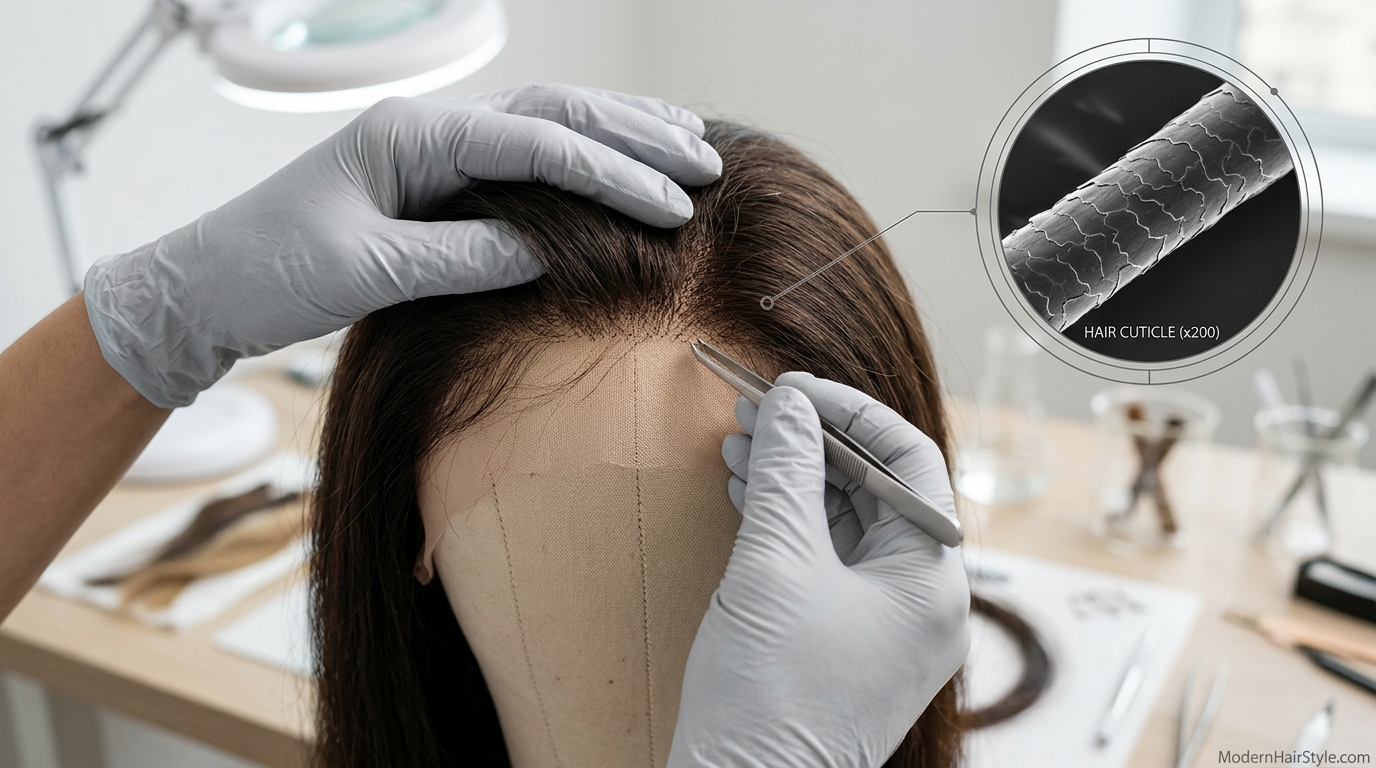
Lifespan is the figure this page refuses to print as one number. Sources span 8 to 12 months at the low end to 5 years at the top, and the spread is mostly wear conditions, not disagreement about hair.
|
Source strand |
Claim |
Wear condition |
|---|---|---|
|
Soul Lady FAQ |
8 to 12 months |
The low outlier strand |
|
OnHairShow |
8 to 14 months daily, up to 3 years occasional |
Daily wear against rotated wear |
|
Mayvenn and Wig Studio 1 |
About 1 year daily, 2 to 3 years occasional |
Daily against occasional |
|
Goldylost and Simply Wigs |
1 to 3 years |
General wear strands |
|
Tirumala, on virgin Remy |
1 year or longer, some clients at 5 years |
Supplier experience, not a guarantee |
The condition columns matter more than the year columns. A wig worn daily meets heat, friction, sweat and washing that a rotated wig never does, so the same hair earns two different lifespans in two different lives.
The richest lifespan discussion sits on a UK category page: the Simply Wigs human hair wigs page works through lifespan and care across ten FAQs, and its 1 to 3 year strand is used here as content, never as US price guidance.
The shorter-lived rungs have their own strands. Synthetic figures cluster at 3 to 6 months across sources, SISHAIR puts blends at 3 to 6 months, and Jessie’s Wig stretches a premium blend to 6 to 9 months.
Care for a Real Human Hair Wig: Wash Strands, Color Rules and the Tangle Mechanism
Washing frequency is another strand set, not a rule. WigAnswers suggests every 6 to 8 wears, Jessie’s Wig every 8 to 12 wears, and both agree that product buildup and sweat move the wash earlier.
Color work starts with a clean, unconditioned wig. The Mayvenn rule is shampoo only before dyeing, because conditioner, silicone and styling buildup coat the cuticle and block color, the same coating that breaks the dye test on coated hair.
Darker is the safe direction, and lighter is the expert one. Depositing color works on most genuine human hair, while bleaching lighter belongs on virgin hair with a strand test first, since processed hair lifts unevenly or not at all.
Tangling is a cuticle story before it is a care failure. Aligned cuticles slide, stripped cuticles catch, and the silicone shine on non-Remy hair wears away in early washes, which is why some wigs turn difficult a month in.
Overnight habits quietly decide which lifespan strand you land in. The Wig Company advises against sleeping, showering or swimming in the wig, and rotating two wigs is the simplest way to stretch every strand.
Texture-specific care goes deeper inside the cluster: our curly hair wig guide covers pattern care, moisture and length for curly textures, which tangle and dry differently from straight hair even when the material grade matches.
Constructions Once the Material Checks Out
Material settled, construction is the next decision. The same verified human hair arrives as a lace front, a glueless cap, a half wig or a leave-out part, and each build changes fit, blending and daily effort.
Lace fronts are the construction this keyword usually pictures: our human hair lace front wig guide covers lace types, density and prices, and our Amelie mono top lace front Remy human hair wig guide shows one named Remy style specified and priced in full.
Leave-out builds trade the lace for your own hairline: our u part wig human hair guide and our v part wig human hair guide cover the two part shapes, their blending work and their prices in full.
Half wigs cover the back and sides while your front stays yours: our half wig human hair guide explains the three-quarter build, and our curly half wig human hair guide covers the textured versions and their lengths.
Glueless and headband builds remove the adhesive step entirely: our Luvme hair glueless wig guide reviews the glueless route, and our headband wig human hair guide covers the headband install, both honest options once the hair itself has passed the same checks.
The full construction shelf is organized in one place: our hair wig category guides gather every build this site covers, and our hair wig buying guide adds the fit and budget framework that sits underneath the construction choice.
The Buying Checklist: Ten Checks in Order
The checklist below is the whole page compressed into buying order. Run it top to bottom on any listing, and stop the moment a check fails, because later checks cannot rescue an early failure.
- Find the exact phrase 100% human hair in the listing. If it is absent, the material is unclaimed.
- Scan for weasel wording: blend, feel, remy-like or bare real hair standing where the claim should be.
- Note the grade claimed, Remy, virgin, raw or single-donor, and whether the seller states it plainly.
- Run the floor math for the construction: $150 Remy lace front, $250 true HD, $300 virgin single-donor, $400 full lace.
- Ask the seller directly: is it 100% human hair, and is it Remy or non-Remy? Grade the evasiveness.
- Read reviews for tangled after one wash, became frizzy and could not use heat styling.
- Demand close-ups of the hairline, wefts and texture, and real customer photos over stock images.
- Read the return policy before paying, especially the rules on cut lace and cut strands.
- On arrival, run the cuticle test first, then heat on a hidden spot, then bleach only if grade matters.
- Burn test last, in three spots, and only once you have decided the wig is staying.
A listing that passes all ten checks has earned its price. One that fails early has priced something else, and the honest move is to keep looking. Verify the wording on the product page on the day you buy, because prices and stock move.
Frequently Asked Questions
1. Is real hair the same as human hair?
Almost always, but the wording alone does not prove it. Real is shopper language for human hair, yet The Wig Company warns that real or natural hair can also be animal hair.
So only an explicit 100% human hair claim settles it.
2. What does “real hair wig” mean?
It is the shopper phrase for a wig made of human hair. No standard or source defines the term itself, so sellers use it loosely, and the material claim to look for is the exact phrase 100% human hair.
3. Is “natural hair” the same as human hair on a wig listing?
No, natural is an appearance word, not a material claim. A listing can call synthetic fiber natural-looking, and natural hair can even mean animal hair, so natural never substitutes for the words human hair on a label.
4. Can a “real hair” wig be made from animal hair?
Yes, it can, and that is the clearest warning in the field. The Wig Company states that many real hair wigs are sourced from animals such as the yak, whose hair structure resembles human hair closely enough to pass casually.
5. What does 100% human hair actually guarantee?
It guarantees material only, and nothing about grade. Supplier Tirumala Hair puts it plainly: the phrase tells you the hair is not synthetic, and it does not state whether the hair is Remy, virgin or processed.
6. What does Remy mean?
Remy means every cuticle runs in one direction. Tirumala Hair defines it as cuticles all lying one way, as they do on a head, which is what reduces tangling.
The word says nothing about processing or donors.
7. What does virgin mean?
Virgin means the hair was never chemically altered. No color, perm, bleach or relaxer has touched it.
The term describes processing history only, and says nothing about cuticle direction or how many donors supplied it.
8. Is “raw unprocessed” hair the same as virgin Remy?
Not exactly, and suppliers openly disagree about it. Tirumala treats raw as unprocessed hair and virgin Remy as a combined grade, while Nyromi claims raw virgin hair does not exist.
Both positions are printed as strands.
9. Does a certificate prove the hair is virgin Remy?
No, a printed certificate is a claim, not proof. Tirumala Hair states that no independent body grades human hair, so a certificate cannot be checked against any standard and should be questioned rather than trusted.
10. What is the difference between Remy hair and standard human hair?
Remy describes cuticle alignment, standard describes everything else. Standard human hair may have cuticles running both ways or stripped entirely, which tangles faster, while Remy keeps every cuticle facing root to tip.
11. What is non-Remy hair?
Non-Remy hair is human hair whose cuticles were not kept aligned. It is usually treated in acid that strips the cuticle layer, then coated with silicone for shine, per The Wig Company, and it tangles and dulls sooner.
12. What is the difference between raw, virgin and Remy hair?
They describe three different axes of the same hair. Remy is cuticle direction, virgin is no chemical processing, and raw adds no steam or texture treatment on top.
One bundle can honestly carry all three labels.
13. Which is better, Remy or virgin hair?
Neither word outranks the other, because they measure different things. Remy promises alignment, virgin promises no processing, and the strongest listings state both.
OnHairShow calls Remy the sensible minimum for a wig you plan to keep.
14. What’s the most reliable way to tell if a wig is made of real human hair?
The burn test is the test the field trusts most. Human hair burns slowly, curls away from the flame and crumbles to ash, while synthetic melts into a hard bead.
Test a few hidden strands, and test in three spots.
15. What does “human hair blend” actually mean?
It means human hair mixed with synthetic fiber, usually mostly synthetic. OnHairShow warns the phrase is chosen to imply human hair without claiming it outright.
The ratio decides the product, and most listings never print it.
16. Can I tell this before I buy, or only after the product arrives?
Both, and the pre-purchase checks come first. Exact wording, price floors and direct seller questions all work before buying, while the burn, heat, bleach and cuticle tests confirm the material after the wig arrives.
17. Can you tell from the price?
Often, yes, because genuine production has hard floors. Lacewig.com puts a Remy lace front floor at $150 and full lace at $400, so a 22 inch virgin Remy HD lace wig advertised at $89 fails the math.
18. Does the burn test damage the wig?
Yes, slightly, and it can end your return. The test burns a few cut strands, and Soul Lady warns that cutting strands makes a wig non-returnable almost everywhere, so the burn test always goes last.
19. My wig was sold as human hair but feels synthetic. What now?
Run the checks before you conclude anything. Feel can mislead, since coated non-Remy hair feels coarse and soft synthetics exist.
Test three spots with the burn test, then use the return or platform process if it fails.
20. How does the burn test work on a wig?
Cut two or three strands from underneath at the nape. Hold them with tweezers over a sink, away from the wig itself.
Human hair ash crumbles to powder, while synthetic melts into a hard plastic bead.
21. Can the burn test tell if hair is virgin or Remy?
No, the burn test verifies material, never grade. Tirumala Hair is explicit that burning confirms the hair is human, not that it is virgin or Remy.
Grade rests on seller wording, price and behavior over time.
22. What is a human hair blend wig, and how much human hair is in it?
A blend mixes human hair with synthetic fiber in one wig. The ratio is the deciding fact, and almost no listing prints it.
The one named example in the field is EnvyHair, at 30 percent human and 70 percent synthetic.
23. Are human hair wigs better than synthetic wigs?
Better depends on the job the wig has to do. Human hair wins on realism, heat styling, coloring and lifespan strands.
Synthetic wins on price, weatherproof hold and zero daily styling, and costs a fraction as much.
24. Is heat resistant the same as heat friendly?
Yes, the two phrases name the same fiber family. Heat resistant, heat friendly, heat defiant and HD all describe synthetic fiber built to tolerate low styling heat.
None of them means the wig contains human hair.
25. What is the difference between a heat friendly wig and a regular synthetic wig?
A heat friendly wig tolerates low heat, a regular synthetic cannot. Wig Studio 1 puts most heat friendly fibers around 300 to 350 degrees at most, and recommends styling nearer 270 to 280 degrees for everyday use.
26. What is heat-friendly synthetic, and is it real hair?
No, heat-friendly synthetic is plastic fiber with a heat tolerance. It survives a low flat iron where regular synthetic melts, which is exactly why it confuses the heat test.
The burn test still exposes it as synthetic.
27. Can synthetic hair look real?
Yes, and that is why appearance proves nothing. Prarvi Hair notes that natural-looking describes an effect, and modern synthetic fiber is designed to copy the look of human hair.
Material is proven by wording, price and tests, not shine.
28. How long does a human hair wig last?
Sources span 8 to 12 months up to 5 years, so conditions decide. Daily wear shortens every strand, while rotation and gentle care lengthen them.
Tirumala calls one year or longer its experience, with some clients reaching five.
29. How often should you wash a human hair wig?
The strands cluster around every 6 to 12 wears. WigAnswers suggests washing after every 6 to 8 wears, while Jessie’s Wig puts it at every 8 to 12 wears.
Wash sooner whenever product or sweat builds up.
30. Why does my human hair wig tangle?
Tangling usually traces back to cuticle direction. Aligned Remy cuticles slide past each other, while mixed-direction or stripped cuticles catch and mat.
Silicone coating on non-Remy hair also wears off, which is why tangling often starts after early washes.
31. Can I style a human hair wig with heat?
Yes, heat styling is the main reason buyers choose human hair. It takes flat irons and curling tools like your own hair.
Sources put working heat anywhere from 250 to 400 degrees Fahrenheit, printed as strands, never one limit.
32. Can human hair wigs be coloured?
Yes, human hair wigs can be colored like growing hair. Box dye, salon color and semi-permanent color all work on a real cuticle, per Mayvenn.
Wash first with shampoo only, since conditioner and silicone block color uptake.
33. Can you bleach a human hair wig lighter?
Only virgin hair should be bleached lighter, and carefully. Bleach is the harshest process hair meets, and processed or coated hair lifts unevenly or fails.
Going darker is the safer direction, and a strand test comes first.
34. Can you dye a synthetic wig with regular hair dye?
No, regular hair dye does not take on synthetic fiber. Mayvenn explains the dye sits on the plastic surface, rinses away or turns the fiber muddy.
Synthetic color change needs fabric dye methods made for plastic fibers.
35. Why are human hair wigs more expensive?
Length, sourcing and hand labor drive the price. Long hair is scarce, single-donor bundles scarcer, and cap construction is slow hand work.
Wig Studio 1 notes that wigs priced far below salon ranges are often blended or lower grade.
36. How Much Does a Good Quality Human Hair Wig Cost?
One specialty retailer puts the answer at $1,300 to $3,000. Wig Studio 1 gives that range for a good quality human hair wig, inside its own $750 to $5,300 shelf.
Brand direct and marketplace channels print very different strands.
37. How much should I spend on my first human hair wig?
Lacewig.com suggests $200 to $350 for a quality first wig. That factory checklist also sets floors by construction, from $150 for a Remy lace front upward.
Spend on verified material and construction before length or density.
38. Are cheap human hair wigs worth it?
Cheap can be honest, but the claim usually is not. A short, simple human hair wig can cost little, while a long virgin Remy HD lace wig at $89 contradicts every floor in the field.
Price the wording, not the hope.
39. How can I tell if a lace wig is fake before buying?
Start with wording, floors and seller answers. Look for the exact phrase 100% human hair, check the price against the $150 Remy lace front floor, and ask directly whether it is Remy or non-Remy.
Evasive answers are the loudest signal.
40. Is a $30 “100% human hair” wig on Amazon real?
Almost certainly not as described. Creators warn that roughly $30 Amazon wigs advertised as 100% human hair are actually synthetic, and the price sits far below every floor the field publishes for genuine human hair.
41. Are human hair wigs suitable for everyday wear?
Yes, with rotation and realistic expectations. Human hair handles daily wear, heat restyling and weather like growing hair.
Lifespan strands shorten under daily wear, so many owners rotate two wigs and treat each one more gently.
42. Are human hair wigs worth it?
For most buyers who style and keep a wig long term, yes. Genuine human hair repays its price in realism, coloring freedom and lifespan strands no synthetic matches.
The value collapses only when the material claim itself was false.
Conclusion
A real hair wig is a phrase to translate, not a material to trust. Shoppers mean human hair, the trade sells human hair, and only the exact words 100% human hair on a listing amount to a material claim.
The label ladder does the sorting before money moves. Synthetic, heat-friendly synthetic, blend, 100% human hair, Remy, virgin and raw are different products at different prices, and each rung has a definition a seller can be held to.
The verification chain then does the checking. Wording first, price floors second, direct seller questions third, and the burn, heat, bleach and cuticle tests last, each one printed with its limits beside it.
Prices stay honest only as dated channel strands. Marketplace claims, a dropship flat price, brand direct, salon and luxury shelves are separate markets, and the right wig sits inside one of them, named plainly.
Verify before you buy, then buy once. Run the checklist on the listing in front of you, and let the wording, the floors and the tests agree before the money does. The guides collected at the ModernHaistyle home page apply the same wording-first discipline across the whole cluster.

Dilawar is a passionate writer and contributor at Modern Hairstyle (modernhaistyle.com), specializing in hairstyles, hair care, grooming, fashion, beauty, and lifestyle trends. He enjoys sharing practical tips, hairstyle inspiration, and easy-to-follow guides to help readers discover their personal style. His goal is to provide informative, engaging, and helpful content that keeps readers updated with the latest trends.


