Synthetic Wig vs Human Hair: The Cost Per Wear Verdict
Synthetic wig vs human hair is usually argued at the sticker price, and that is exactly where the argument goes wrong. Nobody lives at the sticker. You live in wears, one day at a time.
The honest comparison is cost per wear: what you paid, plus what care costs, divided by how many times the wig actually goes on your head.
Run that division and the winner changes by use case. Daily wear, party wear and medical wear each crown a different fiber, and this page shows the arithmetic for all three.
It also separates four options, not two. Standard synthetic, heat friendly synthetic, blends and human hair behave so differently that a two column fight misleads from the first line.
The Short Answer: Price Divided by Wears
For daily wear past a year, human hair usually wins cost per wear, because one unit outlasts several synthetics and keeps its realism the whole way through.
For occasional wear, premium synthetic usually wins. A good synthetic worn twice a month can serve for years at a fraction of the purchase price.
For blends, there is no verdict without a disclosed ratio. A blend that hides its human hair percentage is a label, not a product, and it cannot be priced honestly.
Every figure below is a named, dated strand from a retailer, manufacturer or medical source. Where sources disagree, the disagreement prints instead of being smoothed away.
Nothing in this comparison comes from hands on testing. No unit was bought, worn or lab tested for it; the work here is strand auditing, tracing every figure to its source.
That discipline matters in this category, because wig marketing prints unregulated labels and unsourced lifespans as if they were specifications. Here, a number without a named source does not appear.
The Four Options, Not Two
Most comparison pages collapse this choice into synthetic against human hair and stop. The real shelf has four tiers, and two of them hide inside the binary.
Standard Synthetic: The Style That Remembers Itself
Standard synthetic is a thermoplastic filament, most often modacrylic family fiber sold as Kanekalon or Toyokalon, or polyester and acrylic in budget units.
Its defining gift is style memory. The curl pattern is set in manufacture, survives washing, and returns without a styling session. You shake it out and wear it.
Its defining limit is heat. The fiber softens and deforms at temperatures a flat iron passes in one stroke, and melted, frizzed fiber does not recover.
Heat Friendly Synthetic: The Narrow Heat Window
Heat friendly fiber is engineered to tolerate low, controlled heat, so it can be curled, straightened and refreshed with tools. It sells as Heat Friendly, Heat Defiant or Tru2Life, depending on the brand.
The window is narrow and brand specific. Inside it, the fiber reshapes and then locks the new shape as it cools. Outside it, the damage is the same melting standard synthetic suffers.
It still cannot be dyed, and several sources warn it tangles more readily than standard synthetic. Frequent heat styling is the variable that decides its working life.
Blends: Judged on the Ratio or Not at All
A blend mixes human hair with heat friendly synthetic in one unit. The percentage split decides almost everything about how it behaves, costs and lasts.
A disclosed example at one end is a 30 percent human hair, 70 percent heat friendly synthetic construction. At the other end, some grey blends run 40 to 85 percent human hair by shade.
So this page applies one rule: a blend enters the comparison only with a stated ratio, a stated heat limit and a stated price. Anything vaguer is named unverifiable, not ranked.
Human Hair: Keratin, Cuticle and Consequences
Human hair is keratin with a cuticle layer of overlapping scales. When that cuticle is intact and aligned in one direction, light reflects evenly and strands slide instead of tangling.
When hair is collected mixed, stripped or heavily coated in processing, the same label behaves worse than a good synthetic. Origin on the tag describes where hair came from, not its condition.
Human hair can be heat styled, restyled and colored like growing hair, within limits. It also has to be: it comes out of every wash unstyled, like bio hair.
The Material Difference: Filament vs Keratin
Synthetic fiber is a thermoplastic filament, and one sourced technical strand explains its behaviour through a glass transition: the polymer softens inside a narrow temperature window.
Inside that window the fiber can be reshaped, and it sets as it cools, which is why heat friendly guides insist the style locks during cooling, not during heating.
Standard synthetic has no safe home working window at all. A flat iron set for human hair can pass its deformation point in a single pass, permanently.
Human hair fails differently. Its cuticle scales lift, chip and strip under heat and chemistry, so damage arrives as dryness and tangling rather than a melted strand.
That one material contrast explains nearly every rule in this comparison: the heat tables, the dye rules, the washing products and the friction behaviour at the nape.
Cost Per Wear: The Registers and the Worked Examples
The worksheet has four inputs: purchase price, expected months of service at your wear frequency, wears per month, and care cost across that service period.
The formula is simple. Price plus care, divided by total wears. Nothing in it is a fact about a specific wig; it is arithmetic you run with the strand that matches your life.
The Price Register, Printed Unmerged
Prices move by retailer, length and construction, so the field’s ranges print side by side, never averaged into one tidy figure that no shop actually charges.
|
Price strand (checked November 2026) |
Synthetic |
Blend or heat friendly |
Human hair |
|---|---|---|---|
|
$30 to $500 |
Blend $400 to $2,000 |
$700 to $3,500 |
|
|
UNice |
$20 to $200 or more |
Not split |
$100 to $3,000 or more |
|
SoftWig, daily quality band |
$50 to $150 |
Not split |
$200 to $500 |
|
Headcovers, human hair range |
Not stated |
Not stated |
Most $570 to $1,550 |
Read the register as a map of the market, not a quote. Your unit’s price sits inside one of these strands, and that strand is the one your worksheet should use.
Worked Example One: The Two Synthetic Rotation
Take two premium synthetics at $120 each, rotated daily. On the daily wear strands, each lasts about five months of shared wear, so the pair covers roughly ten months.
That is about 300 wears for $240, plus a small basket of synthetic care products. The arithmetic lands near 80 to 90 cents per wear.
Rotation is doing quiet work here. Alternating units rests each fiber between wears, which is why two synthetics outlast one synthetic worn every single day.
Worked Example Two: One Human Hair Unit, One Year
Take a $400 human hair unit in the daily quality band, worn daily for twelve months on the conservative lifespan strand. That is about 360 wears.
The division gives roughly $1.11 per wear before care costs, and human hair care costs more than synthetic care, so the real figure sits higher.
On a one year horizon, the rotation of synthetics is cheaper per wear. That surprises readers who assumed the expensive wig automatically wins the maths.
Worked Example Three: The 24 Month Crossover
Now let the same $400 unit reach 24 months, a lifespan inside the widest sourced human hair range. The wears double to about 720, and the purchase cost per wear halves.
At roughly 55 cents per wear before care, human hair wins the arithmetic outright. The crossover is not a brand or a fiber. It is a birthday.
So the whole verdict hangs on one question only you can answer: will you keep, care for and keep wearing one unit for two years? If yes, buy the year two math. If not, do not pay for it.
Care Costs: The Basket, Not an Invented Total
No fetched source prints a verified annual care total for either fiber, so this page prints the basket and leaves the pricing to your own shops.
The synthetic basket is small: synthetic safe shampoo, a detangling or conditioning spray, and a wig stand for drying and storage.
The human hair basket mirrors a hair routine: sulfate free shampoo and conditioner, deep conditioning, heat protectant, plus optional professional coloring and trimming at salon prices.
Run Your Own Numbers in Four Steps
- Count your wears honestly. Daily wearers should use 25 to 30 wears a month; event wearers often overestimate, so count last season’s actual outings instead.
- Pick your lifespan strand. Choose the register row that matches your wear frequency, and use its cautious end if you are new to wig care.
- Add the care basket. Price the products your fiber needs across the service period, plus any stylist visits you genuinely expect to book.
- Divide and compare. Price plus care, divided by total wears, for each tier. The lowest figure wins the arithmetic; the use case sections below decide whether arithmetic wins the purchase.
Lifespan by Wear Frequency: Daily vs Occasional
Lifespan is where comparison pages most often mislead, because one number hides two lives. A wig worn daily and a wig worn monthly are different products in time.
|
Lifespan strand register |
Synthetic |
Human hair |
|---|---|---|
|
Breastcancer.org, general |
4 to 6 months |
1 year or more |
|
SoftWig, daily wear |
3 to 6 months |
8 to 14 months |
|
SoftWig, occasional wear |
1 year, maybe 2 |
18 months to 3 years |
|
UNice, general retail |
2 to 6 months |
1 to 3 years |
|
Jon Renau, synthetic with proper care |
Up to 6 to 9 months |
Not stated |
|
Wigs.com, human hair average |
Not stated |
9 to 12 months |
|
Blends: Breastcancer.org and Luvme |
6 to 12 months (blend) |
Blend tier |
|
Blends: UniWigs |
1 to 1.5 years (blend) |
Blend tier |
The pattern survives every disagreement in the table: human hair lasts longer, and the gap widens or narrows with wear frequency, not with marketing.
Occasional wear quietly reverses the value story. At a dozen wears a year, a premium synthetic can serve for years, while a human hair unit may be retired for fashion long before its service life ends.
Length matters inside the synthetic tier. Shorter synthetic suffers less friction at the nape and shoulders, so it holds its finish longer than long synthetic, which frizzes at the ends first.
Looks and Movement: Why Construction Can Beat Fiber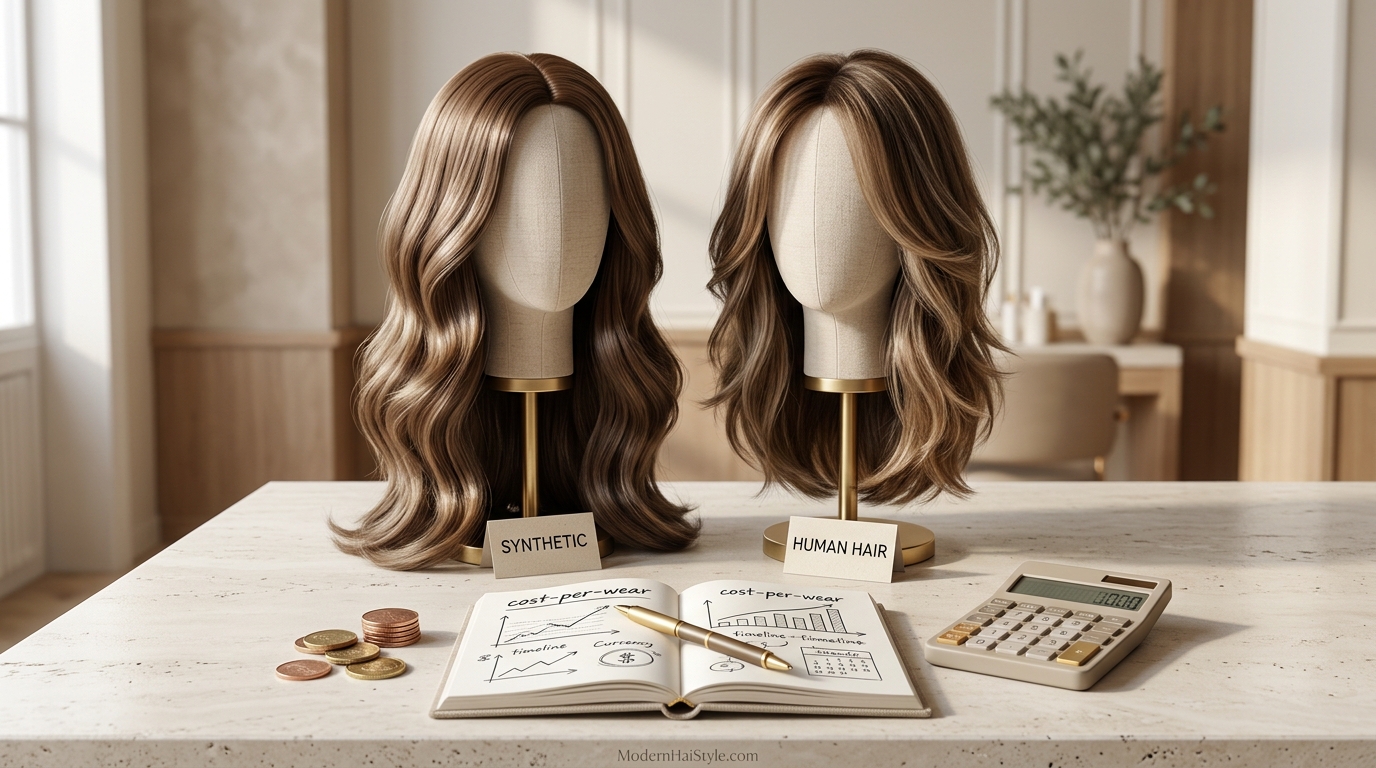
Human hair owns the higher realism ceiling. Varied strand diameter, cuticle reflection and natural movement are genuinely hard to engineer into a filament.
But fiber is not the whole audit. A poorly ventilated, over dense human hair wig can read as a wig across a room, while a well made premium synthetic passes the same test.
Run the five checkpoints the field’s deepest realism audit uses: hairline, part, shine, movement and ends. Judge any unit, either fiber, against all five before you judge its label.
Synthetic’s known tell is shine. Uniform fiber reflects light uniformly, and the sheen can grow with wear and washing. Matte fibers and wig safe sprays are the standard mitigations.
Density is the other quiet tell. Sourced buying strands centre on 130 to 150 percent as the natural looking middle, with 180 percent and above reading full and dramatic.
A glueless wig or lace front construction can lift either fiber’s hairline. Construction and fiber are separate decisions, and this cluster treats them that way.
The Hairline Is a Construction Feature
Nothing in the fiber itself creates a natural hairline. That comes from how strands are ventilated into lace or a monofilament top, and at what density.
Hand tied and monofilament constructions let strands move and part like growing hair, which is why they print as the realism and comfort route on both fibers.
So a buyer comparing two units should audit construction first and fiber second whenever realism is the stated goal. The fiber verdict then settles lifespan, heat and care.
Heat, Dye and Restyling: What Each Fiber Actually Allows
Heat is the section where one number would be a lie. Heat friendly limits are set per brand fiber system, and they print per source in their own table.
|
Heat friendly strand |
Stated limit |
Source |
|---|---|---|
|
General heat friendly guidance |
Below 275F |
Breastcancer.org |
|
Jon Renau HD and Tru2Life fiber |
Up to 350F; 270 to 280F recommended for everyday styling |
WigStudio1 brand guide |
|
Belle Tress heat friendly fiber |
250 to 300F; never above 300F |
WigStudio1 brand guide |
|
Rene of Paris guidance |
Centres on 275F; damage above 300F |
Wig Superstore strand |
Whatever the brand, the working rule is the strand test: try the tool on a hidden nape strand first, at the lowest setting, before any visible hair meets heat.
One conflict prints openly here. Breastcancer.org gives heat friendly fiber a shorter working life, 2 to 3 months, against 4 to 6 for regular synthetic, while retailer guidance treats it as a durable everyday option at low temperatures.
Both strands stand. Heat frequency is the deciding variable: daily hot tooling pushes you toward the short strand; occasional low heat refreshes sit nearer the long one.
Dye is simpler. Synthetic cannot absorb conventional hair color, standard or heat friendly. Fabric dye tricks circulate online, but no retailer guide in this research recommends them as a standard route.
Human hair can go darker safely and lighter at real risk. Bleaching weakens the hair and can end the unit, and most manufactured human hair is already processed, so results are unpredictable unless the unit is sold as colorable.
That caveat matters for color plans. A 613 blonde wig bought as a dye base is a specific, sold as colorable product, not a promise that any human hair wig takes color well.
Care, Washing and the Hidden Annual Costs
Washing frequency is a visible source conflict in this field, and it prints as one. One comparison strand says every 6 to 8 wears for synthetic and every 10 to 15 for human hair.
A sibling strand from the same content family reverses it: every 15 to 20 wears synthetic, every 7 to 10 human hair. When sources flip their own numbers, follow your unit’s maker.
The working rule underneath the conflict: wash when product, sweat and odor build up, use synthetic safe products on synthetic fiber, and keep heat based styling aids away from standard synthetic entirely.
Human hair care follows the routine in our how to wash a human hair wig guide: gentle washing, conditioning, and a full restyle afterwards, because the style does not come back on its own.
Storage is a lifespan variable for both fibers: detangled, on a stand, away from heat and direct sun. Synthetic also needs distance from oven and stove heat bursts, a warning every retailer repeats.
Sleeping in either fiber shortens its life. Friction at the nape frizzes synthetic and mats human hair, so the stand overnight is the cheapest lifespan upgrade available.
For wearers with long bio hair underneath, our how to wear a wig with long hair guide covers the flattening and comfort side of the daily routine.
The Verdict by Use Case
Daily Wear: Human Hair, or a Rotation
For most daily wearers, human hair wins: it outlasts three or four synthetics, restyles freely, and its cost per wear falls every month it stays in service.
The honest exception is the rotation strategy. Two mid range synthetics can cost less per year than one human hair unit and give two looks, at lower realism per look.
Occasional and Event Wear: Premium Synthetic
At one or two wears a month, premium synthetic is the arithmetic winner. It holds its exact style for a full event day and asks for almost no care time between outings.
Paying human hair prices for twelve wears a year rarely survives the worksheet. Save the difference, or spend it on a second style.
Cosplay and Color Experimentation: Synthetic First
Fantasy color is a synthetic manufacturing strength: fiber is dyed to saturation, so the color is exact, vibrant and cheap to replace when the character changes.
Human hair wins color only for a shade you will live in daily, like a pink human hair wig dyed from a light base and maintained with color depositing care.
For a natural shade worn daily, a brown hair wig in human hair earns its price through restyling freedom rather than through the color itself.
Heat Styling Need: Read the Brand Table, Not the Label
If daily hot tooling is non negotiable, human hair is the only full answer. Heat friendly synthetic serves occasional low heat work inside its brand limit, and standard synthetic serves none.
A upart wig human hair wearer blending her own leave out with heat tools is the classic case: the tool touches both hairs, so both hairs must tolerate it.
Medical Hair Loss: Comfort Facts, Not Claims
For medical hair loss, the sourced framing is lifestyle, climate, budget and care energy, from a medical nonprofit that lists all four tiers without pushing one.
The practical checks are physical: cap softness against sensitive skin, monofilament or hand tied construction, total weight, and a secure fit such as a wig grip.
Weight deserves its own line. Human hair is heavier at the same length, which one medical retailer flags as noticeable on tender scalps. Synthetic runs lighter and cooler.
Cranial prosthesis is the terminology that appears in prescription and insurance contexts for medically necessary wigs. This page records the term only and makes no coverage claim; eligibility sits with your insurer and care team.
Budget Ceiling: Spend Inside the Tier First
The tier jump that matters most is cheap synthetic to premium synthetic. Premium synthetic passes across a room and avoids the shine, smell and rough cap problems of the cheapest units.
Set the ceiling by wear count, not by fiber pride. A first wig at a premium synthetic price teaches you your size, your density and your routine before any large spend.
First Wig Buyers: The Trial Route
The sourced trial logic is consistent across the field’s honest pages: learn on premium synthetic first, because two weeks of wearing teaches what no product page can.
You learn your cap size, your density preference and your tolerance for daily care. Those three answers decide whether human hair’s second year arithmetic can ever apply to you.
If the trial proves daily, realism led wear, the upgrade path is clear. If it proves occasional wear, the trial wig was not a compromise. It was the right purchase.
How to Tell Them Apart Without Burning Anything
Start with label and seller records. Disclosure is the reliable route, and every test below is a supporting clue, not a verdict on its own.
The touch test: human hair feels rougher stroked root to tip against the cuticle and smoother with it. Synthetic feels uniformly smooth in both directions.
The shine check: synthetic often reads glossier under strong light and on camera. Check any unit near a window before judging it under shop lighting.
The behaviour check: human hair frizzes and moves in humidity like growing hair. Synthetic holds its set style through weather that would drop a human hair style.
The burn test prints last, deliberately. Sourced descriptions say human hair burns slowly, smells like protein and crumbles to ash, while synthetic melts, balls and smells of plastic.
Treat it as a last resort on a loose strand only, never on a worn unit, and never as a shopping trick. Open flame near any wig is a safety decision first.
Price is the quiet fifth clue. A unit sold at a synthetic price with a human hair claim deserves suspicion, because the registers in this page show how far apart the two markets actually sit.
When the clues conflict, believe disclosure over tests. A reputable seller states fiber, ratio and heat limit in writing, and that paper trail outranks any parlour test.
Marketing Words, Quarantined Once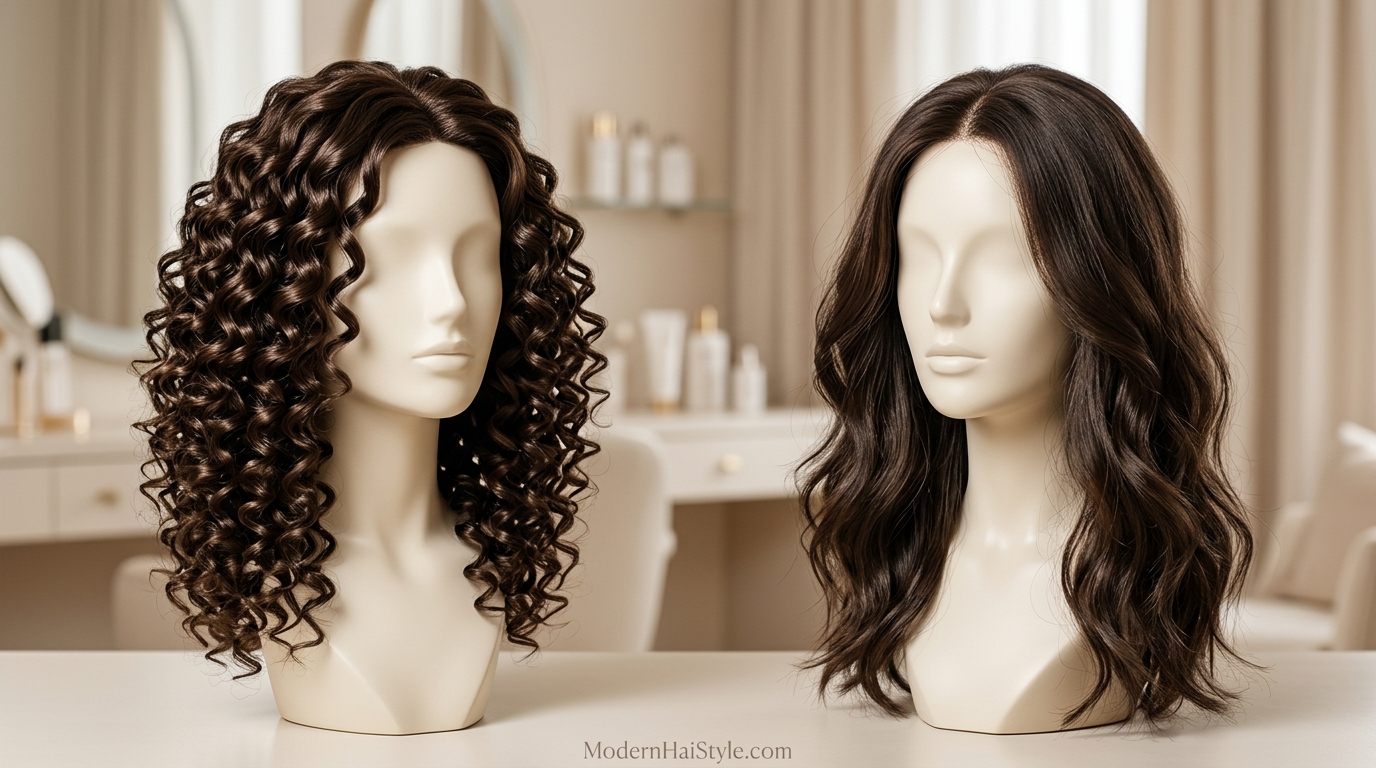
Remy describes hair with cuticles kept intact and aligned. Virgin describes hair claimed as never chemically processed. Both are processing descriptions a seller asserts.
No body certifies either term, and the same holds for grade labels like 10A and 12A. They are unregulated marketing language across this whole market.
So they appear in this page as claims, never as facts about a specific unit. Judge by seller reputation, return terms and the five realism checkpoints instead.
Frequently Asked Questions
1. Which lasts longer, a synthetic wig or a human hair wig?
Human hair, on every sourced strand, with the gap set by wear frequency. General strands run 4 to 6 months synthetic against 1 year or more human hair; daily wear splits 3 to 6 months against 8 to 14.
2. What is the cost per wear difference?
It is arithmetic, not a fixed gap. A $120 synthetic worn daily for 5 months costs about 80 cents per wear; a $400 human hair unit worn daily for 12 months costs about $1.11, and halves if it reaches two years.
3. Which looks more natural?
Human hair owns the higher ceiling, but construction can overturn fiber. A well made premium synthetic with a good hairline can pass across a room while an over dense human hair unit cannot. Judge hairline, part, shine, movement and ends.
4. Can you heat style a synthetic wig?
Standard synthetic, no. Heat friendly synthetic, yes, inside its brand limit, which prints per source: below 275F on one medical guide, up to 350F with 270 to 280F recommended on one brand strand. Strand test at the nape first.
5. Can you dye a synthetic wig?
Not with conventional hair color. Synthetic fiber does not absorb dye the way keratin does, and that holds for heat friendly fiber too. If color change is the goal, buy the color in synthetic or choose colorable human hair.
6. Can you dye a human hair wig?
Generally yes, darker more safely than lighter. Most manufactured human hair is already processed, so results are unpredictable unless the unit is sold as colorable. Bleaching can end the unit. Professional coloring is the shared advice.
7. Which is better for daily wear?
Human hair for most daily wearers, because it outlasts several synthetics and restyles freely. The exception is rotation: two mid range synthetics alternated can cost less per year and give two looks, at lower realism per look.
8. Which is better for occasional wear and events?
Synthetic. A premium synthetic worn once or twice a month can last years on the sourced occasional strand, holds its exact style all day, and needs no styling routine. Human hair prices rarely survive the arithmetic at twelve wears a year.
9. Which is better for cosplay?
Synthetic, for color accuracy, sculpted styles and budget, with heat friendly fiber when the style must be set with tools. Human hair only wins for a long term character piece that gets restyled again and again.
10. How can you tell synthetic and human hair apart?
By combined clues: touch against and with the grain, shine under strong light, and behaviour in humidity. Human hair frizzes and moves; synthetic holds its set. Price, label and seller disclosure remain the reliable route.
11. Is the burn test reliable?
It is a widely repeated strand: human hair burns slowly and crumbles to ash, synthetic melts and balls up. This page quarantines it as a last resort on a loose strand only, never on a worn unit and never as a first method.
12. What is heat friendly synthetic, exactly?
Synthetic fiber engineered for low heat, sold under names like Heat Friendly, Heat Defiant and Tru2Life. It can be curled and refreshed inside its brand limit. It cannot be dyed, tangles more readily, and frequent heat may shorten its life.
13. What is a human hair blend wig?
A mix of human hair and heat friendly synthetic at a ratio the seller should disclose. Verified strands include a 30/70 construction and grey blends at 40 to 85 percent human hair. Lifespan strands run 6 to 12 months, with one retailer printing 1 to 1.5 years.
14. Are blends worth it?
When the ratio is disclosed and the price sits genuinely between the tiers, yes, for wearers wanting some heat styling without full human hair cost. When the ratio hides behind words like premium blend, no honest verdict is possible.
15. What does Remy mean?
Hair with cuticles kept intact and aligned in one direction, so it tangles less. It is a processing description, not a regulated certification. No body certifies Remy, virgin or grade labels, so treat them all as marketing language.
16. What does virgin hair mean?
Hair described as never chemically processed. One experienced strand adds it is not a meaningful step up for most buyers unless the spend is large. Like Remy, the term is unregulated and prints as a claim to verify.
17. Why does synthetic look shiny?
Uniform fiber reflects light uniformly, and the sheen can increase with wear and washing. Matte fibers, dry shampoo strands and wig safe detangling sprays are the commonly sourced mitigations. The shine shows first in strong light and phone photos.
18. Does synthetic hold its style after washing?
Yes, that is its defining convenience: style memory set into the fiber returns after washing. Human hair must be restyled after every wash, like growing hair. Heat friendly styles also return toward their set shape.
19. Which handles humidity better?
Synthetic. It does not absorb moisture the way keratin does, so the set style stays put in rain and humidity. Human hair frizzes, drops or swells, because it is natural hair behaving naturally.
20. Which is lighter and cooler?
Synthetic, on retailer and medical retail strands: lighter fiber and lower density make it cooler in warm climates and over long wear. Human hair is heavier at the same length, which matters on sensitive or tender scalps.
21. What about medical hair loss and chemotherapy wear?
Factual and cosmetic information only. A medical nonprofit frames the choice around lifestyle, climate, budget and care energy during treatment, across all four tiers. Cap softness, weight and grip are the practical checks. Medical questions belong with the care team.
22. Is a wig a cranial prosthesis?
Cranial prosthesis is the medical terminology used in insurance and prescription contexts for medically necessary wigs. This page records the term only, makes no coverage claim, and directs eligibility questions to your insurer and care team.
23. How often do you wash each type?
The strands conflict openly: one prints every 6 to 8 wears synthetic and 10 to 15 human hair; a sibling prints 15 to 20 synthetic and 7 to 10 human hair. Follow your unit’s maker and wash on build up.
24. Can you sleep in either type?
Both guide sets lean no, for lifespan. Friction at the nape frizzes synthetic and mats human hair. A satin bonnet is the lesser option; a stand overnight extends both lives more cheaply than any product.
25. Can you swim or exercise in a wig?
No top guide here recommends swimming in a good unit of either fiber. Chlorine, salt and sweat shorten life, so the consensus practice is a dedicated older or cheaper unit for sport and water. A wig grip improves exercise security.
26. Do synthetic wigs tangle more?
Long synthetic friction frizzes at the nape and shoulders, and the fiber cannot be reconditioned like hair. Human hair tangles too, especially at the nape, but responds to conditioning. Shorter synthetic styles sidestep much of the problem.
27. Can you use regular shampoo on a synthetic wig?
The retailer consensus is no: use products formulated for synthetic fiber, because regular products and heat based aids can coat or damage it. Human hair units take sulfate free human hair products instead.
28. How do you store each type?
On a wig stand, detangled, away from heat and direct sun, for both fibers. Synthetic also needs distance from oven and stove heat bursts. Human hair benefits from a satin bag for travel.
29. What is the cheapest honest way into wigs?
A mid range synthetic in a short or mid length, on the trial logic of learning your size and routine first. Entry price strands print unmerged across the register. The cheapest units carry the shine, cap and smell problems worth avoiding.
30. Why do some human hair wigs still look fake?
Construction, not fiber: lace tint, hairline density, ventilation angle, knots and install decide realism. Run the five checkpoints, hairline, part, shine, movement and ends, on any unit of either fiber before blaming the material.
31. Can you perm or bleach a human hair wig?
Perming and coloring list as human hair capabilities, with bleaching the most damaging route. Going lighter is riskier than going darker, and processed units take color unpredictably. Professional work only is the shared advice strand.
32. Does human hair fade?
Yes, like natural hair, from sun and washing, on multiple retailer strands. A purple shampoo routine is the standard blonde maintenance strand. Synthetic color behavior is the disputed one, covered in the next answer.
33. Does synthetic fade?
The field splits, and both strands print. Retailer guides generally credit synthetic with strong color retention, while one experienced strand reports quick fading, especially in dark shades. This page records the disagreement instead of resolving it.
34. What density should a beginner choose?
Buying guide strands centre on 130 to 150 percent as the natural looking middle, with 180 percent and above reading full and dramatic. The deeper rule: density must match the hairline and part, or any fiber reads as a wig.
35. Are expensive synthetics worth it over cheap ones?
Within the tier, yes, on the experienced strand: premium synthetic passes across a room, lasts years at occasional wear, and avoids the smell, shine and rough cap problems of the cheapest units. Upgrade inside the tier first.
36. Which is better for trying a bold color like pink?
Synthetic for a first bold color: exact, vibrant and cheap to replace, with no bleaching. Human hair for a pink lived in daily, dyed from a light base and maintained with color depositing products. The routes compare; they do not merge.
37. How long does a short synthetic last vs a long one?
Shorter synthetic holds its finish longer because it suffers less friction at the nape and shoulders. No fetched source prints an exact month split by length, so none is stated here. The mechanism is sourced; the number does not exist.
38. Can heat friendly synthetic be dyed?
No. Heat friendly changes heat tolerance, not dye behaviour, on the medical guide strand. It still cannot absorb conventional color. Color change remains a human hair capability, with its own caveats.
39. What cap is best for a sensitive scalp?
Soft, smooth caps: monofilament tops and hand tied construction print as the comfort options regardless of fiber, with soft lace named on the experienced strand. Fiber choice is secondary to what touches the skin. Test cap materials before committing.
40. Do wigs damage your own hair or scalp?
The fiber itself does not, on the sourced strand. Cap roughness and poor hygiene are the irritants named. Keep the cap clean, stop wearing a unit that itches persistently, and take medical scalp concerns to a clinician.
41. Is human hair worth it for a first wig?
Only if the use case is daily, long term and realism led, and the budget survives the arithmetic. For everyone else, the sourced trial route is premium synthetic first. First wig regret is usually a use case mismatch, not a fiber defect.
42. What should I check before buying either type?
Five checks: disclosed fiber or blend ratio; the brand heat limit in writing if heat friendly; cap construction and size; the return policy, commonly unused only on hygiene grounds; and the lifespan strand for your wear frequency.
Conclusion
Synthetic wig vs human hair resolves the moment you divide price by wears and route the answer through your own use case. Daily wear past a year favors human hair; occasional wear favors premium synthetic; blends earn a verdict only with a disclosed ratio.
Start where the arithmetic points, then go deeper in the cluster: the pink human hair wig guide for color, the wiggins hair glueless wig checks for one human hair brand, and the upart wig human hair guide for the construction that blends with your own hair.

Dilawar is a passionate writer and contributor at Modern Hairstyle (modernhaistyle.com), specializing in hairstyles, hair care, grooming, fashion, beauty, and lifestyle trends. He enjoys sharing practical tips, hairstyle inspiration, and easy-to-follow guides to help readers discover their personal style. His goal is to provide informative, engaging, and helpful content that keeps readers updated with the latest trends.