
Womens Oversized Outfits: One Volume, One Anchor, Styled for Every Frame
Womens oversized outfits succeed or fail on one distinction: whether the volume looks chosen. A baggy sweater with a tucked waist reads styled. The same sweater floating over baggy jeans reads borrowed.
The difference is never the size of the piece. It is the presence of a system: one volume, one anchor, lengths chosen on purpose, and fabric that holds its shape.
That system is learnable in one sitting. Master the formula, the anchor menu, and the length map, and every oversized piece you own starts working on purpose.
The System: One Volume, One Anchor
An oversized outfit has two jobs. The volume piece makes the statement. The anchor proves the statement was intentional.
The volume is the oversized piece itself: the blazer, the slouchy knit, the baggy jeans, the boyfriend shirt. One per outfit is the default setting.
The anchor is the one visible point where your actual body or a deliberate structure shows. It can be a waist, a wrist, an ankle, or a structured shoe or bag.
The guide to wearing oversized clothes without looking sloppy states the underlying rule cleanly: pick one oversized piece per outfit and keep everything else fitted. This formula simply names the second half of that rule.
Without an anchor, the eye reads the garment’s outline as your body. That single misreading is where nearly every sloppy oversized outfit comes from.
With an anchor, the same volume flips meaning. The eye finds your waist or wrist, recalibrates your scale, and reads the extra fabric as clothing, not size.
The Anchor Menu: Waist, Wrist, Ankle, Structure
The waist anchor is the strongest. A French tuck, a half tuck, a belt over the garment, or a high rise waistband all draw the line where your torso ends.
The wrist anchor is the quietest and the most reliable. Roll or push the sleeves of any oversized top and your actual scale reappears at the edge of the volume.
The ankle anchor works from below. Cropped hems, a slight break over a shoe, or bare ankle above a loafer keeps wide bottoms from swallowing the leg.
The structure anchor comes from accessories and shoes. A structured bag, a pointed toe, or a chunky sole gives the eye a sharp line to set against soft volume.
You need exactly one of these per outfit. Two is fine. Zero is the whole list of ways oversized goes wrong.
The tuck deserves its own sentence, because it is the most used anchor in the field. The styling guidance on anchors and tucks catalogues the family: French tuck at the front, side tuck for asymmetry, bra tuck for bulky knits.
The Tuck Toolkit, Step by Step
1. The French tuck is the default.
Tuck the front center of the top into the waistband, an inch or two wide. Leave the sides and back loose, then pull the front out slightly so it drapes rather than strains.
2. The side tuck is the asymmetric option.
Tuck one side only, at the hip bone. It breaks the hemline diagonally, which suits straight skirts and trousers where a centered tuck looks too neat.
3. The bra tuck is the bulky knit rescue.
When a sweater is too thick to tuck into a waistband without bulk, tuck its hem up into the bra band instead. The knit crops itself and the volume sits above the waist.
4. The full tuck is the tailored option.
Tuck everything when the bottom is high rise and structured. It is the office register’s version, and it works because the waistband itself becomes the anchor.
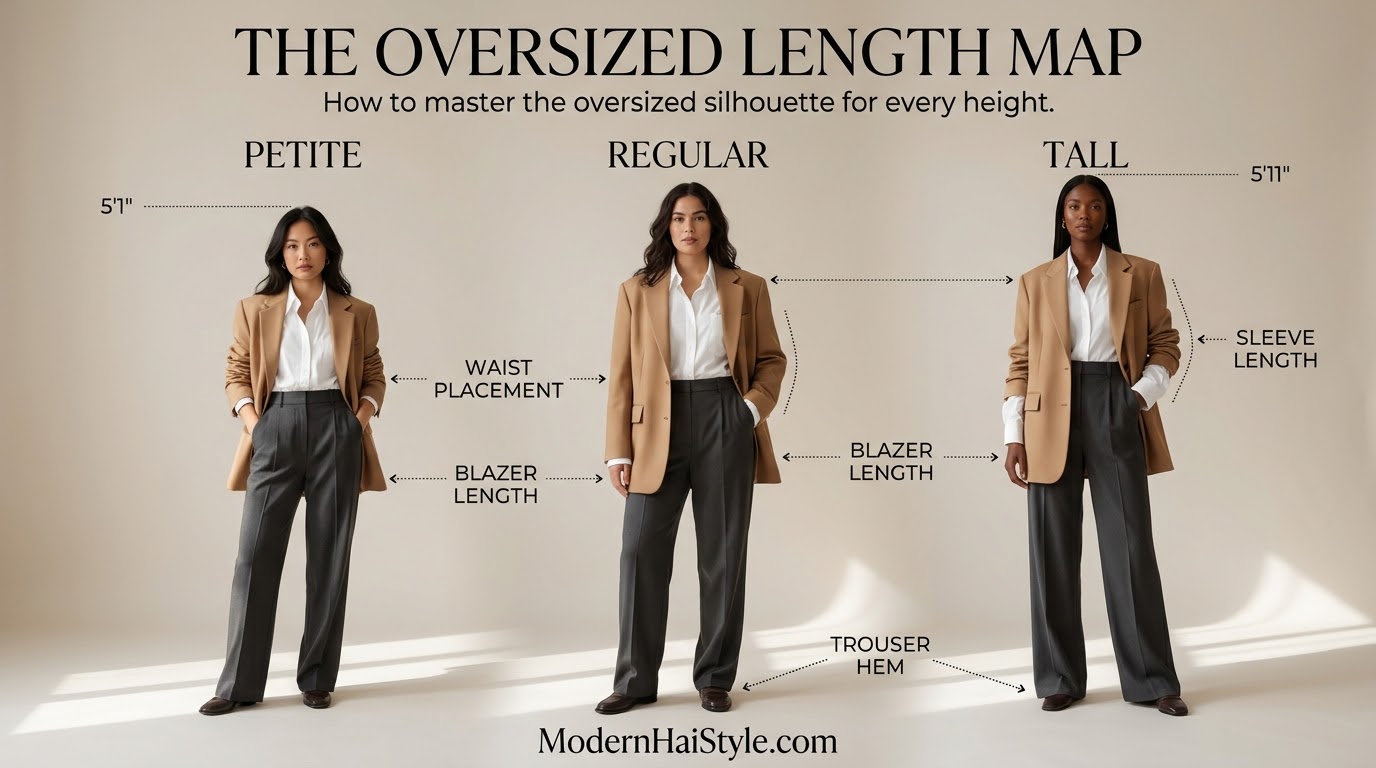
Length Before Width: The Length Map
Beginners shop width. Stylists shop length. How wide a piece is matters far less than where it ends on your body.
An oversized blazer lives between high hip and mid-thigh. Shorter reads cropped and sharp. Longer stops being a blazer and starts being the wrong coat.
An oversized shirt worn untucked should land at the hip or just past it. Once it passes the mid-thigh on a standard frame, it needs a belt, a tuck, or a dress plan.
Petite frames run a stricter version of the same map. A loose top that crosses the top of the thigh cuts the leg line unless the bottom below it is long.
|
Piece |
Length that works |
Length that fails |
|---|---|---|
|
Oversized blazer |
High hip to mid-thigh |
Past mid-thigh, reads as a coat |
|
Oversized shirt, untucked |
Hip to just past hip |
Below mid-thigh without a plan |
|
Oversized sweater |
Hip bone, tucked or not |
Mid-thigh on petite frames |
|
Wide-leg trousers |
Slight break or clean hem |
Pooling and puddling at the shoe |
|
Oversized knit dress |
Mid-thigh to knee |
Below knee with no boot line |
The map has a companion rule for hems generally. A hem that stops at the widest point of the calf or thigh shortens the leg it lands on.
Choose hems that stop above or below the widest point. That one decision does more for an oversized outfit than any accessory you can add.
Fabric With Body: The Structure Rule
Oversized silhouettes are architecture, and architecture needs material that holds. Wool, denim, canvas, leather, and chunky knits keep a garment’s intended geometry at any size.
Limp fabric is the silent failure. A thin, drapey cloth in a big cut collapses in one place and pools in another, and the outline reads accidental.
This is why two sweaters in the same size can look completely different. The structured knit is an outfit. The limp knit is a laundry day.
When you shop, do the hanger test. If the piece cannot hold its own shape on the hanger, it will not hold a silhouette on you.
Designed Oversized, Not Sized Up
Buy oversized pieces designed to be oversized, in your own size. The pattern places the extra volume where it belongs: body and length, with the shoulder extended on purpose.
Sizing up a regular garment moves everything at once. The neck wanders, the shoulder seam slides down the arm, and the sleeve swallows your hand. The result reads borrowed.
One retailer states the rule in plain language: retail styling guidance on oversized fits warns that bigger sizes do not mean oversized. Shop purposely oversized styles, whose hems and structure are built for your frame.
If sizing up is your only route, treat two to three sizes as the ceiling, as the most permissive guides allow. Past that, every checkpoint in the fitting room section starts failing at once.
The Back View Rule
Every check in this system happens twice: once facing the mirror, once turned around. Oversized fabric misbehaves behind you first, pooling at the back, shelving at the shoulders, hems hanging unevenly.
The front of an oversized outfit is the advertisement. The back is the evidence, and it is the view everyone behind you actually gets. Thirty seconds with a phone camera settles what the mirror argues about.
Make the back view a habit, not an event: every new piece, every new formula, once. After that, the checkpoints in the fitting room section keep the standard you set.
The Starter Pieces, Ranked
Five pieces build nearly every oversized outfit worth wearing. Buy them in this order, in neutrals first, and the rest of your wardrobe becomes the supporting cast.
1. The oversized blazer comes first.
It is the most versatile volume you can own: over a slip dress at night, over a fitted tee and jeans by day, belted when you want a waist.
2. The boyfriend button-down shirt is second.
Poplin holds every shape you ask of it: French tucked, worn open, belted as a shirtdress. It is the system’s training piece and its hardest worker.
3. One slouchy knit is third.
A structured chunky sweater runs the entire cold season: half tucked into jeans, over leggings with boots, layered under coats. Weight and texture do its anchoring before you style anything.
4. Baggy or wide-leg denim is fourth.
Bottom volume is the street register’s home piece. It demands the strictest top discipline, which is why it comes after the tucking habit is automatic.
5. The oversized layer is fifth.
A denim jacket or a trench finishes the set. Structured outer volume turns fitted basics into outfits and gives fall and winter their staged depth.
Buy the set in this order for a reason. The blazer and shirt teach the anchor habits with forgiving partners, while bottom volume punishes a missing tuck immediately.
Shop your own closet first before buying anything. Most wardrobes already hold one piece that passes the checkpoints; the starter set exists to fill the gaps around it.
Judge each purchase by cost per wear, not by the tag. A structured blazer worn weekly for years is the cheapest piece in this article, whatever it cost at the till.
Piece by Piece Formulas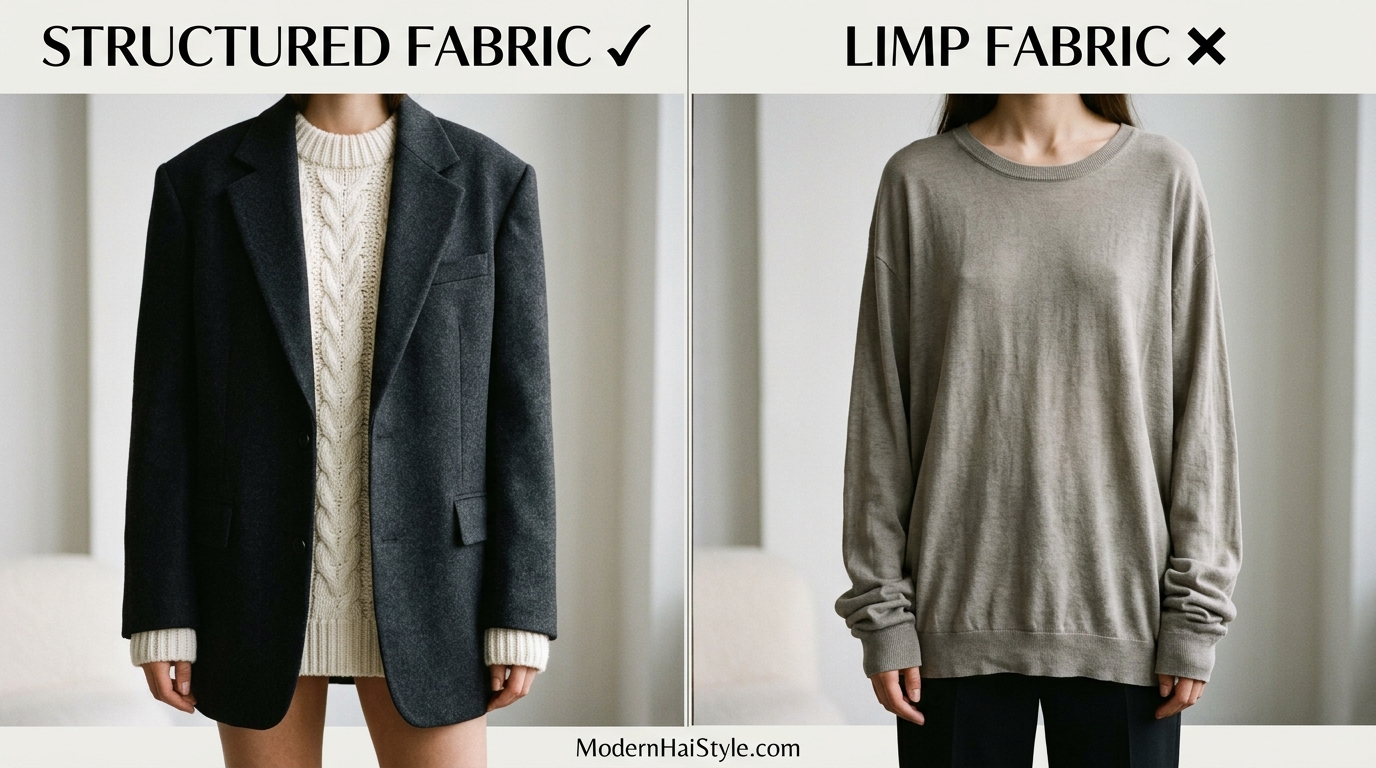
Formulas beat inspiration, because a formula repeats on a tired morning. Each one below is the system wearing a different piece: one volume, one anchor, lengths from the map.
|
Volume piece |
Partner pieces |
Anchor |
|---|---|---|
|
Oversized blazer |
Slip dress, sneakers or boots |
The dress’s body line, pushed sleeves |
|
Oversized sweater |
Leggings, fitted knee-high boots |
Half tuck, boot line |
|
Baggy jeans |
Bodysuit or tucked slim tee |
Tucked waistband |
|
Wide-leg trousers |
Fitted knit or tucked blouse |
High rise waistband |
|
Oversized shirt |
Bike shorts or denim shorts |
French tuck, bare legs |
|
Oversized denim jacket |
Midi dress |
The dress’s silhouette |
|
Oversized knit dress |
Knee-high boots, optional belt |
Boot line or belt |
Oversized Blazer Formulas
The blazer over a slip dress is the field’s signature formula. The dress supplies the body line, the blazer supplies the structure, and a sneaker or boot grounds the register.
The blazer over a fitted base is the workhorse version: slim tee, straight jeans, loafers. Push the sleeves to the forearm and the wrist anchor does the polishing.
The belted blazer is the third register: closed, belted at the natural waist, worn almost as a dress over slim trousers. The oversized outfit ideas and styling guidance builds much of its gallery on these same three blazer shapes.
Sweater, Hoodie, and Knit Formulas
The oversized sweater runs on the half tuck. Front tucked into jeans or a skirt, back loose: the waist appears, the drape survives, and the knit stays the only volume.
Over leggings or tights, the sweater becomes a dress register piece. The formula works because the leg is fully streamlined and a fitted boot draws the bottom line.
The hoodie needs one structured partner to leave the house styled: a blazer or denim jacket over it, or a visible waistband and a deliberate shoe under baggy jeans. Softness everywhere is the only real hoodie mistake.
Baggy Jeans and Wide-Leg Formulas
Baggy jeans are styled from the waist down. The waistband must show, which makes the top a bodysuit, a tucked tee, or a cropped layer, nearly without exception.
Match the hem to the shoe before you leave: a slight break over chunky sneakers, or hemmed clean for boots and loafers. A puddling hem quietly cancels the whole outfit.
Wide-leg trousers follow the same law in a tailored accent: fitted or tucked top, high rise waistband as the anchor, pointed toe or loafer to sharpen the exit.
Shirt, Denim Jacket, Trench, and Cardigan Formulas
The oversized shirt has four standard shapes: French tucked, worn open over a fitted base, belted as a shirtdress, and layered under a knit with collar and cuffs showing.
The denim jacket is structured volume and knows it. Over a midi dress it lets the dress draw the silhouette while the jacket adds the relaxed outline.
The trench runs the control points: shoulder placed, sleeve pushed to show wrist, opening kept clear so the outfit underneath stays visible. Belt it when you want the waist version.
The cardigan is the softest volume and needs the firmest base: a slim tee, a tank, or a slip dress underneath, belted closed when the outfit needs a waist.
Frame Edits
The system does not change by frame. Its settings do. Each frame below gets rules, not reassurance, because rules are what the galleries never give you.
Petite: The Four Rules and the Control Points
Petite styling guidance has matured past the old ban on oversized. A widely cited petite comparison names four rules that decide the outcome: waist break, length, proportion, and break points.
Break the waist high: a tuck, a belt, or a high rise waistband separates the body early and lets the legs read longer behind it.
Manage length strictly: a loose top should not cross the top of the thigh unless the bottom is long. Length is the variable that trips petite frames first.
Keep one oversized piece per outfit, strictly. On a smaller frame the margin for a second volume is thinner, not absent.
Control the break points: where hems, necklines, and tucks stop decides where the eye stops, and the eye should stop high.
A petite proportion study adds the philosophy under the rules: volume is allowed when its placement is controlled. Shoulder, sleeve, and hem must look chosen, not inherited from a taller pattern.
Plus Size: Structure and Placement
For plus size frames the edit is structure and placement. Choose designed pieces whose volume starts where intended, at a placed shoulder rather than a sliding one.
Run one of two silhouette strategies: a defined waist inside the volume, or a deliberate one color column that reads as a single intentional line.
Fabrics matter double here. A cloth with body holds the designer’s geometry; a limp cloth hands the outline over to chance.
Tall: Length as the Advantage
Tall frames hold the system’s natural advantage: standard oversized lengths land where the map wants them, and long coats and wide trousers need no edits.
The tall edit is about not wasting the advantage. Keep the anchor visible anyway, because height does not replace intention, and let maxi lengths do the dramatic work.
Body Shape Notes: Hourglass, Pear, Apple, Straight
Hourglass frames anchor at the waist almost for free. Belts over blazers and shirtdresses and tucked tops simply underline a waist that is already the body’s narrowest point.
Pear frames put the volume decision up top: an oversized blazer or knit above, a streamlined darker bottom below. The anchor is the tucked waist where the two registers meet.
Apple frames often prefer the column strategy: one color, volume falling from the shoulder, interest at the neckline and the shoe. The anchor shifts to wrists, ankles, and structure.
Straight frames use volume to manufacture the waist contrast they do not start with. A belted oversized piece over a fitted base creates the break the silhouette needs.
|
Frame |
Setting that changes |
Rule that never changes |
|---|---|---|
|
Petite |
Stricter lengths, higher waist break |
One volume, one anchor |
|
Plus size |
Structure and placement first |
One volume, one anchor |
|
Tall |
Maxi lengths unlocked |
One volume, one anchor |
|
Over 40 |
Tailored registers, polished anchors |
One volume, one anchor |
Occasions: Work, Weekend, Date, Travel
Work runs the tailored register: oversized blazer over a fitted base, wide-leg trousers with a tucked blouse, loafers, a structured bag. The formal blazer outfit rules shows how quickly formality collapses when the blazer’s discipline goes.
Weekend and street registers run softer and wider. This is where womens streetwear outfits live: baggy denim, hoodies, and oversized layers, all still obeying the anchor law.
Date outfits take the blazer and slip dress formula or the belted shirtdress. The system’s gift here is contrast: volume outside, a clear body line inside it.
Travel outfits exploit oversized comfort honestly: a big knit or shirt over leggings, one structured layer that doubles as the jacket, and shoes chosen as anchors, not afterthoughts.
Seasons restage the same system: fall outfit layering stage volume over fitted bases, winter layering outfits add the coat as the outer volume, and summer outfit formulas shrink the anchor to skin, shorts, and breathable structure.
Accessories finish every register the same way. The thinking in accessories that finish an outfit applies directly: pieces with a line and presence anchor volume, while delicate pieces disappear inside it.
Maternity friendly styling borrows the system whole: designed volume accommodates a changing body, and the anchor moves to the wrist, ankle, and shoe as the waist anchor retires for a season.
Modest registers run the same law at higher coverage: volume layered over fitted bases, anchors at the wrist and shoe, and length chosen from the map rather than left to the garment.
A Week of Oversized Outfits
Monday is the work formula: oversized blazer, fitted base, straight trousers, loafers. The wrist anchor and the structured bag carry the professional register alone.
Tuesday runs the shirt system: boyfriend button-down French tucked into straight jeans. It is the lowest effort outfit in this article and the one that teaches the tuck best.
Wednesday is knit day: the slouchy sweater half tucked over slim trousers, or untucked over leggings with fitted boots when the day runs errands, not meetings.
Thursday takes bottom volume out: baggy jeans, bodysuit, chunky sneakers. The tucked waistband is the whole styling, and the outfit survives on that single decision.
Friday dresses it up: the blazer over a slip dress, or the belted shirtdress. Same blazer as Monday, different register, which is the starter set’s entire economic argument.
The weekend belongs to the exception’s training ground: hoodie under a denim jacket, or a monochrome volume pairing at home in the system before it goes out in public.
The Exception: Volume on Volume, With Conditions
Everything above says one volume. Street style wears two, daily, and any honest guide has to teach the exception instead of pretending it fails.
Volume on volume survives on three conditions. At least one anchor stays visible. Both fabrics hold their shapes. And the palette stays tight, ideally one color family.
Meet all three and baggy jeans under an oversized blazer read as a deliberate silhouette. Miss one and the same clothes become the column mistake with extra steps.
Treat the exception as a skill level, not a loophole. It is earned after the one volume version feels automatic in the mirror, front and back.
Monochrome is the exception’s training wheels. One color removes the horizontal breaks, so two volumes read as one column, and texture contrast does the work color would otherwise do.
Start there: an all black or all cream volume pairing, one anchor showing, both fabrics structured. When that reads intentional in the mirror, the mixed color version is within reach.
The Fitting Room Checkpoints and Tailoring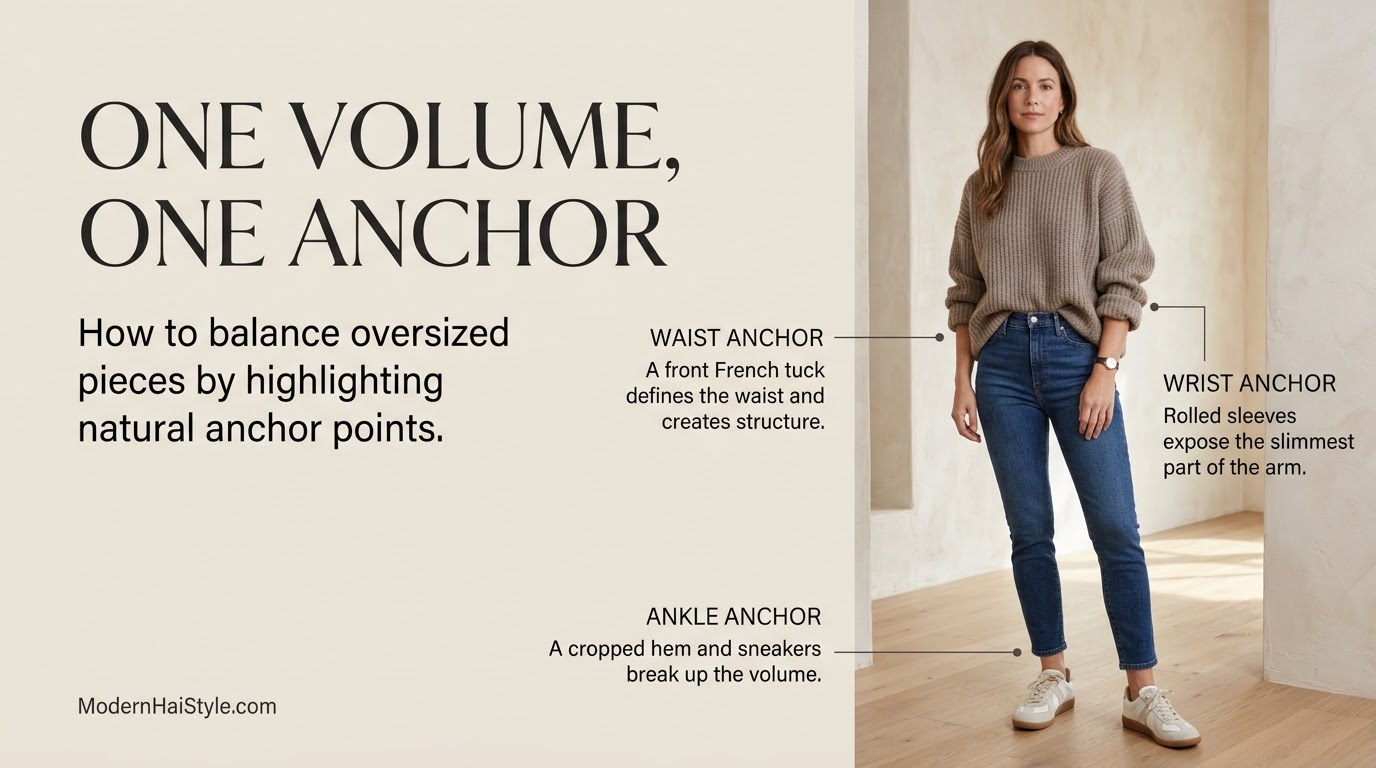
Judge every oversized piece by five checkpoints before it comes home. They take thirty seconds and predict the piece’s whole life in your wardrobe.
1. Shoulder: the seam sits just past your natural shoulder, placed, not sliding toward the elbow.
2. Sleeve: you can free your wrist with one push. If the hand disappears, the sleeve is a styling tax forever.
3. Hem: it lands at a length from the map, chosen by you, not at the widest point of calf or thigh.
4. Neckline: it stays where you put it while you move, sit, and reach.
5. Back view: no pooling, no shelf of fabric. Most oversized regrets are visible only from behind.
The tailoring guidance for oversized silhouettes builds its whole method on the same checkpoints, plus movement tests: raise your arms, sit, walk. Volume should move with you, not migrate.
Tailoring is the checkpoints’ second half. Shortening a sleeve, hemming a trouser to its break, or lifting a shoulder keeps the designed drama and removes the accidental drag.
The Error Catalogue
|
Mistake |
Why it fails |
The fix |
|---|---|---|
|
Volume everywhere, no anchor |
The eye reads garment outline as body |
One volume, one visible anchor |
|
Sizing up regular clothes |
Neck, shoulder, and sleeve all move |
Buy designed oversized in your size |
|
Limp fabric in a big cut |
The silhouette collapses and pools |
Structured fabric with body |
|
Hem at the widest point |
The leg reads shorter at the stop |
Hem above or below the wide point |
|
Sleeves swallowing hands |
Your scale disappears at the edge |
Roll, push, or tailor the sleeve |
|
Skipping the back view |
Bulk hides where you never look |
Mirror check, front and back |
Every error in the table is a version of three root errors: no anchor, wrong route to volume, or fabric without body. Fix the roots and the catalogue empties itself.
Frequently Asked Questions
What are womens oversized outfits?
Outfits built around one intentionally oversized piece, cut with extra volume rather than merely loose.
The craft is contrast: the volume is deliberate, and fit, tucks, belts, or shoes elsewhere prove it was chosen.
How do you style oversized clothes without looking sloppy?
Run the stylists’ system: one oversized piece per outfit, one visible anchor, structured fabric, and chosen lengths.
Sloppiness is never the volume itself. It is volume with no anchor and no deliberate hem anywhere.
What is the one piece rule for oversized outfits?
Wear one oversized piece at a time and keep partners fitted or streamlined. Oversized top, slim bottoms. Wide-leg bottoms, fitted or tucked top.
Contrast is what separates styled volume from a sizing accident.
Which oversized pieces should a woman own first?
Oversized blazer first, then a boyfriend shirt, one slouchy knit, baggy or wide-leg denim, and a denim jacket or trench.
Start in neutrals, because volume in a quiet color is easier to anchor.
Oversized blazer: how should it fit and how long should it be?
Buy designed oversized in your size: shoulder placed just past yours, sleeves you can push to show wrist.
Stylists converge on high hip to mid-thigh. Past mid-thigh it reads as the wrong coat.
How do you wear an oversized sweater without looking frumpy?
Give it a French or half tuck, a streamlined bottom, and one visible anchor at the edges: rolled sleeves or a fitted boot.
A structured chunky knit beats a limp knit of the same size.
How do you style baggy jeans for women?
Anchor the waist and choose the top by contrast: bodysuit, tucked slim tee, or cropped layer.
Match the hem to the shoe, slight break over chunky sneakers or hemmed clean for boots. Tucking is close to non-negotiable.
Wide-leg trousers: what top works with them?
Fitted, tucked, or cropped, almost without exception. The trousers supply the volume, so the top marks the waistline they start from.
High rise pairs best, because the waistband itself becomes the anchor.
What is a French tuck and when do you use it?
Tuck only the front center into the waistband, sides and back loose. It draws a waist point without flattening the drape.
Use it whenever a loose top meets a structured bottom and the outfit needs a focal point.
Can petite women wear oversized clothes?
Yes, with a sharper edit, and petite specialists reject the old ban.
What fails is uncontrolled proportion, not volume: shoulder, sleeve, and waist placement must belong to the smaller frame. One volume, one anchor, strict lengths.
What are the petite rules for oversized outfits?
Break the waist high. Manage length so loose tops stop above the thigh unless the bottom is long.
Keep one oversized piece. Control the break points so the eye travels up, not low.
Can plus size women wear oversized outfits?
Yes, same system, emphasis on structure and placement: designed volume that starts where intended, a defined waist or a deliberate one-color column, and fabrics with body.
The anchor rules work at every size.
Does oversized clothing make you look bigger?
Unanchored oversized can, because the eye reads the garment’s outline as the body.
Anchored oversized does the opposite: a visible waist, wrist, or ankle shows where the body is, and volume reads as clothing, not size.
Should you size up or buy designed oversized?
Buy designed oversized in your size. A designed piece places volume where the pattern intends.
Sizing up moves neck, shoulder, and sleeve too, which is why sized up clothes read borrowed, not styled.
How many sizes up is too many for an oversized look?
Guides that allow it cap it at two to three sizes, and treat designed oversized as better.
Past that, shoulders slide and hems land wrong. Treat it as the outer edge of a shortcut, not a method.
Can you wear oversized on oversized?
Yes, as the advanced exception, with conditions: one anchor stays visible, fabrics hold their shapes, and the palette stays tight.
Beginners master one volume first. The exception is earned, not default.
What shoes work with oversized outfits?
Shoes are anchors, chosen for line: chunky sneakers ground baggy denim, pointed toes sharpen wide-leg trousers, fitted boots streamline knit dresses, loafers tidy tailoring.
More volume above means a more deliberate shoe.
How do you wear an oversized shirt as a dress?
Choose a shirt that lands mid-thigh or below on your frame, then add dress anchors: a belt, rolled sleeves, bike shorts or leggings beneath, and a fitted boot.
The shirt is the volume; everything else is the intention.
How do you style an oversized hoodie for women?
Treat it as the one volume and style against its softness: leggings or bike shorts below, a structured layer over it, or a visible waistband with baggy jeans.
It reads lazy only when everything else is equally soft.
Oversized outfits for work: how do you keep them professional?
Build on tailoring: oversized blazer over a fitted base, wide-leg trousers with a tucked blouse, structured fabrics, polished anchors.
Skip the softest registers. Volume is fine at work; vagueness is not.
How do you belt an oversized blazer or shirtdress?
Belt over the closed garment at your natural waist, snug enough to gather soft folds, never straining the closure.
A medium width structured belt works best. On a shirtdress it converts a column into a waist.
Why do sleeves matter so much in oversized styling?
The wrist is the smallest visible measure of the body, and showing it recalibrates the whole silhouette.
Rolled sleeves tell the eye your actual scale inside the volume. Sleeves swallowing hands are stylists’ first fix.
What fabrics work best for oversized pieces?
Fabrics with body: wool and suiting blends, denim, canvas, leather, and chunky knits that hold a shape.
Structured fabric keeps the garment’s intended geometry, separating an oversized silhouette from a merely large garment.
Which fabrics make oversized look sloppy?
Limp, thin, overly drapey fabrics in large cuts: they collapse in places and pool in others, so the outline reads accidental.
Soft volume plus soft fabric is the combination stylists warn against first.
How do you layer oversized clothes in fall and winter?
Layer by contrast: a fitted base under an oversized open layer, plus one structured outer anchor.
Keep volumes staged, thin inside, volume outside, so the outfit reads as depth rather than bulk.
Oversized summer outfits: how do you stay cool and styled?
Use the system’s light end: an oversized cotton shirt over bike shorts, an oversized tee with denim shorts, wide-leg linen with a fitted tank.
Summer’s anchor is skin at the legs and arms, in breathable structured fabrics.
What is the difference between oversized fit and relaxed fit?
Degree and intent. Relaxed fit adds ease to a normal silhouette; oversized fit redesigns it with visibly extra volume.
A relaxed piece gives comfort; an oversized piece gives the statement.
How do you style an oversized denim jacket?
Use it as structured volume: over a midi or slip dress, over a fitted tee and leggings, or denim on denim in a different wash.
Push sleeves to the forearm. Its stiffness holds an outline over soft pieces.
Oversized cardigan outfits: what goes underneath?
A fitted base that draws the body line: slim tee, tank, bodysuit, or slip dress.
Belt it closed for the waist version, or wear it open over slim bottoms. The cardigan is the volume; the base is the anchor’s first half.
How do you wear an oversized trench or long coat without drowning?
Control three points: the shoulder sits as intended, the sleeve ends deliberately with wrist showing, and the opening stays clear.
Belt it for the waist version. Length does not drown anyone; uncontrolled volume does.
What accessories work with oversized outfits?
Accessories are anchors and scale partners: a structured bag against soft volume, a belt as waist anchor, jewelry with presence, a cap or wide brim hat.
Choose pieces with a line, not pieces that disappear.
Monochrome oversized outfits: why do they work?
One color removes the horizontal breaks that chop a silhouette, so volume reads as one intentional column.
It is the easiest route into volume on volume and a petite friendly strategy. Texture contrast supplies the interest.
How do you define your waist in an oversized outfit?
Four tools: the French or half tuck, a belt over the garment, a cropped or high rise partner, and a fitted base showing through an open layer.
You need only one per outfit. That one is the anchor.
Oversized outfits for women over 40: what changes?
The system stays; the registers shift. Tailoring led volume replaces the softest street pieces, fabrics gain body, anchors get polished.
The proportion rules are not age limited; the edit is about polish, not permission.
Can you wear an oversized sweater dress with boots?
Yes, a most repeated formula: the knit dress supplies volume, a fitted knee-high boot supplies the line, dress landing mid-thigh to knee so the boot shows.
Add a belt if the dress is a true column.
What bottoms go with an oversized top?
Streamlined by default: leggings, straight jeans, slim trousers, pencil or mini skirts, bike shorts, tailored shorts.
If the bottom has width, choose structured width and keep the top tucked or belted so the waist shows.
What tops go with oversized bottoms?
Fitted, tucked, or cropped: bodysuits, slim tees and tanks, fitted knits, tucked button-downs, waist-length jackets.
The bottom supplies volume, so the top marks the waist. A loose untucked top over baggy bottoms is the column mistake.
How do you know an oversized piece is too big?
Judge by checkpoints, not the size tag: shoulder seams sliding toward the elbow, sleeves covering hands, hems at unchosen lengths, a wandering neckline, fabric pooling at the back.
One can be styled around; three means wrong size.
Should you tailor oversized clothes?
Yes, at the checkpoints: shorten a sleeve to free the wrist, hem trousers to the intended break, lift a shoulder.
Small alterations keep the designed volume and remove the accidental parts. Keep the drama, fix the drag.
How do you style an oversized white shirt?
The system’s training piece: French tucked into straight jeans, open over a fitted tank, belted as a shirtdress over bike shorts, or layered under a sweater with collar and cuffs showing.
Poplin’s structure holds every shape.
Are oversized outfits still in style?
Oversized silhouettes have held across many consecutive seasons, and stylists treat the core pieces as wardrobe staples.
That is editorial consensus, not a guarantee: the tailored end ages slowest, in fabrics that hold shape.
Womens oversized outfits: which mistakes matter most?
Three: volume everywhere with no anchor; sizing up regular clothes instead of buying designed oversized; and limp fabric in a big cut.
Every other common error is a version of one of these three.
Conclusion
Womens oversized outfits are not a size decision. They are a proportion decision, repeated daily: one volume, one anchor, lengths from the map, fabric that holds its line.
Start with the blazer and the shirt, run the anchor menu until it is automatic, and let the frame edits tune the system to your body. The exception, the occasions, and the catalogue all hang off that one formula.
Build the starter set first, then keep exploring the wider outfit system at Modern Hai Style, where the same proportion thinking runs through every season and register.

Dilawar is a passionate writer and contributor at Modern Hairstyle (modernhaistyle.com), specializing in hairstyles, hair care, grooming, fashion, beauty, and lifestyle trends. He enjoys sharing practical tips, hairstyle inspiration, and easy-to-follow guides to help readers discover their personal style. His goal is to provide informative, engaging, and helpful content that keeps readers updated with the latest trends.


