

Womens Baggy Jeans Outfit: Show the Waist, Set the Hem, Style Every Register
Womens baggy jeans outfit questions almost always reduce to one editor’s phrasing: what goes on top so the outfit does not wear you. The jeans are rarely the problem. The decisions around them are.
Every baggy jeans outfit is settled by two decisions: what happens at the waist, and what happens at the hem. Make both on purpose and the slouch reads styled at any age.
This guide runs those two decisions in order: the fit family first, then the waist system, then the hem and the shoe it forces, then formulas for every register you actually live in.
The Fit Family: Baggy, Wide-Leg, Boyfriend, Barrel
Loose denim is a family, not a fit, and half of all styling confusion is a naming error. Four members matter, and they differ in where the looseness lives.
Baggy jeans are loose through the waist, hips, and legs, all three. The field’s leading styling guide gives exactly that definition, and it is the test this whole family hangs on.
Wide-leg jeans widen from the hip down but usually keep a fitted, high rise waist and seat. They are tailored on top and dramatic below, which is why they dress up so easily.
Boyfriend jeans borrow the menswear idea at half strength: relaxed, somewhat structured, usually tapering or cuffing at the ankle. They read casual chic where baggy reads street.
Barrel jeans are baggy’s shaped member: loose through the thigh, a curved bowed leg, then a taper back in at the ankle. The volume has a silhouette instead of a fall.
|
Fit |
Loose at the waist? |
Leg shape |
Register |
|---|---|---|---|
|
Baggy |
Yes, loose everywhere |
Straight or wide, pools |
Street, casual |
|
Wide-leg |
No, fitted high rise |
Widens from the hip |
Polished, dressable |
|
Boyfriend |
Slightly |
Tapered, often cuffed |
Casual chic |
|
Barrel |
Yes |
Curved, tapers at ankle |
Fashion forward |
The baggy versus boyfriend comparison draws the baggy and boyfriend line the same way: relaxed and structured on one side, loose and oversized on the other. The table above adds the two members that comparison leaves out.
Carpenter, Skater, and Cargo: The Working Members
Three more members appear in shops often enough to name. Carpenter jeans carry the baggy leg plus workwear details: a hammer loop, utility pockets, and usually a straight fall.
Skater jeans are baggy at maximum volume, built for movement and the street register, often in rigid denim that holds its own architecture. They are the hardest member to dress up and the easiest to wear honestly.
Baggy cargo jeans add cargo pockets to the loose leg. The pockets are extra volume at the thigh, which matters for frame settings: they widen the leg’s visual midpoint and ask for the strictest waist discipline of the family.
All three answer the same three questions the same way baggy does. They are dialects of one fit, and the two decisions style them without modification.
The Three Question Fit Test
Hold any loose pair in a shop and ask three questions. The answers name the fit faster than the label does, because retail labels use these words loosely.
1. Is the waist loose too?
If the waistband and seat are relaxed along with the leg, you are holding baggy or barrel. If the top is fitted and only the leg opens, it is wide-leg, whatever the tag says.
2. Does the leg taper back in?
A leg that bows out and returns at the ankle is barrel. A leg that narrows gradually and ends cuffed is boyfriend. A leg that falls straight and wide to the floor is baggy.
3. Where does the hem want to sit?
Baggy hems pool. Boyfriend hems cuff. Wide-leg hems break or sweep. The hem’s intention tells you which shoe conversation you are about to have, and it is the subject of the second decision.
Decision One: Show the Waist
Baggy denim removes the body’s most useful landmark: the waist. Decision one puts it back, and every top rule in this field is a way of putting it back.
The eye begins an outfit where the waistband sits and measures everything from there. Hide the waist and the eye measures from the shoulder to the hem in one block: the column that reads as size.
Show the waist, by any of the routes below, and the same jeans become a silhouette with a starting point. This is the whole secret, and it is mechanical, not mysterious.
The Tops That Show It
Cropped tops show the waist by ending above it: baby tees, cropped tanks, cropped sweaters. They are the summer default and the street register’s uniform, because the showing is automatic.
Tucked tops show it by drawing the line: a full tuck for tailored registers, a front or half tuck for tees and knits. The tuck is the most transferable skill in this article.
Bodysuits show it permanently: no untucking, no bunching, a clean line under any layer. Brand styling guidance like brand styling guide for baggy jeans builds its office version on a tucked bodysuit, and the logic is sound.
Fitted tops show it by contrast: a ribbed tank or slim tee against the denim’s volume. This is the route for anyone who finds crops and tucks fussy; the waist reads through the fit difference.
Rise: Low Slung Versus High Rise
The rise decides where the waist you show actually is. Low rise sits the waistband on the hip: the classic slouch, the 90s register, and the hardest version to dress up or to wear on shorter legs.
High rise sits it at the natural waist: tucks land better, legs read longer, and the office and date registers open up. Neither is better in the abstract; they are different outfits waiting to happen.
Mid rise is the compromise many wardrobes land on: some slouch, some structure, fewer regrets. When a reader owns one pair only, stylists’ formulas quietly assume it is high or mid rise, and this guide does the same.
Sizing Up, With the Caveats
The field’s most famous fit advice comes from The Mom Edit, whose stylists size up one, even two to three sizes, to get the slouch to sit correctly, because many baggy cuts are designed closer to the body than their name promises.
The trick works, and it has mechanical costs the headlines skip. The rise lengthens, the seat drops, and the waistband stops agreeing with your waist. Sized up jeans are a system, not a size.
Run the system and sizing up is safe. Hold the waistband where you chose it with a belt that actually fits that placement, the subject the accessories that finish an outfit treats as a finishing discipline, not an afterthought.
If the back waistband gaps while the hip fits, the fixes run in order: belt, hidden button or elastic insert, then a tailor taking in the back waist.
Gapping is a tailoring issue, and it is not a sign to size back down into a tighter leg.
Designed baggy in your own size remains the cleaner purchase when the cut already slouches honestly. Size up to rescue a cut that runs neat; do not size up a pair that is already telling the truth.
The Belt as a Waist Tool
On baggy jeans the belt graduates from accessory to equipment. It holds a sized up waistband at your chosen rise, it draws the waist line on an untucked outfit, and it counts as a finishing touch when baggy goes on baggy.
Choose it like equipment: medium width, structured leather, a buckle with presence. A thin decorative belt cannot hold a placement, and a belt that cannot hold a placement is jewelry pretending to work.
A scarf belt is the published softer variation, worn through the loops and tied. It suits the summer and brunch registers, where the waist needs a line more than it needs load bearing.
Belt color does quiet register work. Black on black denim disappears into the column; a tan or white belt on dark denim draws the waist on purpose, which is sometimes the whole point.
Decision Two: Set the Hem
The hem is where baggy jeans either land or collapse. Length is not a detail to accept from the rail; it is a decision to make against the shoe, once, and then keep.
The silhouette expects some pooling: a soft break or a gentle stack at the ankle is the baggy signature. What it cannot survive is a hem that drags, frays, soaks up wet pavement, and hides the shoe entirely.
Pooling, Breaks, and Cuffing
Set the length against the shoe you will wear most. Slight pool over sneakers and boots. A clean kiss of the shoe with flats, because a flat gives extra length nowhere to hide.
When the pair runs long, you have three honest options: hem them to the intended break, cuff them into a chosen hem, or reserve them for your highest shoes and stop pretending they are everyday jeans.
The cuff deserves technique. One wide cuff, even and neat, is the classic. The pin roll folds the excess width inward at the inner ankle before rolling, which narrows a wide leg opening into a tapered finish.
Cuffing is also the petite fix and the summer fix: it converts uncontrolled length into a hem you chose, and it shows the ankle and the shoe that the outfit’s second decision is about.
Hemming Baggy Jeans: What to Tell the Tailor
Bring the shoes. A baggy hem is set against a specific shoe, and a tailor working without it is guessing at the exact measurement the outfit depends on. Say which shoe the pair is married to.
Ask for the original hem to be reattached where the denim has a finished edge worth keeping, and state the target in the outfit’s language: a slight pool over boots, a clean kiss over flats.
Hem one pair at a time until you know your number. Inseam preference is personal data; once a tailor has yours on file, every later pair is a one sentence instruction.
Resist hemming to a compromise length meant to suit every shoe. A hem that half suits three shoes suits none of them, and the second decision quietly unmakes itself.
The Shoe Camps, and How to Choose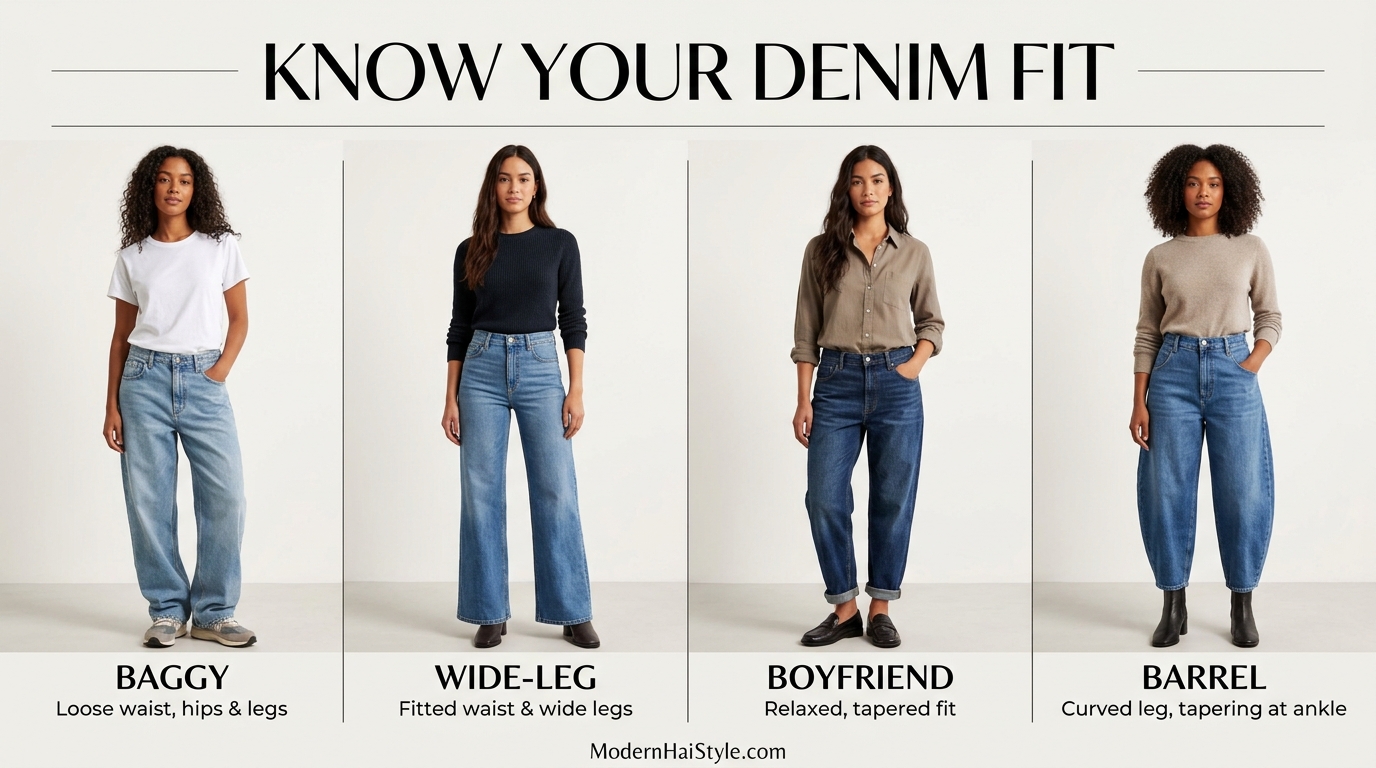
Fashion sources argue about shoes for baggy jeans in two camps, and both are right somewhere. The baggy jeans styling guide represents the street logic well: chunky and platform footwear balances the proportions, with jeans worn long enough to cover them.
The sleek camp answers that the pant already supplies the bulk: ballet flats, pointed toe flats and boots, streamlined sandals, and micro heels give the hem a sharp exit.
The leading guide’s own best shoe overall is the ballet flat, and its foolproof shape is the pointed toe.
Editorial shoe guides state the sleek case hardest, calling baggy denim the undone cousin of wide-leg and ruling out chunky entirely. Street styling answers with a decade of skater and platform outfits.
This guide does not merge the camps; it gives you the deciding factors.
|
Your hem and register |
Camp |
Shoes |
|---|---|---|
|
Pooling hem, street register |
Street |
Chunky sneakers, platforms, substantial boots |
|
Clean break, polished register |
Sleek |
Ballet flats, pointed toe flats or boots |
|
Office or date |
Sleek |
Pointed heels, loafers, sleek ankle boots |
|
Summer, cuffed hem |
Either, lighter |
Low profile sneakers, sandals, ballet flats |
|
Winter, long hem |
Street with one sleek note |
Chunky boots, pointed toe as the note |
One caution belongs to both camps: very thin stilettos can snag on the inside of a wide hem and trip the wearer. However elegant the pairing looks standing still, walk test it before it leaves the house.
The Wash by Occasion Map
Wash is the register dial built into the jeans. The same cut in four washes is four different levels of formality, and choosing the wash against the occasion is the third most common baggy jeans error.
|
Wash |
Register ceiling |
Best use |
|---|---|---|
|
Dark indigo, clean |
Office with a blazer, date |
The one pair to own first |
|
Black |
Evening, winter, office |
Dress up specialist |
|
Medium stone |
Weekend, campus |
The casual default |
|
Light and distressed |
Street, summer, concerts |
Lowest formality, highest attitude |
|
White and ecru |
Summer polish |
Needs hem discipline and care |
The versatility ranking follows from the map: clean dark indigo first, black second, then the specialists. Distressing lowers every ceiling it touches, which is a choice, as long as it is made on purpose.
Fabric choice runs underneath the wash. Rigid denim holds the baggy architecture and reads more intentional; it is the choice for first pairs and for every register above casual.
Soft and stretch denim wears closer to loungewear, which is comfortable and also the root of the pajama problem in the error catalogue.
Neither is wrong. They are different promises: rigid denim promises a silhouette, soft denim promises a feeling. Buy the promise the outfit needs, and do not ask soft denim to hold a blazer’s register.
Outfit Formulas by Register
Formulas are the two decisions pre-made. Each row below is a waist choice and a hem choice already taken; your job is only to pick the register your day is actually in.
|
Register |
Top (waist decision) |
Layer |
Shoes (hem decision) |
|---|---|---|---|
|
Street |
Cropped tee or hoodie, Rule of 3 |
Denim jacket |
Chunky sneakers |
|
Casual |
Ribbed tank, half tuck |
Open button-down |
Low profile sneakers or flats |
|
Office |
Tucked bodysuit or slim sweater |
Structured blazer |
Loafers or pointed flats |
|
Date |
Fitted silky top |
Leather jacket or long coat |
Pointed heels or sleek boots |
|
Winter |
Turtleneck, half tucked knit |
Long coat |
Boots, slight pool |
Street is where womens streetwear outfits live: baggy denim at full slouch, paid for with deliberate shoes, bags, and caps. The register works because every soft piece is matched by a decided one.
Office runs on the formula brand guides call desk to drinks: the cleanest wash, a tucked top, a blazer, and a sleek shoe. The formal blazer outfit rules shows the blazer discipline the register depends on, because the jeans bring none of their own.
Date outfits exploit the contrast: slouch below, polish above. The editor baggy jeans outfit list returns to the blazer and heels version of this formula repeatedly, and it is the register where black denim earns its keep.
Seasons restage the same rows: fall outfit layering add the layers, winter layering outfits give winter its coat and boots, and summer outfit formulas shrink the tops and free the hems with cuffs and sandals.
Brunch and weekend registers sit between casual and date: a striped tee or a soft knit, waist shown, ballet flats or clean sneakers, one pretty element (a scarf belt, a good bag) doing the register lifting.
Travel and campus outfits optimize for hours: mid rise for sitting, a cuffed hem for stairs and security lines, low profile sneakers, and a crossbody that counts as a finishing touch before you need it to.
A Week of Baggy Jeans
Monday is the office row: dark indigo, tucked bodysuit, blazer, loafers. The jeans are the most comfortable thing in the outfit and nobody can tell.
Tuesday runs casual: medium wash, ribbed tank half tucked, open button-down over it, sneakers. The half tuck is the entire styling budget, and it is enough.
Wednesday goes street: the hoodie pairing, paid for with the Rule of 3. Sleek sneakers, a structured bag, and earrings turn two soft pieces into a decided outfit.
Thursday is the black pair’s evening: monochrome column, pointed boots, one piece of jewelry with presence. Black denim carries a register that blue denim borrows.
Friday dresses the same black pair down for the weekend: white tee tucked, tan belt drawing the waist on purpose, ballet flats. One pair, two registers, three days apart.
The weekend belongs to the light wash and the skater register: full slouch, chunky sneakers, a cap, and the confidence that comes from knowing exactly which rules you are choosing to bend.
Buying Baggy Jeans: The Fitting Room Order
1. Start with the waistband, not the mirror’s full view.
Place the waistband where the rise promises it will live and sit down. A waistband that migrates when you sit will migrate all day, and no top rule survives a moving foundation.
2. Check the seat honestly.
Baggy means loose, not collapsed. The seat should slouch with shape left in it. If it hangs to the back of the knee, the size has passed the style and entered costume.
3. Judge the hem against a shoe.
Swap into the shoe type you will marry the pair to, even a shop approximation. The pooling you accept in the fitting room is the pooling you will live with.
4. Do the back view and the walk.
Fabric pools and waistbands gap behind you first. Walk the length of the shop: hems should move with you, not sweep the floor or catch at your shoes.
5. Name the register before you pay.
Say out loud which row of the formula table this pair serves. A pair bought for every register usually serves none, because rise and wash are register decisions made at the rail.
Baggy on Baggy: The Rule of 3
The advanced pairing is baggy jeans under an equally loose top: the hoodie, the oversized sweater, the big tee. It is allowed, and it has a price, named by The Mom Edit as the Rule of 3.
Wear baggy on baggy and you owe the outfit three polished, intentional finishing touches: sleek shoes, a good bag, statement jewelry, a belt, a structured layer. Count them. Three touches are what separate the silhouette from the laundry basket.
The rule is the jeans specific form of a general law: volume is fine, unanchored volume is not.
The touches are anchors wearing accessories’ clothes, and they work for exactly the reason the waist rule works: they give the eye decided points to measure from.
Beginners should still start with waist showing tops, because the Rule of 3 is easier to break than to keep. Graduate to baggy on baggy when the touches happen without counting.
Frame Settings
Petite settings: higher rise, length hemmed or cuffed to a slight pool at most, waist strictly shown. Petite wearers in the guides report looking swamped exactly when length runs wild; the frame does not need smaller jeans, it needs a managed hem.
Plus settings: structure first. A rise that places the waistband deliberately, a top that shows or implies the waist, a shoe with presence, and the darker cleaner washes for polish.
The fit’s forgiveness through hip and thigh is the point of the style, not a problem to hide.
Tall settings: the silhouette’s home ground. Standard inseams pool as designed and low rises sit as intended, so the tall edit is mostly permission: full length hems, long coats, the street register unmodified.
|
Frame |
Setting that changes |
Rule that never changes |
|---|---|---|
|
Petite |
Rise up, hem managed |
Show the waist, set the hem |
|
Plus size |
Structure and wash discipline |
Show the waist, set the hem |
|
Tall |
Full length unlocked |
Show the waist, set the hem |
|
Over 40 |
Cleaner washes, polished registers |
Show the waist, set the hem |
The Error Catalogue
|
Mistake |
Why it fails |
The fix |
|---|---|---|
|
Loose top, waist hidden, no touches |
Every anchor removed at once |
Waist showing top, or pay the Rule of 3 |
|
Hem dragging and fraying |
Length landed by accident |
Hem, cuff, or reserve for higher shoes |
|
Shoe swallowed by the hem |
The second decision never happened |
Set length against the shoe, or cuff |
|
Sized up with a sliding waistband |
The trick without the system |
Belt the placement, or tailor the back waist |
|
Distressed wash at the office |
Wash chosen against the occasion |
Dark clean wash for work registers |
|
Thin stiletto, untested hem |
Snagging and tripping risk |
Walk test, or choose a sturdier heel |
Every error in the table is a waist error, a hem error, or a wash error. There is no fourth kind, which is why two decisions and one map run the entire style.
Frequently Asked Questions
What is a womens baggy jeans outfit?
An outfit built on baggy jeans, denim loose through waist, hips, and legs, styled so the slouch looks intentional.
Two decisions control it: the waist (top, tuck, rise) and the hem (length and shoe).
What are baggy jeans, exactly?
Loose and relaxed throughout the waist, hips, and legs. Baggy is a family: barrel, straight, and wide-leg shapes can all qualify.
If the waist and seat are tight and tailored, the jeans may be wide-leg, but they are not baggy.
Baggy jeans vs wide-leg jeans: what is the difference?
It is fit through the top. Wide-leg jeans widen from the hip but often keep a fitted high rise waist and seat.
Baggy jeans are loose everywhere, waist included, and pool or slouch at the ankle. Not all wide-leg jeans are baggy.
Baggy jeans vs boyfriend jeans: what is the difference?
Degree and shape. Boyfriend jeans are relaxed and menswear inspired, somewhat structured, usually tapered or cuffed.
Baggy jeans go further: very loose, straight or wide leg opening, streetwear register.
How do you style baggy jeans without looking sloppy?
Make two decisions on purpose. At the waist, show it: cropped, tucked, or bodysuit. At the hem, set the length against the shoe.
Add structure somewhere, and the slouch reads as styling.
What tops go with baggy jeans?
Tops that show the waist: baby tees, cropped tanks and sweaters, bodysuits, ribbed tanks, anything you will tuck.
The oversized top is allowed only when the outfit pays with polished finishing touches.
Should you size up baggy jeans?
It is the field’s signature fit trick: stylists at the leading guide size up one, even two to three sizes, for the right slouch.
Caveats: the waistband must stay placeable (belt or tailor), and the rise and seat grow too.
How should baggy jeans fit at the waist?
Loose but located. The waistband sits where you place it and stays there without hiking.
A sized up pair that slides needs a belt as part of the outfit. A seat sagging to the knee is past slouch.
What shoes go with baggy jeans?
Two camps, both right somewhere. Sleek: ballet flats, pointed toes, streamlined sandals. Street: chunky or platform sneakers and boots.
Choose by hem behavior and register: pooling hems take presence; polished looks take sleek.
Can you wear heels with baggy jeans?
Yes. Pointed toe heels are a foolproof shape: the sleek point under a wide hem dresses the denim up.
One caution: very thin stilettos can snag inside a wide hem, so walk test the pairing.
Are ballet flats good with baggy jeans?
The leading guide’s best shoe overall with baggy jeans: a feminine, sleek counterpoint that elevates the slouch.
Flats demand hem discipline: pool slightly or break just above the shoe, never drag.
Chunky sneakers or slim sneakers with baggy jeans?
Both are published positions. Editorial guides argue streamlined because the pant supplies the bulk; street styling argues chunky balances the volume.
Decide by the hem and the register you want.
How long should baggy jeans be?
Long enough to mean it: some pooling or a soft break at the ankle is the silhouette. Set length against your most worn shoe.
Hems that drag, fray, and soak are past the line: hem, cuff, or size.
How do you cuff or roll baggy jeans?
One wide cuff, or a pin roll folding excess width inward before rolling, controls pooling and shows the shoe.
It is also the petite fix and the summer fix. Keep it neat; a sloppy roll reintroduces the accident.
Can petite women wear baggy jeans?
Yes, with settings changed: higher rise to place the waist, length hemmed or cuffed so pooling stays slight, tops strictly waist showing.
The fix is the hem, not avoiding the jeans.
Baggy jeans for plus size women: what works?
Same two decisions, structure emphasized: a rise that places the waistband, a top that shows or implies the waist, a shoe with presence.
Darker, cleaner washes read polished. The forgiving fit is the point.
Can you wear baggy jeans to work?
In many offices, yes, in the clean register: dark indigo or black, no distressing, tucked bodysuit or slim sweater, a blazer, loafers or pointed flats.
Low rise, ripped, and very pooled versions stay out.
How do you dress up baggy jeans?
Move every partner up a register: blazer or long coat, fitted top, pointed heels or sleek boots, a structured bag, real jewelry.
Dark washes dress up; distressed washes resist it.
What is the Rule of 3 for baggy on baggy outfits?
A named rule from the field’s leading guide: baggy jeans plus an equally loose top needs three polished finishing touches, such as sleek shoes, a good bag, statement jewelry, or a belt.
The touches prove the volume was styled.
Can you wear an oversized top with baggy jeans?
Yes, as the advanced pairing, paid for with finishing touches (Rule of 3) and usually a partial tuck or belt.
Without them, every anchor hides at once, which is why beginners pair baggy jeans with waist showing tops.
High rise or low rise baggy jeans: which is better?
Registers, not a ranking. High rise: natural waist, easier tucks, easier dressing up, kinder to most frames.
Low rise: the classic slouch, more street and 90s, harder at work and on shorter legs. Most wardrobes work the high rise pair hardest.
What wash of baggy jeans is most versatile?
A clean medium to dark indigo, no distressing. It runs errands, sits in a casual office with a blazer, and takes a heel at night.
Black is the evening specialist; white is the summer specialist.
Baggy jeans with a blazer: how to make it work?
A fitted or tucked top under the blazer, the cleaner wash, and a structured blazer.
Gray and black versions run across the field’s outfit lists, usually with heels or sleek boots. The blazer supplies the tailoring the jeans lack.
How do you style baggy jeans in winter?
Stage warmth around the jeans: fitted turtleneck base, chunky knit half tucked, a long coat as outer anchor, boots the hem can pool over slightly.
Keep one sleek element so layers read as depth, not bulk.
How do you style baggy jeans in summer?
Shrink the top, free the hem: cropped tanks, baby tees, ribbed tanks, sandals or low profile sneakers. Cuff to show ankle and shoe.
Cropped tops do the waist showing automatically.
Baggy jeans with a hoodie: how to keep it styled?
Treat it as baggy on baggy and pay the Rule of 3: sleek shoe, good bag, jewelry, or a structured layer over the hoodie.
It fails only when nothing in it looks decided.
What belt works with baggy jeans?
A belt with presence: medium width, structured leather, a buckle that reads at a distance.
On sized up jeans it is load bearing, so it must fit the loops and your waist at that placement.
Why do my baggy jeans look like pajamas?
Usually three causes: soft light washed denim, an equally soft top hiding the waist, and a worn trainer with no line.
Fix one at a time: darker or more rigid denim, a waist showing top, a deliberate shoe.
Baggy jeans for women over 40: what changes?
Formulas stay; registers polish. The leading guide’s stylists span Gen Z to Gen X, making the same point: cleaner washes, structured layers, sleek shoes, the waist rule.
The most distressed, lowest, most pooled versions retire first.
Are baggy jeans still in style?
Baggy denim has held from its 90s revival through many seasons, and brand guides now treat it as a permanent category.
That is editorial consensus, not a guarantee; clean washes in classic rises age slowest.
What is the difference between baggy and barrel jeans?
Barrel jeans are a shaped member of the baggy family: loose thigh, curved bowed leg, tapering back at the ankle.
Straight baggy keeps the leg wide and even to the hem. Both obey the same waist and hem decisions.
Can you wear baggy jeans on a date?
Yes, in the dressed register: dark wash, a fitted or silky top showing the waist, pointed heels or sleek boots, a structured small bag.
The contrast between slouch and polish is the charm.
What bag goes with baggy jeans?
A bag with structure or intention: structured shoulder bag or tote for polish, crossbody for street and travel.
It counts as a Rule of 3 touch in baggy on baggy outfits. A shapeless bag adds a third soft volume.
Do baggy jeans make you look bigger?
Unstyled, they can: the eye reads the denim’s outline as the leg.
Styled, the waist showing top tells the eye where your body starts, and volume reads as a chosen silhouette. The fix is the two decisions, not a different body.
How do you fix a gaping waistband on baggy jeans?
In order: a belt that fits the placement; a hidden button or elastic insert; or a tailor taking in the back waist, the standard jeans alteration.
Gapping at the back with a fitting hip is a tailoring issue, not a sizing failure.
Baggy jeans with boots: which boots?
Two camps. Sleek: pointed toe ankle boots, the foolproof polished choice. Substantial: chunky or decorated toe winter boots for pooling hems and street register.
The hem should pool slightly over the boot or break cleanly above it.
Can you wear baggy jeans with a tucked shirt?
Yes; the tuck is a core move. Full tuck for tailored registers, front or half tuck for knits and tees.
On low rise pairs a tuck proves the waistband placement was chosen.
What jacket goes with baggy jeans?
Structured or cropped, mostly: blazers for polish, denim jackets for double denim, leather for edge, long coats and trenches over a fitted base.
An oversized jacket joins the baggy on baggy rules.
Are baggy jeans good for tall women?
Yes; tall frames are the silhouette’s home ground: standard inseams pool as designed, low rises sit as intended.
The waist rule still applies; height is not an anchor by itself.
How do you style black baggy jeans?
The easiest dress up wash: monochrome black column, blazer and pointed boots for evening, or a white tee and sneakers for high contrast casual.
Black reads closer to trousers than other washes.
White baggy jeans outfit: how to wear them?
The summer specialist: ribbed tanks, striped tees, light knits, sandals or clean sneakers, and a belt to draw the waist line.
White shows pooling and dirt honestly, so hem discipline matters more, not less.
Womens baggy jeans outfit: which mistakes matter most?
Three. Hiding the waist with a loose untucked top and no finishing touches. Ignoring the hem, so length lands by accident.
And choosing the wash against the occasion, distressed and low where the room wanted clean and dark.
Conclusion
A womens baggy jeans outfit is never really about the jeans. It is about the two decisions the jeans force: show the waist, set the hem, and let the wash choose the register.
Run those decisions and one pair covers street to office to date, at any height and any age. Skip them and the same pair is the pajama story in the error catalogue, waiting for its diagnosis.
Build the rest of the system around them at Modern Hai Style, where the same proportion thinking runs through every outfit category on the site.

Dilawar is a passionate writer and contributor at Modern Hairstyle (modernhaistyle.com), specializing in hairstyles, hair care, grooming, fashion, beauty, and lifestyle trends. He enjoys sharing practical tips, hairstyle inspiration, and easy-to-follow guides to help readers discover their personal style. His goal is to provide informative, engaging, and helpful content that keeps readers updated with the latest trends.


