100% Human Hair Wig With Bangs: How to Verify the Claim Before You Pay
100% human hair wig with bangs shopping starts with a claim, not a product. The percent sign in the title is a promise about fiber, and almost no listing teaches you how to check that promise.
The bangs are the easy part. The hard part is knowing whether every strand on the unit, fringe included, is really human hair, or whether a blend is hiding under confident wording.
That is the spine here. The percent is the product: read the claim word by word, test in return-safe order, and let price act as evidence, not as decoration.
Shape, face fit and trimming live on the sibling page, the human hair wig with bangs guide . This page does the verification job that the product shelf skips.
Prices, lifespans and test opinions below print as dated, labelled strands. Sellers and guides disagree, sometimes sharply, and those disagreements stay visible, never merged.
The Short Answer: The Percent Is a Claim, Not a Certificate
Quick answer: a 100% human hair wig with bangs is a fringe wig whose listing claims every fiber is human hair. No US agency certifies that claim before sale.
The claim covers fiber identity only. It says nothing about grade, donor count, softness, density honesty or how long the unit will actually last you.
So buy in this order. Wording first, channel second, return-safe tests third, and price last, checked against the dated strand band in the price section below.
What 100% Human Hair Actually Claims, Word by Word
Listings stack three different claim types into one shiny title. Composition, grade and origin sound like one promise, but each carries a different level of proof behind it.
|
Claim layer |
What it promises |
What proves it |
|---|---|---|
|
Composition: 100% human hair |
Every fiber is human hair, no synthetic or animal fiber mixed in |
Fiber tests, channel trust and return terms |
|
Grade: virgin, Remy, raw, 10A |
Processing history, cuticle handling or a seller grade ladder |
Nothing standardized; no federal definition exists |
|
Origin: Brazilian, Indian, Malaysian |
Where the hair supposedly came from |
A title word alone proves nothing |
Composition Claims vs Grade Claims vs Origin Claims
Composition is the only layer the percent sign speaks to. If a unit is honestly 100%, the fringe and the lengths behave like hair under heat, water and dye.
Grade words are trade vocabulary. Virgin claims untreated hair, Remy claims aligned cuticles, and numbered grades like 10A and 12A are seller invented ladders with no shared scale.
The full general claim register lives in the wig human hair decoder . This page applies that register only to basic cap fringe wigs, where this query actually shops.
Weasel Wording: Blend, Feel, Like and Other Near Claims
Near claims are engineered to sound like the percent without saying it. Buyer protection guides flag the same phrases again and again, across otherwise unrelated stores.
|
Exact wording |
What it really means |
|---|---|
|
100% human hair |
A composition claim: all fiber claimed human |
|
Human hair blend |
Human hair mixed with synthetic, ratio unstated |
|
Human hair feel / human hair like |
Implies hair, claims nothing; assume synthetic share |
|
Remy-like, premium, top grade |
Marketing adjectives with no legal definition |
|
Real hair (no percent) |
Unquantified; could describe a blend honestly |
Read the spec block, not the title. Titles compress claims for search; the fiber line in the specifications is where sellers write what they will stand behind.
If the fiber line will not say 100% plainly, treat the unit as a blend until proven otherwise. That one habit prevents most bad buys on this query.
The Law Gap: No Certification Stands Behind the Percent
Shoppers assume a regulator checked the label. For wigs in the USA, that check does not exist, and the history is short enough to state in one paragraph.
The Federal Trade Commission once published wig labeling guides, at 16 CFR Part 252. It rescinded them on August 9, 1995, recorded in the Federal Register notice 60 FR 40453 .
What remains is general law. A false fiber claim can still be deceptive under Section 5 of the FTC Act, but that is enforcement after a sale, not pre-sale certification.
Fiber labeling rules at 16 CFR Part 303 govern textile fiber products broadly. Whether a finished wig sits fully inside that scope is genuinely uncertain, as claim guides note.
The clearest shopper summary of this gap is the Wig Avenue labeling claims explainer . It separates regulated claims from unregulated trade terms without selling anything.
One disclosure belongs here. The FTC website blocked automated checking during verification for this page, so FTC material is named in text only, while the Register and eCFR sources above are linked directly.
The practical meaning is simple. You are the inspector. The test ladder in the next section is not extra caution; it is the only inspection this product ever gets.
The Test Ladder, Ordered by Return Safety
Every fiber test costs something. Some cost a look in daylight, and one costs your return rights, so the order below runs from free and reversible to destructive and final.
Run the tiers in order and stop early. Most honest units pass tier one cleanly, and most blends betray themselves by tier two, long before anything needs cutting.
Tier 1: Daylight Shine, Strand Variation and Cuticle Feel
Take the unit to daylight, not bathroom light. Human fringe breaks light unevenly, strand by strand, while synthetic fringe reflects it as one glossy sheet.
Feel for variation and direction. Human strands vary slightly in thickness, and running fingers upward against the cuticle feels rougher than running downward with it.
Synthetic strands feel uniform and slightly squeaky, the same diameter end to end. None of these checks touches the unit, so your return window stays fully open.
Tier 2: Water Behavior and Smell After Washing
Wet one section and watch. Human hair absorbs water, gains weight and relaxes or waves; standard synthetic sheds water and springs back toward its factory set shape.
Smell is a supporting clue, never a verdict. A faint processing smell that rinses out is common; a strong plastic note that survives washing leans synthetic.
The seller guide that orders these tests most carefully is the Soul Lady six tests guide . It places smell and tangle checks in the middle, and fire last, for a reason.
Tier 3: Heat and Bleach Strand Tests, Where Return Rights End
Heat tells the truth fast. A low flat iron pass on a hidden section styles human hair and makes standard synthetic frizz, singe or fuse at the same setting.
A bleach strand test works the same way. Human strands lift in color, synthetic strands do not take dye at all, and a blend lifts unevenly, in patches.
Both tests alter the unit. Sellers who accept only unworn, uncut returns will refuse a heat tested or strand cut wig, so tier three is a decision, not a step.
Tier 4, Quarantined: The Burn Test and Its Dissent
The burn test is the most argued about check in this category, so both strands print here side by side, unmerged, and the test itself sits in quarantine.
|
Source strand |
Position on the burn test |
|---|---|
|
SoftWig and OnHairShow guides |
Call it the most reliable at home check for fiber identity |
|
Soul Lady guide |
Ranks it sixth and last: destructive, return voiding, and a blend can pass it |
|
LongRoadHomeProject explainer |
Leads with non-destructive screens; treats laboratory methods as the real proof tier |
The mechanics are simple. Human hair burns slowly to crushable ash and smells like burnt hair; synthetic melts into a hard bead and smells like plastic.
If you ever use it, use it last. Take hidden strands from three places, fringe included, only after you have knowingly decided the return rights are spent.
Never present it to yourself as proof from one spot. A blend passes a single point burn test whenever the sampled section happens to be its human share.
Why the Fringe Fails First on a Fake or Blend
Here is the insight no product page states. The fringe is the highest risk fiber zone on the whole unit: shortest strands, most heat, most oil and most direct light.
A wig can pass a nape test and fail at the fringe. That is why three place testing must include the fringe itself, not just hidden hair at the back.
|
Behavior |
True human fringe |
Synthetic fringe |
Blend fringe |
|---|---|---|---|
|
Daylight shine |
Uneven, broken up strand by strand |
One glossy sheet, glass like |
Patchy dull and glossy zones |
|
Flat iron response |
Tolerates moderate heat, re-sets after washing |
Frizzes, singes or melts |
Human sections style, synthetic sections fuse |
|
Forehead oil by midday |
Absorbs and dulls, recovers with dry shampoo |
Separates into stringy spikes fast |
Spikes in the synthetic share first |
|
Dye response |
Lifts and deposits like growing hair |
No color change at all |
Uneven, two tone result |
|
Water behavior |
Relaxes or waves, needs re-setting |
Springs back to factory shape |
Mixed response across sections |
|
Tangle pattern |
Tangles like hair, combs out |
Mats at ends, stays deformed |
Mats first where synthetic concentrates |
Read the blend column twice. Blends are built to pass single checks: the human share carries the feel test while the synthetic share waits at the fringe, exposed by heat and oil within a week.
The fringe also explains the shine complaints in reviews. Plastic shine reads as an unbroken sheet on a blunt fringe, which is why fiber honesty matters more here than on the human hair lace front wig worn away from the face.
Forehead oil speeds the verdict. The fringe rests on skin all day, collecting oil, sweat and skincare, and synthetic strands separate into stringy spikes under it faster than human strands.
The Caps This Query Actually Sells
Forget the lace catalogue for a moment. This query returns mostly machine made, non lace basic caps, often called classic caps, held on with combs, straps and elastic.
|
Cap family |
How it works |
Tradeoff |
|---|---|---|
|
Classic or basic cap |
Machine wefted, fringe covers the front edge, no lace |
No parting; worn as it comes |
|
Scalp top |
Basic cap plus a skin like top panel imitating a scalp |
Better part look, still no lace |
|
Minimalist Lace (Luvme strand) |
Small lace element at the front of a mostly basic design |
Some parting realism, higher price |
|
Closure or lace front versions |
Real lace, sold mainly by UNice and Luvme here |
Minority of this SERP; parting and glue questions return |
The honest tradeoff is parting. The Mayvenn bob with bangs states it plainly on its own product page: no lace means no part, and the unit is worn with the bangs down.
In exchange you skip the whole lace workload. No cutting, no melting, no plucking, because the fringe does the hairline job, which is exactly why beginners dominate this query.
Fit still matters on a basic cap. Cap strands cluster at 22.5 inches standard medium from ILIKEHAIR and 21 to 23 inches adjustable in Amazon listings, printed as strands, so measure your own head.
For the wider format map, the human hair wig guide owns the general overview, and the glueless wig human hair guide owns the no glue family beyond bangs.
Bang Shapes, Summarized: Fiber Behavior by Fringe Type
Shape selection is not this page’s job. The five axis system, bang type by face shape by forehead by texture by trim plan, lives in full on the human hair wig with bangs page .
What belongs here is narrower: how each shape handles fiber honesty. A blunt, bone straight fringe is the hardest test, because its flat sheet shows plastic shine and every uneven strand.
Broken up shapes forgive more. Wispy, choppy and curly fringes scatter light, hide shine and disguise the patchiness that gives a blend away in its first week.
One conflict stays held, exactly as the sibling page holds it. Two face shape sources disagree about heart shaped faces and full fringes, and that disagreement is printed there, not rebuilt here.
Trimming carries one rule that survives every page: wig fringe never grows back. Factory fringes ship long on purpose, so cut dry, in small passes, and only after every fiber check is done.
Texture examples sit sideways in the cluster. The curly wig human hair guide owns curl behavior, and the deep wave human hair wig page shows how a set pattern and its shrinkage change length claims.
Price as Evidence: The Strand Band for November 2026
On this query, price is a fiber clue. The same branded unit appears at a factory price, an Amazon tracked low and a roundup price inside one month, so strands print with seller, channel and date attached.
|
Price strand, checked November 2026 |
Product and channel |
Listed price |
|---|---|---|
|
Nadula official store |
Short bob with bangs, classic cap, sale against a $245 list |
$49.00 sale |
|
Luvme via HearSmart roundup, Nov 22 |
Yaki straight bob with bangs, Minimalist Lace |
$69.93 sale, $99.90 regular |
|
Mayvenn official store |
Straight bob with bangs, 14 inch, virgin claim |
$76.00 and $92.00 in two extracts, both printed |
|
ILIKEHAIR factory store |
Pixie and body wave bangs range, 180 percent claims |
$81.00 to $106.00 |
|
Soul Lady via WigsPick |
Redda bob with bangs, 8 to 10 inch |
$99.99 |
|
Amazon via deal.ai tracking, Nov 13 |
Curly bob with bangs low; ginger curly unit low |
$24.99 low (against $144 high); $20.99 low |
The credible band these strands draw is roughly $49 to $140 for a short basic cap bob from a returnable seller. Inside it, price differences mostly track cap, length and channel.
Below the band, slow down. Buyer protection guides treat a long, dense unit at a too good price as the first warning sign, and the Amazon lows above show how far tracking prices can swing.
The Mayvenn conflict stays visible on purpose. Two extracts of one product showed $76 and $92, and a page that hides that teaches you less than a page that prints both.
Sale framing needs the same skepticism. An 80 percent discount against a list price nobody paid is channel theater; compare the strand band, the cap and the return window instead.
Where to Buy: Channel Risk Compared
|
Channel |
Price character |
Return reality |
Risk note |
|---|---|---|---|
|
Brand direct stores |
Regular prices, dated sales, spec blocks |
Clearest terms; Luvme strands cite one free return in 30 days |
Lowest claim risk in this SERP |
|
Amazon marketplace |
Widest scatter, tracked lows far below brand prices |
Fulfilled orders return easily; third party terms vary |
Check the exact seller, not just the platform |
|
Factory direct stores |
Low to mid prices, claim stacked titles |
Terms vary by store and shipping route |
Spec blocks repeat; verify fiber on arrival |
|
TikTok Shop and social shops |
Coupon driven lows |
Often the weakest return route |
Highest risk when price sits below every strand |
Channel choice is a verification tool. A returnable channel lets tier one and two tests stay free, because a failed unit can still go back unworn.
The hair wig hub maps the wider category if your next unit is not a fringe wig at all. Inside this query, stay with channels whose terms you have actually read.
Ask for the fiber composition in writing before paying anywhere. A seller who will not state 100% in a message thread has answered the claim question more honestly than the title did.
Washing, Oil Control and Re-setting the Fringe
Fringe care is its own routine, because the bangs age faster than the lengths. They collect forehead oil daily, while the rest of the unit can go many wears between washes.
Wash the fringe alone when oil builds. UNice collection guidance, named in text only here because its site blocked automated checking at verification, suggests diluted shampoo on the fringe, rinsed well and dried flat.
Keep conditioner and serum off the fringe roots. Both make bangs sit flat and stringy against the forehead, which readers then misread as a fiber problem.
Between washes, blot with tissue and use a little dry shampoo at the fringe roots. That handles the midday stringiness that the behavior table ties to oil, on any fiber type.
Re-set after washing with water, a round brush and gentle drying, working the fringe back into its fall. The American Academy of Dermatology hair damage guidance gives the general heat principle behind keeping that heat low.
Store the unit on a stand, fringe falling naturally. A fringe crushed flat in a bag needs full re-setting, and compressed storage quietly becomes a daily styling tax.
Color claims follow the same evidence rule as fiber claims. The 613 human hair wig page shows how to read a bleached color claim before paying a premium for it.
Lifespan, Density and Cap Size: Strands, Not Standards
Three numbers on every listing look like standards and are not. Lifespan, density and cap size are seller defined strands, and printing them as strands is what keeps this page honest.
ILIKEHAIR spec blocks claim more than one year across the bangs range. That is a seller claim with no tested basis published, set against roundup practice of months to over a year by care tier.
The fringe usually decides the real number. A blend fringe fails months before honest lengths do, because heat, oil and light concentrate exactly where the shortest strands live.
Density splits the same way. Most marketplace units list 150 or 180 percent, a ratio each seller defines privately; at bob length 150 reads natural, while 180 reads full and makes fake shine louder.
The bob wig human hair guide shows the short length end of that pairing. Short units concentrate fullness near the face, so step density down, not up.
Cap size closes the trio: 22.5 inch medium in one factory system, 21 to 23 adjustable in marketplace copy. Your tape measurement outranks both, every time.
Fiber honesty has a comparison page too. The synthetic wig vs human hair comparison and the real hair wig guide cover the checks that sit above this product in the cluster.
And the no lace family resemblance is real: the headband wig human hair guide trades hairline realism for speed in the same spirit, with a band instead of a fringe doing the covering.
The Three Point Test, Worked as One Routine
The ladder becomes useful when it runs as one short routine on delivery day, before the unit is worn, cut or styled. Work through it in this order, fringe last among equals.
- Daylight pass: hold the fringe, crown and nape to a window in turn and compare shine across all three.
- Feel pass: run strands upward and downward at the same three points and note any change in texture.
- Water pass: wet one small section at each point and watch weight, shape and recovery as it dries.
- Record it: note which point behaved differently, if any; inconsistency is the blend signature.
- Decide: pass all three and the unit earns styling; fail one point twice and it goes back unworn.
One coating trick deserves naming inside this routine. Some processed hair carries a silicone coating that makes early feel and shine tests read better than the fiber underneath deserves.
The coating washes down over the first few washes, which is why delivery day silkiness is weak evidence. The water pass and a first gentle wash tell you more than the box opening moment.
That is also why review literacy matters here. Weight reviews written after the third wash, when coating, shine and tangling have settled into their real pattern, over reviews written on delivery day.
Mistakes That Cost Buyers the Most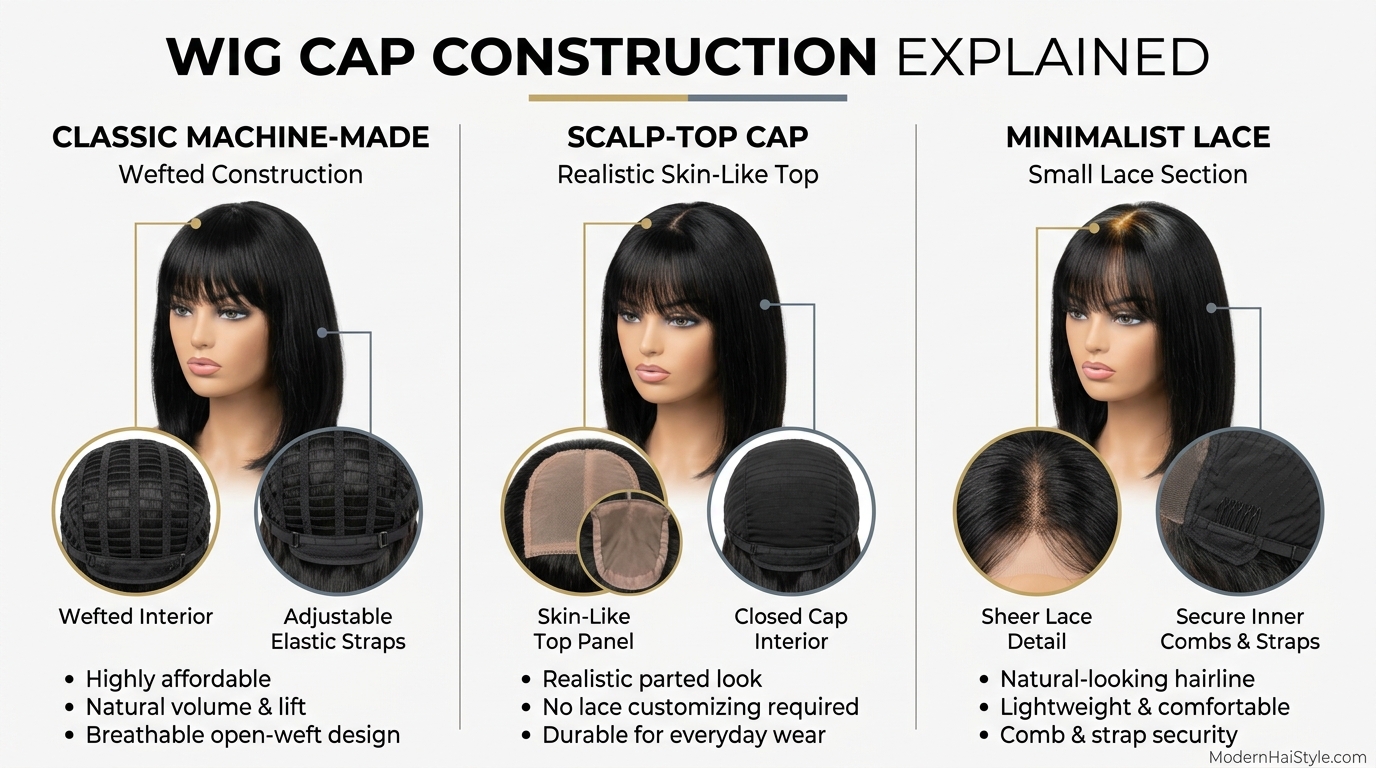
Most regret on this query is verification regret, not style regret. These are the errors that produce it, in the order buyers usually make them.
- Trusting the title percent: the spec block and the tests decide, not the headline.
- Cutting the fringe on day one: the first trim ends most return rights, before any fiber check.
- Burn testing first: the most destructive test spent before the free ones had their say.
- Testing one spot only: blends pass single point checks by design.
- Chasing the lowest tracked price: a low far below the strand band is a warning, not a bargain.
- Paying grade premiums: 10A and virgin are unregulated words priced like certifications.
- Skipping the glasses test: long blunt fringe plus frames crowds the eyes; try both together first.
Frequently Asked Questions
What does 100% human hair mean on a wig with bangs?
As a composition claim it means every fiber is human hair, with no synthetic or animal fiber mixed in. It says nothing about grade, donors or lifespan, and no US agency certifies it before sale.
Is every wig labelled 100% human hair really 100% human hair?
No. Verification guides warn the phrase is widely misused, and blends sell under human hair language. Treat the label as a claim to check with tests, channel and return terms, not a certificate.
Is there a law or certification behind the 100% claim?
There is no current FTC wig guide; the old guides were rescinded in 1995, as the Federal Register notice records. False claims remain actionable under Section 5 of the FTC Act, after the fact.
What is the difference between 100% human hair and a human hair blend?
A 100% claim means all fiber is human. A blend mixes human hair with synthetic in an unstated ratio, so sections behave differently. Blend or feel wording is not a 100% claim.
How can I tell if my wig with bangs is really human hair?
Start non-destructive: daylight shine, strand variation and cuticle feel. Only if you accept losing return rights, test hidden strands from three places. Inconsistent results are themselves blend evidence.
What is the burn test and should I do it on a new wig?
It burns a few cut strands: human hair turns to crushable ash, synthetic melts into a hard bead. It is destructive and usually voids returns, so this page quarantines it as a last resort.
Why do some experts advise against the burn test?
Because it destroys strands, needs care to do safely, and a blend can pass it if you sample only human sections. Careful guides place it last in the order for exactly those reasons.
What is the heat test for a wig fringe?
Pass a flat iron on low heat over a hidden section. Human hair tolerates it like your own; standard synthetic frizzes, singes or melts. Heat friendly synthetic is the exception that weakens the test.
Can a synthetic fringe really melt?
Yes. The fringe sits where flat irons work closest, and standard synthetic softens and fuses at styling temperatures. That fringe first failure is why fiber matters more on a bangs wig.
Why does the fringe show fake fiber first?
The fringe is short, dense, forward facing and lit by every light. Plastic shine reads as one sheet there, and forehead oil separates synthetic fringe into stringy spikes faster than human fringe.
What does virgin mean next to 100% human hair?
Virgin claims hair not chemically processed before manufacture. It has no definition in federal law, like Remy and the numbered grades. Price it as seller language, not a verified tier.
What does Remy mean on a bangs wig listing?
Remy claims cuticles kept intact and aligned, the claim most relevant to tangling. It is unregulated trade vocabulary and cannot be checked from a photo; only wear and wash behavior tests it.
What do grades like 8A, 10A and 12A mean?
They are seller invented ladders with no standard, certifier or shared scale. An 8A unit from one factory can outlast a 12A from another, so this page ranks listings by fiber evidence instead.
Does Brazilian, Indian or Malaysian in the title prove origin?
No. Origin words are claims, and customs origin marking is a separate duty from a marketing adjective. Never pay an origin premium on a title word alone.
Why are some 100% human hair wigs with bangs under $30?
Price trackers showed the same branded curly bob at $24.99 on Amazon against $144 on the brand path in November 2026. Very low prices on long, dense units are a recognized warning sign.
What is a fair price for a human hair wig with bangs in the USA?
Dated November 2026 strands run from $49 for a Nadula classic cap bob on sale to $99.90 regular for a Luvme bangs bob. Most credible basic cap units sit between about $50 and $140.
What cap do most wigs for this query use?
Machine made, non lace basic caps, often called classic caps, with combs and adjustable straps. Lace front and closure versions exist, mainly from two brands, but they are the minority here.
Do I need glue for a wig with bangs?
Usually no. The fringe covers the front edge, so most basic cap units hold with combs, straps and elastic. That glue free install is the style’s main practical benefit for beginners.
Can I part a non lace wig with bangs?
Generally no. A leading seller states the tradeoff plainly: no lace means no part, and the unit is worn as it comes, bangs down. If parting matters, step up to a closure or lace front version.
Can I heat style the bangs on a human hair wig?
If the fiber is truly human, yes, with protectant and moderate heat, and the fringe re-sets after washing. If a section melts or fuses, that section is synthetic, whatever the title said.
Can I dye or bleach a 100% human hair wig with bangs?
True human hair dyes darker readily and lifts with more risk. A blend lifts unevenly because synthetic takes no dye, making a strand test diagnostic as well as cosmetic. Major lifts belong with a professional.
How do I wash just the bangs without washing the whole wig?
Wash only the fringe with diluted shampoo when oil builds, rinse well and air dry it flat. Keep conditioner and serum off the fringe, because both make it sit flat and stringy.
Why do my bangs get oily and stringy by midday?
The fringe rests on the forehead, collecting oil, sweat and skincare first. Blot with tissue, use a little dry shampoo at the roots, and keep heavy products away from the front section.
Can I trim the bangs myself?
Yes, cutting dry so you see the true fall, in small sections a few millimetres at a time. Wig fringe never grows back, so small passes only, and only after every fiber check is done.
What bang shapes exist on human hair wigs?
Listings cluster around blunt, wispy, curtain and side swept shapes, with choppy and layered variants in pixie styles. Shape by face is owned by the existing bangs page; this page ranks fiber behavior.
Which bang shape hides fiber shine best?
Textured, broken up fringes like wispy, choppy and curly bangs scatter light and forgive shine. A blunt, bone straight fringe is the hardest test for fiber honesty.
How long do bangs wigs last?
One factory range claims more than one year, printed here as a seller strand. Real life depends on fiber truth, wash rhythm and heat; a blend fringe usually fails months before honest lengths.
What density should I choose, 150 or 180 percent?
Density is a seller defined ratio, not a weighed standard. At bob lengths, 150 percent reads natural for daily wear; 180 reads full and photographic, and makes a shine problem louder.
What cap size do these wigs come in?
One factory system lists 22.5 inches standard medium; Amazon listings commonly state average 21 to 23 inches adjustable. Measure your own circumference; average is a strand, not a fit guarantee.
Are wigs with bangs good for hair loss coverage?
They can be, because the fringe covers the front hairline without adhesive and the basic cap is gentle. Choose soft interiors, check comb pressure on fragile areas, and trial wear at home first.
Can I wear a wig with bangs with glasses?
Yes, but check fringe length against your frames. Long blunt fringe plus frames crowds the eyes; wispy or side swept shapes clear frames more easily. Try both together before trimming anything.
Why does my new wig smell like chemicals?
A faint processing smell is common and usually washes out. A strong plastic smell that survives washing is a synthetic leaning signal. Smell is a supporting clue, never a verdict alone.
What should I check before cutting or styling a new wig?
Everything return related. Most sellers accept only unworn units with uncut hair. Run every non-destructive check and the fit check first; the moment you trim the fringe, the purchase is final.
Where is the safest place to buy this wig?
Channels with clear 30 day return terms on unworn units are lowest risk, brand direct or marketplace fulfilled. The riskiest route is a no return social shop priced far below every strand here.
What is a scalp top wig with bangs?
A machine made cap with a skin like top panel imitating a scalp at the part, sold at higher density claims such as 200 percent. It improves the part look without adding lace.
Do bangs wigs work for Black women specifically?
This query’s marketplace shelf is built largely around Black women buyers: yaki, kinky curly and afro textures dominate. Texture match to leave out matters less because the fringe covers the front.
Can I straighten a curly wig with bangs?
If the fiber is human, yes, but repeated straightening spends the steam set pattern and the fringe shows heat damage first. In a blend, the synthetic share may not survive the iron at all.
How do I store a wig with bangs so the fringe keeps its shape?
Store it on a stand, fringe falling naturally, away from heat and compression. A flattened fringe needs re-setting with water, a round brush and gentle drying before it looks right again.
What is the difference between this page and a normal bangs wig guide?
A normal guide chooses shape and fit. This page verifies the fiber claim behind the listing, because the query itself contains the claim: 100%. Shape advice is summarized here and owned by the sibling page.
Should I buy the fresh version or the existing bangs page version?
They are the same product family split by job. Use the existing page to choose shape and face fit; use this page to verify fiber, channel and price before paying.
What is the single best check before paying?
Read the exact fiber wording, then compare the price with the dated strands for the same cap and length. Vague wording plus a price far below the band is the combination every protection guide flags first.
Can a wig be 100% human hair and still be low quality?
Yes. The claim covers fiber identity only. Donor mixing, heavy processing, silicone coating and thin density can all sit under an honest 100% label. Fiber truth is the floor, not the whole decision.
Conclusion
A 100% human hair wig with bangs rewards the buyer who verifies before styling. Read the wording, choose a returnable channel, run the free tests, and let price confirm the claim, not replace it.
That order turns a claim echo chamber into four clear checks. The fringe will tell you the truth within a week; the ladder above lets you hear it while returns are still open.
Start with the shape shortlist on the sibling page, then bring your chosen listing back here and run it against the claim decoder and the strand band before you pay.

Dilawar is a passionate writer and contributor at Modern Hairstyle (modernhaistyle.com), specializing in hairstyles, hair care, grooming, fashion, beauty, and lifestyle trends. He enjoys sharing practical tips, hairstyle inspiration, and easy-to-follow guides to help readers discover their personal style. His goal is to provide informative, engaging, and helpful content that keeps readers updated with the latest trends.