Deep Wave Human Hair Wig: Every Construction, Pattern and Care Rule in One Guide
Deep wave human hair wig shopping goes wrong in one predictable place. Buyers choose the pattern first, then discover the construction, density and length were the real decisions.
The pattern only decides the look of the waves. The construction decides the wig: how it installs, how it parts, how it feels, and what it costs.
That is the spine here. Construction first, pattern second, then length after shrinkage, then density paired to length, in that order, every time.
The full human hair wig overview lives in the human hair wig guide. This page does the parent job: one decision system for every deep wave format sold.
Prices, shrinkage and lifespan figures below print as dated, labelled strands. Sellers disagree, sometimes with themselves, and those disagreements stay visible, never merged.
The Short Answer: Construction Decides the Wig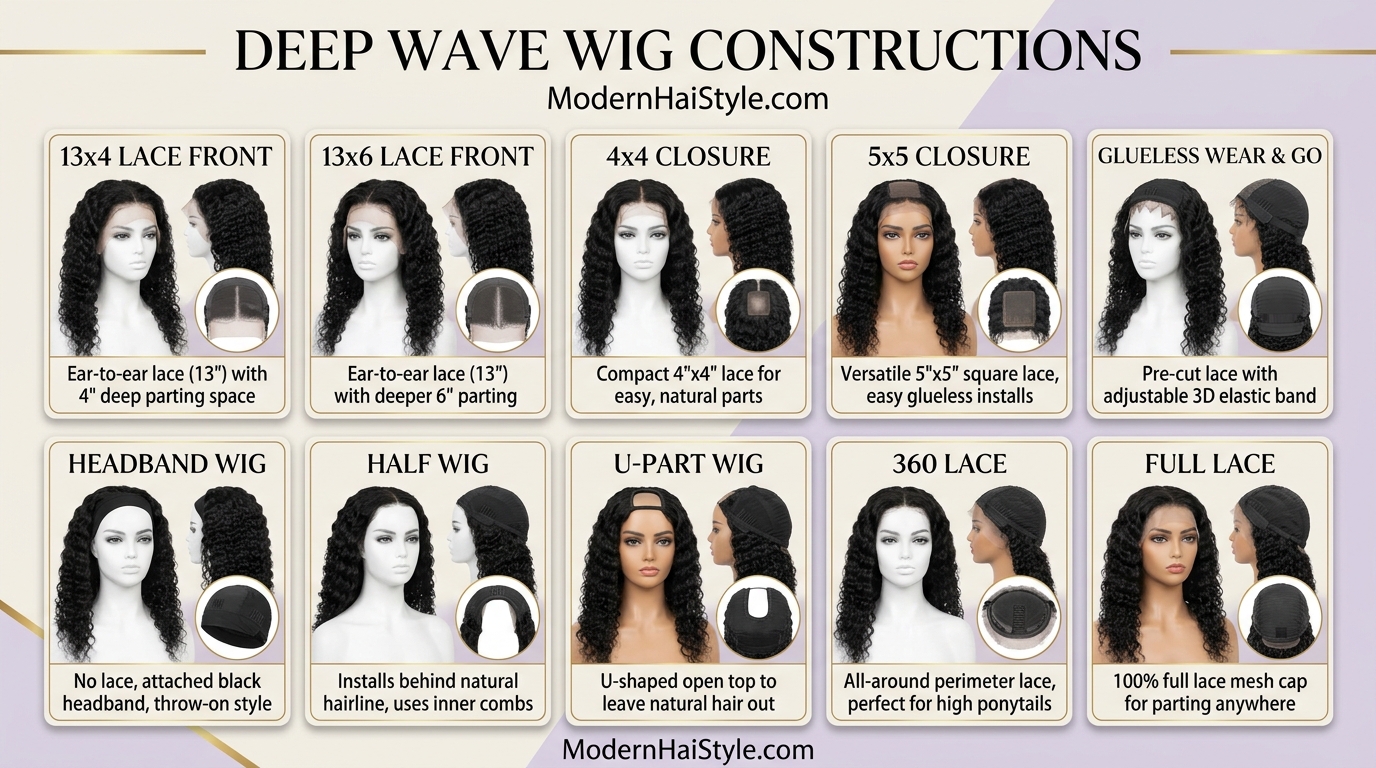
Quick answer: a deep wave human hair wig is a human hair unit set into tight, uniform S waves, sold in at least nine different constructions.
Those constructions are lace front, closure, glueless, headband, half, U part, 360 lace, full lace and plain machine made caps. They are not interchangeable products.
A closure unit suits a beginner who wants one part and low upkeep. A frontal unit suits a buyer who wants free parting and styling range.
Pick the construction by your routine first. Then check shrinkage, then pair density to length, then read the price by its construction, not its headline.
What a Deep Wave Human Hair Wig Actually Is
Deep wave is a tight, regular S pattern. It sits deeper than body wave, looser than a true coil, and more uniform than water wave.
The fiber claim is separate from the pattern claim. Human hair describes what the strands are; deep wave describes only the shape they were set into.
The definition explainer at Hair Works Central makes that split plainly. A pattern name promises appearance, not quality, construction or fiber grade.
Steam Texture: Why the Pattern Returns After Washing
Most deep wave hair starts straight before processing. Sellers set the S shape with steam, which is why listings call it steam textured hair.
It also explains the pattern’s limit. Repeated flat iron heat spends the set, wash by wash, and loosened sections rarely return to their original tightness.
Choose the Construction First: All Nine Formats
Construction changes install time, glue exposure and parting freedom more than any other variable in this category. It also changes price more than density does.
A buyer who picks the right pattern in the wrong construction usually returns the wig. A buyer slightly loose on pattern but right on construction usually keeps it.
Lace Front Deep Wave: 13×4 and 13×6 Frontal Freedom
A deep wave lace front wig carries hand tied lace across the front. The common panels are 13×4 and 13×6, measured ear to ear by depth back.
That panel buys free parting across the front, a realistic hairline and baby hairs you can style. It also buys glue or gel work most days.
The general human hair lace front wig guide covers frontal care across textures.
The 13×6 panel parts deeper than the 13×4. Deeper parting suits center parts worn long, while 13×4 covers most everyday parting needs for less money.
One format inside this family has its own full decision page here: the deep wave 13×4 HD lace front wig guide covers HD fragility and frontal density in depth.
This parent page keeps the frontal summary short on purpose. HD lace is the thinnest grade, the most invisible and the easiest to tear in a wet handled texture.
Closure Deep Wave: 4×4, 5×5 and 7×5 Simplicity
A deep wave closure wig limits lace to a small square or rectangle. Common sizes are 4×4, 5×5 and the wider 7×5 now sold on wear and go units.
You give up free parting everywhere. In return you get one clean part, far less lace to manage and a faster, calmer install.
For a first deep wave human hair wig, a 5×5 or 7×5 closure is the safest starting construction. It teaches the texture without teaching lace surgery too.
Glueless Wear and Go Deep Wave: The Beginner Format
A deep wave glueless wig replaces adhesive with fit systems. Listings stack pre-cut lace, an elastic band, a drawstring and combs, then call the result wear and go.
The convenience is real when the cap fits your head. Glueless security is a fit claim before it is a lace claim, and fit starts with measurement.
Pre-done claims need decoding one by one. Pre-bleached knots save a messy step, pre-plucked hairlines save tweezing and pre-cut lace saves the riskiest beginner cut.
The wider glueless system on this site, the glueless wig human hair guide, covers fit systems across textures. Here, glueless matters as the default beginner deep wave route.
Headband, Half and U Part Deep Wave: No Lace at All
A deep wave headband wig starts behind your hairline. A band covers the join, your own edges show and there is no lace to melt or tear.
That makes headband units the fastest daily format. They suit protective rotation, gym weeks and buyers who simply do not want lace work.
A half wig covers the back and crown while your front hair blends over it. The blend is the job: your leave out must match the wave.
The half wig system here, the half wig human hair guide, owns blending depth. This page counts half wigs as the leave out construction.
A U part wig leaves a U shaped opening, so your own part and scalp show. The U part wig human hair guide covers leave out matching in full.
360 and Full Lace Deep Wave: Ponytail Freedom at a Premium
A 360 lace wig wraps lace around the whole perimeter. That perimeter is what makes high ponytails and updos look natural from every side.
A full lace wig hand ties the entire cap. It parts anywhere, styles in any direction and carries the highest labor cost in the category.
The Construction Comparison Table
|
Construction |
Parting freedom |
Glue needed |
Beginner ease |
Ponytail freedom |
Price tier |
Main tradeoff |
|---|---|---|---|---|---|---|
|
13×4 lace front |
Free across front |
Usually |
Medium |
Low to medium |
Mid to high |
Frontal upkeep |
|
13×6 lace front |
Free, deeper part |
Usually |
Medium |
Low to medium |
High |
Cost and upkeep |
|
4×4 or 5×5 closure |
One part area |
Optional |
High |
Low |
Low to mid |
Limited parting |
|
7×5 glueless closure |
Wider part area |
No |
Highest |
Low |
Mid |
Fit dependent security |
|
Headband |
Your own hairline |
No |
Highest |
Medium |
Low |
No hairline illusion |
|
Half wig |
Your own front |
No |
Medium |
Medium |
Low to mid |
Blend work daily |
|
U part |
Your real part |
No |
Medium |
Medium |
Low to mid |
Leave out styling |
|
360 lace |
Perimeter freedom |
Usually |
Lower |
High |
High |
Lace care load |
|
Full lace |
Anywhere |
Optional |
Lower |
High |
Highest |
Price and delicacy |
Read the table by your week, not your wishlist. The best construction is the one whose daily job you will actually do happily.
Pattern Ladder: Deep Wave Against Every Neighbor
Pattern names are informal seller labels, not measured standards. One seller’s deep wave can sit close to another seller’s loose deep wave or curly.
The broader pattern family system lives in the curly wig human hair guide. This ladder keeps only the comparisons a deep wave buyer actually faces.
|
Pattern |
Shape |
Volume |
Upkeep level |
Best for |
|---|---|---|---|---|
|
Body wave |
Broad, loose S |
Lowest of the family |
Lowest |
Soft movement, easy brushing |
|
Loose wave |
Open, relaxed S |
Low to moderate |
Low |
Casual everyday waves |
|
Loose deep wave |
S with wider spacing |
Moderate |
Medium |
Definition without tightness |
|
Deep wave |
Tight, uniform S |
Full |
Medium to high |
Defined wet look volume |
|
Water wave |
Irregular, undone waves |
Moderate |
Medium |
Relaxed, less uniform finish |
|
Curly |
Coil or spiral |
Highest root volume |
High |
Maximum curl definition |
|
Jerry curl and kinky curly |
Tight coil patterns |
High |
High |
Closest texture matching |
Deep Wave vs Water Wave
Water wave breaks its waves in changing directions. Deep wave repeats one disciplined S, so deep wave photographs tidier and water wave reads more natural and undone.
Mayvenn’s own water wave guidance conflicts with itself on shrinkage, quoted later in the length section. Treat any single seller’s pattern comparison numbers as strands.
Deep Wave vs Body Wave and Loose Deep Wave
Body wave is the low maintenance neighbor. It brushes easier, shrinks less and loses its pattern faster with heat and time.
Loose deep wave is the closest call. The dry strand test helps: deep wave springs into a tight repeating S, loose deep opens wider between turns.
If you want definition that survives a full day, choose deep wave. If you want waves that relax gracefully, loose deep is the kinder pattern.
Deep Wave vs Curly
Curly hair wraps around itself in coils or spirals. Deep wave stays a flat S, which is why deep wave detangles faster and shrinks by inches, not fractions.
The curly hair wig guide owns coil care in full. For this decision, curly buys maximum root volume at maximum upkeep cost.
Length and Shrinkage: Buy the Worn Length
Length in this category is measured with the hair pulled straight. Mayvenn states that method openly; most sellers use it silently on every listing.
A stretched measurement is honest as a manufacturing spec. It misleads as a style expectation, because the pattern folds visible length back the moment it springs up.
So every length decision here uses two numbers. The label length is what you order; the worn length is what people actually see on you.
The Shrinkage Strands, Printed Honestly
Sources do not agree on deep wave shrinkage. Each strand prints with its name attached, because a merged chart would be invented precision.
|
Shrinkage strand |
Claim |
Source type |
|---|---|---|
|
Wet and defined passage |
A 20 inch unit wears closer to 16 inches |
Mayvenn collection guidance, first passage |
|
Sprung pattern passage |
The same 20 inches hangs closer to 18 inches |
Mayvenn, same system, conflicting passage |
|
Texture guide strand |
Deep wave loses about 2 to 4 inches; 18 inches sits near 14 to 15 |
GoviHair texture guide |
|
Proportional strand |
Deep wave shrinks often by a third |
Fairwithhair FAQ, non-US seller, flagged |
The safe buying rule survives every strand. Order 2 to 4 inches longer than the look you want, and judge success by worn length after the first wash.
Stretched Length vs Worn Length Chart
Use this chart as a planning range, not a promise. Your unit lands inside it depending on definition, moisture and how tight your seller’s pattern runs.
|
Label length ordered |
Expected worn range |
Reads on the body as |
|---|---|---|
|
14 inch |
About 11 to 12 inch |
Bob to chin grazing waves |
|
18 inch |
About 14 to 16 inch |
Shoulder to collarbone waves |
|
20 inch |
About 16 to 18 inch |
Below collarbone, defined |
|
22 inch |
About 18 to 20 inch |
Mid back when stretched |
|
24 inch |
About 20 to 22 inch |
Long, photo ready length |
|
28 inch |
About 23 to 25 inch |
Dramatic long waves |
|
30 inch |
About 25 to 27 inch |
Maximum retail drama |
Density by Length: 150, 180, 200 and 250 Percent
Density is a seller ratio, not a weighed standard. It claims how much hair sits on the cap against a natural baseline each brand defines privately.
Deep wave changes what the number means. The pattern occupies visual space, so 150 percent in deep wave reads fuller than 150 percent in straight hair.
The Pairing Table No Competitor Publishes
Pair density to length first, taste second. Long hair spreads its fullness over more inches, so long units need more density to keep their ends honest.
|
Length band |
Sensible density |
Why it works |
Where it fails |
|---|---|---|---|
|
Bob, 10 to 14 inch |
150 to 180 percent |
Fullness stays near the face |
250 percent overwhelms short cuts |
|
Mid, 16 to 22 inch |
150 to 180 percent |
Balanced body, believable ends |
130 percent can read thin |
|
Long, 24 to 28 inch |
180 to 200 percent |
Ends stay full at distance |
150 percent thins at the tips |
|
Extra long, 30 inch plus |
200 to 250 percent |
Drama needs real hair mass |
Heavy, hot, costly to maintain |
The bob wig human hair guide shows the short end of this pairing. Short lengths concentrate fullness, so step density down, not up.
Hair Grade Claims on Deep Wave Listings, Applied Only
Grade language stacks three separate axes into one prestige ladder. Fiber purity, cuticle handling and donor count are different claims wearing one shiny label.
The full claim register lives in the wig human hair decoder. This page applies it only to deep wave listings you will actually meet.
100 percent human hair is the base claim. It excludes synthetic fiber but says nothing about cuticle direction, mixing or processing history.
Virgin claims hair never chemically treated before texturing. Remy claims cuticles kept aligned, which is the claim that matters most for tangling at the nape.
Raw and single donor claims sit at the premium end. They are also the hardest to verify from a listing, so price them as claims, not facts. Grades like 10A and 12A stay unregulated marketing terms.
The real hair wig guide and the synthetic wig vs human hair comparison cover fiber honesty checks in full.
Cap Size, Fit and Comfort Checks
Fit is the silent return driver in this category. Textured volume hides a loose cap in photos, then fails in wind, movement and real life.
Average cap strands cluster around 22 to 22.5 inches in QVR and Wavymy type listings. Heads vary well beyond that band, so average is a warning, not a fit.
Measure before ordering. Wrap a soft tape around your hairline, over the ears and at the nape, with your hair flattened as it will sit under the cap.
- Elastic band: grips the perimeter for glueless security.
- Drawstring: fine tunes circumference after purchase.
- Adjustable straps: set the base tightness at the back.
- Combs: anchor into your own hair or wig cap.
- Silicone or grip bands: help on smooth or covered hair.
Comfort checks matter most for hair loss coverage wearers. A cap that feels fine for an hour can irritate over a full day, so trial wear at home first.
The American Academy of Dermatology warns that tight styles can damage hair and scalp over time. Treat pulling, headaches or red marks as fit failures, not break in periods; its hair damage prevention guidance covers the general principle.
Price by Construction in the USA: Dated Strands
There is no single deep wave price. Price follows construction first, then length, then density, then the grade claim, and the strands below show that order working.
Each strand keeps its seller, construction and date together. A headband price cannot judge a frontal, and a 14 inch price cannot judge a 26 inch cart total.
|
Price strand, checked November 24, 2026 |
Construction and spec |
Listed price |
|---|---|---|
|
Mayvenn headband unit |
Virgin, 150 percent, 14 inch |
From $128.00 |
|
Mayvenn U part unit |
Virgin, 130 percent, by length |
$107.00 to $237.00 |
|
QVR wear and go unit |
7×5 glueless, 180 percent, 16 to 26 inch |
$139.99 to $289.99 |
|
QVR full lace unit |
Full lace, 180 percent, top variant |
Up to $519.99 |
Photo and Review Literacy: Reading Listings Like an Expert
Studio photos show this pattern at its tightest and fullest. Units are photographed freshly styled, sometimes stretched or damp, under light chosen to flatter the waves.
Your unit will live in a different state: shipping compression, a first wash and your own morning refresh. Review photos show that state, so weight them higher.
Run the three photo check on every listing:
- Dry, unstretched photo: shows true pattern and realistic worn length.
- Close parting photo: shows lace, knots and hairline realism.
- Ends photo: shows whether density survives to the tips.
Color formats follow the same rule, as the 613 human hair wig page shows.
Check the return policy before the price. Shrinkage disappointment is predictable, so a seller with a fair unworn return route is worth more than a small discount.
The Care System: Wash, Detangle Wet Only, Refresh, Sleep, Store
Deep wave care fails in one predictable chain. Dry brushing breaks the wave clumps, broken clumps puff, and heavy product then builds up until the nape starts tangling.
The system below breaks that chain in sequence. Treat it as one routine with ordered steps, not a pile of tips to sample randomly.
Step by Step: The Wash Routine
Wash on a schedule you can name. The strands below disagree on timing, so the routine separates wear count washing from calendar washing honestly.
- Soak first: wet the unit fully on a stand or in a basin.
- Cleanse gently: smooth sulfate free shampoo downward, never in circles.
- Condition generously: work deep conditioner through lengths, avoiding lace knots.
- Detangle while wet: only now, in sections, as detailed next.
- Rinse cool: leave a trace of slip, not a squeak.
- Scrunch and air dry: shape the waves, then leave them alone.
SISDORE type guidance puts a full wash at every 7 to 10 wears. WriteUpCafe type guides say every 2 to 3 weeks or at buildup. Both print as strands.
Detangle Wet Only: The Rule That Saves the Pattern
Never brush a deep wave wig dry. Dry brushing separates clumps, explodes volume into frizz and starts the matting you then blame on quality.
Detangle wet, conditioned and sectioned. Start with fingers, then a wide tooth comb, working from the ends upward in small passes.
The nape tangles first for a mechanical reason. Hair rubs collars, seats and shoulders there, and friction plus shed hairs weave the underside into knots.
Prevent it upstream: lift and separate the nape during every refresh, keep lengths off rough fabrics and never sleep with the unit loose and compressed.
The Mousse Scrunch Refresh
Most mornings need refresh, not washing. Mist the hair with water plus a little leave in until it feels damp, not dripping.
Work a small amount of mousse through the lengths. Mousse defines without the crunch or weight that makes deep wave look wet all day.
Then scrunch upward in handfuls and stop touching it. Every extra pass while drying breaks clumps you just built, so hands off until dry.
Sleep and Storage: Protecting the Set Overnight
Sleep is where good units quietly degrade. Cotton friction roughs the surface, compression flattens one side and loose hair tangles against itself by morning.
Use the pineapple method for worn units: gather lengths high and loose. Cover with a satin bonnet, or sleep on a satin pillowcase as backup.
Revival: When a Puffy Unit Comes Back
A deep wave unit rarely dies all at once. It dries, loses definition, tangles at the nape and looks puffy long before the hair itself is spent.
Assess before reviving. Torn lace, a balding part or heavy shedding cannot be fixed by conditioning, so check those first and decide honestly.
Then run the revival sequence: deep cleanse for buildup, deep condition generously, wet detangle in sections, mousse scrunch and a full air dry on a stand.
Styling Limits: Heat, Dye and Bleach as a Risk Ladder
Heat advice in this category splits between sellers. The honest answer is a ladder, where each rung trades a little more pattern safety for style freedom.
|
Risk rung |
Action |
Pattern consequence strand |
|---|---|---|
|
Lowest |
One low heat pass with protectant |
Pattern usually returns after washing |
|
Middle |
Repeated straightening over months |
Pattern loosens gradually, strand by strand |
|
High |
Bleaching or major lift |
Dryness rises; pattern relaxes and frays faster |
|
Highest |
Heat plus bleach combined |
Treat the original pattern as spent |
Mayvenn headband copy says the hair can flat iron and revert. UNice FAQ copy warns straightening may alter the pattern permanently. Both strands print; the ladder reconciles them.
UNice is named in text only here, because its site blocked automated checking at verification time. Its lifespan and heat strands are seller claims, labelled as such.
If keeping the waves matters, skip straightening entirely. If a straight week matters more, accept that you are spending pattern life and budget for it.
Do a strand test before any color, hide it under the top layer and wait a full wash. Major lifts belong with a professional colorist, not a bathroom experiment.
Lifespan by Care Tier: No Single Number Exists
Lifespan claims range from months to years across sellers. That spread is not only marketing; care and construction genuinely move a unit between tiers.
|
Care tier |
Realistic strand range |
What defines the tier |
|---|---|---|
|
Occasional wear, stored well |
Toward the 1 to 2 year seller strands |
Low wear count, gentle handling |
|
Regular wear, full routine |
Several months to over a year, UNice strand |
Wet care, night protection, refresh system |
|
Daily wear, rough handling |
Toward the 6 month floor strands |
Dry brushing, heat, poor storage |
UNice category guidance gives several months to over a year with proper maintenance. AliGlossy and Sulmy type listings claim 1 to 2 years. Wavymy language starts at at least 6 months.
Printed together, the strands teach the truth: lifespan is a care outcome. Your routine picks the tier long before the seller’s number does.
Pros and Cons by Construction Family
|
Family |
Pros |
Cons |
|---|---|---|
|
Lace front |
Freest parting, most realistic hairline |
Glue work, frontal wears first |
|
Closure and glueless |
Fast, forgiving, beginner safe |
Parting limited to the lace area |
|
Headband, half and U part |
No lace work, fastest daily wear |
Your own hair or band shows |
|
360 and full lace |
Ponytails and updos look natural |
Highest price, most lace to protect |
Mistakes That Cost Buyers the Most
Most deep wave regret is ordering regret, not quality regret. These are the errors that produce it, in the order buyers usually make them.
- Ordering the worn length as the label length: shrinkage then shortens the look by inches.
- Chasing 250 percent at bob length: fullness overwhelms the cut and reads costume like.
- Buying a frontal for a glueless lifestyle: the install work arrives daily, resented.
- Skipping the tape measure: average caps fail heads outside the average band.
- Brushing dry on day one: the pattern breaks before the first wash teaches anything.
- Trusting studio photos alone: the dry, ends and parting photos were never checked.
- Ignoring variant pricing: the headline price belonged to a shorter, thinner unit.
For the wider starting point across all textures, the hair wig hub maps the full category. Return there when your next unit is not a wave at all.
Frequently Asked Questions
What is a deep wave human hair wig?
It is a human hair wig set into tight, uniform S waves. The pattern decides the look, while the construction, lace front, closure or glueless, decides install, parting and price.
How is deep wave different from water wave?
Deep wave repeats one disciplined S pattern. Water wave breaks direction for an undone finish, photographs less tidy and forgives imperfect refreshing more easily than the uniform deep wave pattern.
How is deep wave different from loose deep wave?
Loose deep wave spaces its turns wider apart. Use the dry strand test: deep wave springs into a tight repeating S, while loose deep opens softer and relaxes faster through the day.
How is deep wave different from body wave?
Body wave is a broad, loose S with less shrinkage and easier brushing. Deep wave is tighter, fuller at the same density and demands wet detangling to protect its definition.
How is deep wave different from curly hair?
Curly hair forms coils or spirals that wrap around themselves. Deep wave stays a flat S, so it detangles faster and shrinks by inches rather than fractions of its stretched length.
How much does a deep wave wig shrink?
Strands disagree, printed unmerged: Mayvenn passages imply 16 or 18 inches from a 20 inch unit, GoviHair says 2 to 4 inches, and a flagged non-US source says about a third.
How long should I order if I want a true 22 inch look?
Order 24 to 26 inches and judge by worn length after the first wash. When the look depends on length, choose the longer answer, because a wig can be trimmed, never lengthened.
Is length measured straight or in the wave?
Length is measured with the hair pulled straight, a method Mayvenn states openly. That is why the label length always reads longer than the worn length the pattern settles into.
What density is best for a deep wave wig, 150, 180, 200 or 250 percent?
Pair density to length: 150 to 180 percent for bobs and mid lengths, 180 to 200 for long units. The pattern manufactures volume, so most buyers need less than straight hair density.
Does higher density always look better on deep wave?
No. Excess density buys weight, heat and puff, especially at short lengths. Honest, full ends at 180 percent look better than thin ended 250 percent on almost every buyer.
Which is better for beginners, a closure, frontal or glueless deep wave wig?
A glueless closure unit wins for beginners. It needs no adhesive, limits parting mistakes and installs in minutes, provided the cap size is measured before ordering rather than assumed average.
What is the difference between 13×4, 13×6, 4×4 and 5×5 lace on deep wave?
The numbers are lace panel sizes in inches. Frontals, 13×4 and 13×6, part freely across the front; closures, 4×4 and 5×5, limit parting to a small, simpler area.
Is HD lace worth it on a deep wave wig?
HD lace is the thinnest, most invisible grade, and the easiest to tear. It suits careful handlers and photo wear; daily wet detangling routines usually favor standard transparent lace durability instead.
Can a deep wave wig be worn glueless?
Yes, when the fit system does the work: elastic band, drawstring, straps and combs on a correctly measured cap. Glueless security is a fit result, never a label promise alone.
How do I know my cap size for a deep wave wig?
Measure your flattened hairline circumference with a soft tape, over the ears and at the nape. Average listing caps cluster near 22 to 22.5 inches, but your measurement outranks every average.
Is deep wave human hair really 100 percent human hair on every listing?
Not always. The claim should mean no synthetic fiber, but blends exist at suspicious prices. The wig human hair decoder explains how to read fiber claims before paying premium prices.
What is the difference between virgin, Remy and raw deep wave hair?
Virgin claims untreated hair, Remy claims aligned cuticles, which limits tangling, and raw claims minimal processing from one donor. All three are seller claims with no shared certification behind them.
Can I straighten a deep wave human hair wig?
You can, at a pattern cost. Mayvenn copy says the hair can flat iron and revert; UNice warns straightening may alter the pattern permanently. Repeated heat makes the warning the likelier outcome.
Will the wave come back after straightening?
Often partly after one gentle pass, less after repeated straightening. Steam set patterns loosen strand by strand, so treat every straight session as spending pattern life you cannot fully buy back.
Can I dye or bleach a deep wave human hair wig?
Dyeing darker is the gentlest move. Bleaching adds dryness to an already dry prone texture and relaxes the pattern, so always strand test first and give major lifts to a professional.
Can I curl a deep wave wig with hot tools?
Yes, with low heat and protectant, but added curls fight the set pattern as they cool. Flexi rods and wet setting usually blend better and cost the pattern nothing.
How long does a deep wave human hair wig last?
Seller strands range from at least 6 months to 1 to 2 years, with UNice at several months to over a year. Your care tier, not the listing, picks the real number.
How often should I wash a deep wave wig?
Strands split two ways: every 7 to 10 wears on wear count guidance, or every 2 to 3 weeks on calendar guidance. Co-wash between full washes when definition fades before dirt builds.
How do I detangle a deep wave wig without ruining the pattern?
Detangle wet, conditioned and sectioned, fingers first, then a wide tooth comb from the ends upward. Dry detangling breaks clumps, creates puffiness and starts the matting cycle this texture is blamed for.
Why should I never brush a deep wave wig dry?
A dry brush separates every wave clump at once. The result is instant frizz, lost definition and friction that weaves shed hairs into nape tangles by the end of one day.
What products work best on deep wave, mousse, curl cream or leave-in?
Mousse defines most units without weight. Curl cream suits drier, coarser hair, and a water plus leave in spray handles daily light refresh. Use one system per morning, not all three.
How do I refresh deep wave curls in the morning?
Mist with water and a little leave in until damp, smooth in a small amount of mousse, then scrunch upward and stop touching it while it dries. Hands off is the technique.
How do I stop deep wave from getting puffy and frizzy?
Puffiness usually means broken clumps or buildup. Reset with a damp scrunch, separate the nape, and clarify wash if product has accumulated; never chase frizz with more dry brushing.
Why does deep wave tangle at the nape?
The nape rubs collars, seats and shoulders all day. Friction plus shed hairs weave the underside into knots, which is why nape separation belongs in every refresh, not just wash day.
How do I sleep in a deep wave wig?
Gather lengths into a loose high pineapple and cover with a satin bonnet, or use a satin pillowcase. Cotton friction and loose compression are the two overnight pattern killers.
Can I swim or shower in a deep wave wig?
You can, but chlorine and salt water shorten unit life and tangle textured hair fast. Most owners protect the unit, rinse immediately after and accept swimming as a cost, not a feature.
Is deep wave good for vacation and humidity?
Yes, it is a strong vacation texture. The wet look suits humidity, the pattern hides frizz better than straight hair and a headband format survives pool days with the least fuss.
Is deep wave a protective style?
It can be, when the cap fits without pulling and your own hair rests braided underneath. Tight installs undo the benefit, so comfort and scalp checks decide, not the label.
Does deep wave look natural on a beginner?
Yes, especially in a glueless closure format at 150 to 180 percent. The pattern is forgiving, and the main beginner risks are wrong length after shrinkage and an unmeasured cap, both preventable.
Which face and style goals suit deep wave best?
Deep wave flatters buyers wanting volume around the face, soft movement and a defined wet look. It suits photo heavy occasions and anyone whose own hair goal is fullness over sleekness.
Is a deep wave bob or a long deep wave wig easier to maintain?
The bob is easier. Short lengths tangle less, dry faster and need less density, while long units demand more detangling time, more product and more shrinkage allowance at ordering.
What is the best length for a first deep wave wig?
Choose 18 to 22 inches ordered, which wears near 15 to 19 inches. That band teaches the texture, keeps ends manageable and avoids both bob overwhelm and extra long upkeep.
How much does a deep wave human hair wig cost in the USA?
Dated strands from November 2026 run from $107 U part and $128 headband units to $289.99 glueless and $519.99 full lace. Construction explains the spread before brand names do.
Why are deep wave wig prices so different between sellers?
Price stacks construction labor, length, density and grade claims. A hand tied full lace cap costs more to make than a headband unit, and headline prices often hide shorter variant pricing.
How can I tell if deep wave photos are misleading?
Look for a dry unstretched photo, a close parting photo and an ends photo. Studio shots are often stretched, damp or freshly styled, so review photos show the state you will live with.
What should I check in reviews before buying a deep wave wig?
Filter for your construction and length, skip delivery day reviews and weight reviews mentioning the second and third wash. That is when tangling, shedding and pattern loss honestly reveal themselves.
When should a deep wave wig be replaced instead of revived?
Replace when lace is torn, the part is balding or shedding stays heavy after a full revival routine. Conditioning fixes dryness and definition; it cannot rebuild lace or lost hair.
Conclusion
A deep wave human hair wig rewards the buyer who decides in the right order. Construction first, pattern second, worn length after shrinkage, density paired to length and price read by format.
That order turns a confusing category into nine clear choices. Pick the construction your routine can keep, order 2 to 4 inches longer and let the wet care system protect the pattern.
Start with the format that fits your week: a glueless closure for the easiest start, a frontal for parting freedom or a headband unit for lace free daily wear.
Buy your chosen deep wave human hair wig with the checklist above open beside the listing.

Dilawar is a passionate writer and contributor at Modern Hairstyle (modernhaistyle.com), specializing in hairstyles, hair care, grooming, fashion, beauty, and lifestyle trends. He enjoys sharing practical tips, hairstyle inspiration, and easy-to-follow guides to help readers discover their personal style. His goal is to provide informative, engaging, and helpful content that keeps readers updated with the latest trends.