
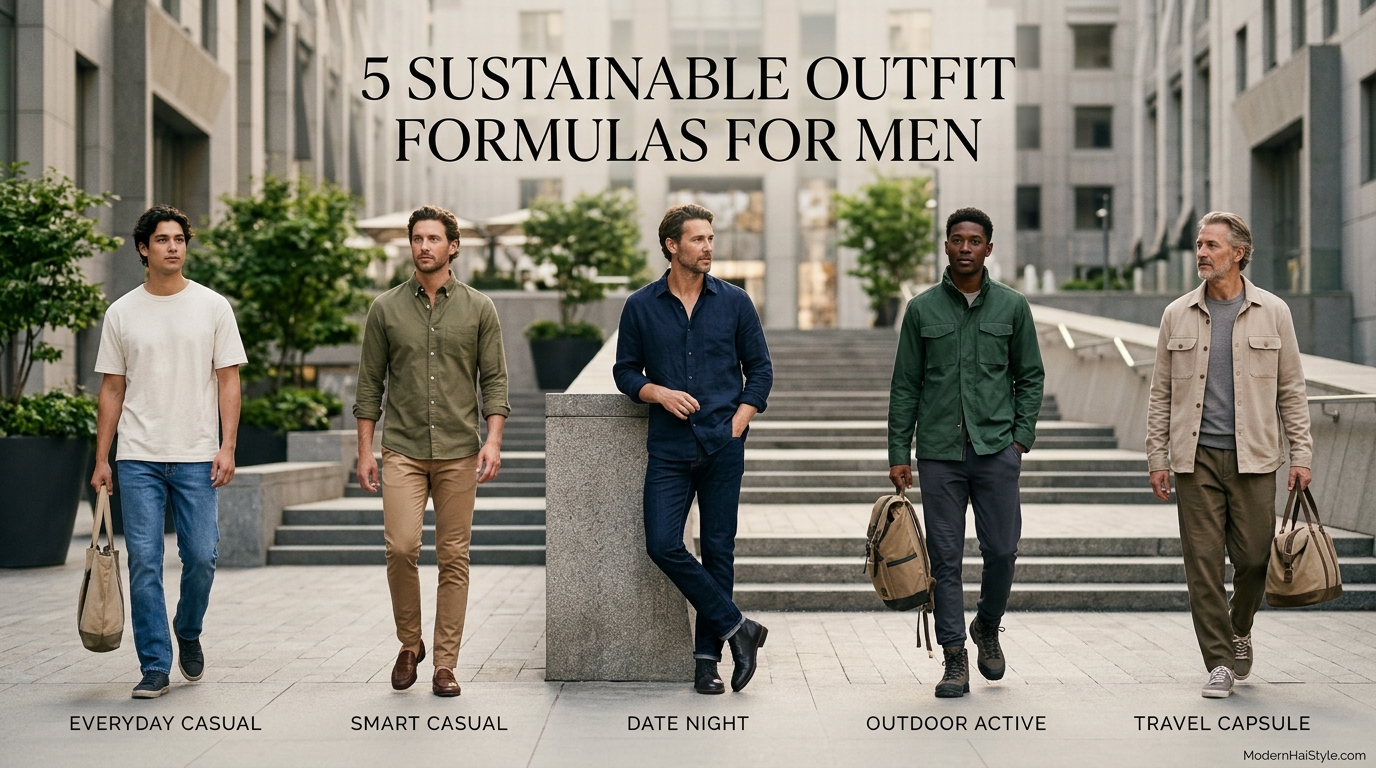
Mens Sustainable Fashion Outfits: The Three Filter System for Looks That Last
Mens sustainable fashion outfits start with a wardrobe you already own, styled in new combinations. The most sustainable outfit carries no new production cost at all, and honest guidance begins there.
After that come second hand pieces, then certified new ones. That hierarchy, wear what you have, buy used, then buy proven new, is the order every serious source in this space endorses.
What follows gives you the system behind the order. Three filters judge every piece, outfit formulas assemble the pieces by occasion, and the Modern Hai Style outfit library shows how these looks sit inside a full seasonal wardrobe.
What Makes an Outfit Sustainable: The Three Filters
An outfit is sustainable when three things hold together. The fibers are low impact, the claims behind them are independently proven, and the pieces are built and styled to be worn for years.
Fail any one leg and the outfit is only partly sustainable. A certified tee in a trend cut you discard by spring fails the third filter, whatever its label says.
Filter One: Fabric First
Start every purchase at the fiber content label. Hemp and linen sit at the top of the ladder, certified organic cotton anchors the staples, and recycled fibers carry the circular load.
Conventional cotton and virgin polyester sit at the bottom. They are not banned from a wardrobe, but they never get to call an outfit sustainable on their own.
Filter Two: Proof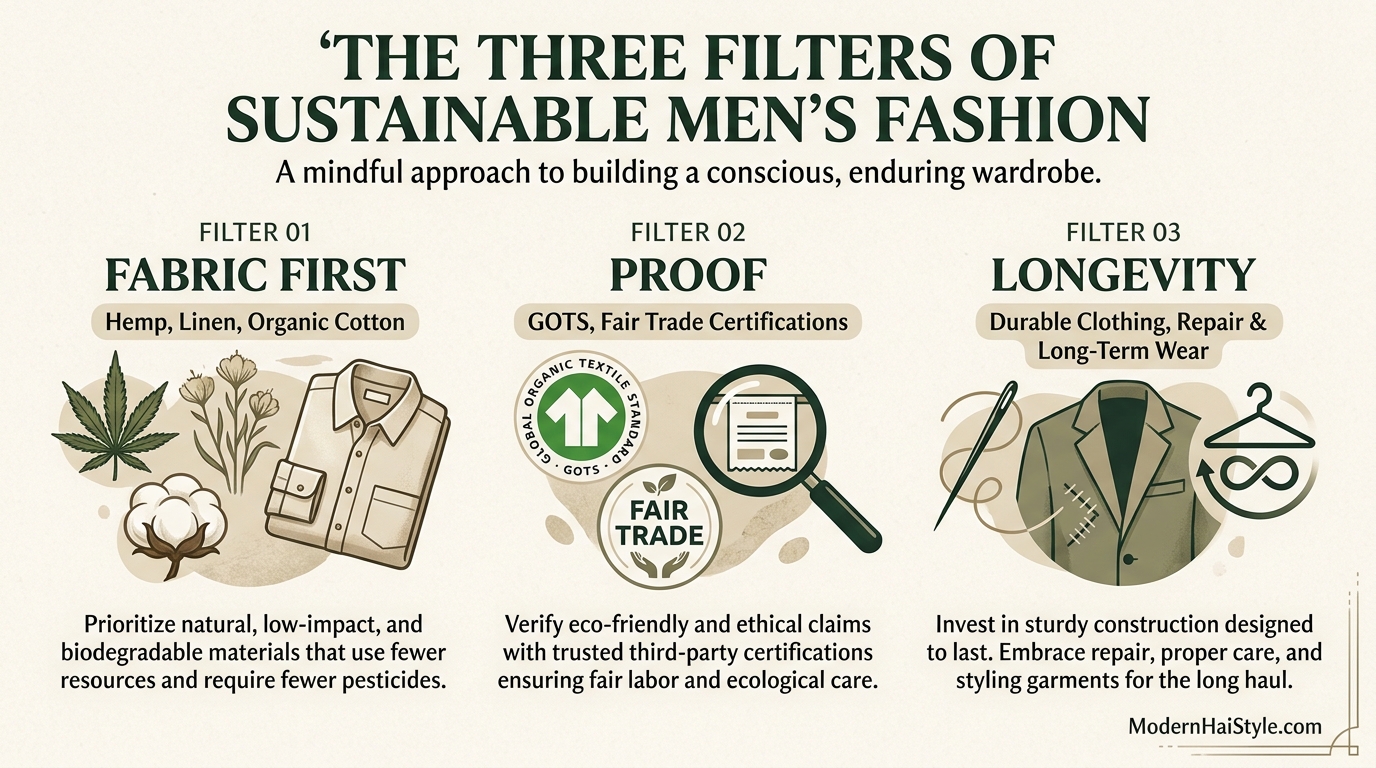
Claims need a named, independent referee. The Global Organic Textile Standard certifies organic fibers through the supply chain, and Fair Trade Certified certifies the sewing and labor side.
Company level standards count too. B Lab assesses whole companies as Certified B Corporations, which supports a brand claim without certifying any single garment.
Filter Three: Longevity Math
Divide the price by realistic wears. A well made pair of jeans at a higher price, worn two hundred times, costs less per wear than a cheap pair worn fifteen times.
Repairability is part of the math. A brand that fixes what it sold is making a durability promise it has to honor, which marketing alone cannot fake.
The Fiber Ladder
Fibers form a ladder, not a halo. Each rung trades something: organic cotton removes the chemical load but stays thirsty, recycled synthetics divert plastic but still shed microfibers.
|
Rung |
Fibers |
Why They Sit There |
Best Outfit Jobs |
|---|---|---|---|
|
Top |
Hemp, linen |
Low input natural fibers, durable, biodegradable |
Summer shirts, tees, warm weather outfits |
|
Upper middle |
GOTS organic cotton, recycled wool, recycled cotton |
Certified chemistry or circular feedstock |
Staple tees, sweaters, denim |
|
Middle |
TENCEL lyocell, recycled polyester, recycled nylon |
Closed loop wood fiber; recycled synthetics with a microfiber asterisk |
Shirts, performance and weather layers |
|
Bottom |
Conventional cotton, virgin polyester |
Chemical and water load; fossil feedstock |
Nothing an outfit should be built on |
The waste context is firmer than most fashion statistics. The US EPA textiles data counted about 17 million tons of textiles generated in the United States in 2018, most of it landfilled.
The popular claim that fashion produces a tenth of global emissions is widely repeated but disputed, with published estimates ranging lower. Treat it as an estimate, and build your decisions on the ladder instead.
The Certification Decoder
One strong certification beats five vague badges. Learn the core six and you can read any label in the store in under a minute.
|
Certification |
What It Actually Proves |
What It Does Not Prove |
|---|---|---|
|
GOTS |
Organic fiber content plus environmental and social criteria through the chain |
That the garment will suit your style or last forever |
|
Fair Trade Certified |
Labor and factory standards on the sewing side |
Fiber level environmental performance |
|
B Corp |
Whole company standards, assessed by B Lab |
Any single product’s fiber content |
|
Climate Neutral Certified |
Carbon measured, reduced, and offset at company level |
Fiber or labor specifics |
|
Global Recycled Standard |
Verified recycled content |
That the piece sheds no microfibers |
|
OEKO-TEX Standard 100 |
Testing for harmful substances in the finished textile |
Organic origin or labor conditions |
The US referee behind all green marketing is the Federal Trade Commission. Its Green Guides set the rules for environmental claims, which is why vague words like eco carry no weight without a named standard behind them.
The Outfit Formulas
Formulas are where sustainability becomes visible style. Each one names the pieces, the fibers, and the proof, so you can build the look from your closet first and shop only the gaps.
The Everyday Casual Formula
Start with an organic cotton or hemp tee, recycled or organic denim, and an overshirt or flannel from a certified brand. Finish with transparent sneakers and the outfit is complete.
The mens denim jacket outfit guide shows the jacket version of this chassis. A denim jacket in a classic wash is exactly the kind of decade proof layer the third filter rewards.
The Smart Casual and Office Formula
Build on an organic cotton oxford shirt, responsibly made chinos, and a recycled wool crewneck or unstructured blazer. Clean loafers or minimal sneakers keep it office safe.
In a neutral palette, every piece recombines across the week. The office is where the capsule logic earns its keep, because nobody needs five unrelated outfits that share nothing.
The Date Night Formula
Evening dressing rewards restraint: a well fitting linen blend or organic cotton shirt, dark denim or tailored trousers, and a knit or unstructured blazer over the top.
The mens date night outfits collection shows the silhouette range. Sustainable pieces carry it easily, because a sharp, timeless line has never required virgin synthetics or trend items.
The Outdoor and Active Formula
Performance is where recycled synthetics earn their middle rung. Recycled polyester and nylon layers, a merino base, and durable footwear handle weather that natural fibers cannot.
Buy the durable version once. Outdoor gear worn for a decade of weekends beats seasonal kit replaced yearly on every measure the three filters track.
The Travel Capsule Formula
Pack a capsule inside the capsule: pieces sharing one palette, layering across temperatures, and tolerating repeat wear. Merino and hemp resist odor, which stretches every piece further.
Five days can run on six to eight pieces when everything matches everything. The multiplier that builds a wardrobe builds a suitcase the same way.
Seasonal Outfit Systems
Seasons change the fibers, not the filters. Each system below keeps the same three checks and swaps the materials the weather demands.
Spring: Light Layers, Low Impact
Spring runs on transitional layers: the overshirt, the light knit, the organic cotton tee beneath. Linen enters as temperatures rise, and the palette stays neutral so winter pieces keep working.
Summer: The Linen and Hemp System
Linen shirts and hemp tees carry the heat without synthetic help. The mens summer outfits 2026 guide shows the warm weather silhouettes these fibers serve best.
Organic cotton shorts, breathable sneakers, and open weaves do the cooling. Light colors help, and every piece crosses into evening with one layer change.
Fall: Transitional Layering
Fall is the layering season, and the mens fall outfits 2026 formulas show the shapes. Recycled wool knits, flannel overshirts, and organic denim rebuild the summer base for cooler air.
Winter: The Recycled Wool System
Winter stacks the warmest rungs: a merino or recycled wool base, a recycled wool sweater, and a responsibly made coat over organic denim or wool trousers.
The mens winter layering outfits system and the mens capsule wardrobe for winter guide show the full architecture. Heavy pieces worn daily for months post the best cost per wear in the whole wardrobe.
The Capsule Multiplier
Outfits multiply; they do not add. Five compatible tops, three bottoms, three layers, and two pairs of shoes combine into dozens of distinct looks before accessories enter.
|
Pieces |
Count |
Outfit Role |
|---|---|---|
|
Tops (tees, shirts, knits) |
5 |
The daily rotation |
|
Bottoms (denim, chinos, trousers) |
3 |
The base of every look |
|
Layers (overshirt, knit, blazer, coat rotation) |
3 |
Weather and occasion control |
|
Shoes (sneakers, boots or loafers) |
2 |
The finish that sets the register |
That arithmetic is why the mens capsule wardrobe essentials approach beats buying outfits one at a time. Every new piece should unlock several combinations, not star in exactly one.
Compatibility is a sustainability feature. A piece that matches nothing gets worn rarely, fails the longevity filter, and drags the whole wardrobe’s cost per wear upward.
Fit and Timelessness: The Style Half of Longevity
Longevity has a style half the fiber talk misses. A garment leaves rotation early for two reasons: it wears out, or it stops looking right, and the second kills more pieces than the first.
Fit is the defense. Pieces that fit your body today, in classic proportions, survive trend cycles because they were never chasing one. Slim, straight, and relaxed classics all qualify; extreme cuts date fastest.
Timelessness is also a palette decision. The neutral base lets a five year old piece sit naturally beside this season’s addition, so the wardrobe renews by combination instead of replacement.
Tailoring belongs in the system too. A small alteration can return a drifting piece to heavy rotation for less than any replacement, and it keeps a proven garment in service.
Judge every candidate piece with one question: will this still look right in five years, on the body I actually have? A yes is the third filter passing its style exam.
The Brand Bench, by Outfit Role
Brands earn their place here by role, not alphabet. Each entry names what the brand does for your outfits and the proof or program behind it, with brand claims labelled as brand claims.
Basics: Tees, Underwear, and Staples
Pact is the roundups’ standard answer for affordable organic cotton basics, made in fair trade certified factories. It is the natural first purchase for most men starting the system.
Quince sells certified basics through a direct model at accessible prices, per its own published positioning. Verify current certifications on its site, as ranges change.
Organic Basics covers tees, underwear, and socks in GOTS certified organic cotton and recycled fibers. Basics are where cost per wear returns arrive fastest, because they are worn constantly.
Denim: The Repairable Core
Nudie Jeans is famous for free repairs forever on its jeans, with repair shops and partners. A repair promise that strong is the third filter written into a business model.
MUD Jeans builds leasing and recycling into denim, using recycled and organic cotton. Outerknown’s SEA jeans carry its own published social and environmental standard for the category.
Shirts, Knits, and Transparent Makers
ASKET sells a permanent collection instead of seasons and publishes traceability and cost breakdowns. That is slow fashion as an operating system, not a campaign.
Taylor Stitch and Buck Mason anchor durable casual shirting and knits in the US market. Jungmaven is the hemp specialist, the first name for hemp blend tees and basics.
Kotn built its name on traceable Egyptian cotton staples. Faherty covers the relaxed shirt and knit role with an increasing recycled and organic fiber mix, per its published materials reporting.
Outerwear, Outdoor, and Footwear
Patagonia remains the benchmark: recycled materials across the line, fair trade certified sewing on much of it, and the Worn Wear repair and resale program behind everything.
Tentree plants trees per item, ten per purchase by its own published model, and works in organic cotton, hemp, and recycled fibers. Treat its planting totals as brand reported figures.
Veja and Allbirds finish outfits at ground level: Veja with wild rubber and organic or recycled uppers, Allbirds with carbon labeling on its footwear. Shoes are outfit components, not afterthoughts.
Three Budget Tiers, Same Filters
Sustainability is a filter set, not a price point. The tiers change where pieces come from, never which checks they must pass.
|
Tier |
Where Pieces Come From |
Typical Strategy |
|---|---|---|
|
Zero spend |
Your existing wardrobe |
New formulas on owned pieces; repairs and tailoring only |
|
Thrift and resale |
Worn Wear, thrift stores, vintage |
Quality fibers (wool, linen, denim) at second hand prices |
|
Certified new |
Pact, Quince, Organic Basics, then the bench above |
Buy the most worn staples first, one filter pass at a time |
Run the math before judging a price. A certified tee at a moderate price worn 100 times beats three cheap tees worn ten times each, in money and in impact alike.
The Second Hand Tier: Outfits That Already Exist
A garment that already exists carries no new production impact. That is why second hand sits above certified new in the hierarchy, and why brand resale programs matter.
Shop it with the same discipline as new: fit first, fabric second, compatibility third. Wool, linen, and denim are the thrift store’s best fibers because they survive previous owners gracefully.
How to Spot Greenwashing: The Four Checks
Run these in the store, on any brand, in about a minute. Failing two or more is the working definition of greenwashing used by consumer advocates.
1. Named certification. Is there a specific, independent standard on the label, or only words like eco, conscious, and green? Vague language with no certifier earns no credit.
2. Published supply chain. Does the brand name its factories or publish its chain? Transparency you can read beats promises you cannot check.
3. Specific, sourced numbers. Percentages and claims should carry a basis you can find. A number with no published source is decoration, not data.
4. Core range or capsule. Does the green line represent the brand’s main offer, or one small collection inside a fast fashion catalogue? Proportion is the tell.
Care and Repair: Where Longevity Is Decided
Lifespan is decided after purchase. A garment worn 200 times instead of 50 quarters its per wear footprint, whatever fiber it started as.
Wash less, wash cooler, and air dry where you can. Store knits folded rather than hung, and fix small damage early before it becomes structural.
Brand programs handle the bigger jobs. Nudie’s repairs and Patagonia’s repair operation exist so a favorite piece can stay in rotation for years, not seasons.
Common Mistakes
1. Buying the logo piece first. Statement items invert the system. Build from the most worn staples outward, and let personality arrive through combinations.
2. Trusting vague eco language. Without a named certification or published chain, the claim is unproven. The four checks take a minute; use them every time.
3. Chasing trend colors. Trend palettes date a wardrobe and force replacement. Neutrals keep a five year old piece current beside a new one, as the mens old money outfits and mens quiet luxury outfits guides show in their restrained palettes.
4. Ignoring the shoes. Footwear is where outfits quietly break the chain. One transparent, durable pair outlasts three disposable ones and finishes every formula above.
5. Treating vegan as automatically sustainable. Vegan answers the animal question; substitutes are often virgin synthetics. Keep the animal, environmental, and labor claims separate, because they are separate questions.
6. Skipping formal entirely. Suiting is the category’s frontier, not a dead end. The mens wedding guest outfits guide shows the silhouettes, and second hand tailoring with good alteration is often the most sustainable route of all.
A Week of Sustainable Outfits
Systems prove themselves across a week. Here is the capsule above worn Monday to Sunday, with no piece bought for the demonstration and nothing repeated in the same combination twice.
Monday opens office sharp: the organic oxford, chinos, recycled wool crewneck, and loafers. Tuesday swaps the crewneck for the unstructured blazer and the chinos for dark organic denim.
Wednesday runs the same denim with a hemp tee and the overshirt. Thursday returns to the oxford with trousers and the blazer, a different register from the same rail.
Friday relaxes into the flannel overshirt, tee, and denim. Saturday takes the tee, shorts or denim, and sneakers, while Sunday layers the knit over the tee for the slowest version of the set.
Seven days, five tops, three bottoms, three layers, two shoes. The week is the multiplier made visible, and it is why the filters matter more than any single purchase.
Building Your First Sustainable Outfit: Six Steps
Start from your closet, not a cart. The sequence below builds one complete outfit that passes all three filters, spending money only where a genuine gap appears.
1. Audit what you own. Pull every piece that fits the formula you want. Most men find the base of the outfit already hanging in the wardrobe.
2. Pick the formula. Choose everyday, office, or evening from the formulas above. The formula decides the pieces, and the pieces decide the shopping, never the reverse.
3. Run the fiber check. Read the labels of the owned pieces. Note which already sit on the upper rungs of the ladder, and which slots need a better fiber.
4. Fill gaps second hand first. Search resale and thrift for the missing slots, wool, linen, and denim first. Only a slot that stays empty earns a new purchase.
5. Buy the gap certified. Apply the four greenwash checks in the store, then buy the piece that passes, in the palette your wardrobe already uses.
6. Log the wears. Wear the outfit, note the combinations it unlocks, and let cost per wear accumulate. The log is what turns one outfit into the system.
Frequently Asked Questions
What is sustainable fashion for men?
Clothing designed, made, and worn to minimize environmental harm and respect its makers. Preferred fibers, credible third party proof, and garments built to be worn for years define it.
It is a system of choices, not a single label. The outfit sections above show how the choices assemble into everyday looks.
What makes an outfit sustainable?
Three things together: low impact fibers, independent proof behind the claims, and a lifespan measured in dozens of wears. That is the three filter test used throughout this page.
Fail any one leg and the outfit is only partly sustainable, whatever the marketing on the tag says.
What are the best sustainable clothing brands for men?
The names that recur across independent roundups: Patagonia for outdoor and repair culture, Pact for affordable organic basics, Nudie and MUD for circular denim, and ASKET for transparent essentials.
Tentree, Outerknown, Taylor Stitch, Quince, and Jungmaven complete the usual bench. Best depends on the job, so the brand bench above is organized by outfit role.
What fabrics are most sustainable for menswear?
The preferred list runs hemp and linen at the top, then GOTS certified organic cotton, recycled wool and cotton, TENCEL lyocell, and recycled synthetics where performance demands them.
Conventional cotton and virgin polyester sit at the other end. Fiber alone is not proof, though; certification is what makes the claim checkable.
How can men dress sustainably on a budget?
Buy fewer, better basics and work the cost per wear math. A certified tee worn 100 times beats three cheap tees worn ten times each, in money and in impact.
Then use the free tiers: second hand pieces, resale programs like Worn Wear, sales at certified brands, and care habits that stretch what you already own.
What is cost per wear and why does it matter?
Price divided by the number of wears. A well made pair of jeans worn 200 times can cost well under a dollar a wear, while a cheap pair worn 15 times costs far more each outing.
It is the single most useful number in sustainable menswear, because it unites the budget argument and the environmental argument in one figure.
What is greenwashing in fashion?
Marketing that makes clothing sound greener than the evidence supports: vague words like eco with no certification, one green capsule inside a fast fashion catalogue, or baseless percentages.
In the US, the FTC’s Green Guides govern environmental claims. The reader’s defense is simple: no named certification or published supply chain, no credit.
What certifications should I look for on men’s clothing?
The credible core: GOTS for organic fibers, Fair Trade Certified for sewing and labor, B Corp for company level standards, and the Global Recycled Standard for recycled content.
Climate Neutral Certified, OEKO-TEX, and bluesign complete the working set. One strong certification beats five vague badges every time.
Is organic cotton really better than regular cotton?
On chemical and soil measures, yes: certified organic cotton is grown without synthetic pesticides and fertilizers, which is the core of the GOTS standard.
It is not impact free, since cotton of any kind is thirsty. Fibers form a ladder, not a halo, and hemp and linen go further on water.
Is recycled polyester sustainable?
Partly, and the nuance matters. It diverts plastic and avoids virgin fossil feedstock, which is why it serves performance and weather gear well.
Its costs are real too: it still sheds microfibers and is rarely recycled again. Treat it as a mid ladder fiber, best in long life garments.
What is a capsule wardrobe for men?
A small set of versatile pieces in a restrained palette, every item compatible with the rest. It is the operating system of sustainable menswear.
A capsule of roughly 20 to 30 pieces including shoes can cover office, casual, and evening for most men, which is why capsule thinking anchors this page.
How many outfits can you make from a small sustainable wardrobe?
Far more than the piece count suggests, because outfits multiply. Five tops, three bottoms, three layers, and two pairs of shoes combine into dozens of distinct looks.
That multiplier is why the system values compatibility over quantity. Every new piece should unlock several outfits, not star in one.
What is slow fashion?
The deliberate opposite of fast fashion: fewer collections, timeless designs, quality construction, and transparent pricing. ASKET’s permanent collection is the textbook example.
For the wearer, slow fashion is a buying rhythm. Plan the piece, choose it once, and wear it for years instead of weeks.
Are thrifted and second hand outfits sustainable?
They are the highest tier of the ladder, because a garment that already exists carries no new production impact. Brand resale, thrift stores, and vintage all qualify.
Judge them by the same rules as new clothing: fit, fabric, and compatibility first. Second hand is also the budget route into quality fibers.
What is Patagonia’s Worn Wear program?
Patagonia’s resale and repair platform: customers trade in used gear for credit, and the company repairs and resells it. Roundups rank it the industry benchmark for circularity.
Program terms change over time, so check the brand’s own site for current details before relying on specifics.
Do sustainable brands offer repairs?
The leaders do, and it is one of the cleanest credibility signals in the category. Nudie Jeans is famous for free repairs forever on its jeans.
Patagonia runs repair at scale, and MUD builds leasing and recycling into its model. A brand that fixes what it sold has to honor its durability claim.
What are good sustainable outfit ideas for the office?
Build on the smart casual chassis: an organic cotton oxford shirt, responsibly made chinos, a recycled wool crewneck or unstructured blazer, and clean loafers or minimal sneakers.
In certified fabrics and a neutral palette, the outfit reads fully professional. The office formula section above breaks the build down piece by piece.
What is a sustainable casual outfit for men?
The everyday formula: an organic cotton or hemp tee, recycled or organic denim, a flannel or overshirt from a certified brand, and transparent sneakers.
Every piece is a staple that recombines across the week. Sustainable casual is a system of staples, not a rotation of novelties.
What sustainable outfits work for summer?
Linen and hemp carry the season: a linen shirt, organic cotton shorts or light chinos, a hemp tee, and breathable sneakers or sandals from transparent brands.
Light colors and open weaves do the cooling naturally. Each piece crosses into evening with a single layer change.
What sustainable outfits work for winter?
Layer the certified wardrobe: a merino or recycled wool base and sweater, organic denim or wool trousers, a responsibly made coat, and resoleable boots.
Winter is where cost per wear shines, because heavy pieces are worn daily for months. Recycled wool earns its place here, warmth without new virgin fiber.
Are there sustainable options for date night and evening outfits?
Yes, and the formula is restraint: a well fitting organic cotton or linen blend shirt, dark denim or tailored trousers, a knit or unstructured blazer, and clean minimal shoes.
Evening sustainable dressing works because timeless reads as intentional. Nothing about a sharp silhouette requires virgin synthetics or trend pieces.
What is the difference between ethical and sustainable fashion?
Sustainable focuses on environmental impact across a garment’s life. Ethical focuses on people: wages, safety, and rights in the supply chain.
The strongest brands address both, and certifications split the same way. Good guidance says which claim a piece supports instead of merging the words.
Is hemp clothing good for men?
Hemp is one of the strongest sustainable fibers: hardy, low pesticide, modest on water, breathable, and durable, softening with every wash.
Jungmaven built its name on hemp blends for tees and basics. Blended with organic cotton, hemp makes some of the best casual staples in the category.
Why is linen considered sustainable?
Flax grows with relatively low water and pesticide inputs in temperate climates, and nearly the whole plant is usable, which keeps waste down.
Linen is also exceptionally durable and biodegradable. Its wrinkles are the trade off, and in summer outfits that trade is usually worth making.
What does GOTS certified mean?
The Global Organic Textile Standard: an independent standard covering organic fiber content plus environmental and social criteria through the whole supply chain.
It turns organic from a marketing adjective into a checkable claim. The organization’s public database lets shoppers verify certified suppliers directly.
What does B Corp mean for a clothing brand?
Certified B Corporations meet verified standards of social and environmental performance, accountability, and transparency, assessed by B Lab across the whole company.
It does not certify a single garment’s fiber. Careful shoppers pair it with product level standards like GOTS or Fair Trade Certified.
How do I spot greenwashing when shopping?
Run four checks: a named independent certification, a published supply chain, specific sourced numbers, and a green range that is the brand’s core rather than a tiny capsule.
Failing two or more is the working definition of greenwashing. The FTC’s Green Guides exist because these claims are regulated marketing, not decoration.
Are expensive clothes always more sustainable?
No. Price buys the possibility of better fiber, wages, and construction, but plenty of expensive fashion is conventionally made.
Some affordable brands publish credible certifications too. Price is a clue, never a proof, and the three filters stay the same at every tier.
What is the 30 wears rule?
A popular heuristic from sustainable fashion campaigners: before buying, ask whether you will wear the item at least 30 times.
Below that threshold, even a certified garment is hard to justify. It is a rule of thumb, not a standard, and it changes buying behavior more than any fiber lecture.
How should men care for sustainable clothing to make it last?
Wash less often and cooler, air dry where possible, repair small damage early, and store knits folded rather than hung.
Care is where lifespan is actually decided. A garment worn 200 times instead of 50 quarters its per wear footprint regardless of fiber.
What shoes complete a sustainable outfit?
The recurring names are Veja for sneakers on wild rubber and recycled uppers, Allbirds for carbon labeled footwear, and resoleable welted boots for the longest life.
Footwear is where outfits most often break the chain. Treat shoes as a first class outfit component, not an afterthought.
Can sustainable outfits look stylish and not boring?
Yes. The constraint is palette and silhouette discipline, not a style sentence, and certified pieces style into the same looks as conventional fashion media.
Sustainable dressing fails aesthetically only when it buys logos and slogans instead of fit and fabric. The outfit formulas above are built to prevent exactly that.
What is deadstock fabric?
Leftover fabric from other production runs, used by some brands for small batch clothing without commissioning new material. It diverts existing cloth from landfill.
Supply is finite and claims can be loosely audited. Treat deadstock as a plus with an asterisk, below certified fibers in the proof hierarchy.
Is vegan clothing automatically sustainable?
No. Vegan removes animal materials, which answers an ethical question, but the substitutes are often virgin synthetics with their own footprint.
PETA Approved Vegan certifies the animal question only. It does not measure carbon, water, or labor, so keep the three claims separate.
What is the most sustainable outfit of all?
The one built from clothes you already own, worn in a new combination. Every serious source lands on the same hierarchy: wear what you have, buy second hand, then buy certified new.
That is why outfit guidance is the most sustainable content of all. A new formula makes an existing wardrobe feel new at zero production cost.
How does fast fashion compare on the numbers?
Carefully, because the popular figures are contested. The claim that fashion produces about a tenth of global emissions is widely repeated but disputed, with estimates ranging lower.
The firmer ground is waste: the US EPA’s 2018 data counted about 17 million tons of textiles generated in the US, most of it landfilled.
What should a beginner’s first sustainable purchase be?
The piece he will wear most: for most men, organic cotton tees and underwear from a certified basics brand, or one pair of durable, repairable jeans.
Basics give the fastest cost per wear returns and teach label reading. Starting with a statement piece inverts the logic of the whole system.
Do sustainable brands make formal and suited outfits?
The options are thinner but real: transparent brands offer unstructured blazers, responsibly made shirts, and wool trousers, and made to order makers eliminate unsold stock waste.
For weddings and events, second hand tailoring plus professional alteration is often the most sustainable and best fitting route. Suiting is the category’s frontier, not its strength.
How do I build a sustainable travel wardrobe?
Pack a capsule inside the capsule: one shared palette, layers across temperatures, and pieces that tolerate repeat wear, with merino and hemp for odor resistance.
A five day trip can run on six to eight pieces when every item matches every other. It is the capsule multiplier applied to a suitcase.
What colors work best for a sustainable capsule wardrobe?
Neutrals with one accent family: navy, charcoal, olive, tan, white, and black maximize combinations per piece, which is the entire capsule mechanism.
Trend colors date a wardrobe and force replacement. The palette is a sustainability decision disguised as a style decision.
Are there sustainable activewear options for men?
Yes: recycled polyester and nylon performance pieces from outdoor and specialist brands, merino base layers, and platforms that curate certified sportswear.
Activewear is where recycled synthetics earn their mid ladder place. Buy the durable version once rather than the seasonal version repeatedly.
Where can I verify a brand’s sustainability claims?
Start with the certifiers: the GOTS public database for organic claims, B Lab’s directory for B Corp status, Fair Trade Certified’s listings, and Textile Exchange for fiber data.
Then read the brand’s impact reporting against those records. A claim found in no independent registry is marketing until proven otherwise.
Conclusion
Mens sustainable fashion outfits are a system, not a shopping list: fabric first, proof second, and longevity math on every piece. Run the three filters, build from what you own, and let the formulas do the styling.
Explore the Modern Hai Style outfit library for the seasonal systems in full, and rebuild one outfit this week from pieces already in your closet. The most sustainable look you own is the one you have not combined yet.

Dilawar is a passionate writer and contributor at Modern Hairstyle (modernhaistyle.com), specializing in hairstyles, hair care, grooming, fashion, beauty, and lifestyle trends. He enjoys sharing practical tips, hairstyle inspiration, and easy-to-follow guides to help readers discover their personal style. His goal is to provide informative, engaging, and helpful content that keeps readers updated with the latest trends.


