
Mens Sustainable Fashion Outfits: The Three Filter System for Looks That Last
Mens accessories for outfits fail in a predictable way: not because the pieces are wrong, but because they were never matched to each other or to the outfit wearing them.
The fix is a system of three matches and a count. Match the leathers, match the metals, match the formality, then stop at about three pieces with one clear focal point.
What follows pairs every major outfit with its accessory set, collects the sizing rules in one table, and sequences a starter kit. The Modern Hai Style outfit library shows where each outfit lives in full.
The System First: Three Matches and a Count
Accessories are the smallest part of an outfit and the most visible when they clash. A ten second check before you leave covers nearly every mistake men make with them.
Run the three matches in order. Each one is a convention from classic menswear, not a law, but together they explain almost every outfit that looks finished and every one that looks off.
Match One: Leathers
Your belt should match your shoes: black with black, brown with brown. That is the most repeated rule in men’s style, because its violation is visible across a room.
Go one level deeper and match finish and texture too. Polished dress leather belongs with dress shoes, matte and rugged leather with boots and casual loafers, suede with suede nearby.
Match Two: Metals
Watch case, belt buckle, tie bar, cufflinks, and jewelry read as one metal family per outfit. Silver tones together, or gold tones together, and the whole look locks into coherence.
Pick the family of the piece you wear most, usually a watch or a wedding band, and let everything else follow it. Small deliberate exceptions exist; accidental mixing is the failure.
Match Three: Formality
Every accessory has a register, and it must equal the outfit’s. A rugged diver watch under a suit cuff and a silk pocket square on a denim jacket are the same mistake in opposite directions.
The mens formal office outfits guide and the mens blazer outfit casual guide show the two ends of the scale. Dress the accessories to the occasion the clothes already chose, not the one you wish you were attending.
The Count: Rule of Three and the Focal Point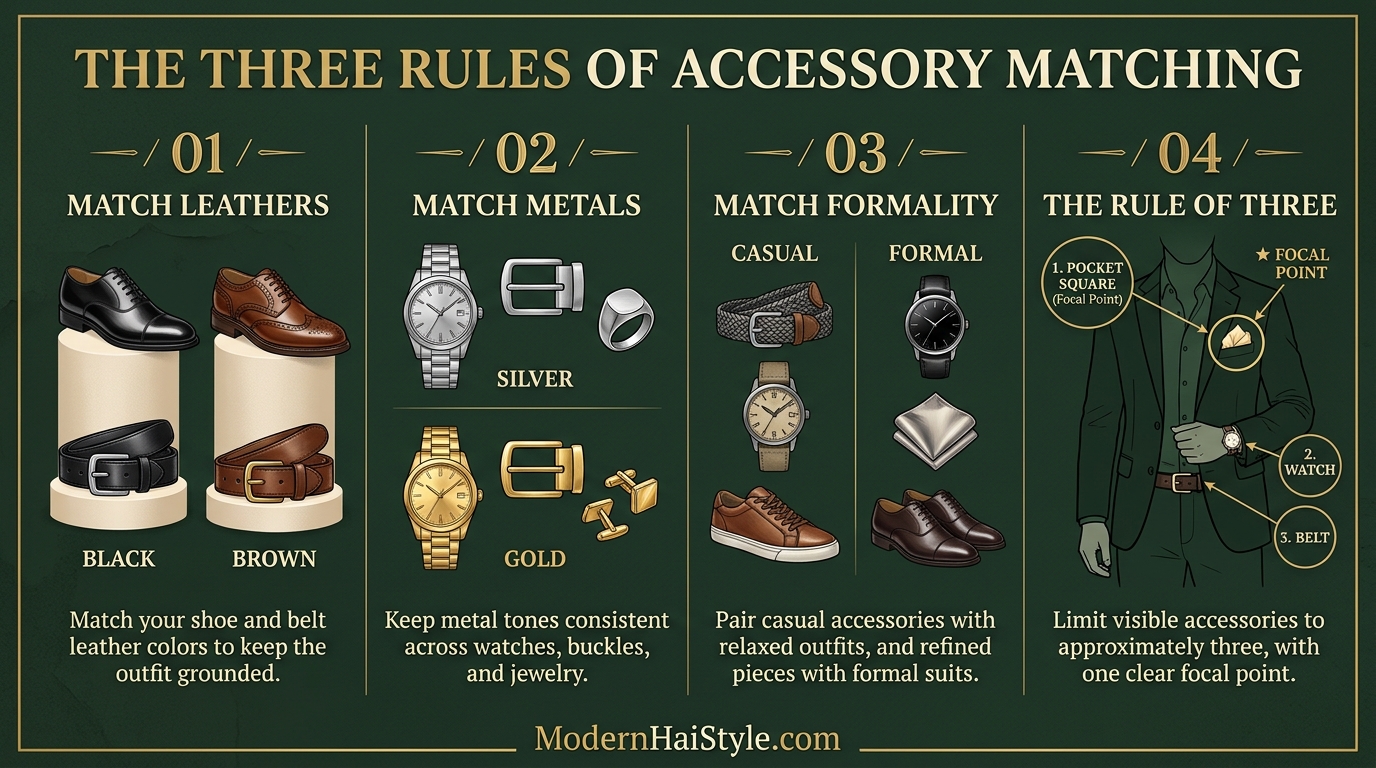
Cap visible accessories at about three per outfit, with one of them clearly leading. A watch, a belt, and sunglasses read as finished; add a chain, two rings, and a hat and the outfit turns to noise.
Formal dressing usually runs leaner than three. Streetwear sometimes runs louder by design. The rule is a default to break deliberately, never a pile to accumulate by accident.
The focal point deserves its own sentence: it is the piece a viewer should notice first and remember. Choose it before you leave, or the loudest accident in the outfit will choose itself for you.
The Outfit Pairing Matrix
This matrix is the page in one object: each outfit, its set, its leader, and its banned item. Build any look in the left column and the rest of the row is your checklist.
|
Outfit |
Accessory Set |
Focal Point |
Leave Out |
|---|---|---|---|
|
Jeans and a t-shirt |
Casual watch, matte or woven belt, classic sunglasses, one jewelry piece at most |
The watch |
Pocket squares, tie bars, dress belts |
|
Smart casual |
Leather or steel watch, belt matched to loafers, blazer pocket square, minimal jewelry |
The pocket square or watch |
Sport caps, athletic socks, loud chains |
|
Suit and tailoring |
Dress watch, matched dress belt, pocket square, tie bar, cufflinks on French cuffs |
The watch or square |
Bulky sport watches, novelty pieces |
|
Office business casual |
Clean watch, matched belt, structured bag, optional square |
The bag or watch |
Gym backpacks, heavy jewelry |
|
Date night and evening |
Fitted watch, one quiet jewelry piece, matched leathers |
The watch |
Debuting three statement pieces at once |
|
Summer outfits |
UV verified sunglasses, woven or canvas belt, light strap watch, no show socks |
The sunglasses |
Heavy scarves, dark bulky pieces |
|
Winter outfits |
Wool or cashmere scarf, leather gloves, flat cap or beanie, steel or heavy strap watch |
The scarf |
Summer weight accessories |
|
Wedding guest |
Suited set by dress code: square, tie bar, cufflinks if the shirt allows, dress watch |
Restraint itself |
Anything that outshines the wedding party |
|
Streetwear |
Chain, cap, statement watch or sneakers led detail, crossbody or backpack |
The chain or cap |
Tailoring details like tie bars and cufflinks |
Notice what the matrix teaches: the same watch cannot lead every row. Accessories are outfit specific equipment, which is why catalogues organized by category alone never finish the job.
The Core Categories, Piece by Piece
With the system set, the categories become shopping with rules attached. Each one below carries its register, its matching duty, and its most common failure.
Watches: Registers, Case Size, and Straps
The watch is the anchor accessory: the piece most outfits are matched around. Dress watches are slim with clean dials and leather straps; field and diver styles carry the casual and outdoor registers.
Size by proportion, not fashion. Most wrists land between about 36 and 42 millimeters of case, with the lug to lug span deciding whether the watch sits inside the wrist or overhangs it.
Straps swap the register cheaply. Leather dresses a watch up, steel splits the difference, and canvas or perforated straps take it casual and summer ready, as the mens party outfits looks show after dark.
Belts: The Shoe Rule and the Two Belt Minimum
Own two dress belts minimum, one black and one brown, in full grain leather with simple buckles. Those two cover nearly every tucked outfit a man wears, from suits to chinos.
Size a belt by the plus two convention: buy about two inches above your trouser size, so the strap lands on a middle hole. Casual belts (canvas, braided, suede) follow the outfit’s texture, not the dress rule.
Sunglasses: Face Shape First, UV Always
Choose the frame by contrast with your face: angular frames structure round faces, rounded and aviator frames soften square faces, and oval faces carry almost anything. Fit beats shape theory; frames should never rest on your cheeks when you smile.
Protection is not optional decoration. The American Academy of Ophthalmology advises choosing sunglasses that block 99 to 100 percent of UVA and UVB rays, labelled UV400, because a dark tint alone is not protection at all.
The mens summer outfits 2026 guide shows the frames in their natural habitat. Wayfarers in black or tortoise remain the one pair default, because they survive the widest range of outfits.
Tailoring Details: Ties, Tie Bars, Cufflinks, Pocket Squares
The suited details reward precision. A tie bar sits between the third and fourth shirt buttons, fastens tie to placket, and spans about half to three quarters of the tie’s width, never past its edge.
Cufflinks belong only to French cuff shirts, which makes them occasion led by construction. The mens blazer outfit formal rules show the full formal set working together at the top of the register.
The pocket square complements the tie, never matches it exactly. White linen with a flat presidential fold is the permanent safe answer; silk squares fold soft, in a puff, for smart casual.
Jewelry: Chains, Bracelets, Rings, in That Order
Start jewelry at its quietest point: a slim chain under a shirt, a plain bracelet, a single ring. Add visibility only when an outfit feels unfinished without it, one piece at a time.
Chain lengths run 18 to 24 inches: 18 at the collarbone, 20 the all purpose default at the top of the chest, and 22 to 24 lower and more statement led. The mens leather jacket outfit looks show how a single chain behaves against a strong jacket.
Keep one metal family across all of it, matched to your watch. If your eye lands on the jewelry before the outfit in the mirror, subtract one piece; that test never lies.
Carry: Wallets and Bags
Carry the slimmest wallet your real day allows: a bifold or card holder in quality leather. Overstuffed wallets break trouser lines and jacket drape, which makes minimal carry a style rule.
Bags follow load and formality: a leather briefcase for formal workplaces, a structured messenger for business casual, and a clean minimal backpack for casual offices. The mens office outfits casual guide shows the business casual version in context.
Headwear and Textiles: Caps, Hats, Scarves, Gloves, Socks
Headwear obeys formality matching strictly. Baseball caps belong to casual and streetwear, flat caps to smart casual and knitwear, and beanies to winter casual; a sport cap over tailoring is the classic collision.
The mens winter layering outfits system carries the textile set: a wool or cashmere scarf in a simple loop, leather gloves in the coat’s palette, and layers that each do a weather job.
Socks match the trouser, not the shoe, so the leg line stays unbroken when you sit. No show socks belong to loafers and summer sneakers; white athletic socks stay with athletic shoes, full stop.
The Sizing and Placement Table
Accessory knowledge is mostly numbers nobody collects. Here they are in one place, each with the reasoning that makes it stick.
|
Item |
The Number or Placement |
Why |
|---|---|---|
|
Belt size |
Trouser size plus about 2 inches |
Lands the buckle on a middle hole with room both ways |
|
Watch case |
About 36 to 42 mm for most wrists |
Proportion: lugs should not overhang the wrist |
|
Chain length |
18 in collarbone, 20 in default, 22 to 24 in statement |
Landing point decides how visible the piece reads |
|
Tie bar position |
Between the 3rd and 4th shirt buttons |
Holds the tie centered against the placket |
|
Tie bar width |
About half to three quarters of the tie width |
Never extends past the tie’s edge |
|
Bracelet fit |
One to two fingers between bracelet and wrist |
Movement without sliding up the forearm |
|
Pocket square default |
White linen, presidential fold |
The zero risk formal answer |
Treat these as conventions with logic, not statutes. Bodies and tastes vary; the numbers are the starting grid that keeps a first attempt from looking accidental.
Seasonal Sets
Seasons change the accessory kit the way they change the clothes. The mens fall outfits 2026 transition is where most men feel it first: scarves and heavier straps return, and summer pieces retire.
Spring and Summer Sets
Summer’s kit is light and functional: verified UV sunglasses, a woven or canvas belt, a breathable watch strap, no show socks, and one chain or woven bracelet at most.
Everything breathes, and nothing heavy sits on skin. That is the season’s whole design brief, and the accessories that ignore it feel wrong by noon.
Fall and Winter Sets
Winter adds the textile layer: scarf, gloves, and headwear, each doing weather work. Boots shift the belt register to matte and rugged, and steel bracelets earn their keep under cuffs.
The count rule relaxes in winter because every piece has a job. The matching rules do not relax at all; a mismatched scarf still breaks a coat outfit.
The Starter Kit Ladder
Buy accessories in the order your outfits need them, not in the order adverts present them. The ladder below covers the most outfits per piece at every rung.
|
Rung |
Buy |
Outfits It Unlocks |
|---|---|---|
|
First |
Black and brown dress belts |
Every tucked outfit you own, immediately |
|
Second |
One versatile watch, mid size, leather and steel options |
Casual through smart casual |
|
Third |
Classic sunglasses with verified UV protection |
Every daytime outfit, all summer |
|
Fourth |
Slim leather wallet |
Daily carry, every outfit |
|
Fifth |
One work bag fitted to your real load |
Office and travel registers |
|
Next five |
Pocket squares, a tie bar, cufflinks, one chain, a scarf |
Formal, evening, and winter range |
Accessories are worn daily and kept for years, so cost per wear collapses faster here than anywhere else in the wardrobe. Buy the best version of each rung you can, one rung at a time.
The two aesthetics that prove the ladder are already in the cluster. The mens old money outfits and mens quiet luxury outfits guides run on exactly this restrained kit: few pieces, perfectly matched, nothing loud.
Care and Storage
Accessories are bought rarely, so their lifespan is almost entirely a storage story. Small habits decide whether a belt serves two years or ten.
Watches rest off the wrist, away from moisture, on a tray or in a box. Belts hang or roll; never fold them under weight in a drawer, which is how cracks start.
Sunglasses live in a hard case and clean with microfiber only. Jewelry stores separated so pieces cannot scratch each other, and textiles go away clean before the off season.
Leather wants occasional conditioning and rest between wears, the same rotation logic as shoes. A belt worn daily without rest ages in dog years; two in rotation age gracefully together.
Watches want wrist time and dryness in balance: worn regularly, wiped down after summer days, and kept away from speakers and magnetic clasps. Quartz batteries and mechanical services follow the maker’s guidance, not internet folklore.
None of this is elaborate. Accessories reward boring consistency: the same small routines, applied for years, are what separate a kit that looks seasoned from one that looks tired.
Common Mistakes
1. Belt and shoes in different leathers. The most visible clash in menswear, and the cheapest to fix. Run match one before anything leaves the house.
2. Mixed metals by accident. A gold buckle, steel watch, and copper bracelet in one outfit reads as unconsidered. Choose the family of your anchor piece and commit.
3. Too many pieces at once. Outfits fail by accumulation far more than by restraint. If in doubt, subtract one; the mens date night outfits standard is edited, not decorated.
4. The pocket square clone. A square identical to the tie, in fabric and pattern, reads as a boxed set. Complement by sharing one element and differing in the other.
5. The tie bar worn wrong. Too wide, too low, or clipped to the tie alone. Between the third and fourth buttons, fastened to the placket, inside the tie’s width.
6. Sunglasses as a headband. Indoors, on the head, or hanging from a collar at an event, they stop being an accessory and become clutter. Case them or leave them.
7. Athletic socks with dress shoes. The boundary is absolute in every serious guide. Dress socks match the trouser; no show socks handle the bare ankle looks.
8. Novelty at formal events. Loud squares, joke cufflinks, and statement jewelry at weddings and ceremonies. Formal dressing rewards the men whose details whisper, as the mens wedding guest outfits standard shows.
Worked Example: One Outfit, Three Accessory Levels
Systems get clearer on a single rail. Take a navy blazer, white oxford, grey trousers, and brown loafers, and watch what each accessory level does to the same clothes.
At level zero, the outfit is clean but anonymous: no watch, the wrong belt from the drawer, nothing in the pocket. It passes, and nobody remembers it.
At starter level, the brown belt matches the loafers, a mid size watch on brown leather joins the same family, and the outfit suddenly reads considered. Two pieces, both matched, nothing else added.
At full level, a white linen square in a flat fold and a silver tie bar arrive, with the watch’s steel case completing the metal family. The clothes never changed; the register and the intention did.
The ladder between those levels is the whole subject of this page. Most men do not need more accessories; they need the next level of matching on the ones they already reach for.
Choosing Your Metal Family: A Four Step Decision
Metal matching fails when it is left to daily improvisation. Decide the family once, in this order, and every future purchase decision makes itself.
1. Start with the unwearable truth. A wedding band or a watch you never take off is the anchor. Its metal is your family by default, because it is present in every outfit.
2. Check the wardrobe hardware. Belt buckles and bag hardware you already own vote too. If two of three anchors agree, the decision is made; replace the dissenter over time, not overnight.
3. Buy the next pieces inside the family. Tie bar, cufflinks, chain, and bracelet all follow the anchor. A bargain in the wrong metal is not a bargain; it is a future mismatch.
4. Allow one deliberate exception. A two tone watch or a single inherited piece can bridge families when it is repeated and intentional. One accidental exception is clutter; a chosen one is character.
Frequently Asked Questions
What are the essential accessories every man should own?
The starter core: a versatile watch, black and brown leather belts matched to your shoes, classic sunglasses with real UV protection, a slim wallet, and one bag that fits your working life.
Those five cover almost every outfit a man wears. Jewelry, pocket squares, and seasonal pieces follow, in the order your outfits demand them.
How many accessories should a man wear at once?
About three visible pieces, with one clear focal point: the widely used rule of three. A watch, a belt, and sunglasses read as finished.
Add a chain, two rings, a bracelet, and a hat on top and the outfit turns to noise. Outfits fail by accumulation far more often than by restraint.
What is the rule of three for accessories?
A styling heuristic: choose up to three accessories per outfit and let one of them lead. It forces selection instead of accumulation.
Formal dressing often runs leaner, streetwear sometimes louder by design. Treat the rule as a default to break deliberately, not a statute.
What is the third piece rule?
An outfit building idea: beyond your top and bottom, a deliberate third piece (a jacket, hat, scarf, or chain) completes the look and signals intention.
It governs the outfit’s architecture, while the rule of three governs count. Used together they agree: add pieces on purpose, and know which one leads.
How do you match a belt to your shoes?
Match the leather family first: black belt with black shoes, brown with brown. Then match finish and texture: polished with dress shoes, matte or rugged with boots and loafers.
Suede asks for suede or a soft finish nearby. It is the most cited matching rule in menswear because its violation shows across a room.
Should belt buckle match your watch?
Ideally, yes: buckles, watch cases, tie bars, cufflinks, and jewelry read as one metal family per outfit, silver tones together or gold tones together.
Pick the metal of the piece you wear most and let the rest follow. Small deliberate exceptions exist; accidental mixing is the failure.
Gold or silver jewelry for men: how do I choose?
Silver and steel are the neutral default that pairs with everything; gold reads warmer and more statement led. Skin tone convention points the same way, cool tones to silver, warm to gold.
The practical decider is consistency with your anchor piece, usually your watch or wedding band. Buy into the family you already own.
What watch should a man wear with a suit?
A dress watch: slim case, clean dial, leather strap in the outfit’s leather color, sized to slide under a cuff. Mid 30s to about 40 millimeters suits most wrists.
Chronographs and divers can visit smart casual. The suit’s cleanest partner is restraint, which is why every classic guide starts there.
What size watch should I wear for my wrist?
Proportion rules: the case should sit within your wrist’s width, lugs never overhanging. For most men that lands between about 36 and 42 millimeters.
Dress watches sit at the smaller end, sport watches at the larger. Measure your wrist and let the lug to lug span, not the headline diameter, decide.
Which wrist should a man wear his watch on?
Tradition says the non dominant wrist, usually the left, so the watch takes less wear and the dominant hand stays free. It is convention, not correctness.
The style detail is fit: snug enough not to slide onto the hand, loose enough to sit above the wrist bone.
What sunglasses suit my face shape?
Work by contrast: angular frames structure round faces, rounded and aviator frames soften square faces, oval faces carry most shapes, and heart shaped faces balance with bottom weighted styles.
Then judge by fit: frames within the face’s width, no pinching, and never resting on your cheeks when you smile.
Do sunglasses need UV protection, or is a dark tint enough?
Tint is not protection. The American Academy of Ophthalmology advises sunglasses that block 99 to 100 percent of UVA and UVB rays, labelled UV400 or 100 percent UV protection.
Dark lenses without UV filtering can be worse than none, since pupils dilate behind them. Polarization cuts glare; it says nothing about UV by itself.
Aviator or wayfarer: which is more versatile?
Both are classic defaults. Wayfarers read sharper and dress up toward smart casual; aviators read relaxed and suit longer, more angular faces.
For a one pair wardrobe, most guides land on the wayfarer family in black or tortoise. Your face shape and all day comfort make the final call.
How long should a men’s necklace chain be?
Standard lengths run 18 to 24 inches: 18 sits at the collarbone, 20 is the all purpose default at the top of the chest, and 22 to 24 hang lower and read more statement.
Pendants need the longer lengths to sit right. Measure against the neckline you wear most; chain length is a proportion decision.
How do men wear jewelry without overdoing it?
One metal family, one focal piece, and scale matched to the outfit: a single chain, or a bracelet and ring pairing, with everything else quiet.
Start with the least visible version and add only when an outfit feels unfinished. If your eye hits the jewelry before the outfit in the mirror, subtract one piece.
Which finger should a man wear a signet ring on?
Tradition places the signet on the pinky of the non dominant hand, its historical position for seals and crests. British convention is the classic reference.
Modern wear is looser: ring and middle fingers read contemporary. Whatever the finger, sizing comes before design, since a spinning signet ruins the effect.
How tight should a men’s bracelet be?
Close to the wrist with a little movement: the working fit lets one or two fingers slip between bracelet and wrist.
It should not slide halfway up the forearm or hang onto the hand. Choose a fastening you can work one handed, the practical detail style guides forget.
What is a tie bar and how do you wear it?
A tie bar fastens the tie’s front blade to your shirt placket so the tie stays centered. Place it between the third and fourth buttons of the shirt.
Clip across tie and placket together, never the tie alone. The bar should span about half to three quarters of the tie’s width and never pass its edge.
When should a man wear cufflinks?
When the shirt asks for them: cufflinks belong to French cuff shirts, which makes them occasion led by construction, weddings, formal events, dressed up business.
Barrel cuff shirts take buttons, not cufflinks. Keep the metal in the outfit’s family and the design quiet unless the event is festive.
When should a man wear a pocket square?
Whenever a suit jacket or blazer has a breast pocket and the occasion rises above the purely casual: business, weddings, evenings, dressed up smart casual.
The square complements the tie, never matches it exactly. White linen with a flat fold is the permanent safe answer for formal settings.
How do you fold a pocket square?
Three folds cover almost everything: the presidential flat fold for formal and business, the one point for smart casual, and the casual puff for relaxed blazers.
Fabric drives the choice: linen holds crisp folds, silk puffs and slumps. The square should look settled, not engineered.
Should your pocket square match your tie?
Complement, never copy. A square identical to the tie in fabric and pattern reads as a pre packaged set, the tell of an unconsidered outfit.
Share one element, a color or a pattern scale, and differ in the other. With no tie, coordinate with shirt and jacket; white linen is the zero risk option.
What wallet should a man carry?
The slim one that fits his real carry: a bifold or card holder in quality leather, sized to the cards and cash he actually uses daily.
Overstuffed wallets ruin trouser lines and jacket drape. Quality and slimness outrank exact color matching, since a wallet is seen only in flashes.
What bag should a man use for work?
The one that fits his actual load and his office’s formality: a leather briefcase for formal workplaces, a structured messenger for business casual, a clean minimal backpack for casual offices.
Size it to the real objects, laptop dimensions first. Keep the material in conversation with your shoes and belt.
Are backpacks acceptable with smart outfits?
Yes, with design conditions: a structured, minimal backpack in leather or clean technical fabric reads as modern professional in most business casual settings.
What fails is the gym or hiking silhouette against tailoring. Formal and traditional client settings still belong to the briefcase and messenger.
What hat works with which outfit for men?
Caps follow formality like everything else: baseball caps for casual and streetwear, flat caps for smart casual and heritage looks, a fedora for the dressed option, beanies for winter casual.
The failure mode is formality collision, a sport cap over tailoring. No serious guide defends that combination.
How do men wear scarves without looking bundled?
Scale and knot discipline: a mid weight wool or cashmere scarf with winter coats, in a simple loop or once around knot, ends at similar lengths.
Keep the color inside the outfit’s palette, and let the scarf be the one soft focal point rather than competing with a hat and statement gloves.
What socks should men wear with different outfits?
Match the trouser, not the shoe: dress socks near the trouser tone keep the leg line unbroken when you sit and the cuff rides up.
No show socks belong to loafers and summer outfits. White athletic socks stay with athletic shoes; breaking that boundary is instantly visible.
What accessories work with a suit besides a tie?
The suited set: a dress watch, a belt matched to the shoes (or braces, never both), a pocket square, cufflinks on French cuffs, a tie bar, and a structured bag.
The suit rewards the full matching system: leathers aligned, metals aligned, and the count lean enough that the tailoring stays the headline.
What accessories go with jeans and a t-shirt?
The casual chassis: a field or casual watch, a woven or matte leather belt, classic sunglasses, and one piece of jewelry at most.
Sneakers finish it, and a cap only when the setting is fully casual. The tee outfit is where the rule of three does its most useful work.
What accessories suit smart casual outfits?
Smart casual is the accessories sweet spot: a clean watch on leather or steel, a belt matched to loafers, a pocket square in the blazer, and sunglasses that dress up.
Jewelry stays minimal and in one metal. Accessories, more than the clothes, are what set this register.
What accessories should a wedding guest wear?
Follow the dress code first: suit level weddings take the suited set, black tie takes studs and cufflinks with a formal watch or none.
Never outshine the wedding party, and keep novelty pieces out of someone else’s photographs. You will wear this for eight hours, so comfort counts.
What are good date night accessories for men?
The edited version of your best register: a watch that fits the venue, one piece of quiet jewelry, matched leathers, and everything clean.
Date dressing rewards subtraction. The most common failure is debuting three new statement pieces at once.
How do I accessorize on a budget?
Sequence the starter kit by coverage: the belt and shoe match first, then a versatile watch, then UV verified sunglasses, then the wallet upgrade.
Buy the best version of each tier one piece at a time. Cheap metal jewelry is the worst budget buy; a good belt quietly serves for years.
What accessories make an outfit look more expensive?
The quiet ones, correctly matched: a slim dress appropriate watch, leathers matched in color and finish, a white linen pocket square, classic sunglasses that fit your face.
Fit and condition do the heavy lifting: clean shoes, an uncracked belt, unscratched lenses. Coherence reads expensive; logos do not.
Do accessories need to match each other exactly?
They need to agree, not clone. Leathers match by color family and finish; metals by tone family; patterns share at most one element.
Exact matching sets actually read as less considered than near matching with one small deliberate variation. Harmony is the target; uniformity is its counterfeit.
What is the difference between a tie bar and a tie clip?
In modern usage the terms are largely interchangeable; retailers sell the same product under both names. Historically the bar fastened across tie and placket, early clips pinched the tie alone.
What matters is use: fasten to the placket, place it between the third and fourth buttons, and respect the width rule.
Can men wear earrings with formal outfits?
Context decides: a single small stud is unremarkable in creative and social formal settings in 2026, while conservative corporate and ceremonial rooms still read earrings as casual.
Match the metal to the outfit’s family and keep scale minimal. Know your room; dress codes are social facts.
What accessories work for summer outfits?
Summer’s set: sunglasses with verified UV protection, a woven or canvas belt, a lighter watch strap, no show socks, and a cap or brimmed hat for real sun.
Jewelry lightens to one chain or a woven bracelet. Everything breathes and nothing heavy sits on skin; that is the season’s design brief.
What accessories work for winter outfits?
Winter adds the textile layer: a wool or cashmere scarf, leather gloves in the coat’s palette, a beanie or flat cap, and heavier straps or steel.
Boots shift the belt register to matte and rugged. The count rule relaxes because each piece works against weather; the matching rules do not.
How should men store and care for accessories?
Watches rest off the wrist, away from moisture, in a box or on a tray. Belts hang or roll, never folded under weight. Sunglasses live in a hard case.
Jewelry stores separated so pieces cannot scratch, and textiles go away clean before storage. Accessories are bought rarely, so lifespan is a storage story.
What are the biggest accessory mistakes men make?
The recurring list: belt and shoes in different leather colors, mixed metals by accident, too many pieces at once, sunglasses worn indoors, a tie bar wider than the tie.
Add a pocket square identical to the tie, athletic socks with dress shoes, and novelty at formal events. Every one is a matching or count failure, and all are free to fix.
Conclusion
Mens accessories for outfits come down to three matches and a count: leathers aligned, metals in one family, formality matched to the clothes, and about three pieces with one leader. Run the check, build the ladder rung by rung, and every outfit you own finishes properly.
Start tonight with match one: lay tomorrow’s belt beside tomorrow’s shoes. Then explore the Modern Hai Style outfit library for the outfit guides each accessory set was built to finish.

Dilawar is a passionate writer and contributor at Modern Hairstyle (modernhaistyle.com), specializing in hairstyles, hair care, grooming, fashion, beauty, and lifestyle trends. He enjoys sharing practical tips, hairstyle inspiration, and easy-to-follow guides to help readers discover their personal style. His goal is to provide informative, engaging, and helpful content that keeps readers updated with the latest trends.


